
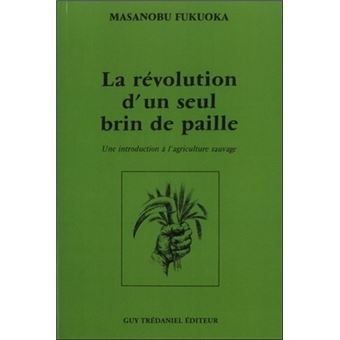
[review] The Revolution of a Single Straw by Masanobu Fukuoka, a must-read
The book “The One-Straw Revolution” was written in 1975 by Masanobu Fukuoka, a Japanese farmer and writer (€14.90, Amazon link, Fnac link)
One day, Fukuoka decides to quit his job and takes over his father’s farm. Advocating natural farming, he lets the fruit trees fend for themselves and they die. What follows are 30 years of experiments where he finds THE method of do-nothing farming, intervening minimally while achieving yields very close to modern agriculture.
This book tells his journey and his reflections. According to Fukuoka, we must let nature take its course without using pesticides or chemical fertilizers, and cultivate plants in a way that mimics the natural system of a healthy ecosystem.
Summary
Fukuoka argues that this approach can not only produce abundant harvests, but also contribute to environmental regeneration and ecosystem restoration. Plowing, turning the soil, only encourages weeds and the use of herbicides. After each harvest, you return everything you don’t need (straw, among other things) to the soil to enrich it. A layer of clover is maintained on the soil surface to enrich it, but also to prevent other weeds from harming the plants. A few ducks or chickens will suffice to provide necessary fertilizer and eat insects. According to this method, we won’t even need to use chemical fertilizers.
As for insects and diseases, he claims that when the ecosystem is maintained, some plants are indeed attacked by insects, but overall the yield
is still better than with insecticides. They attack the weakest plants, so the stronger ones have more space and sunlight and produce more seeds.
The only downside is the absence of machinery: harvesting must be done by hand (to avoid damaging the seeds that are germinating).
The book presents, at the end, Fukuoka’s ideas on the philosophy of life and the relationship between humans and nature, very close to Taoism.
Fukuoka’s book laid the foundations for permaculture. He recommends not using plowing, pesticides, or chemical fertilizers, and growing multiple plant species together to create a diverse ecosystem. Permaculture has since evolved and places greater emphasis on observation and analysis of these ecosystems to determine how to use them sustainably. Permaculture also encourages the use of ecological gardening and farming techniques, such as composting and crop rotation, and emphasizes the importance of designing systems that are ecologically sound and economically viable in the long term. Note that these two farming methods differ from “organic” farming because it still shapes nature to adapt to humans, whereas do-nothing farming completely follows nature.
It reminds me of our visit to a shaman in the Amazon who has a huge garden (actually a piece of forest). When he shows us plants where half the leaves are
eaten by insects, we ask him why he didn’t think of planting such and such a plant nearby because it repels insects/snakes. He looks at me in horror and says: “It’s nature! It’s the ecosystem! Insects have the right to eat my leaves.” This perfectly sums up the difference between permaculture (planting compatible trees nearby to repel insects if they aren’t useful to the plant’s ecosystem) and Fukuoka’s philosophy (respecting nature as much as possible).
This ecosystem lesson was taught to me during the same trip to the Amazon: our guide finds a venomous snake right on the path. It blends into the landscape because it’s the same color as the ground. He knows the snake is venomous because usually snakes flee when there’s noise, but this one just stays put. He blocks it with a branch and grabs it by the neck so it can’t bite. While we expect the guide to chop its head off with a machete, he releases it into the wild, far, far away from us, because “we must respect the ecosystem.” For us, killing the snake would have seemed perfectly natural, when in reality it hadn’t done anything to us at all.
The worst famine in China was caused by the extermination of sparrows. These birds ate too many seeds, and the Chinese rallied their population to kill as many as
possible. Unfortunately, with the sparrows gone, insects and grasshoppers ran rampant. They eat even more seeds than sparrows ever did. Anyone who thinks they’re smarter than nature is bound to pay a heavy price.
In short, “The One-Straw Revolution” is a plea for sustainable and environmentally friendly agriculture, emphasizing the importance of working with nature rather than against it. It’s not a practical guide, though everyone can find advice in it. This book raises reflections and tells the story of this Japanese man who spent 30 years of his life testing and finding THE sustainable method. The hardest part is adapting the advice you read in the book to European climates and plants (since the author is Japanese).
Criticism
This method has nevertheless been criticized for several reasons.
According to some, Fukuoka’s method cannot produce enough food to meet the needs of a rapidly growing global population, and requires significant amounts of labor to maintain the fields. In the book, he takes the example of a 1000m² field cultivated using his method, yielding enough to feed 10 people for 70 hours of work per week. Assuming a French farmer works 8 hours a day, it would take 1.25 farmers to feed 10 people. Yet, farmers make up only 1.5% of the population in France. If we follow the Fukuoka method, the percentage of farmers would have to increase eightfold, meaning 12.5% of the population would work to feed everyone. Not to mention the rise in food prices this would cause. However, considering the nutrient richness of the vegetables and grains produced with this method, it’s possible we’d need less food. Moreover, yields improve over time as the land is enriched through these efforts, so after 30 or 50 years, maybe we’d only need 0.5 farmers to feed 10 people.
Others argue that Fukuoka’s method cannot be scaled up sufficiently to be economically viable, and that farmers following this approach may struggle to generate enough income to make a living.
Finally, Fukuoka’s approach may not suit all contexts, and other approaches, such as permaculture, can be more effective in some cases.
However, many people have successfully adopted Fukuoka’s approach. I’ve seen a few private gardens and vegetable patches, as well as a Vietnamese farmer selling clementines, and they’ve seen positive results in terms of crop yields, sustainability, and economic viability.
I highly recommend reading this book, (14,90€, Amazon link, Fnac linkwhether to expand your knowledge or if you’re looking to start a nature-friendly vegetable garden. Written in 1975, it’s “unfortunately” still relevant today: the problems (nutrient loss, pollution) raised in 1975 are still with us and have even worsened. Several solutions are right before our eyes, but unfortunately, fertilizer, pesticide, and herbicide companies won’t see it that way.

