

My review of the Accor payment card
While in North America, credit cards offer huge benefits if you use them wisely, France has long been (and still is) lagging behind. That’s not necessarily a bad thing, given how rampant abuse can be.
If you wanted to enjoy benefits in France through everyday purchases, there was basically only the American Express card. It had the merit of existing, but you can’t say the returns are amazing.
That’s gradually changing, and there’s not a month that goes by without a new company launching a new card promising incredible perks. That’s recently been the case with the hotel company Accor, which operates numerous hotel chains: Fairmont, Sofitel, Ibis, Mercure, Formule 1, Pullman, Adagio, … With a total of over 5,000 hotels worldwide.
For travelers like us, this new card naturally sparks our curiosity: turning our everyday spending into hotel nights is an appealing prospect. Let’s take a closer look at what it’s all about.
The 3 Accor payment cards
Accor offers 3 different payment cards, all of which are Visa cards:
- The Pulse card, billed at €54/year
- The Explorer card, billed at €162/year
- The Ultimate card, billed at €408/year
No foreign transaction fees
First major advantage for travelers: none of the 3 Accor payment cards charge any fees for payments or withdrawals abroad, even if you’re outside the eurozone.
This benefit is very welcome, even though it’s gradually becoming standard—many cards now offer this service.
When paying in a foreign currency, you receive a notification that I find a bit confusing.
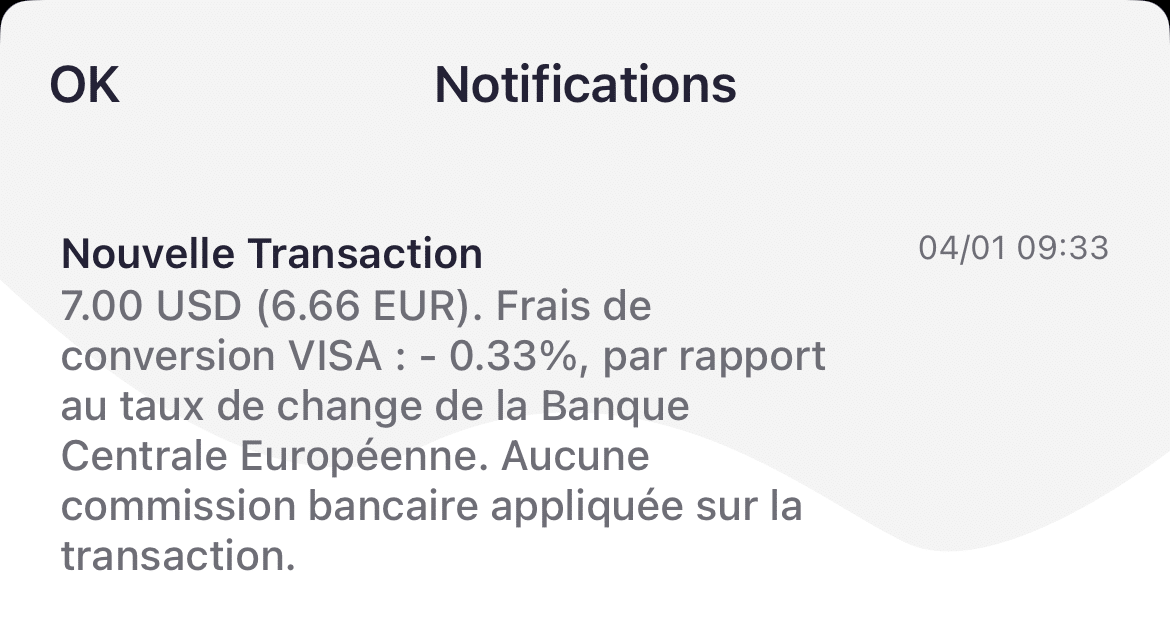
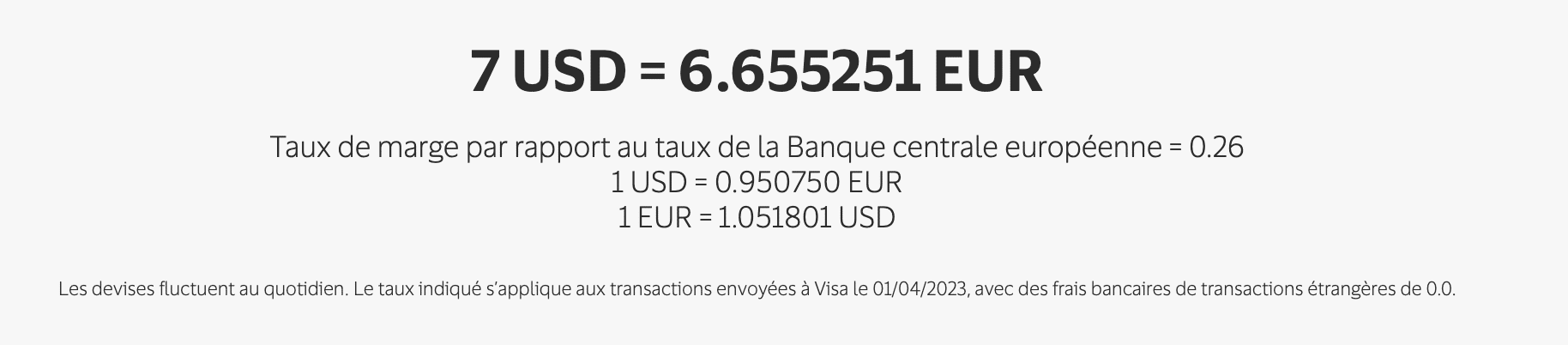
But after checking, it’s indeed Visa’s exchange rate that applies (rounded to the nearest cent). Accor charged me €6.66 for a €6.655 expense.
Your expenses are billed at the beginning of the following month
Like the American Express card, the Accor card isn’t a bank card. You keep your current bank, use your Accor card for daily purchases, and all your monthly expenses will be deducted at the start of the following month.
That’s a nice perk because it gives you a cash advance; you just need to make sure that on the deduction date, your account balance is sufficient to cover all your previous month’s expenses.
Broad coverage with insurance
Flight delays, baggage delays, trip cancellations, … the Accor card comes with a range of protections.
Two stood out to me as particularly interesting:
- Phone insurance: loss or theft of your phone is covered up to €800
- Car rental insurance: any damage to the vehicle during your rental will be covered, with no deductible. This coverage isn’t available with the Pulse card.
These two points make the insurance better than American Express’s. Amex’s “personal effects” insurance is a paid option, and its car rental insurance now (recently) has a deductible that significantly reduces its value.
Cashback
This is probably the most interesting aspect: what value do you get back for every euro spent with this card?
Each euro you spend will earn you reward points (Accor’s loyalty program points), which can be converted into hotel nights.
First, you should know that 2,000 reward points are worth €40.
So one reward point is worth €0.02.
The number of reward points you earn per euro spent depends on the card type:
- Pulse card: €1 spent = 0.25 reward points, i.e., a cashback of 0,5%.
- Explorer card: €1 spent = 0.4 reward points, i.e., a cashback of 0,8%.
- Ultimate card: €1 spent = 1 reward point, i.e., a cashback of 2%.
Status nights
The Pulse, Explorer, and Ultimate cards provide 10, 20, and 30 status nights respectively in the Accor loyalty program.
For instance, you need 60 nights to reach Platinum status. The cards can be an opportunity to make up for missing nights to achieve certain statuses.
A “real” credit card
Most bank cards issued in France are debit cards, not credit cards.
While this makes no difference in everyday use, it can cause problems at some car rental agencies abroad that require a credit card.
Accor cards have this advantage: they are “real” credit cards.
Until now, I used my card American Express for that, but it charges 2.8% in foreign transaction fees when you pay in a foreign currency, which is not the case with Accor cards.
Other advantages for Explorer and Ultimate cards
The two top-tier cards offer very interesting perks when you stay at least 2 nights in Accor hotels: a €50 hotel credit valid at the bar and restaurant, room upgrade, late checkout, free breakfast, etc.
However, these perks are only offered at the top-tier Accor brands; you won’t get them at Ibis or Mercure hotels, for example.
The monthly spending limit
I had the unpleasant surprise of discovering that my monthly spending limit was quite low (€1,500) when the payment of the €2,000 deposit for a car rental was declined.
I sweated a bit, and luckily I found another card that worked.
You can request an increase in the limit from support, but you need to plan ahead; it won’t be effective in 5 minutes.
I actually had to sign an amendment (online, not by mail, thankfully) to increase the limit to €5,000, which will be more than enough for my needs.
Even though the process isn’t the simplest, it was done in a single day, and support was efficient.
Extending the free period
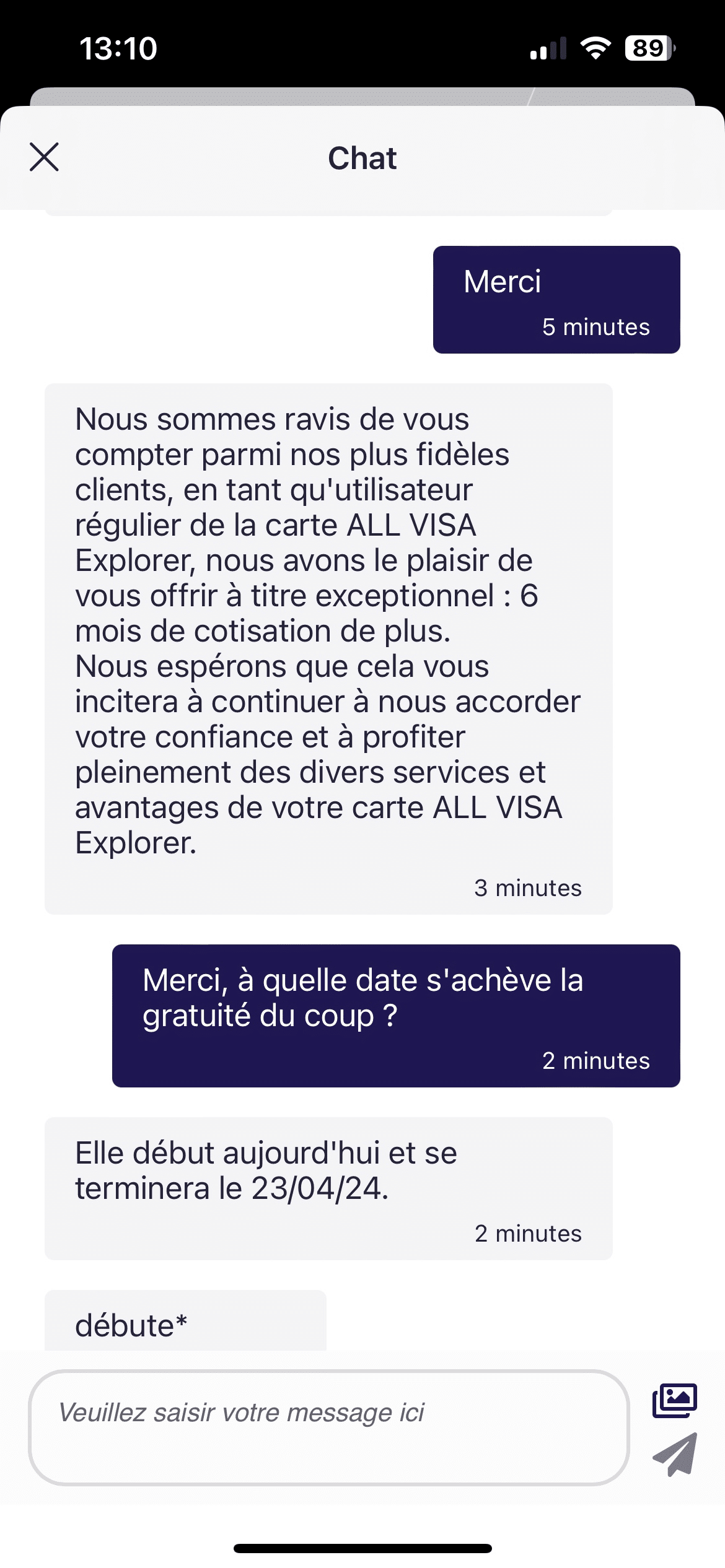
After a year of the card being free, I contacted support via chat asking if I could get an additional free period, and that I wanted to cancel if it wasn’t possible.
Support replied that I was one of their most loyal customers (lol) and that as a special exception (lol again), they’d give me 6 more months free.
That’s nice, and I’ll try my luck again in 6 months.
My opinion
To be honest, I started with a negative bias when I discovered this new card.
While not amazing, the benefits are pretty decent.
If you compare it with the card American Express Air France Gold for example. Accor’s cashback is somewhat lower, but the insurance is better, and you can use it abroad with no foreign transaction fees. However, while the Amex is officially paid, it’s free for the first year, and that free period can be extended… which isn’t the case with Accor cards, which are paid from the first year (even though welcome bonus points cover part of the first year’s fee).
In my opinion, the real value lies in the top-tier card, the Ultimate. Business travelers who regularly stay at Accor’s upscale hotels will quickly get their money’s worth thanks to the 2% cashback and the stay perks.
For others, why not instead opt for a Binance card or Crypto.com ? It’s free, easily offers 2% cashback, and has no foreign transaction fees.
Edit after using the card
I finally signed up for the Explorer card, taking advantage of a free first year.
The automated sign-up process was laborious (what a nightmare when the photo of your ID is rejected and they ask you to retake it 15 times!).
But after that hurdle, I’m pleasantly surprised by the service.
The app is very user-friendly. I appreciate being able to set the geographical zones where the card is activated in two clicks.
And the combination of no foreign transaction fees on foreign currency payments + cashback + the cash float (the previous month’s expenses are debited on the 5th of each month) makes it an excellent card.
I don’t think I’ll renew the card after the free year, but it almost makes me hesitate.

