My Japanese/Korean Layering Routine – Digital Nomad
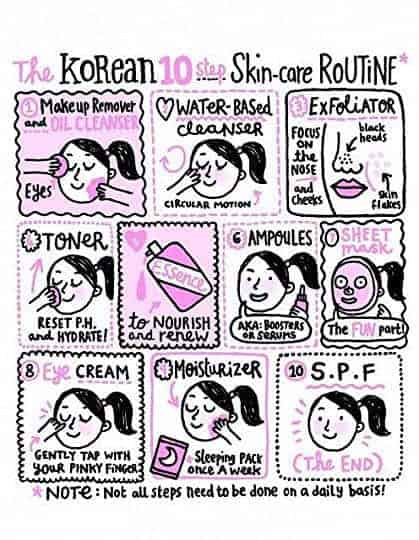
Photo: The 10 steps of Korean layering according to Charlotte Cho
Last time I told you about my skincare routine, it was in my analysis of Dr. Hauschka products. Unfortunately, despite the excellent results I had with that routine in Europe, as soon as I got to Asia, the Dr. Hauschka products turned out to be too oily and not watery enough for the hot, humid climate plus the pollution in Asia.
After my time in Japan , and and South Korea, I was able to establish another routine based exclusively (or almost) on Japanese and Korean products.
Japanese products are more numerous because Japan has the advantage of having a hot, humid climate in summer, but also very dry and cold in winter. Their products are particularly well-suited to travelers like me. The Korean products I use are best-sellers in their category, and I choose them because there are no equally good products on the Japanese side.
And as soon as I arrived in South Korea, I immediately understood why Korean women are so keen on hydrating their skin and having a portable humidifier at the office: even when it’s 29°C, the air is super dry here.

Here’s my new 9-step routine. Don’t worry, I don’t use all of this every day. It’s heavier than my routine as a backpacker during the round-the-world trip; but I’m less constrained by weight now that I’m a digital nomad. And this routine is more hydrating and nourishing for the skin in the long run.
You’ll find more info on the basics of layering here (why double cleansing, etc.)
Korean product prices are marked in won: 10,000won = 7.8€
Japanese product prices are marked in yen: 1,000yen = 7.7€
If you’re in France, most of the products below can be purchased on Korean cosmetics sites like Yesstyle, Testerkorea, Jolse, Olive Young... Japanese products can be purchased on Yesstyle, Amazon, Testerkorea, Jolse or Takaski.
Most of the links here point to YesStyle, Jolse, and Olive Young, all based in South Korea:
YesStyle is a reliable site with a huge selection of Korean/Japanese products. Shipping takes 2-3 days for the most popular items, prices are very gentle, and customs fees (if any) are refunded. There are always plenty of gifts and samples. The advantage is that they sell both Korean and Japanese products.
Jolse is a reliable site for buying Korean and Japanese cosmetics. Shipping costs are a bit high right now because of Covid, but under normal circumstances, they’re free if you spend a certain amount. There are always plenty of gifts and samples. They sell more Korean products than Japanese ones.
Olive Young is the equivalent of our Sephora. They’ve recently started shipping internationally. It’s very fast, and they carry some products that even YesStyle and Jolse don’t have. Free shipping on orders over $60
Step 1: Makeup Removal
1a.Clean it Zero – Purifying Cleansing Balm (Korean product, 22,000won): I use it to remove makeup, only if I’m wearing foundation or if I feel particularly dirty. Otherwise, I use the oil above. In South Korea, you can only find them online or in the brand’s stores (Banila Co.), especially in the Myeong-dong neighborhood where there are 3-4 stores. (Yesstyle link, Jolse link)
Lately, people prefer Heimish All Clean Balm (Korean product) because the texture is more pleasant and it removes makeup more effectively than Clean it Zero (Yesstyle link)
1b.Fancl – Mild Cleansing Oil (1,700yen): I use it to remove sunscreen and all the dirt. It’s the number 1 cleansing oil in Japan, available everywhere in Japan, even in convenience storestores like 7-Eleven, Lawson… (Yesstyle link)
Step 2: Cleansing
2.Evita – Beauty Whip Soap (1,200yen): This cleanser from Kanebo is not only pretty (you get a rose-shaped foam) but it also cleans well, leaving the skin very soft. Note: its pH is higher than 5.5, so you need to use a toner right after.

Step 3: Exfoliation (once a week)
3. Cure – Natural Aqua Gel (1,200yen for 100g): This is the best physical exfoliator without grains. I’ve tried many products, and this one, ranked number 1 in Japan, deserves its place. The skin is very soft afterwards; best used on dry (but clean) skin. I got the 100g version because you don’t need much product each time. I’ve tried many equivalent Korean products, but none match the original Japanese version. If there’s only one product to buy, this is it. (buy from France)
Step 4: Toner
This is truly the essential step because the skin needs to restore its pH after cleansing. If not, it will feel attacked and many problems will appear, including acne… because the skin is no longer protected by its natural acid barrier. I think if you’re going to invest money in one product, it should be a good toner. At the end of the round-the-world trip, I ran out and couldn’t find one in South America, and I can tell you my skin quickly deteriorated.
4. Mamonde – Rose Water Toner (Korean product, 15,000won): This toner, with an ideal pH, no alcohol, no parabens… is refreshing, hydrating, and smells really good (link Yesstyle, link Jolse). I love it! There’s another very famous product, which is also natural: Organic Flowers Deep Rich Essence Toner by Whamisa (Korean product, twice as expensive, around 35,000won).
Step 5: Essence
5. SK-II – Facial Treatment Essence (9,000yen for 75ml): (buy the trial kit here) also called “miracle water”, this miraculous essence, based on Pitera (a bacteria extracted during sake fermentation), prepares the skin to better absorb the hydrating products that follow. To avoid wasting product, I use it with the Unicharm Silco cotton (on the right in the photo, Yesstyle link). This essence is especially recommended for the famous lotion mask Japanese. For that, I use the cotton on the left, which can be torn into 5.

Step 6: Mask (every 2-3 days)

I’ve tested many hydrating masks, and my top four are the following (I use them every 2-3 days)
- MINON Amino Moist Face Mask (Japanese): This mask deeply hydrates the skin. The next day, it’s as if it erased all imperfections and redness overnight. Tourists come to Japan to buy these masks by the dozen, despite the price (2€ per mask, mind you!) and its texture (gel). I haven’t found a mask as effective as this one. (click to buy from France)
- Yeast sake mask from My Beauty Diary (a Taiwanese brand): It’s very hard to find even in Japan, but they are sake-based like SK-II. I use it when my skin is stressed by hormonal changes.
- Mediheal (Korean): All Mediheal masks are rich in essence and so pleasant to use. I’m currently using the Collagen Impact (because it’s on promo) but I also like the original version with hyaluronic acid; it’s just as good. The skin is super well hydrated afterwards; sometimes I’m so lazy that I put on this mask and don’t apply moisturizer after. (buy from France)
- Kiehl’s – Turmeric & Cranberry Seed Energizing Radiance Mask : anti-stain mask based on turmeric. It’s not an Asian product, and it’s not a sheet mask but it’s so effective that I haven’t found an equivalent in Asia. It brightens the skin and fades dark spots, while also having a slight exfoliating effect thanks to the little granules in it.
Step 7: Serum
7. HAKU – Melanofocus V (10,000yen for 45g) : For Asian skin, aging shows in the number of dark spots, not wrinkles. So Japanese women have super effective products against spots. This product is also sold everywhere, and there are ads for HAKU, Shiseido’s sub-brand, in all magazines, as well as for POLA’s White Shot, which looks very effective. But I’ve only tried HAKU. I did a skin analysis before and after 1 month of use, and you can clearly see on the machine that the spots have disappeared. Note: Most of my spots are from acne scars, so that’s why they disappear so fast, but for dark spots, it takes longer, you know. I noticed that at first, the dark spots get darker, and then they fade slowly after 2 months. As for price, I paid around 80€ for 45g. It’s very economical because 2 drops are enough for the whole face. Besides being effective, this product is also very moisturizing. If it’s too hot, I only use it at night. (Yesstyle link)
Step 8: Moisturizer
8. Minon Amino Moist – Moist gel back (1,200yen) : Since I can’t afford to buy masks at 2€ each forever, I preferred to invest in the moisturizing gel from Minon (same brand as my favorite mask). The skin absorbs the gel in record time and it doesn’t leave an oily residue, perfect for humid weather in Asia. MINON products are for sensitive skin, so the ingredients are also high quality. The gel is so light that I also use it around the eyes.
Step 9: Targeted treatment
9. Clearasil (Japanese version): I still have a few pimples due to my period. I apply this gel on top, which doesn’t have the same formulation as its American or French equivalent: the Japanese version does not contain benzoyl peroxide at all – and it’s slightly tinted, so it helps camouflage small pimples.
Korean women don’t hesitate to camouflage pimples with transparent patches. It’s totally acceptable to walk around with this “bandage” on your face. You have the Dr. Wonder version (only sold in Korea or online: link) which contains very thin round patches (11,000won for 60 rounds) or the cheap version (two 7x10cm rectangles to cut) from some brand. I find them particularly effective for making pimples go away faster (they absorb all the gunk inside) and protecting them from pollution or dirt (especially at night when the skin is in contact with pillows, etc.).
In France, you can find an equivalent product from COSRX (a Korean brand): COSRX Acne Pimple Master Patch, they are thicker and less discreet but very effective for protecting pimples (Yesstyle link, Jolse link, Olive Young link). If you can’t find them, you can buy blister plasters at the pharmacy (Compeed brand) and cut them into small pieces.

Are you planning a trip to South Korea? Our partner Get Your Guide offers entry tickets and guided tours with French-speaking guides at very reasonable rates. Click here to see what they offer and book online.