
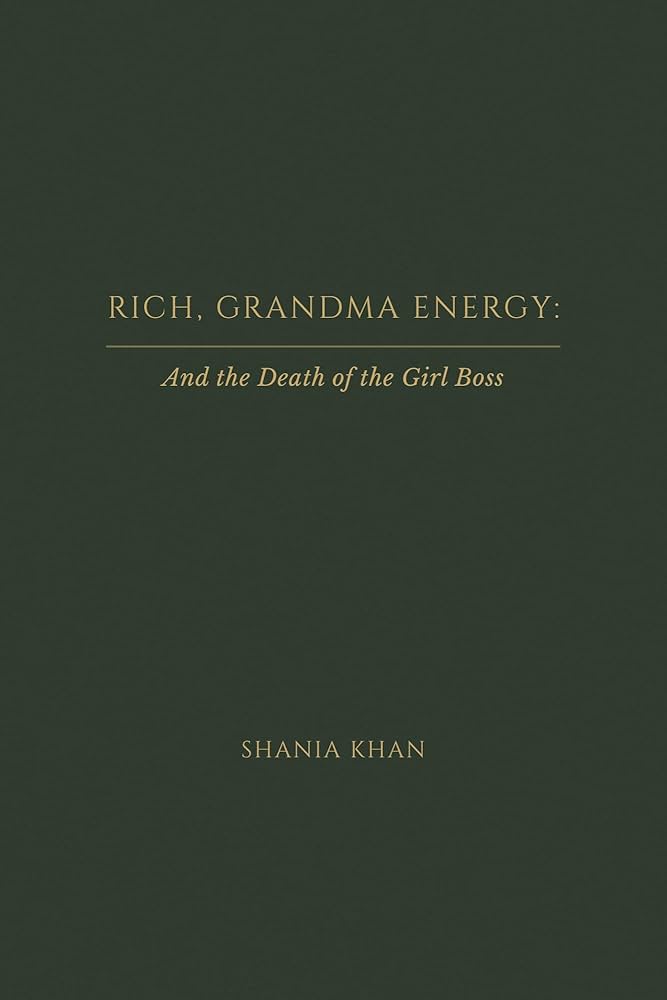
[review] The book “Rich Grandma Energy” by Shania Khan
The title may make you smile (Rich Grandma Energy: And the Death of the Girl Boss, Amazon link) but the book is enjoyable, short and easy to read, even in English. The format is very American but I really like the mindset of this entrepreneur, founder of a PR agency. I found it while looking for a silk slip dress ahahha (she wears them all the time).
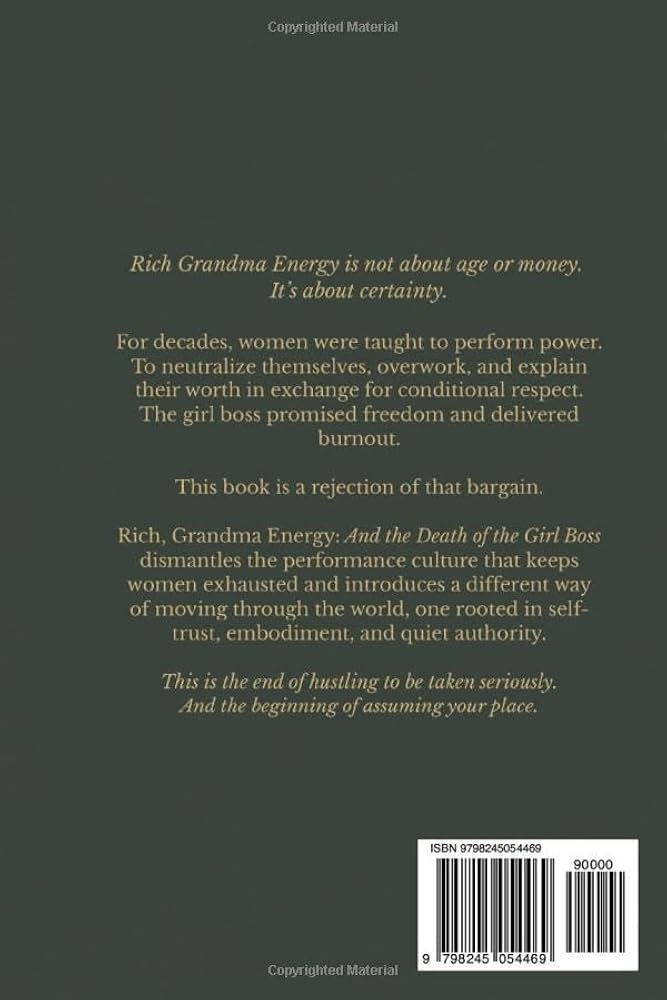
Here’s the official book blurb, translated from English:
Rich Grandma Energy is not about age or money. It’s about certainty. For decades, women have been sold the girl boss dream: work harder, perform competence, neutralize your femininity, and maybe they’ll finally take you seriously. This dream promised freedom. What it delivered was exhaustion, invisibility, and burnout.
In Rich Grandma Energy: And the Death of the Girl Boss, Shania Khan dismantles the performance culture that taught women to make themselves small, to hustle, and to justify themselves in exchange for conditional respect. This is not a productivity book. It’s a power shift.
Through personal stories, cultural reinterpretations, and uncompromising truths, Khan introduces another way of moving through the world: rooted in presumption rather than permission, in embodiment rather than performance, and in self-trust rather than validation.
This book is for women who are tired of making themselves small. Tired of explaining themselves. Tired of being “acceptable” to survive. You don’t need to become more disciplined, more productive, or more polite. You need to decide. This is the death of the girl boss. And the birth of something far more powerful.
Physically, Shania Khan is the typical American influencer, but her words have real depth, hidden under a light and simplistic tone. What I like about her is her boldness: she dares to try everything, she embodies what she preaches, she always has lots of ideas and she executes quietly, without announcing them 3 years in advance. A few examples that speak for themselves: she coded an app with AI to promote her personal development program, she left the rat race right after a divorce to launch her own PR agency, lost weight, and since her book is self-published (so no Audible), she simply recorded the audiobook herself and uploaded it to her site as a downloadable mp3. Simple and effective! She also has a very interesting video on jealousy, which she suggests treating as a signal rather than suppressing: if someone makes you jealous, it’s because you want what they have. And the best move? Go directly ask them how they got there.
What I love about this type of personality is the consistency between words and life. And also the relationship with social media: she made it a second career without ever cutting ties with the business world. Far from the full-time influencer disconnected from reality.
In short, I think her little book is an easy read. It’s not great literature, nor a typical self-help. It’s a concentrated version of what she shares on her social media. It speaks to women close to burnout, or those waiting for a promotion for a long time, or those wanting a boost to become entrepreneurs after years of salaried work. The idea is to change your limiting mindset to move away from survival and activate the parasympathetic system more => achieve success without burnout.
Alright, I’ll translate an excerpt from my favorite chapter: chapter 6
CHAPTER SIX
The Slip Dress Theory
The slip dress theory is simple: luxury has nothing to do with what you can afford. It’s about how you take care of yourself when no one is watching.
A woman in a silk slip dress, sipping her coffee alone in her kitchen at six in the morning, cultivates a certain frequency. One of “I deserve beauty, even without witnesses.” And this frequency changes everything.
That’s where most women go wrong. They confuse luxury with ostentation. The designer bag, the prestige car, the carefully staged vacation photos. Acquisitions meant to impress. But that’s not luxury. That’s insecurity dressed up as grandeur.
True luxury is what you do in the shadows. Silk sheets you sleep in alone. Fresh flowers you buy yourself on a Tuesday for no reason. Luxury moisturizer you apply even when staying in. A table set with care for just one person. Music you play while cleaning. Time you take to get ready, even with nowhere to go.
All of this matters because true luxury recalibrates the nervous system. It sends your body the message: “We are safe, we are fulfilled, we have worth.” And when the body internalizes that, something shifts. You stop acting out of fear of scarcity. You stop clinging. You stop playing a role.
You begin to settle into certainty.
I discovered this by accident. Exhausted from years of performing in girl boss mode, I did something I never allowed myself. I bought a silk slip dress. Not for others. Not because I had somewhere to go or someone to impress. Just because I wanted to. The first morning I put it on, I felt ridiculous. It was six in the morning, I was alone in my apartment, and I was wearing a three-hundred-dollar slip dress to drink coffee and check my emails. It was excessive. Extravagant. Too much.
And yet, something had changed. I was sitting differently. I was moving differently. I felt different. Not because the slip dress had given me power, but because choosing beauty for myself, without external justificationwas an act of self-worth I had never practiced before.
Most women only allow themselves luxury once they’ve earned it. After the promotion. After hitting a goal. After proving they’re worth it. But that’s still performance. It’s still looking outside for permission to treat yourself well.
The slip dress theory says this: you don’t need permission. You don’t have to deserve beauty. You give it to yourself first, and everything else follows.
It’s about regulating the nervous system, not materialism. When you live in a state of constant deprivation, telling yourself you’ll take care of yourself later, once you’ve accomplished enough, earned enough, been enough, the body stays in survival mode. And survival mode is the frequency of lack. Of fear. Of never enough.
You don’t build an empire from lack. You don’t access your power from fear. You can’t move forward with certainty when your nervous system is screaming: “We’re not safe yet.”
Luxury, even tiny, tells your nervous system: “We’re safe now.” And it’s in safety that power resides.

