
[review] Stained Glass Workshop in Chartres (France): Glass & Lead
A long time ago, while spending a weekend in Chartres, we happened to run into a couple of friends on the street. We asked them what they were doing there and learned that the friend’s mother was taking a stained glass workshop in Chartres. That bit of info stayed in my head for about ten years because I was really impressed to learn that people still did it as a hobby and that there were classes—it totally aligns with my obsession with gothic cathedrals. In May 2023, I returned to Chartres (right in the middle of a pilgrimage) and went straight to the stained glass center to inquire and sign up.
In October, right after my bookbinding course in Tours, here I am in Chartres for 5 intense days of training, while JB conquers the EBC (Everest Base Camp) with his brother.
The training takes place at the International Stained Glass Centre https://www.formations-vitrail.fr/fr/pratique-du-vitrail/, which is also a museum. The entrance for classes is on the left. There are often curious tourists who stand still in front of this door to watch, and my teacher, Sylvie Roudaut, very kind, always invites them to take a tour of the workshop and have a good look.
There are several courses, but considering my dates, my desire, and the price, I opted for “Glass and lead”, which is the traditional cathedral method. The course cost me €748, and there’s no financial aid (CPF) for me because this course has nothing to do with my professional background.

Accommodation
Since I’ve been to Chartres several times, I roughly know which street suits me, and I booked an Airbnb (Airbnb link) 10 meters from the training center. Since it starts early (at 9am), it’s a huge pleasure to be able to leave my accommodation at 8:55am 😀 But you’ll see, I’ll end up getting up early. It cost me €261 for 5 nights (Sunday to Friday morning).
The course starts Monday at 9am, but I get there on Sunday because I have no desire to leave Paris at 7am.
Note: key pickup is between 3pm and 7:15pm Monday to Saturday, and on Sunday it’s between 9am and 12:30pm because they leave the key in a box inside a Franprix, and if the Franprix is closed, too bad, no keys. Fortunately, on Sunday, I was already there in the morning and got my keys without any problem. It’s a two-story apartment, so you need to be small and fit.
Otherwise, there’s another hotel I really like that’s just behind the cathedral, and 2 minutes from the stained glass center; I stayed there in May, it’s the Saint-Yves hotel (Booking link), in a former abbey, with a “The Name of the Rose” vibe guaranteed 😀
Monday, first day
Too excited about my course, I can’t sleep and get up too early. I walk around the old town looking for an open bakery and spot two with a terrace: at Paul’s and Boulangerie Feuillette. Otherwise, there are absolutely delicious organic pastries at 31 Rue des Changes, but there’s no terrace, it’s takeaway only.
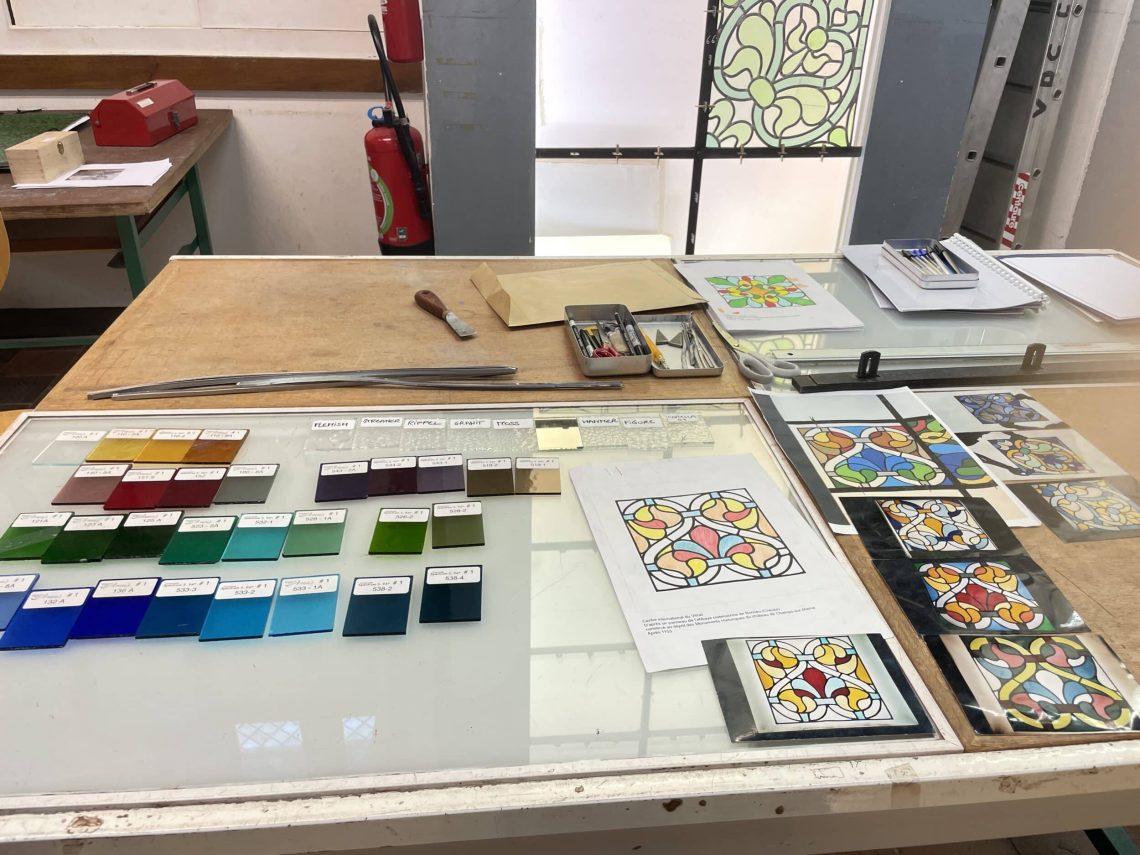
The center opens right at 9am, and Sylvie already has tools and storage spaces ready for each of us, with our names on them. It’s very well organized. So, I get:
- A metal box full of tools
- A storage corner with three rulers, two large sheets, a huge cardboard envelope, and carbon paper
- A notebook with useful info: where to buy materials, list of recommended books, etc.
- A box full of glass samples
- I have access to a huge stock of glass


We are 7, but in reality, there are 2 students who already know the craft so well that they work on their own projects and don’t even listen to the explanations anymore. Of the remaining 5, there are 3 who have already done a similar course at the center, of which 2 remember it very well, and 1 vaguely. Another woman and I are true beginners.
Sylvie shows us the tools and details the steps we’ll be doing, namely:
1 – Choose a design from the proposed designs
2 – Choose colors for each of the glasses and color the model at 1/10th scale
3 – Make the tracing: transfer of the lead lines, glass pieces are numbered
4 – Color: the reference of the chosen color is indicated for each glass piece
5 – Cut the numbered templates with the 3-blade scissors.
6 – Glass cutting: with a steel wheel cutter
7 – Setting with lead strips, glass pieces held in place with mounting nails
8 – Trimming the leads with a boxwood or PVC spatula
9 – Soldering with a soldering iron (on both sides of the panel)
10 – Puttying and cleaning with sawdust
Sylvie also explains how these pieces of glass are assembled and held in place in cathedrals, and I’m shocked to learn that the principle is much simpler than it looks.
1 – Choose a design from the proposed designs
There are lots of cool designs, but I prefer a design with one line of symmetry instead of two. With two lines of symmetry, you cut the same shape four times, whereas with one, you only cut it twice. So it’ll be more varied for me, and I’ll learn more. I also went for a design with the most varied shapes possible. Among the proposed designs, some come from real churches or cathedrals. Sylvie says it’s deliberate that the glass pieces aren’t perfectly symmetrical, to give a handmade feel.

2 – Choose colors for each of the glasses and color the model at 1/10th scale
We have colored pencils to color the small mock-up, and there are so many glass samples that I end up coloring at random. I use as many colors as possible, but I also like to include clear (textured) glass to highlight the pattern. Later, when I go back to see the stained glass at the Cathedral, I think I may have made a mistake—there’s no clear glass in the old windows; they use blue where it’s empty.

3 – Make the tracing: transfer of the lead lines, glass pieces are numbered
4 – Color: the reference of the chosen color is indicated for each glass piece
5 – Cutting out the numbered patterns with the three-blade shears
All of this is done fairly easily; there’s no technical difficulty. The three-blade shears are an ingenious invention—they leave exactly 2 mm between the two templates, allowing the lead to slide in later.


Next, I sort the patterns by color and place a glass sample of the same color on top:

6 – Glass cutting: with a steel wheel cutter
It’s from this point that the speed of execution widens between participants. The two men who remember their previous lessons very well work at lightning speed, while I break glass after glass and have to re-cut. By the end of the morning, I’ve only managed to cut 7 pieces in total (out of 57). Sylvie confirms that for true beginners, that’s what she expects from us, and she gives us until Wednesday evening to cut everything. For now, I can’t see how I can manage by Wednesday evening, but if she says so…
As soon as I saw glass shards flying, I immediately asked for gloves and safety glasses. I don’t know why the others continue to do it barehanded (some even get hurt), maybe to feel the glass better? Anyway, I’m glad I have my protection because at one point, I misoriented the glass and shards grazed my face.


At 5:30 PM, it’s normally closing time, and while all the other students continue cutting, I decide to leave the center and rest quietly at home. Hearing the sound of glass from 7 people (including myself) gave me a headache, even though I can usually concentrate despite noise.
Tuesday, day 2
To fix this noise problem, I’m equipped with my noise-canceling AirPods to listen to the audio ofIn Search of Lost Time (I’m on volume 3: In Search of Lost Time). Unfortunately, I miss all the cuts in the morning because glass cutting is extremely linked to sound: you have to listen to the cutter to know if you’ve scored the glass properly. You also have to listen to the glass to know if you’ve tapped hard enough to break it. After understanding this problem, I disable the noise-canceling feature and it goes better, but on the other hand, I can’t understand Proust’s text anymore 😀 (you can’t do two difficult things at once), so I settle for soft music.
I also notice that some glasses are easier to cut than others. The pigments seem to change the properties of the glass. So to console myself, I focus on easier-to-cut glasses and simpler shapes.
When you can’t follow the shape, you can cheat with pliers, and that creates a cloud of glass dust. I think I’ve got a bunch of it in my lungs because when I get home in the evening, I have a lot of trouble breathing.
As beginners, we use industrial glass (about €120 per square meter), not blown glass (3-4 times more expensive). Blown glass has bubbles inside and varied thicknesses and colors, so it’s easy to distinguish. In the workshop, the blown glass is kept at the back, so there’s no risk of using it by mistake.
At the end of the day, I still haven’t finished cutting the 57 pieces; I have 7 or 8 left, the hardest ones.
Honestly, I’m starting to have doubts and wonder what I’m doing here. I don’t like glass to begin with; why did I sign up for a stained glass course? What an idea!! A trip to Chartres Cathedral and I’m instantly soothed. I’m here to understand how the craftsmen made such beautiful stained glass, to better appreciate their work, to simply understand. And since I’m a fan of William Morris, who among his 1000 other activities made quite a few stained glass pieces, I’ll better understand the genius of my idol.


Wednesday, day 3
After wasting 3 more pieces of glass in a row, I ask Sylvie for help, and she cuts one or two difficult facets for me and leaves the rest.
It’s better this way, and I reduce the gap I’ve fallen behind the two gentlemen who have already moved on to leading since yesterday. I finally have my 57 pieces cut.

7 – Setting with lead strips, glass pieces held in place with mounting nails
Leading is another shock for me because I’ve seen the gesture hundreds of times (on Instagram), but in reality, it’s very, very hard and I feel so useless that I could cry. I have no idea how I’m going to finish this stained glass piece, but if the workshop exists, people must manage it, right? It’s rare that I feel this useless, this lost. Because before signing up for a workshop, I usually have some experience at home. But with stained glass, I’d never touched glass before, and I underestimated the difficulty.
Handling lead requires protective gloves (because it’s toxic).


M. my girlfriend appears like an angel, and her presence makes me so happy. When she found out I was in Chartres alone, she came, first for one night, then finally two nights because I insisted she stay for the opening of the Chartres labyrinth on Friday.
Here’s the video M. took for me:
At the end of the day, I’m at 1/4 and constantly wondering if I’ll make it.
When we get back, M. suggests we do some shopping for a homemade Korean meal. It’s super super good, and it’s nice to see a familiar face and be pampered during tough times.
Thursday, day 4
In the morning, M. prepares a homemade breakfast for me while I go get organic pain au chocolat for both of us. She takes care of me like a mother because she saw me at the workshop and knows the training is very intense. It means a lot to me. While I’m in training, M. explores Chartres or reads; she’s already visited the city, so she can just enjoy its atmosphere. Our airbnb, right next to the cathedral, feels very peaceful and healthy.
Okay, I don’t know if the pieces of glass I have are cut better than the first ones, or if I’ve gotten used to it, but I’m progressing much, much faster. At the end of the day, I stay 30 extra minutes with the goal of leading the 57 pieces, but I still have 3 pieces left. Today you have to be on your feet all day, and it’s very physical because you bend over more to fit the glass properly. I had to recut 3-4 pieces when I noticed I might have a gap or that the curve didn’t match the other pieces. Sylvie also had to help me with some particularly tricky parts. Poor thing, she’s constantly being called over for this part. She doesn’t even have a minute to breathe.
The other beginner decides to give up, but the teacher encourages her, saying she can go as far as she wants, and she’ll finish the rest for her. I think it worked because in the end, she still managed to lead half of her pieces.
I’m surprised to see that the teenager next to me was moving as fast as I was. Actually, she’s also used to focusing for long hours thanks to her drawing and ceramics classes. I think the key to this training is that: being able to focus for 3-3.5 hours without a break, being able to stand all day. There’s so much to do and it requires so much concentration that we don’t even talk to each other and have to save all our energy for the work. The advantage I have is that I have a large table to myself (while others share a big table), so I can spread out all my tools without having to put them away or worry about someone else’s space.
So at the end of the day, I’ve caught up; instead of being a day behind the two gentlemen, I’m only half a day behind now.
At 9pm, as we stroll through the city center, we catch the sound and light show in front of the cathedral. It’s magical. After the show, the doorways are lit up too, and the statues are all colorful.


Friday, day 5
M. wakes up very early because she thought bedbugs had attacked her. Actually, it was just the cold making her skin dry and itchy, but there’s a bedbug epidemic in Paris right now, so she freaked out. I wanted to wake up early to go with her, but I was so tired that I couldn’t bring myself to open my eyes before 8am. Another homemade breakfast, very hearty.
After leading the last three pieces, Sylvie comes to check the dimensions.
I have a 5mm gap between the two sides of the stained glass piece, meaning I have to recut some pieces and compact others. After 2 long, painful hours, the gap is reduced to 1-1.5mm, which I hope no one will notice. We can finally move on to the next step:

8 – Trimming the leads with a boxwood or PVC spatula
9 – Soldering with a soldering iron (on both sides of the panel)
Soldering has always been my favorite part, whether in jewelry making or stained glass. I could spend hours doing it. Writing these lines, I think I should have done the “Tiffany stained glass” workshop instead, because I’d have gotten my fill of soldering 😀
It’s when you turn the stained glass over that you realize some pieces weren’t set correctly between the lead wings. Fortunately, it only happened to 3 out of 57 pieces, and I could ask Sylvie for help with the tricky ones.
Having gotten a bit ahead of schedule, I head out at 11am to return the Airbnb keys. By noon, I meet M. at the cathedral to walk the labyrinth, which is open between 10am and 4:45pm every Friday. Fortunately, it’s less crowded at noon, and I walk the labyrinth at my own pace (it still took me 10 minutes at a normal speed). M. does his second walk-through with me. It’s truly magnificent; ideas come to us during this walk, it’s a precious moment of meditation. While walking this labyrinth, I relived the emotions of the past few days: at one point, you stray very far from the center, and not knowing the labyrinth by heart, you don’t know how much distance remains, nor how you’ll get there. The arrival seems so distant and unattainable, but you have to keep going. Finally, the end of the walk is very easy because you get closer and closer to the goal, and you see the remaining path more and more clearly. You who see me accomplish many things, know that I’m like everyone else, I’m scared to death when I start something new, but curiosity is too strong for me to stop, and I must continue thanks to this insatiable curiosity.

We have enough time to visit the shop right next to the cathedral, dedicated to stained glass techniques; I highly recommend going there, there are also many books on the subject.

I stop by to pick up my package (a large cardboard envelope to bring my stained glass back to Paris) at a pickup point and say goodbye to M. who returns to Paris.
10 – Puttying and cleaning with sawdust
This is the part I hate the most because it’s dirty and requires a lot of muscle to scrub it all. I really have no arms left by the end of the day.
In short, we apply a mixture that will slide under the lead, harden, and consolidate the stained glass. But this mixture is all gray, all dirty, all oily, so you have to remove it from the glass by scrubbing energetically. This mixture also gives shine to the glass, so you spend 2 hours working out your arms in this way.
At the end, we placed my stained glass on the frame as if it were a cathedral stained glass; you can see that the system is super super simple and you can remove it easily as well.

At first, I didn’t want to keep this stained glass, because I didn’t know what to do with it. And keeping it means making a detour to my sister’s before leaving for Poland, but after so much work, I tell myself that I can’t ruin it, I’ll keep it in the basement until I can show it somewhere. So, I do everything to leave for Paris as early as possible (to have time to stop by my sister’s). Running with my suitcase and my stained glass, I arrive at the train door just as the closing is announced. I caught my train by 5 seconds.
As I’m very loaded down and drenched in sweat, the train passengers look at me with disdain, and many keep their bags on empty seats to prevent me from sitting next to them. I temporarily left my bag on a seat while storing my suitcase, and a woman didn’t even remove her bag from that seat, clearly signaling that she doesn’t want me near her. Eventually, I found a very wide seat for 5 people where my stained glass could be protected from other passengers passing by. I gained 1 hour by taking the earlier train, but then lost 1 hour in Uber traffic. But my stained glass is now safely stored at my sister’s. The next day, I leave at dawn to take the Ryanair shuttle at Porte Maillot, heading towards Gdansk.
Conclusion
It’s a challenging workshop, requiring a lot of concentration and perseverance. I couldn’t necessarily see the end, but each time, I told myself that I’d be happy when my stained glass was finished.
I think there’s no harm in asking the teacher for help (Sylvie is so kind and patient!!!), and without her to correct the difficult parts, I would have thrown the glass sponges in tears 😀
Anyway, you might find the price (750€) a bit high, but it’s not because the glass is very expensive. As a beginner, you’ll also waste quite a bit of glass, so I think the value for money is excellent. Now I’ll better appreciate stained glass and any glass-related work.
Restaurants
Except for the times M. cooked for me, I was so tired that I just went to restaurants. Here are the restaurants I really liked in Chartres:
- L’Annexe : I liked their salads
- La Table du Marché : I liked their duck breast
- Le Comptoir de Mamie Bigoude : original decor, the crêpes and galettes are delicious
- Aux Comptoirs : they have Gillardeau oysters, everything is good, but the service is unpleasant


Budget
- TER Paris – Chartres: 37€ round trip
- Accommodation: 261€ for 5 nights
- Restaurant: between 18€ and 25€/meal
- Workshop: 748€

