[Story time] How I got a master’s degree through VAE (Validation of Acquired Experience)?
I studied computer science: a DUT (2-year university degree) obtained in 2007. The plan was to continue with a master’s degree, but I started a business and never went back to school.
During almost 20 years of career, my education level never held me back. I worked in a new field (web marketing), most profiles were self-taught, and there were no academic courses.
In 2025, I decided to switch careers to cybersecurity. I trained, passed a certification, and then started looking for a job. A job search is never a walk in the park, especially when changing careers.
I received dozens of rejections for “lack of experience,” which was perfectly legitimate. I also received responses like “we only hire master’s degree holders.” That’s less legitimate and even a bit annoying. Being reduced to the studies you did 20 years ago, after creating companies, managing teams, leading numerous projects…
I eventually found an employer, but this episode left a bitter taste in my mouth, and I thought it would be a shame if my education level continued to close doors for me in the future.
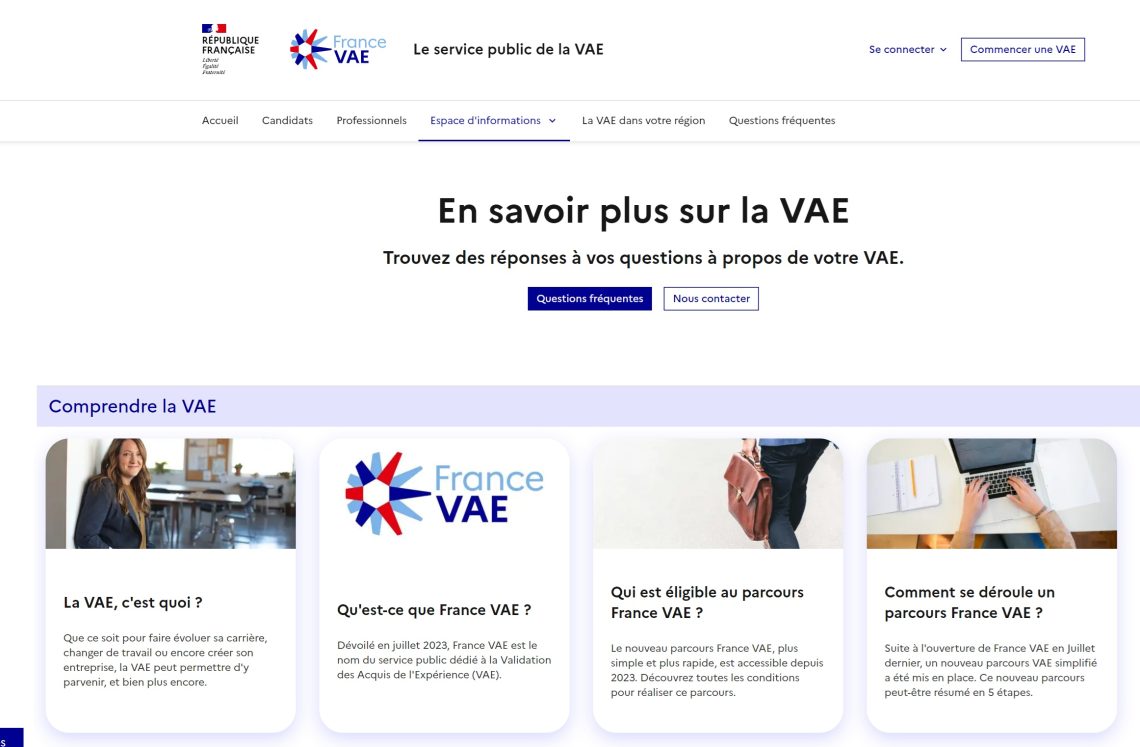
That’s why I started a VAE (Validation of Acquired Experience), a process that allows you to officially validate an education level by proving your experience.
Choosing the certification
The first step, one of the most important, is carefully selecting the certification you will pursue.
To do this, you need to visit the France Compétences website. As of this writing, there are 29,586 certifications listed!
I started by searching for my area of expertise (“SEO”) and filtered by the qualification level I wanted: “Level 7” for a master’s degree.
That left only 41 results—progress!
Each certification lists all the skills you need to demonstrate to earn the coveted credential. In the one I chose, there were 32 skills, divided into 4 blocks.
Pro tip: at the bottom of each page, you can click on “Référentiel d’activité, de compétences et d’évaluation” to download the reference guide as a PDF, which is much easier to read than on the web page!
For each certification, I did a quick initial screening of those that might match my experience.
You then need to make sure the certification is available through VAE, which isn’t always the case. For each certification, you get a list of certifying bodies (usually schools or universities). You have to visit their websites to see if VAE is available; unfortunately, this isn’t indicated directly on the France Compétences site.
My final choice was the “Manager de la stratégie marketing digitale” certification offered by ESPL (Ecole Supérieure des Pays de Loire).
How much does it cost?
The cost of a VAE can vary widely; it depends on the diploma, the school, and whether you choose to be accompanied by an external organization to help you through the process.
For example, a VAE at HEC costs a mere… €20,000!
In the case of ESPL, it cost me €3,310:
- €630 for the school
- €2,600 for 24 hours of support to prepare the dossier and the oral exam
- €80 in fees for organizing the jury
Two important things to know:
- You can use your CPF credit if you have any; I was able to use €1,000.
- The support is optional.
Given that the support represents a significant part of the budget, many wonder if it’s worth it.
I don’t think it’s absolutely essential, but I’m certain it saved me a lot of time and energy.
The support gives your work structure; regular progress meetings put pressure on you that you wouldn’t have without deadlines to meet.
Most importantly, your coach will guide you on the jury’s expectations, which are much more “academic” than what you encounter in your professional life. There are, of course, resources available to explain what you need to prepare, but I had dozens of questions about how to approach my work. The support will help you avoid many mistakes that could be fatal at the jury stage.
My deliverables would have been very different without the support. Would I still have passed my VAE? Maybe. But I don’t think I would have done it so quickly, in 6 months.
The receivability request
Once you’ve chosen your certification, you must complete a purely administrative formality: the receivability request.
This is an official CERFA form in which, basically, you have to state your identity, your level of education, and your professional experience.
For each experience, you need to briefly describe how it matches the certification you’re aiming for and provide supporting evidence (a work contract, a pay slip, an Kbis extract, etc.).
This CERFA form is sent to the certifying school, which will review your application.
A few days later, you’ll receive a response. If it’s positive, you get a “notification of admissibility” and you can get to work!
Writing Booklet 2
This is the bulk of the work: Booklet 2 (the admissibility request is considered “Booklet 1”) is a sort of thesis (between 80 and 100 pages) in which you must describe the professional experiences you’ve had that prove you have the skills required by the certification.
To simplify slightly, there are two main parts:
- A long table in which you must briefly justify each skill
- A detailed description of “professional situations” (between 4 and 6)
The second part is the most important: you must carefully select the professional situations to cover all the required skills (32 in my case). This is one aspect I didn’t really enjoy about this work: instead of naturally telling your experiences and highlighting interesting points, I had to constantly make sure I was “checking” every box, even if it meant embellishing anecdotal details.
In this part, you must provide as much evidence as possible to support your experience, either in appendices or in the body of the text. For my part, I included screenshots of dashboards I had built, tools I used, an interview I gave to a media outlet, a press release announcing the project I led, a budget tracking spreadsheet, etc.
I struggled a bit to find my writing style at first; I hesitated between using the past tense (some experiences were quite old!) and the present, which makes the narrative more vivid. I also had a strong tendency to use “we,” because the vast majority of the projects I described were the result of teamwork. But my advisor really insisted that I was the one being evaluated by a jury, and they want to know what I did. So I had to systematically use “I.”
When I explained this work to friends and family, their usual reaction was to ask, “Did you use ChatGPT?” And well, no! Even though I use it daily (one of my professional situations was actually about an AI project), I think any experienced reader quickly recognizes the lack of substance in a story written by AI.
So I handed in a “100% organic” write-up, and it was very well received by those who read it, including the jury!
On the other hand, for the big, very academic table where you had to match each required skill with one of your experiences, I used AI without hesitation! I gave it the table on one hand and my narrative on the other, and let it do the heavy lifting; I just had to make minor edits.
The jury
This probably varies depending on the institution; mine holds four jury sessions a year. To register for a session, you simply send your completed Booklet 2 45 days before the jury date.
I appreciated this flexibility, which allowed me to complete my VAE (prior learning accreditation) quickly. I started in September 2025 and appeared before the jury in March 2026. Since no timeline is imposed, if you need two years, that’s not a problem.
The jury consists of at least two people, and I had three during my session. Normally, the exercise takes place in person. Since there was a good chance I’d be abroad, I was able to do it via video call.
It consists of a 30-minute presentation followed by a 15-minute Q&A session.
The format is quite flexible, even though a template is provided: presentation, motivations for the project, professional situations, and a review of the process.
I was able to have two “mock juries” with the organization supporting me to fine-tune my presentation.
During my session, everything went well (except for a technical glitch!). After the Q&A, I disconnected while the jury deliberated. A few minutes later, I was called back to receive the positive response. I now have a master’s degree (bac+5)!
Conclusion
I’m really happy to officially have a Master’s degree now. The level achieved through a VAE process has exactly the same value as if it were earned through a traditional pathway; there’s no difference and no mention of it being obtained via VAE.
The process was still painful, in the sense that I have a lot of trouble motivating myself to work on something that doesn’t interest me. Unlike many who undertake a VAE out of necessity (to get a job or change positions), my only motivation was to “check the bac+5 box” that I might need someday. As a result, the (long) hours I spent working on my VAE were hours I didn’t dedicate to developing skills in my new profession (cybersecurity).
Still, it’s a great achievement, and I can now shine at parties by explaining that I have two degrees: one in computer science and another in management!

