
Custom leather goods: My hand-stitched saddle-stitch bag in Novonappa Gold
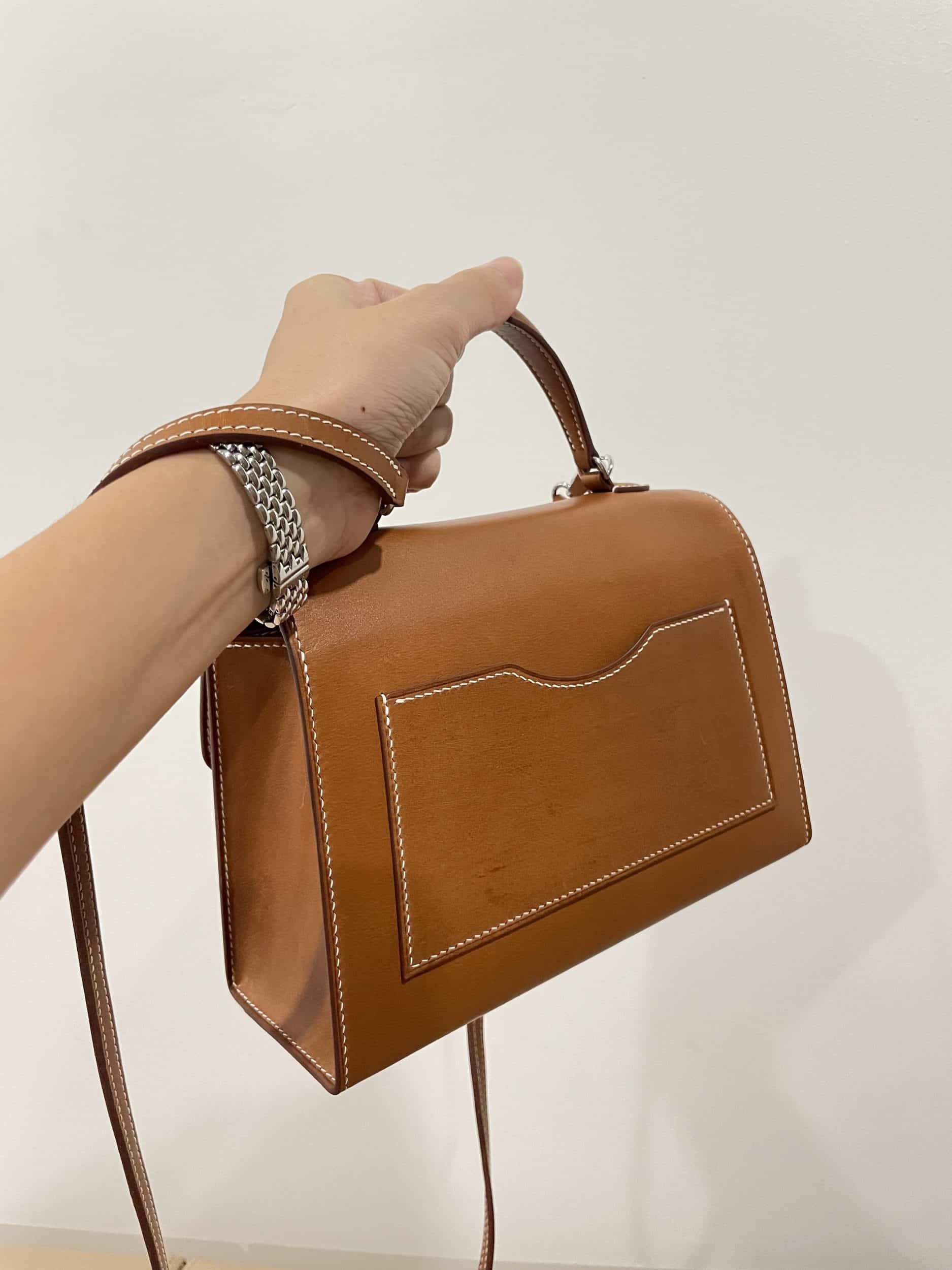
Today, I’ll tell you how I had my custom leather bag made by a Vietnamese leather craftsman. It’s entirely hand-stitched (saddle stitch) and made of Novonappa leather, lined with Sully goat leather.
Story time
This section could have been titled “how I got here” because I didn’t like leather to begin with.
In 2020, I bought my first Hermès scarf and fell into a kind of obsession with this luxury brand. I learned that it’s one of the few luxury brands that still hand-stitches a small part of their bags (the others do it by machine). I read several books on Hermès and started familiarizing myself with the different leathers used by the brand, the hand-sewn “saddle stitch” – but I absolutely didn’t have the budget to afford even a leather card holder from Hermès.
In 2021, I stumbled upon an old, never-used Hermès passport holderon Vinted, which had aged naturally in its box for over 20 years. It was my very first item in such beautiful leather, and I realized that if I didn’t like leather before, it was because I had never had access to such quality.
JB fell in love with the texture, and we bought the second one the seller had. But we couldn’t find other items in this absolutely gorgeous pig leather. JB said we’d try to find some in South America and have matching items made to go with the passport holder. The idea of using a leather craftsman took shape in my mind. My passion for leather was born.
I talked about it with my friend M., who loves luxury leather goods. We lamented how impossible it was even to touch the real Hermès bags, when she remembered a former Hermès artisan who now has his own shop and can make custom bags with good quality leather like Hermès. She bought two from him (around 400€), and they’re durable. The only thing that annoys her is that he doesn’t line his bags, and her nails are all black after rummaging through the bag; maybe a custom bag will be fully lined? That made me think more about this type of service, which I find even more luxurious than luxury brands.
This is quite surprising because I’m not a bag collector at all. Even less leather bags – I’ve bought only 4 or 5 in total, and I gave them all away; there was something about the design, weight, and texture that didn’t appeal to me. But a bag designed by me? I like the idea.
After reading several books on the art of leather goods at Hermès, I devoured beginner leather crafting books, then intermediate ones… up to reading a book on “how to create your own bag,” meant for pros. I’ve listed the ones I consulted below. Note: I’m used to having custom clothes made in Vietnam, so I know that the more knowledgeable you are, the better you can communicate your needs and get optimal results.
- Hermès bag guide and codes (Amazon link)
- Fashionary Bag Design: A Handbook for Accessories Designers (Amazon link)
I looked again at the photos M. sent me, and I find this artisan’s bags far below the “luxury” level I’m aiming for. I did some research and found another Swiss artisan, but I clearly don’t have the thousands of euros needed to place an order with him.
I thought: why not do it myself? Classes would cost less than an artisan. I even went as far as signing up for a small leather goods class during my stay in Vietnam. Unfortunately, there weren’t enough students, so the teacher canceled the class.
One day, JB’s old cork wallet tore and gave up the ghost. I suggested we buy a new one at a leather specialty shop run by the Vietnamese Ministry of Trade. “We’re sure to find authentic leather there,” I told him. JB didn’t like any of the models, and that’s when I remembered the leather crafting teacher. Does he make ready-made wallets? One phone call later, we learned he could make a custom wallet for JB in a few days. I’ll spare you the details because we talked about it here.
I loved that experience and the quality of his products so much (and I especially realized it would take me years to learn to sew straight), and I saw that I was now able to articulate my request properly because I’d absorbed enough leather crafting knowledge. I decided to entrust him with my project “dream bag.” No need to go through a European artisan. Let’s do it in Vietnam! What he did for JB was so good that anyone would have thought the wallet came from a luxury house.
Note: Leather is a recycled product of the food industry. Without leather, all these hides would end up in the trash. French tanneries use raw bovine hides of French or European origin. The goat skins come from India (because they’re more commonly consumed there). They are first tanned in India to prevent deterioration during transport. French tanneries re-tan them a second time in France.
Where to find an artisan?
My artisan Loi from Dolio School (Instagram link) is based in Vietnam. You can contact him directly; he can ship internationally. I receive no commission for recommending him.
For French artisans, look at handmade products on Etsy. If you like a design, contact the artisan directly to customize it or make a completely bespoke bag. If you prefer an artisan close to home, Google is your friend 🙂
My inspirations
I already have a more or less clear idea of what I want. I’m such a fan of the Kelly from Hermès that I try to take all the elements I like, without wanting an exact copy or a counterfeit either lol 😀 Why copy a bag when you can create one that perfectly matches your expectations?
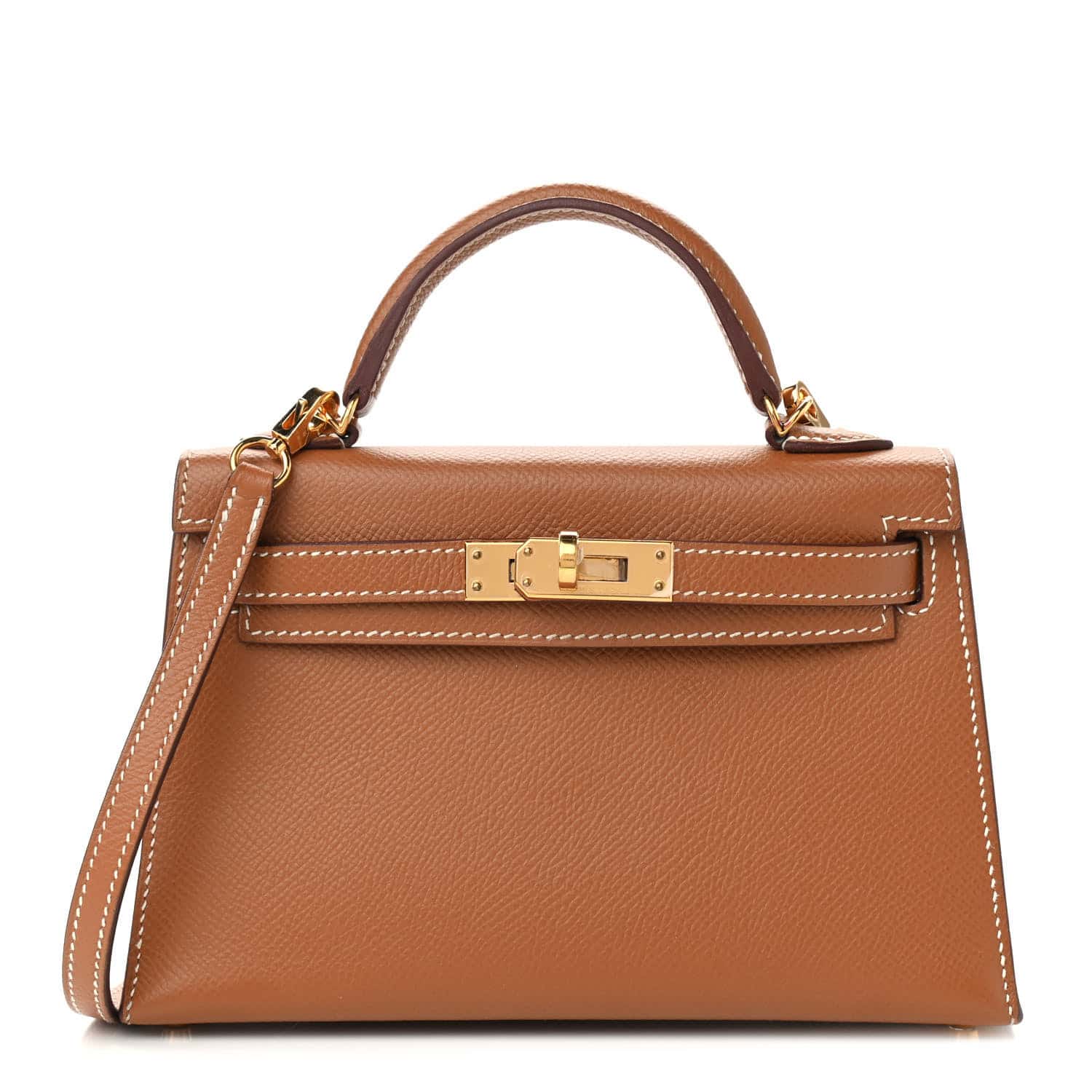
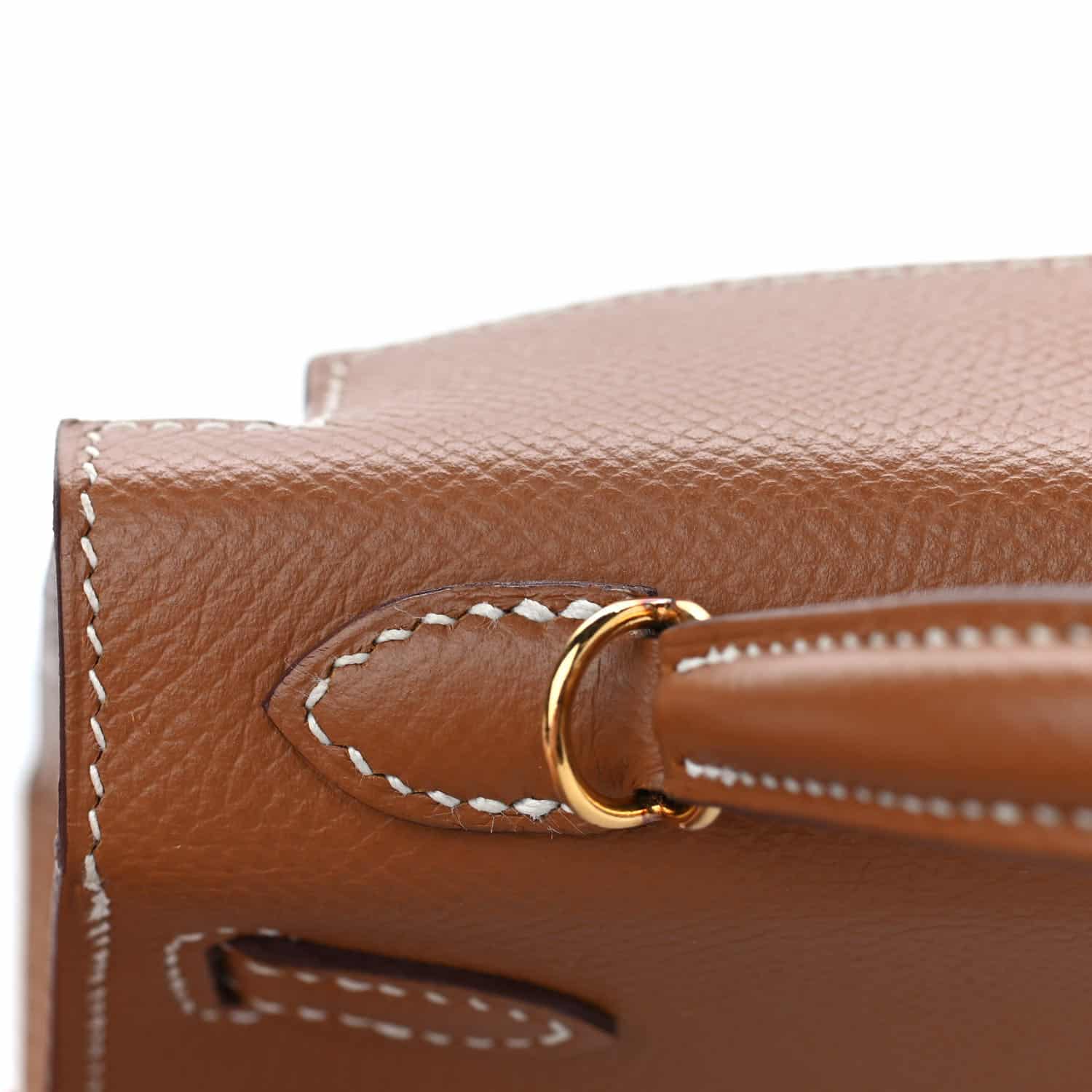
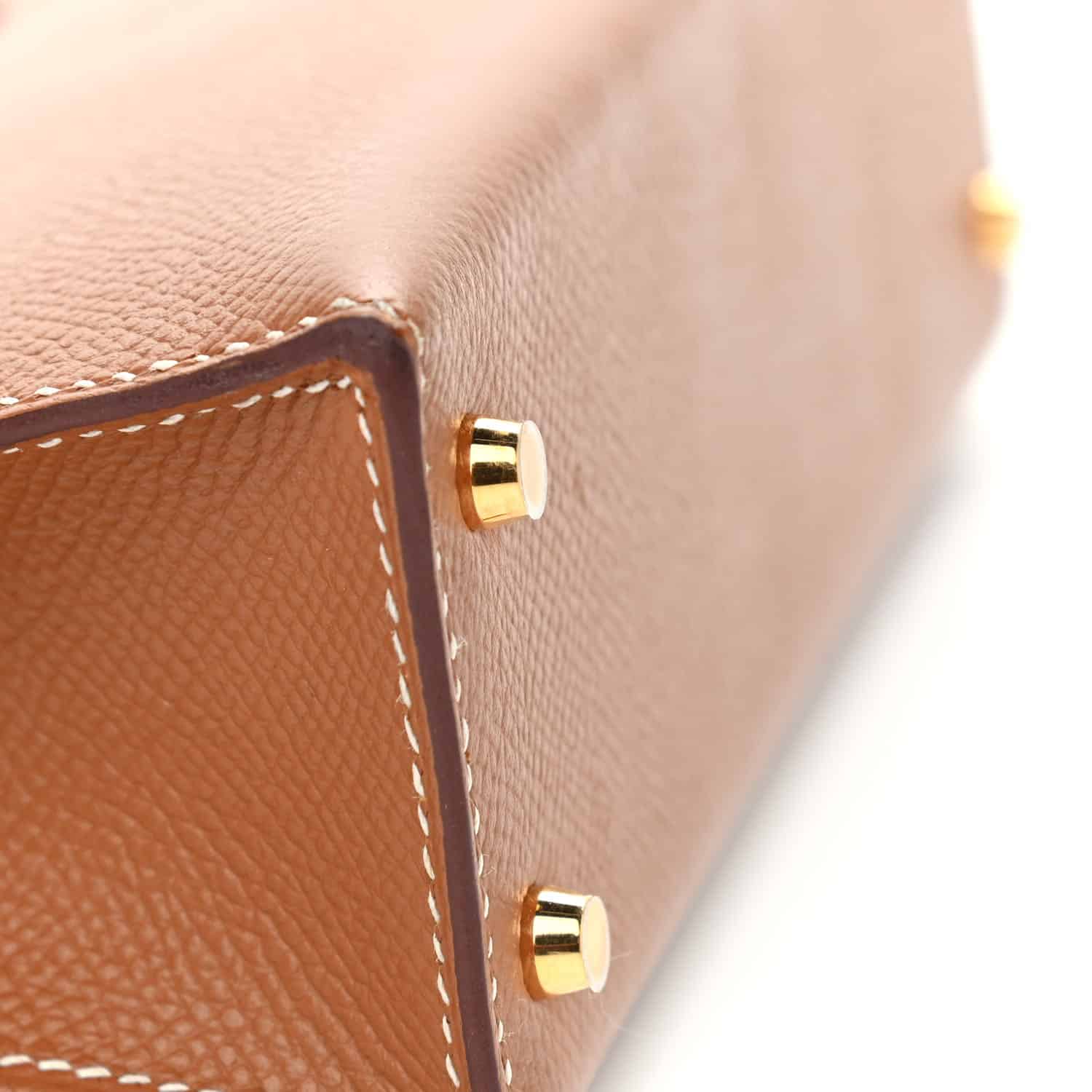
The bag from Hermès (photos taken from Sacalab) for example has several points that I really like, unlike the Birkin model:
- metal feet: you can put the bag anywhere without worrying about dirtying the leather
- Kelly bags in standard size have an extra leather reinforcement underneath the bag.
- all-leather lining: having only had bags with fabric lining, I realized that the feel is a thousand times more pleasant
- the “sellier” version of Kelly has visible stitching on the outside, which gives the bag a very appreciated rigid look
- I love the single handle of the Kelly as well as the strap attachment system. I haven’t seen such a small and ingenious system on other bags
However, the clasp and the two useless pieces of leather on the side don’t appeal to me at all, and the trapezoid shape combined with the rigid “sellier” version significantly reduces the bag’s storage space.
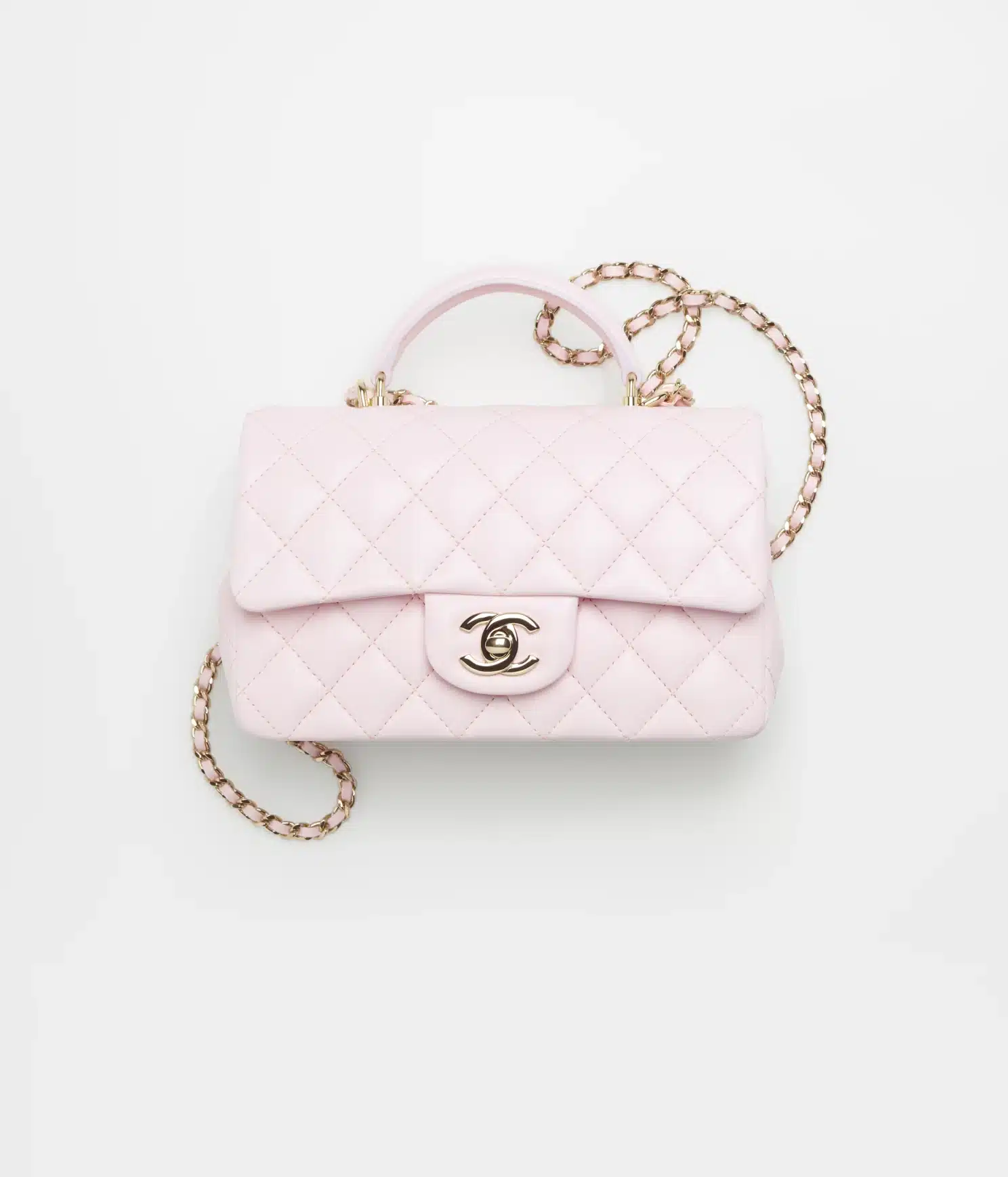
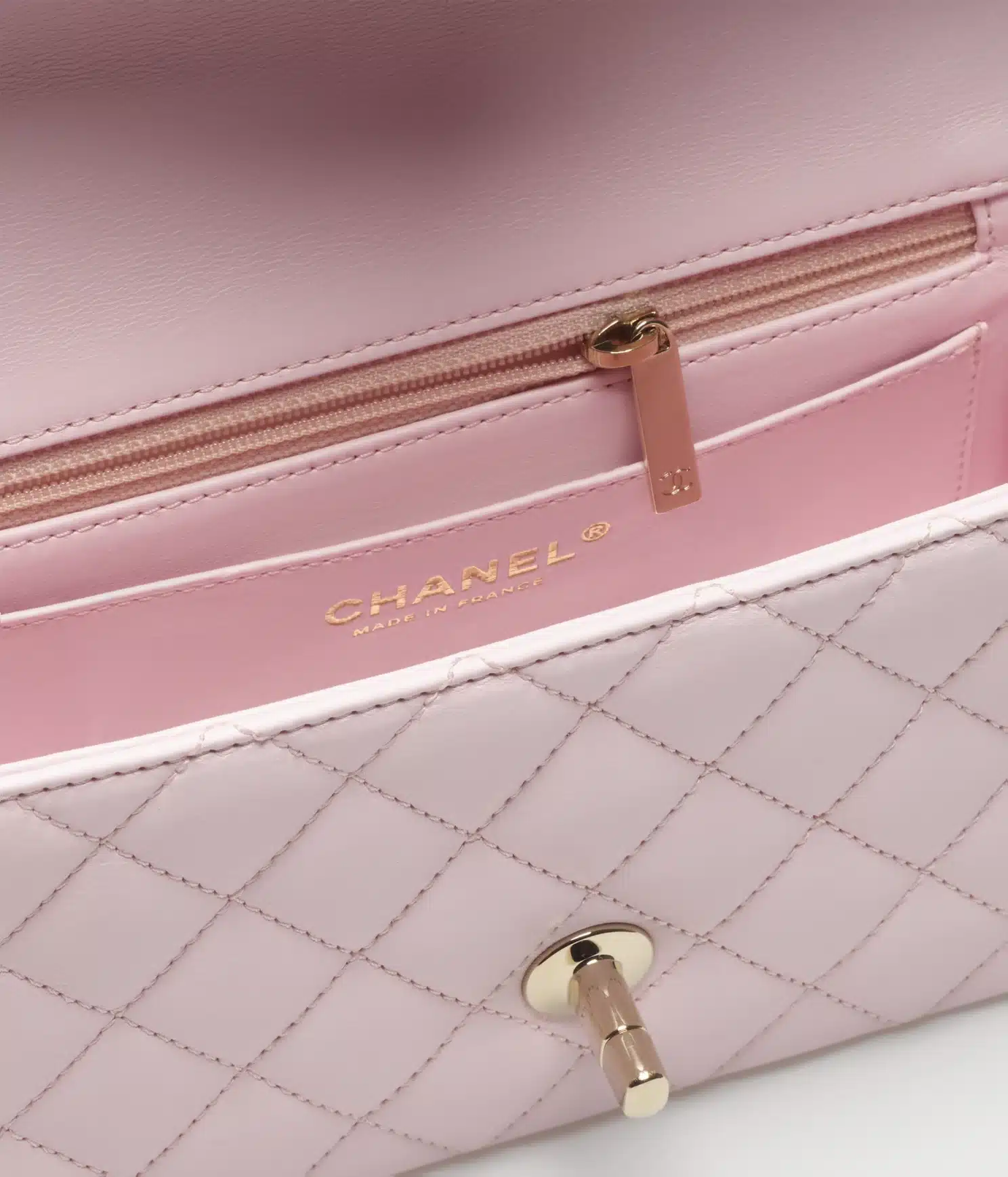
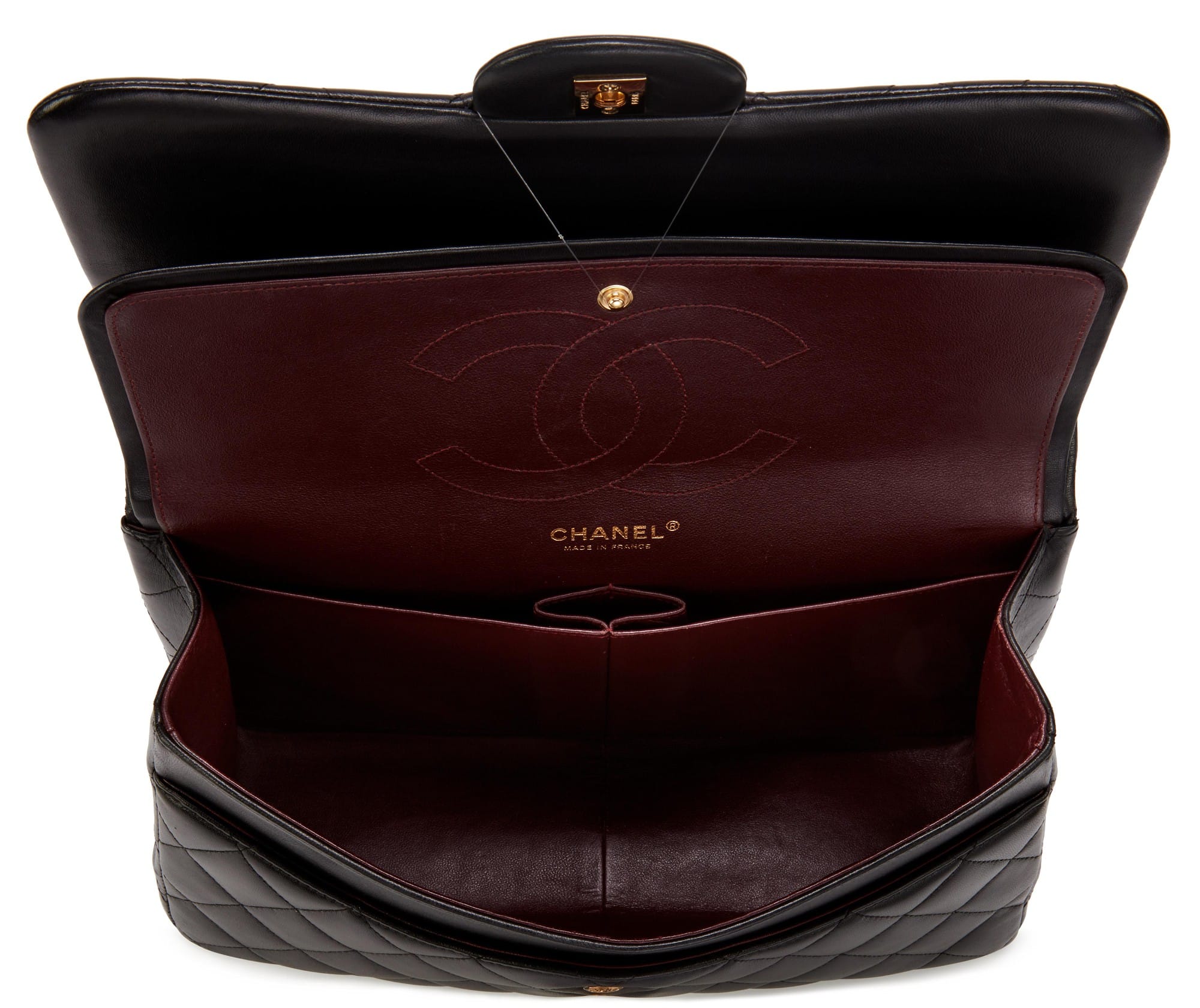
Then, there’s also the bag Mini Flap Bag with top handle from Chanel (photos taken from Chanel’s official website) that I really like
- I really like the clasp: I think it’s small enough that thieves would have a hard time opening it discreetly, but big enough to open it easily with one hand
- lots of useful pockets
- the larger version of the Chanel Flap bag contains what’s called an “omega pocket”: it’s ingenious and allows you to store a lipstick between the two small pockets
I hate its strap, which can’t be removed. Plus it’s a metal strap with a leather thread, typically Chanel, which I hate. The quilted leather, let’s not even mention it. I can’t stand it! The larger version of the flap bag has a zippered pocket at the opening of the bag, which I find very cute, but it’s there for historical reasons: Coco Chanel kept love letters in it. Most users don’t touch it, so I think there’s no point in incorporating a zippered pocket either.
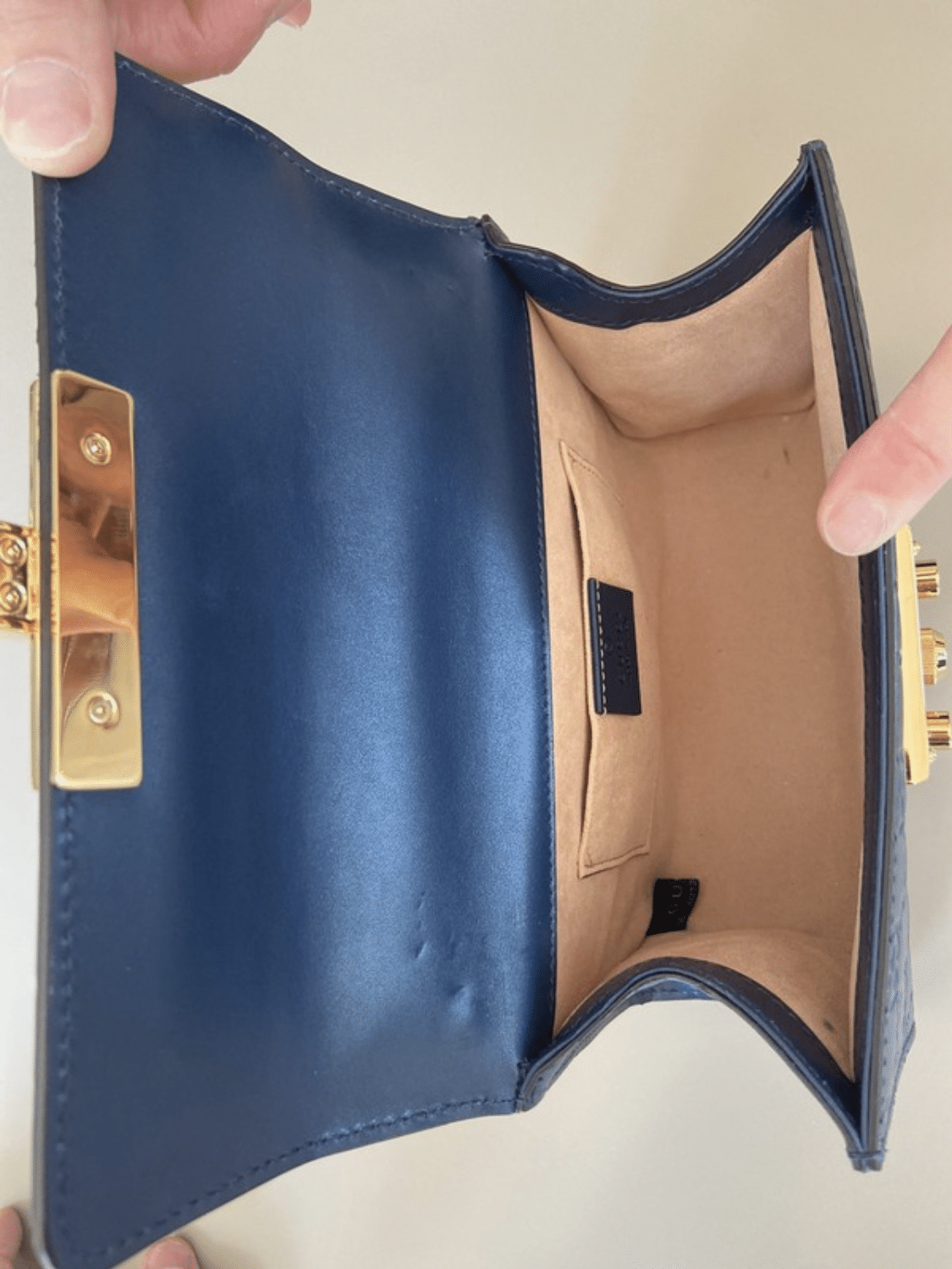
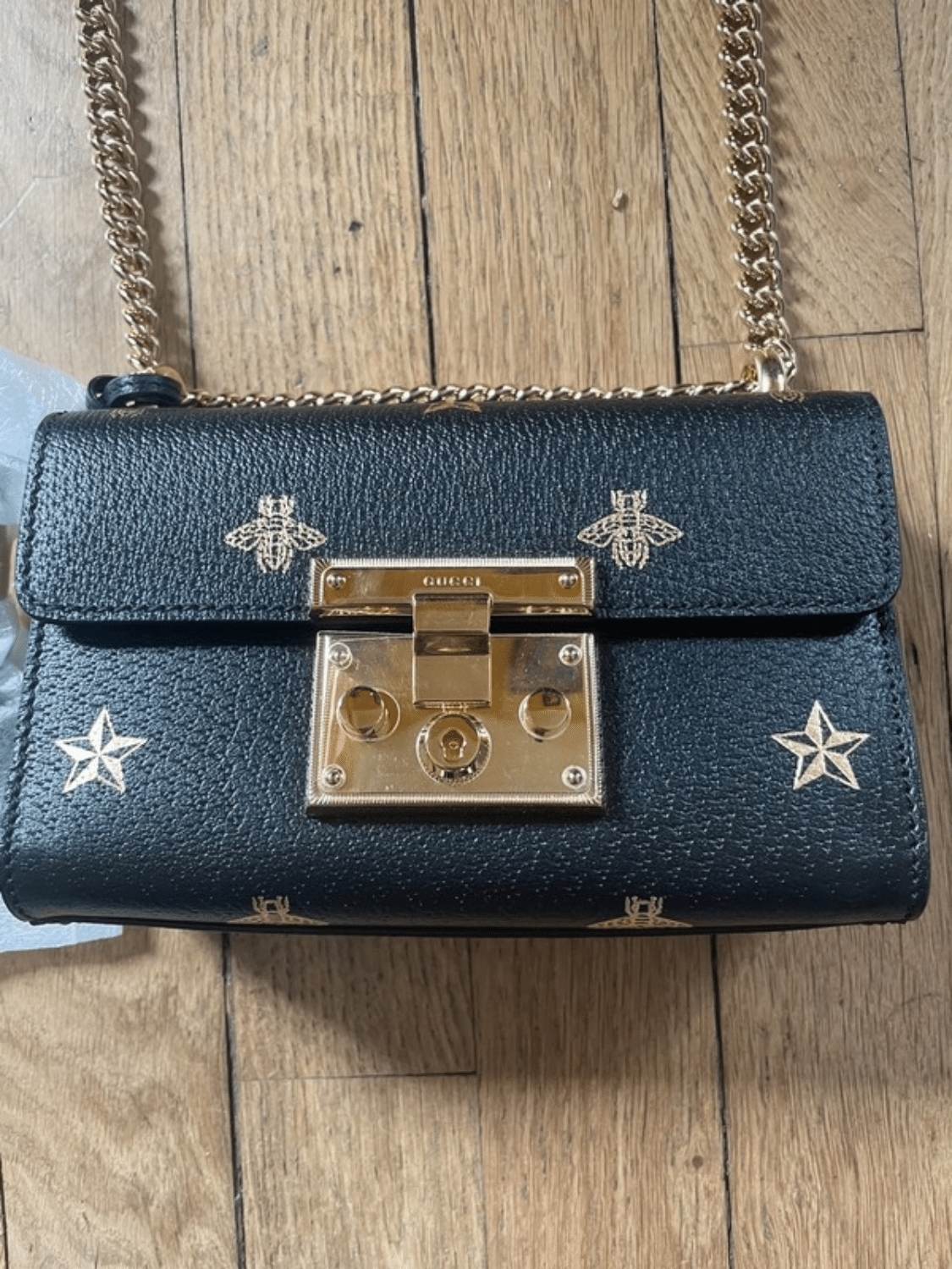
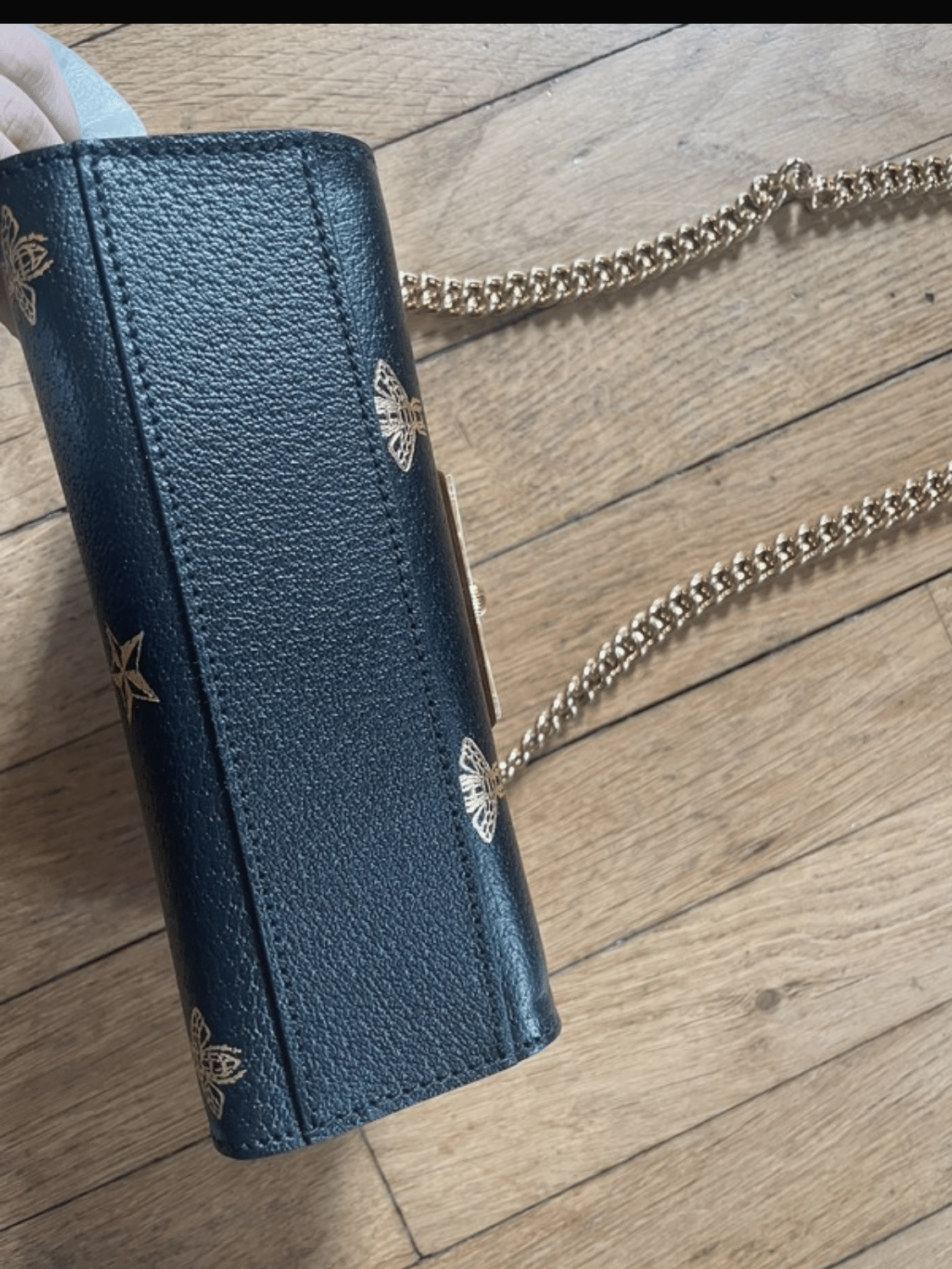
Finally, I absolutely loved the Padlock bag from Gucci (photos taken from Vinted)
- the proportions are top-notch in my opinion
- there’s tons of space. I find that this rectangular shape with a rectangular flap that opens perfectly well (unlike the Kelly bag) is ideal for clearly seeing what’s inside the bag.
- I was able to touch an authentic one at a friend’s house, and when she showed me all the items she could fit inside, I concluded the shape was great
I hate its clasp which takes up too much space physically and visually. I still can’t stand metal straps that hurt. And I like the lining leather even less.
Anyway, I drew inspiration from all these designs, spent hours on Instagram, on YouTube, looking at handmade bags by artisans from around the world. Each has their own technique, but the more you watch these videos, the more you find common steps and “standards” to respect. The more you look at good work, the better you recognize good work.
Luckily I also had my vintage Hermès passport holder as an example, from the era when the brand had better production quality. I also had as an example JB’s handmade wallet, whose quality is fully comparable to the craftsmanship of top luxury houses. I was able to closely observe these items to get an idea of what I want as a final result, and which details might bother me.
So, I advise anyone who wants to make custom leather goods to start by watching some YouTube videos to learn the main steps and to frequent luxury boutiques like Hermès, Moynat, just to look and get your eyes used to the details. That way, you’ll know which mistakes luxury houses would never have accepted 🙂
To be sure to find an artisan within your budget, before submitting your idea, first ask what their price range was for previous projects. That way, you know yours will cost between -30% and +50%.
Choosing the exterior leather
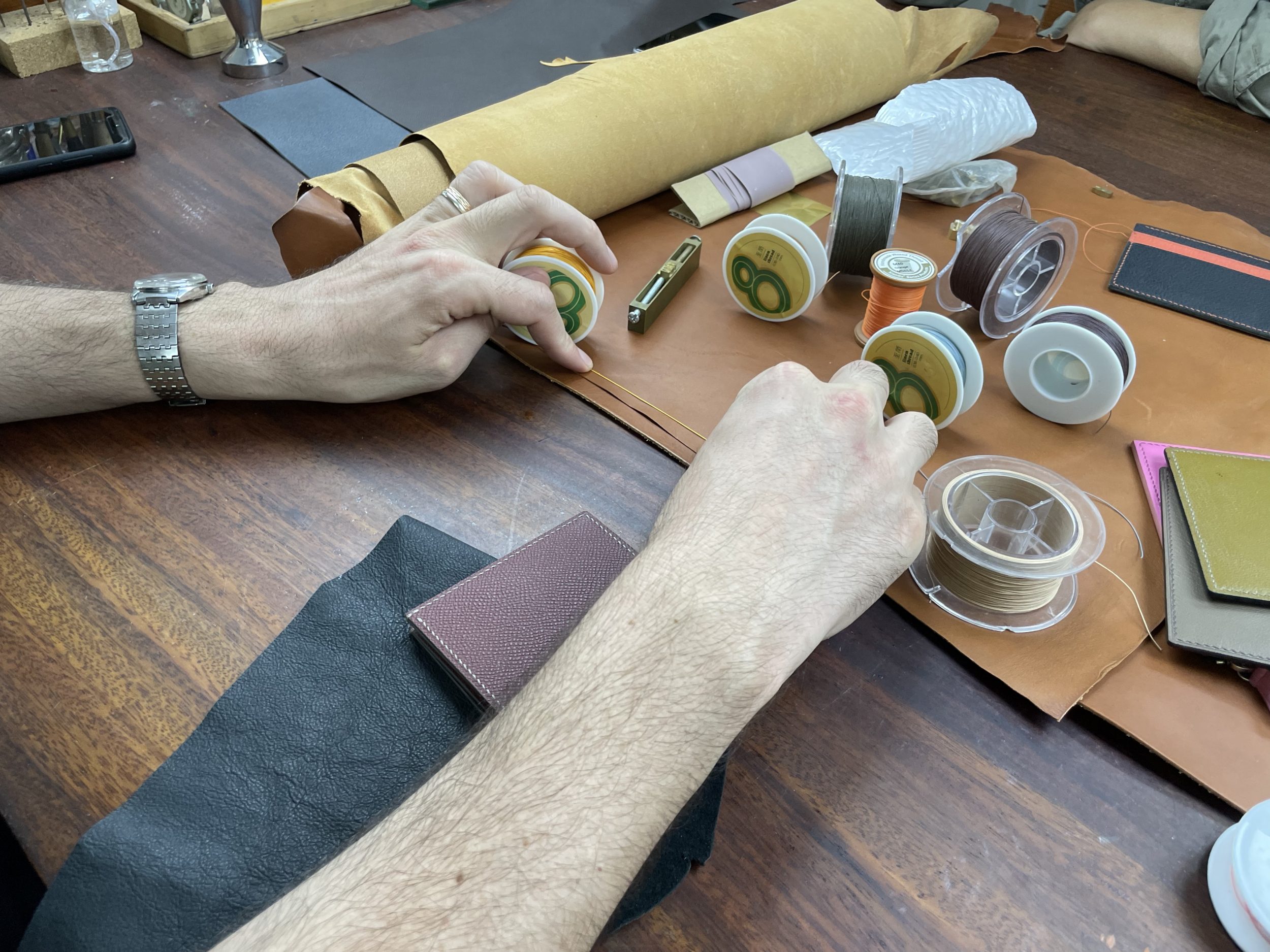
The choice isn’t limited to just this, but to sum up very succinctly, I have to choose either a smooth full-grain leather that develops a patina, or a full-grain textured leather that scratches less but doesn’t develop a patina (please do a Google search for terms you don’t fully understand because this article is quite long).
In most cases, you pick the leather after the design is done, but for me, it was the other way around.
As soon as I heard about the Barenia® leather at Hermès, mainly used for saddlery, I kept it in mind and thought to myself: this one’s for me! I highly recommend this book, which you can use as a basis for choosing your leather and, above all, for getting standards worthy of a luxury house. The book is called “Guide and codes for Hermès bags“.
One advantage of loving a signature Hermès leather is that you can find tons of pictures online of bags made over 20-30 years ago. The patina you see on Barenia® is just… out of this world!!!! Even more beautiful than the patina on my pigskin passport cover. This leather gets better with age, and Hermès bags in Barenia® are all in impeccable condition, unlike other leathers. The lucky owners of Barenia® bags are surprised that such a smooth leather can self-heal so well and are very surprised to have so few marks.
The problem with all leathers is that top-quality #1 is purchased by luxury houses.
Even though tanneries also sell their leathers to everyday people like you and me, we only get access to quality #2 at best, otherwise #3, 4, 5… Despite the instructions given to my leather craftsman, I know I will never have access to perfect leather; it will have tiny marks, tiny traces, so it’s up to the craftsman to select the most beautiful spots for cutting.
Barenia® leather (the name given by Hermès) is sold by the Alsatian tanneries Haas. A similar leather exists at Degermann under the name Novonappa or Barenil®. Barenia® is a “double-tanned calf leather nourished in a hot-air drum”. Double tanning is the signature of this leather: the first is vegetable, and the second is chrome. Thus, it is as supple as chrome-tanned leathers, but still capable of developing a patina like vegetable-tanned ones.
In France, you can call Haas and buy the leathers directly from them. The problem is they only sell from 35 skins apparently!! While I only need 0.4 of a skin.
In the end, we found some at a Vietnamese reseller: Mochi Leather. I agreed to pay for half the skin even if we won’t use it all. I keep the offcuts; he won’t be allowed to use them for his other clients.
What bothers me the most is that I’ve never been able to touch this leather before. Because this leather is so expensive and not sold as offcuts, my leather craftsman has to order a huge piece only when he needs it. So I’ve had to trust photos, descriptions, and books… to convince myself that novonappa is right for me.
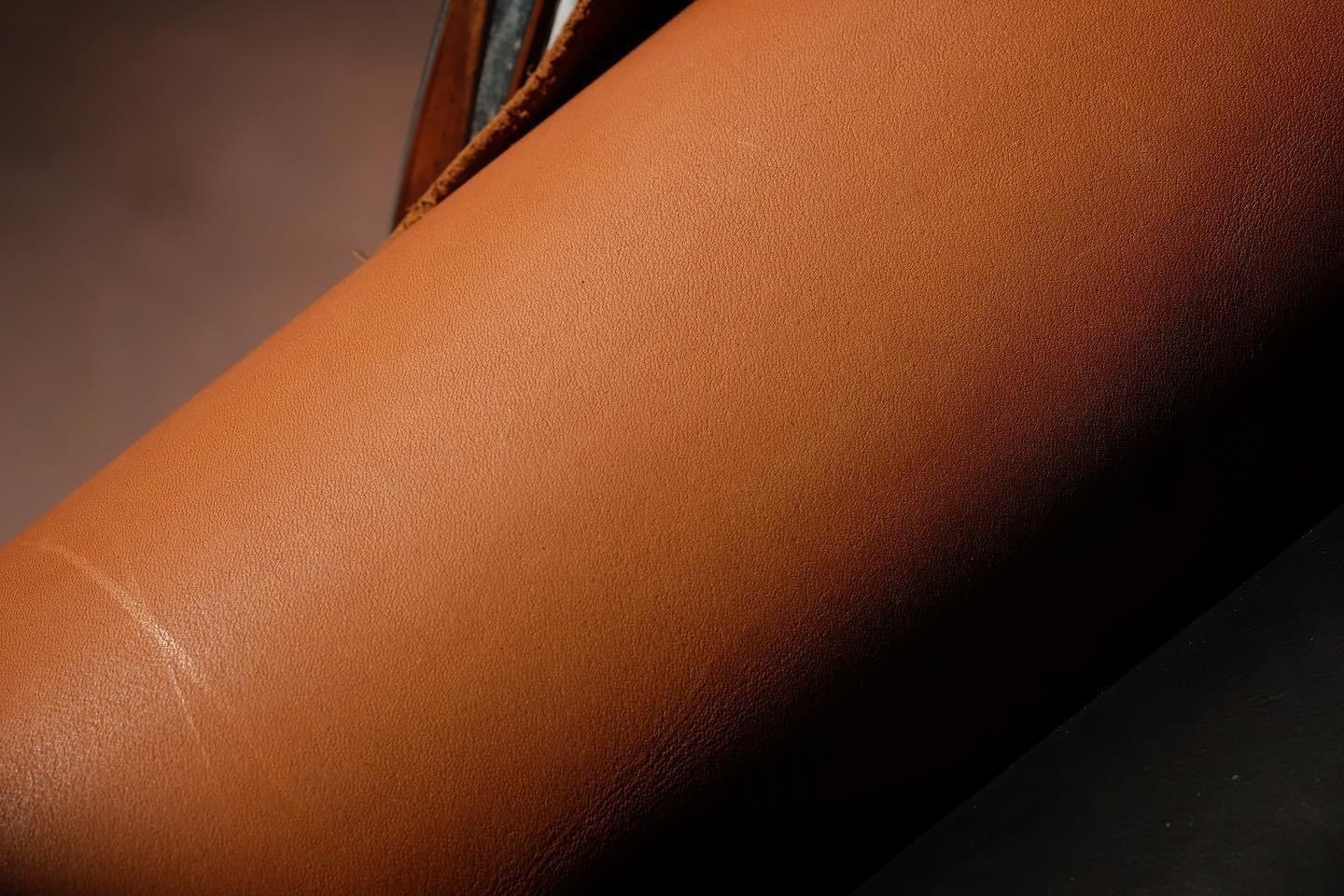
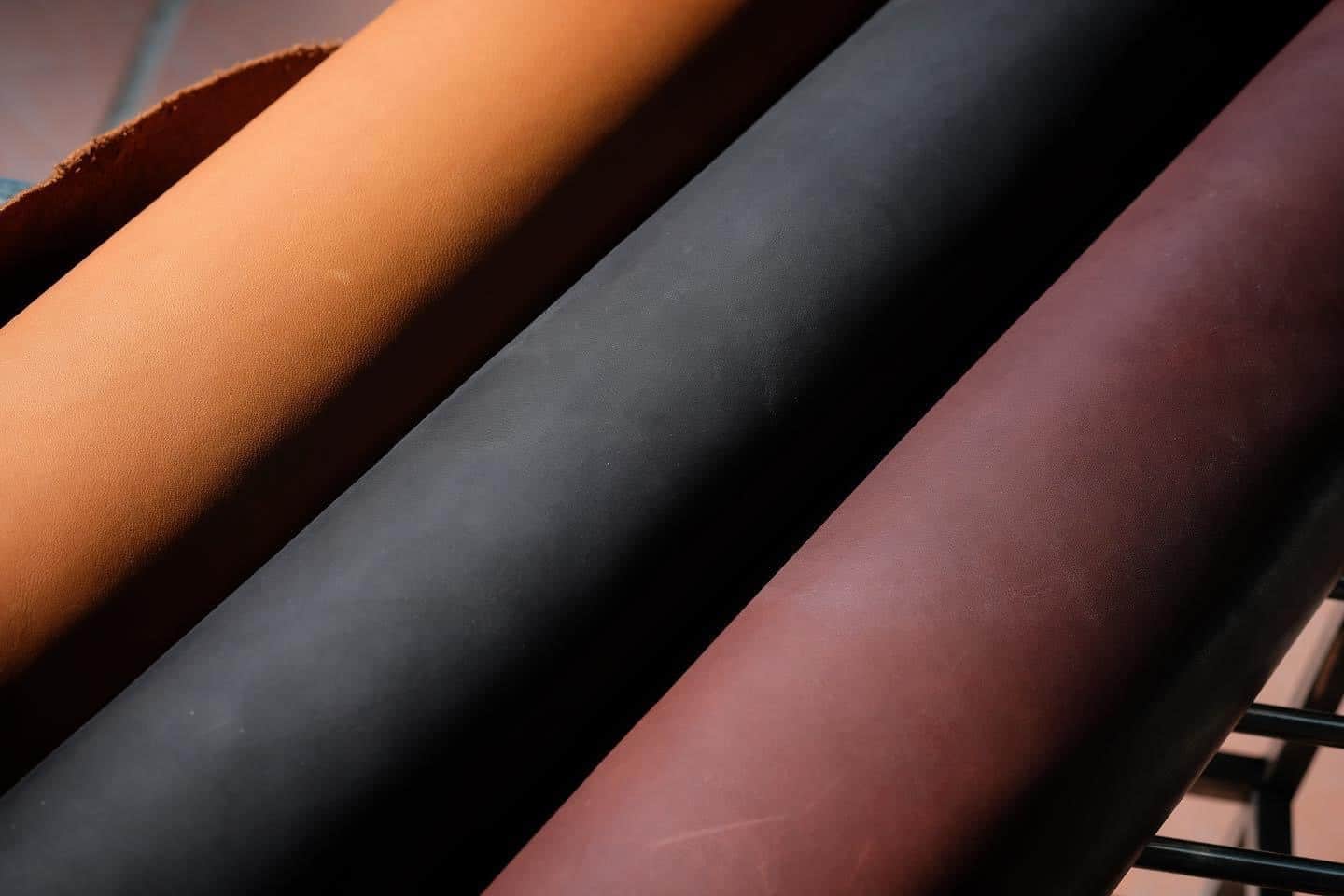
Shopping break: you can admire handmade novonappa products by artisans on Etsy (here)
My leather craftsman has already worked with this type of leather (it’s a detail but it matters because he’ll be able to advise me on the design. The choice of leather is not insignificant) and also reassures me in my choice.
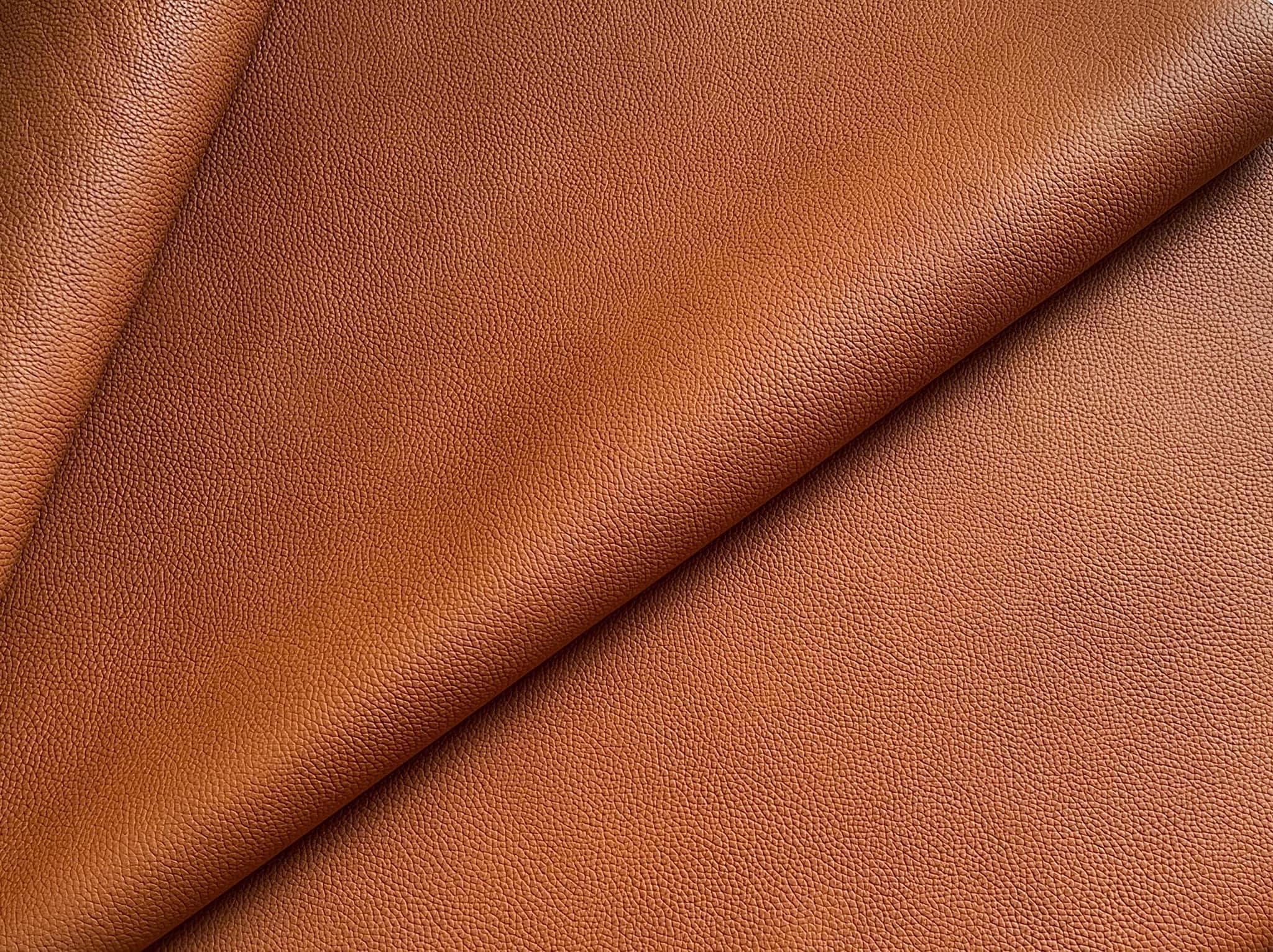
I’ll now let you look at the grained leather.
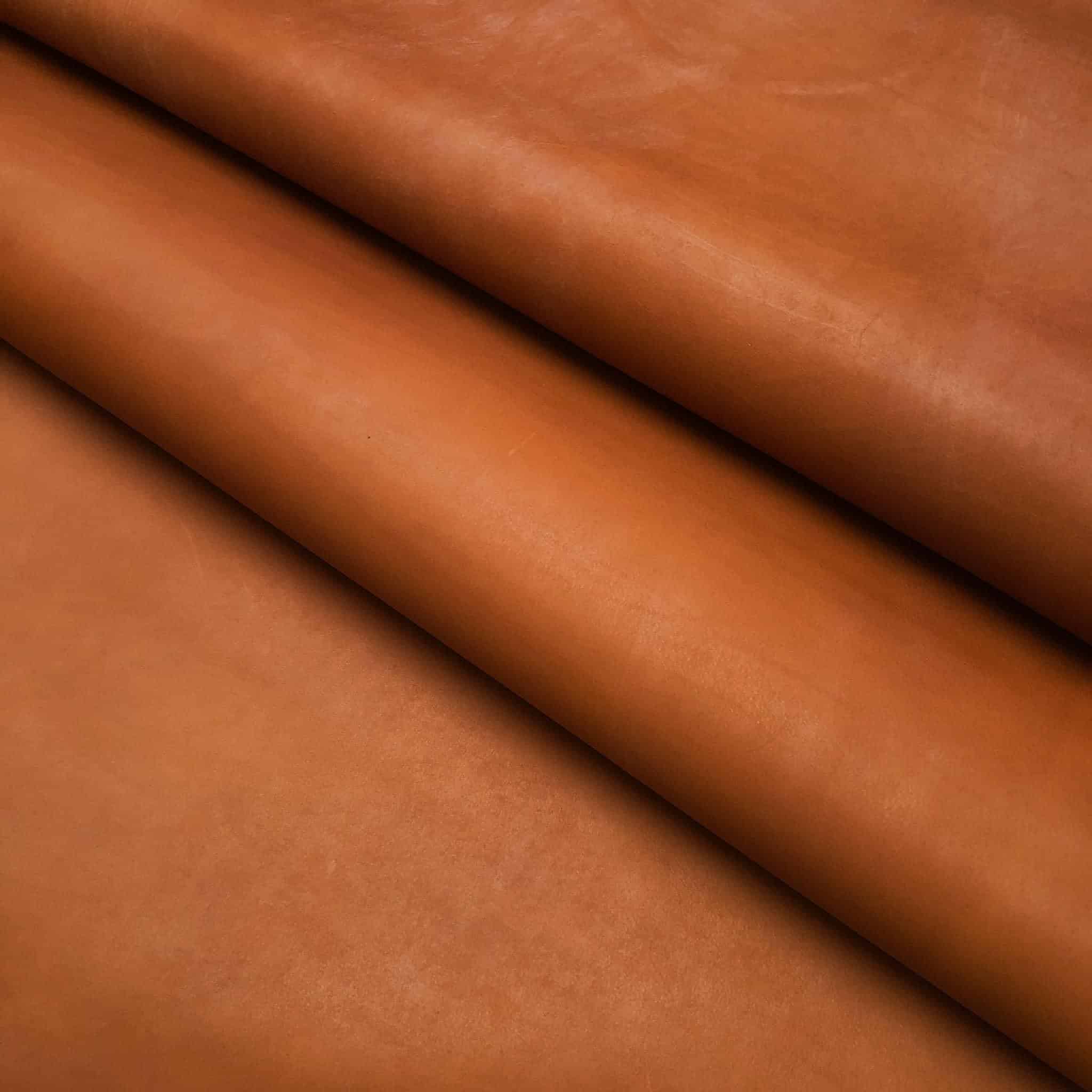
And the smooth leather. I went with smooth leather because the finish seems more natural to me. I like that the leather lives, gets scratched, has its own story.
Choosing the lining leather
Now, I need to choose the leather for the lining.
I’ve seen pictures of inserts or bag organizers, and I understood that we need a lighter-colored liningso that all the bag’s contents are immediately accessible, at least visually. A dark lining makes everything look dark and you can’t find anything.
A big fan of the tannery HaasI go with the Zermattleather, super famous there. It’s a leather mainly used for lining watch straps because it’s water-resistant. I got to touch it because JB’s watch strap is lined in Zermatt, and I love both the color and the feel. I want to use it for my bag’s lining, to make cleaning easier, I thought. Yes, with a light-colored lining, “you can see dirt more easily and feel like cleaning it all”.
But in the end, Zermatt leather is almost as expensive as novonappa. You also have to buy half the skin; it’s not possible to buy offcuts. It’s a financial sink, just for the lining, so I decided to sacrifice the Zermatt leather and opted for Sully goatskin from the French tannery Alran, as my craftsman advised. I find it unfortunately darker than Zermatt.
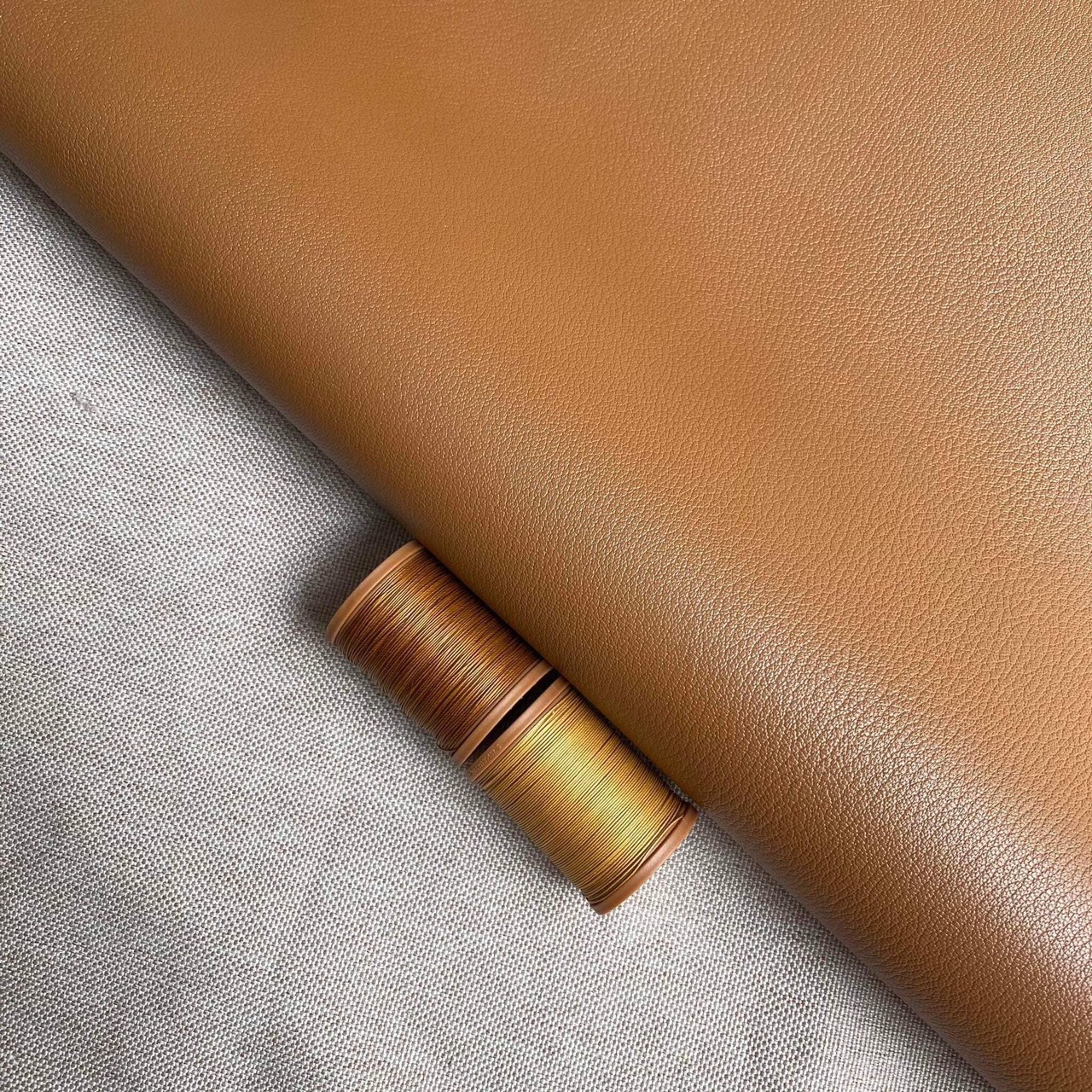
Luckily, between the time he finishes the prototype and the time I return to inspect it, the biggest Vietnamese luxury leather supplier 3Q Leather has a shipment of huge Zermatt offcuts from the Haas tannery, and I was able to stick with my initial idea without spending a fortune.
Note: In Vietnam, there are two luxury leather suppliers (excluding exotic leathers): Mochi Leather based in Ho Chi Minh City and 3Q Leather in Hanoi. As a result, buying leather is pretty easy since the choice is limited to two suppliers. Easy. I pay everything to my leather craftsman, who then buys from these suppliers. Both sellers ship internationally.
Choosing the clasp
I knew I wanted a bag with a clasp. A clasp that you open and close, not a magnetic clasp, which I find less safe (against pickpockets) and puts pressure on the leather every time you open the bag. I could see this leather deformation around the magnetic clasp every time I opened my Le Tanneur bag, so I came to the conclusion: “no magnetic closure”.
No visible zipper for a shoulder bag either. I almost got pickpocketed in Barcelona with a zip-up bag. Since then, I know the safest would be to have a bag with a clasp and zipper. My bag will have both, but I’m not paranoid enough to complicate my life with this double closure system. I want a nice design and practicality: the zipper will be small and only inside.
However, for the clasp, my leather craftsman advised me to choose it first. That’s what will determine the size and proportions of the bag. To do this, he simply gave me his suppliers’ websites. Better to choose from existing options than to imagine a clasp. A custom clasp would have been too expensive.
I told him I wanted “the best of the best” because this bag needs to last me 10, 20 years. It’ll be my only bag. There’s no way I’ll throw it away or send it for repairs because of poor-quality metal parts. So my craftsman gave me “luxury” suppliers. The choice is plentiful, he says, the problem is how far I can go 😀
Choosing the clasp is extremely difficult because there are too many options. I knew I wanted gold-colored leather so a silver-colored clasp will suit me better. It’ll be less flashy.
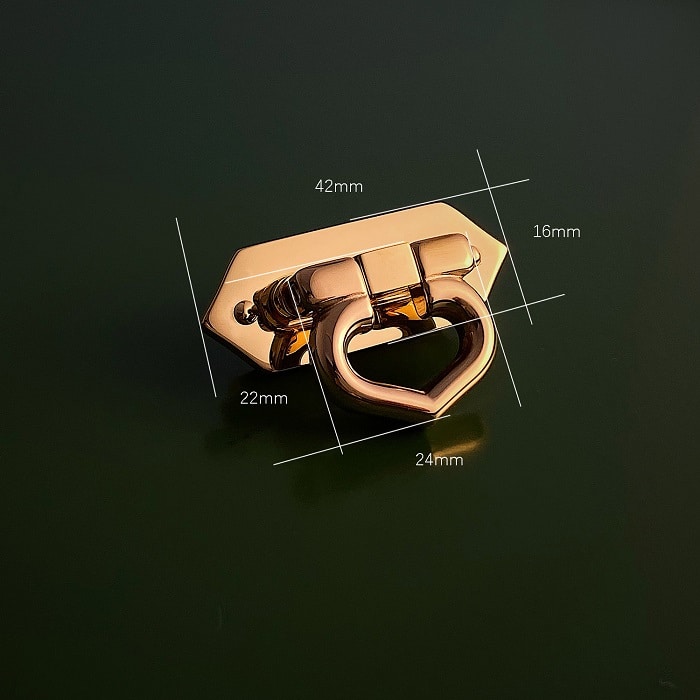
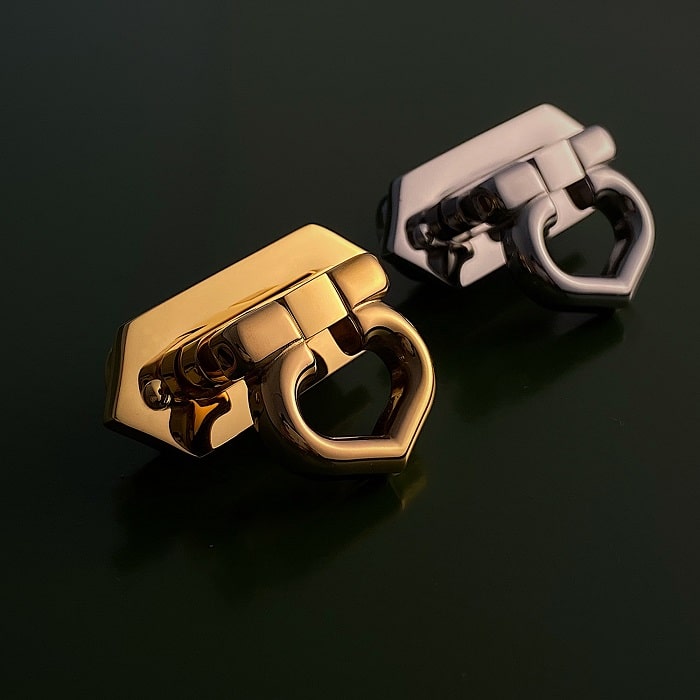
The suppliers are very creative, some have already worked with an engraverto turn a boring clasp into a work of art.
Other suppliers even work with jewelers to make custom clasps, or cover them in diamonds. But we don’t have the budget for that. Calm down, calm down. Just the clasp cost me €40!
Once you have the clasp, the other metal parts are chosen with great ease. I really liked the metal feet, handle, and strap of the Kelly Mini bag, so I asked to buy almost the same ones—they’re steel, non-oxidizing. They come from 3Q Leather.
However, there was a big hesitation about the zipper closure. The zipper is an American invention, brought to France with exclusive use by Hermès. It was then called the “fermeture éclair” (éclair being a brand). Now Japanese YKK dominates the market, but Swiss Riri is used by luxury houses. We hesitated between using YKK Excella (YKK’s high-end product) and Riri. My craftsman recommends YKK Excella.
The design
The bag design is the most important and time-consuming part.
This part occupied my mind for weeks, invading my nights, my dreams, my nightmares. I thought about it constantly.
Among backpacks, shoulder bags, handbags, crossbody bags, waist bags, etc., I know I’ll go for a bag with a detachable crossbody strap and a handle. The crossbody strap is the most versatile and safest option for me, since I often forget my stuff wherever I go. The handle is for design and also for carrying the bag by hand.
So having that precise choice in mind already limits the possibilities. Phew.
As soon as I see an item, a detail I like, I pin it, I note it, I screenshot it, I try to incorporate it into my bag… there are so many little details I like, so many designs that speak to me, that my bag, in my head, is like a patchwork of everything I’ve seen and looked up.
So I had to work on versions 1, 2, 3, 4… imagining how to open the bag, how to close it, how it will look when I’m standing, sitting, when I set it on a chair, when I’m looking for my passport, when I pull out my smartphone… But the most important thing is to imagine the main uses and the items you carry with you:
There are three main scenarios for me:
- I go out sightseeing: I’ll bring my Osmo Pocket, my Insta360 Go 2, my iPhone 12 mini, and a card holder. How do I make sure each has its own spot, and that I can take them out and put them back without emptying the bag?
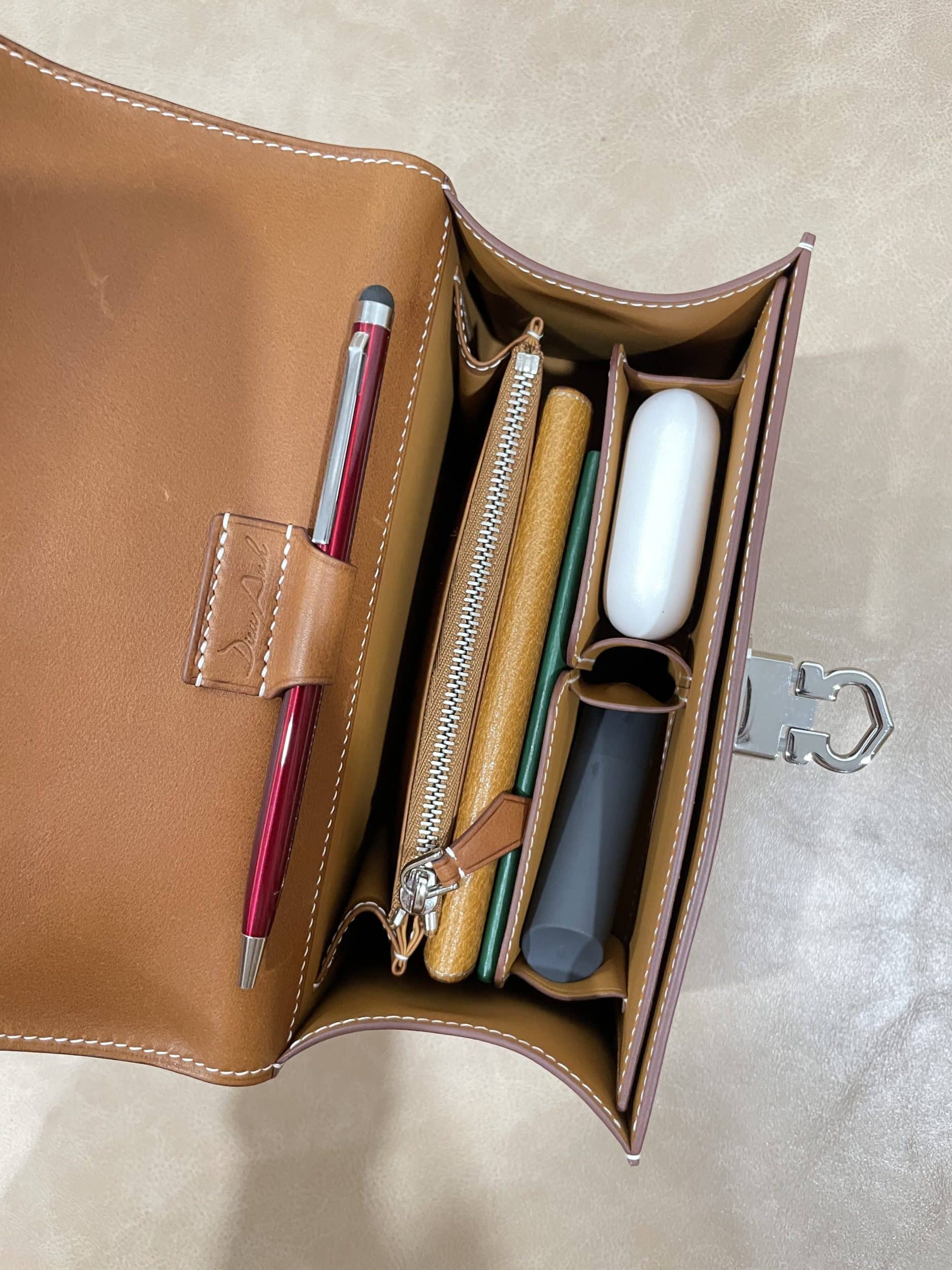
- I fly: I need a separate compartment for my passport (which is in its leather passport holder—I have no desire to scratch it), my iPhone, my AirPods Pro, and a pen (to fill out forms on the plane). The pen must be stored horizontally so the ink doesn’t accidentally leak.
- I’m in Paris (lol, that’s a whole different situation): I’ll open my bag minimally, and I need quick access to metro tickets. My valuables need maximum protection in case of pickpocket attacks (hence the need for a zipped compartment anyway). I’ll have keys with an AirTag.
For those wondering why my life just boils down to going out and traveling, reread the title of this blog. I’m a digital nomad, I work remotely, in my pajamas, in front of my computer, so when I go out, it’s just to eat, sightsee, or fly.
Imagining all these situations helped me determine the bag’s size, the storage pockets, and their dimensions. The pockets must have multiple uses: for example, able to hold an Insta360 Go 2 but also keys… (even though they have completely different dimensions).
It’s often recommended to build a cardboard mockup at full scale to get a sense of (1) the bag’s size (2) how practical the bag is.
I didn’t have to do that because it’s my leather craftsman who will validate the design for me, and he’s the one who’ll make the mockups, but I did draw the bag full-size on my tablet to get a sense of its size and proportions. I took out the things I want to put in the bag and laid them on the mockup to see if there’s really room for them. You need to account for an extra 1cm on all sides (width, height, length) because you need room to dip your fingers in and pull the item out.
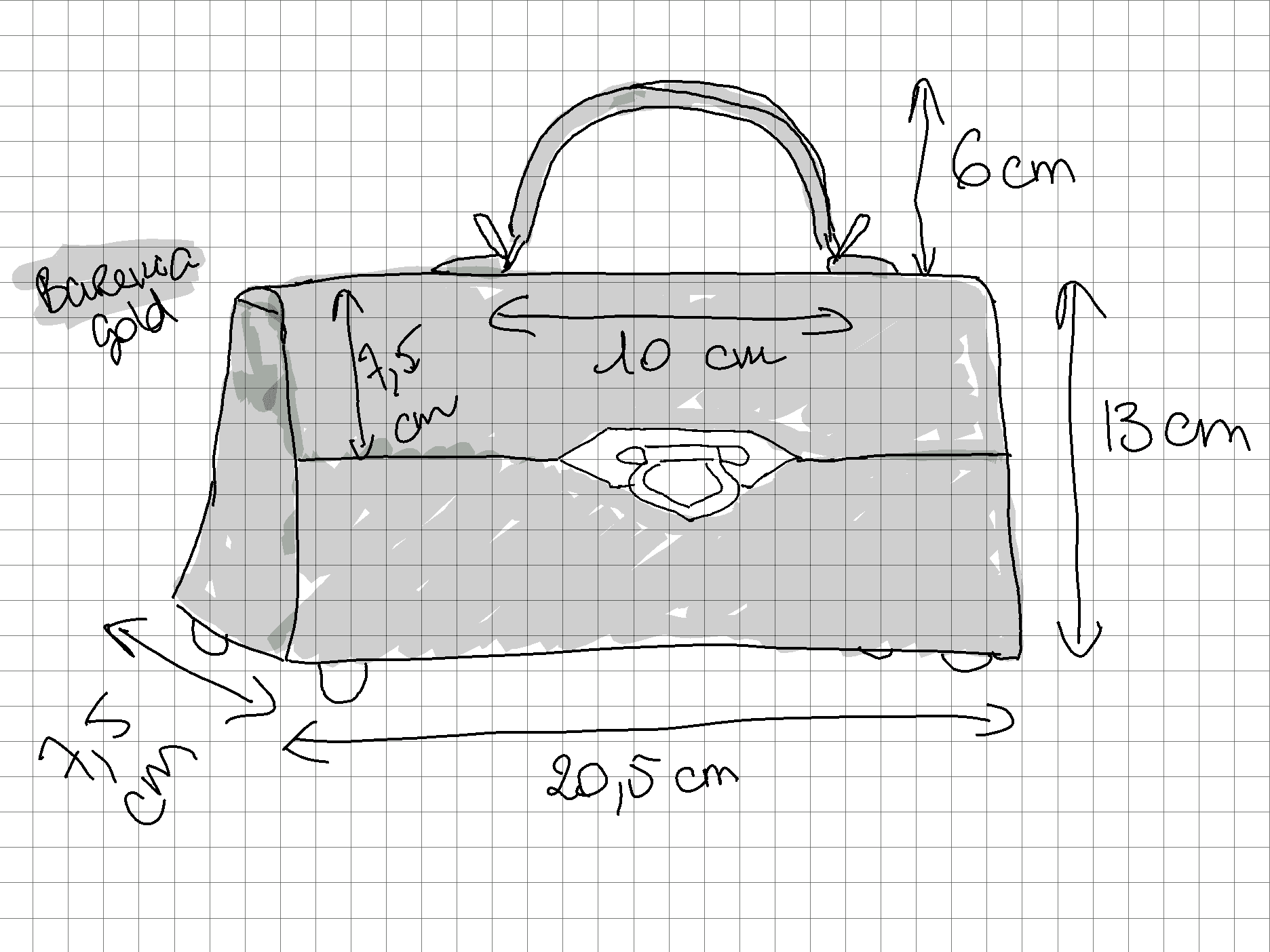
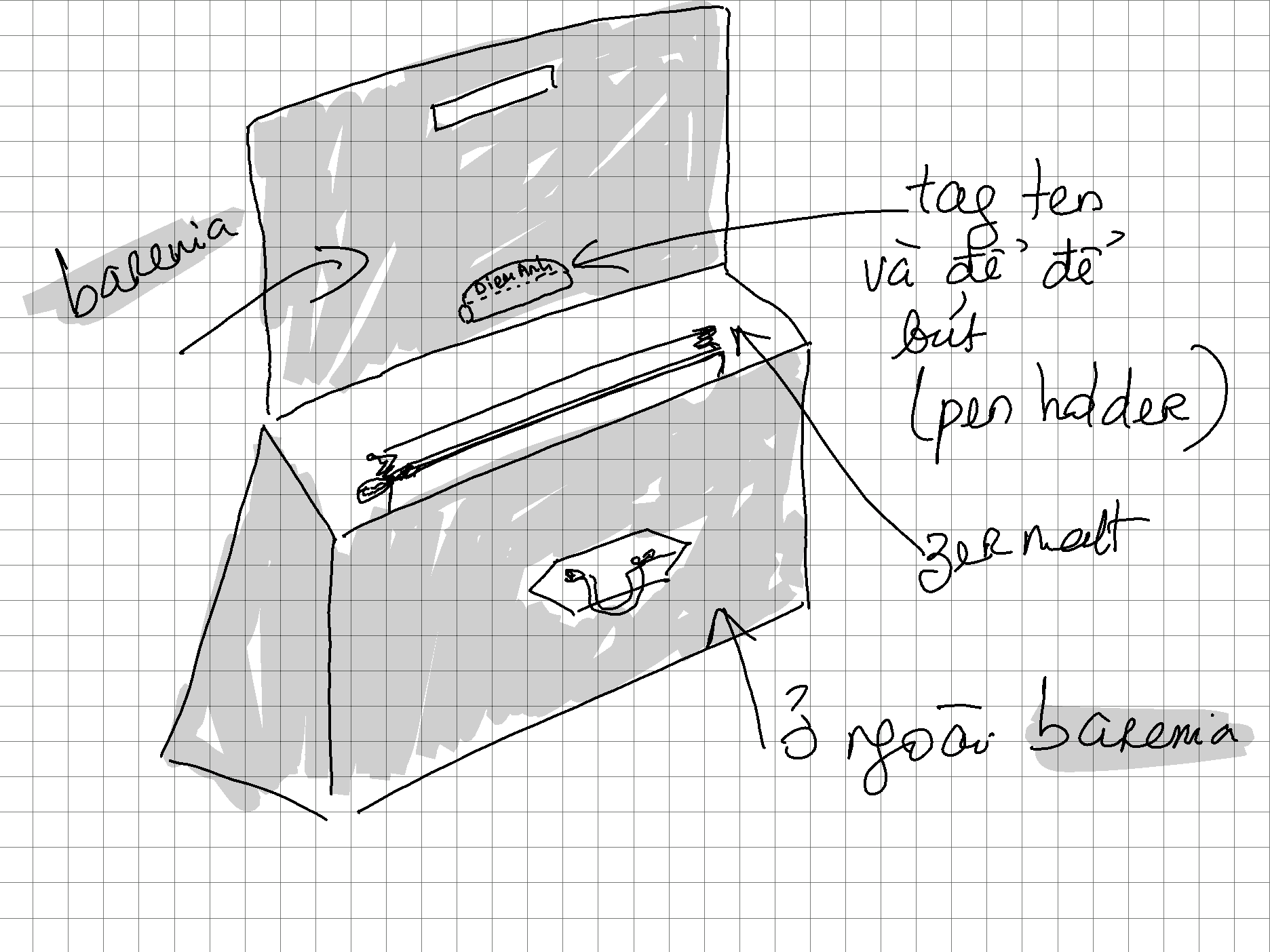
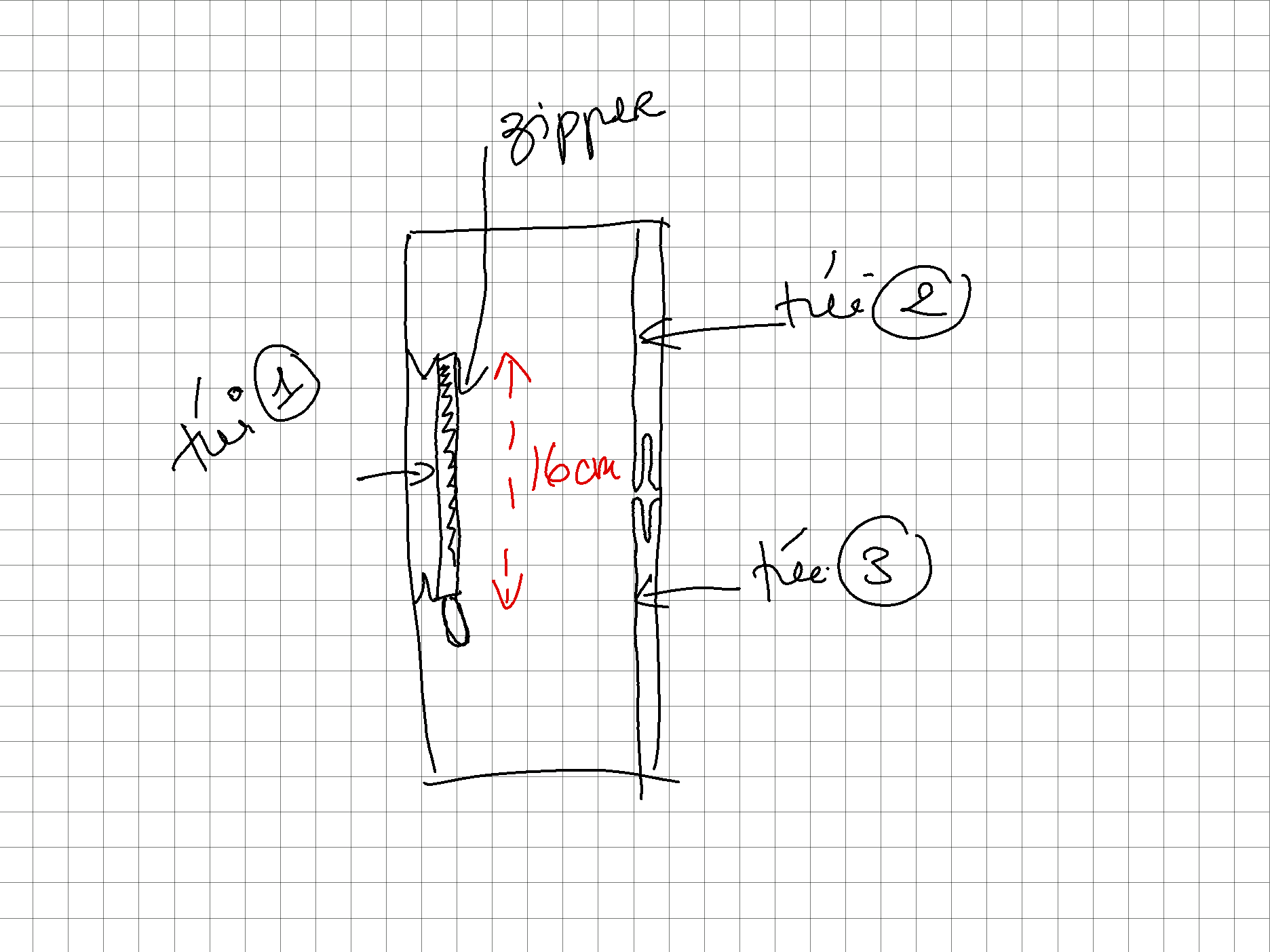
I saw that it was important to give the craftsman as much information as possible. Not to leave things to chance or to “common sense,” because what’s “common sense” and standard for me isn’t necessarily standard for someone else. So, apart from the very very explicit drawings, here are the points I passed on to him:
- name of the exterior leather + name of the tannery + name of the leather color + grained or smooth (then he handles the leather thickness himself because I’m not an expert, you know)
- name of the lining leather + name of the tannery + name of the leather color + grained or smooth (then he handles the leather thickness himself because I’m not an expert, you know)
- which part uses the Novonappa and which part uses the lining leather
- the entire bag must be lined, including the pockets
- the precise dimensions of the bag
- the precise dimensions of the handle and strap: I’m small and can afford a small handle (not very tall) and a shorter strap, so I need exact dimensions, not an adjustable strap (I’m not going to grow anymore anyway). Then, the strap can be adjustable if you tend to wear very bulky coats in winter. In my case, I really don’t like adjustable straps, I don’t find them “made-to-measure” enough, so I found the length that works with all my clothes, summer and winter
- the opening direction of the zipper. I’m right-handed and like to be able to open the bag, then unzip with my right hand. So the zipper must open from left to right (from my point of view). It’s admittedly a small detail, but I noticed that zippers on Hermès bags open the other way, and that would have annoyed me
- I hate having a handle that moves. My Tory Burch bag is beautiful, but its handle falls every time I wear the bag crossbody, and it annoys me every time. Luxury is in the little details, especially in bag handles. My handle must be very round, very plump, and must not move. My craftsman will have to spend a lot of time building that perfect curve.
- all pocket dimensions + the dimensions of the items I want to put in them (or at least the names of the items if they’re well-known, e.g., AirPods Pro, iPhone Mini 12…)
- the bag’s stance: I want my bag to stand up on its own, and it’s important for me to specify that to the craftsman. That’s why it also has a leather reinforcement at the bottom, in addition to its 4 metal feet.
- the bag’s stiffness: the craftsman can add layers to strengthen the leather, so that’s a detail not to overlook. I can’t do floppy bags.
- Little details:
- all the little details that make my bag unique: all the little pieces of leather (zipper, handle base) must echo the shape of the clasp….
- Where should I put my first name, silver or gold? Or simply engraved? Even though there’s a good chance I’ll be the only one using this bag, I also like the idea of being able to pass it on to someone I love. So, my first name will be engraved on a piece of leather that can be detached, or a piece of leather can be glued over it to hide my name, without affecting the bag’s design. I’ve been inspired by Hermès again, which has a special spot on the Bolide bag for exactly that.
- where the stitching will be: I really like the rigid look, again, of the Kelly “sellier”, so I want my bag to have as many visible exterior stitches as possible.
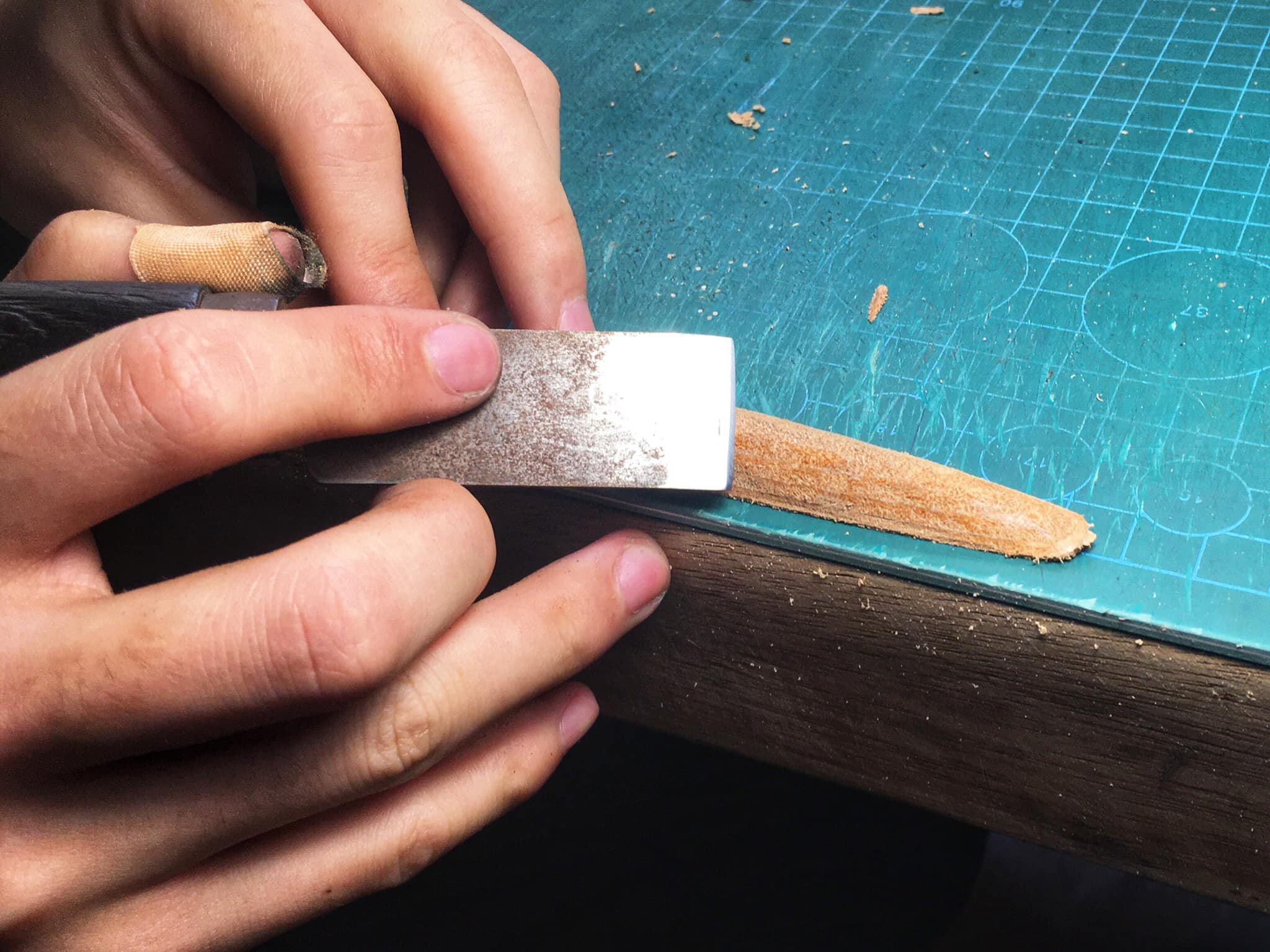
- the color of the thread: the thread has to contrast with the leather to stand out more. Yes, what’s the point of having handmade stitching, the “point sellier”, if the thread is the same color as the leather, no one will see it. On the contrary, I want connoisseurs to spot the point sellier from miles away. The most meticulous will even specify the size of the stitching (the space between two saddle stitches).
- the edges: this step is called “astiquage”. I like a flat finish, not a rounded one. A finish that’s too rounded annoys me because it looks very “industrial”. I really like the burgundy color but very dark.
- when multiple layers of leather are sewn together (especially at the edges), it can create too much thickness and it gets ugly. So it’s not unnecessary to ask the craftsman to thin out the corners of the leather (paring) for elegant, not too thick edges. I think this is a detail that sets luxury products apart from others.
The process
- I communicate all these details to my leather craftsman
- He contacts suppliers to get a precise list of what’s available and at what price
- He comes back to me with a budget estimate: materials (he doesn’t mark up) + labor.
- I pay him a 70% deposit
- He buys all the materials
- He creates a first digital mock-up. The dimensions are more precise than my brief because he takes the seam allowance into account. I can give feedback.
- He then creates a full-size cardboard mock-up and will give me feedback on my design. I can give feedback.
- He quickly makes a bag in leather (with his own leather) at full size. This is the essential step to finally validate the model. I can give feedback.
- The production of the bag with real luxury materials begins. There’s no turning back
- The bag comes with a multi-year warranty. I get the leather scraps, which I keep or use to make items that match my bag… my choice.
This whole process will take between 2 months and 2.5 months. I’ll update this post when the bag is finished.
Budget estimate
It’s very detailed, it allows me to see where I can save money
In my case, 30% of the budget is just for materials. 70% is for labor.
| Label | Unit | Price per unit | Total price |
|---|---|---|---|
| Novonappa leather | 12 square feet | 25,42€ | 305€ |
| Zermatt leather (Haas Tanneries) | 5 square feet | 12,3€ | 61,5€ |
| Metal feet & rings for the handle | 1 | 102,5€ | 102,5€ |
| Clasp | 1 | 37,72€ | 37,72€ |
| YKK Excella zipper, size 3 | 1 | 10,25€ | 10,25€ |
| Metal elements for the YKK Excella zipper | 1 | 6,15€ | 6,15€ |
| Labor | 1 | 902€ | 902€ |
| 5% discount | -71€ | ||
| TOTAL | 1353€ |
Project progress
The leather craftsman takes several weeks to buy all the accessories. The clasp I wanted is out of stock, so we looked at other alternatives. He sends me the two mock-ups so we can agree on the shape and dimensions:
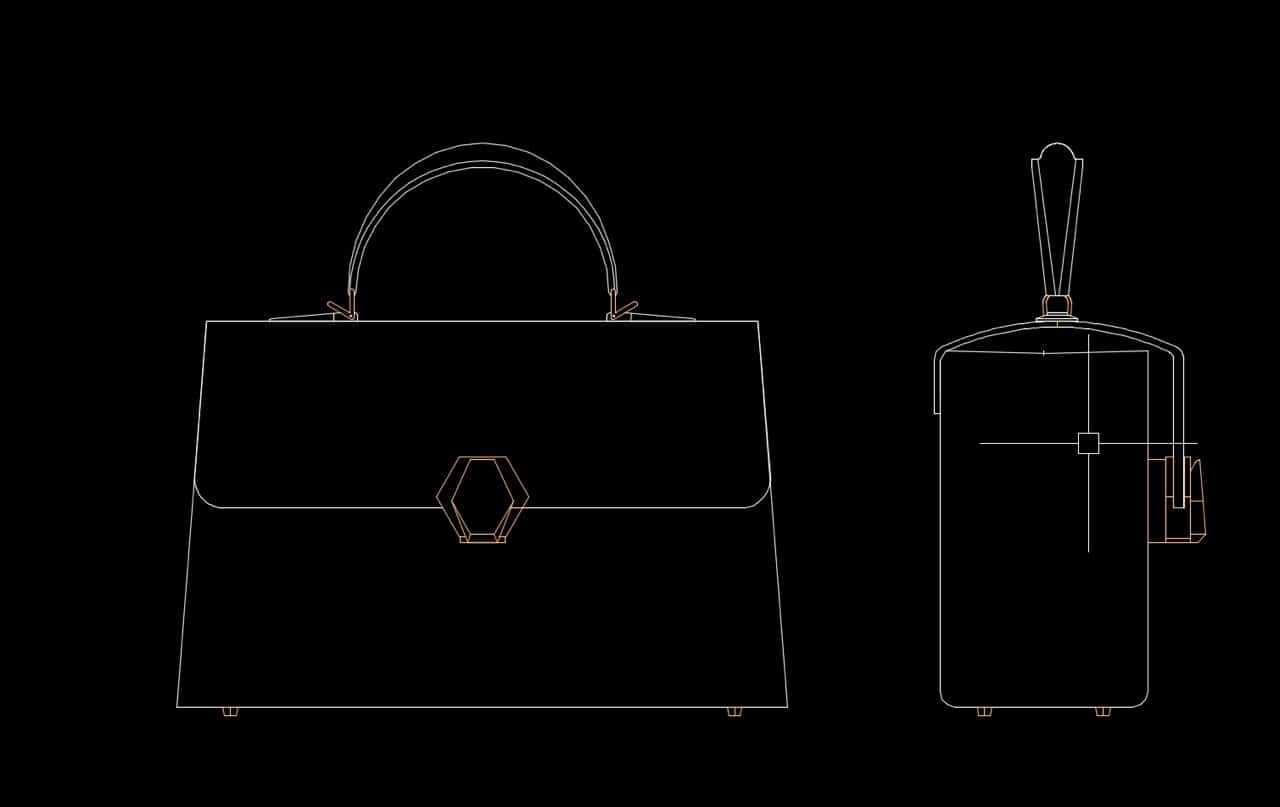
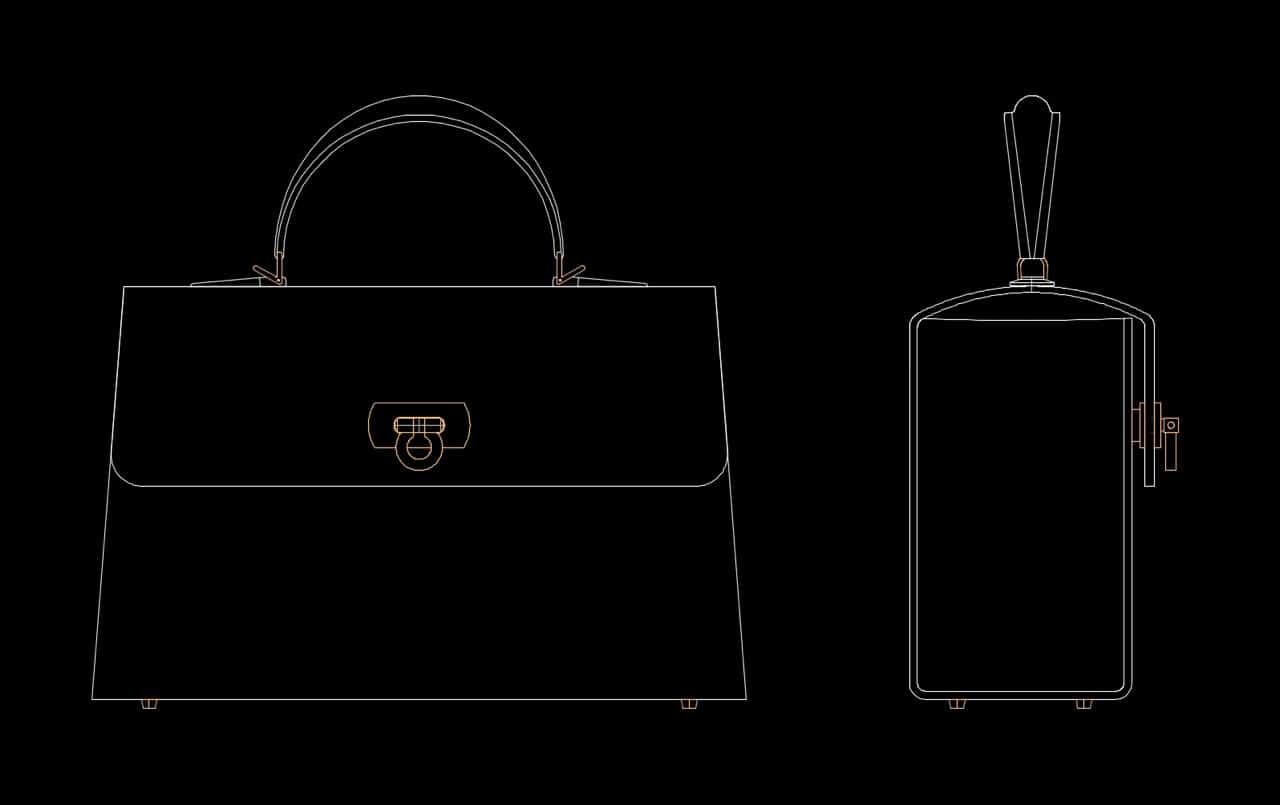
However, I prefer my clasp and had to use a mail forwarding service to have it shipped from China.
Here are photos of the prototype, made in a similar leather (vachetta). The craftsman took time to create the template, but mainly to study the thickness of each part of the bag and the parts that need reinforcement.
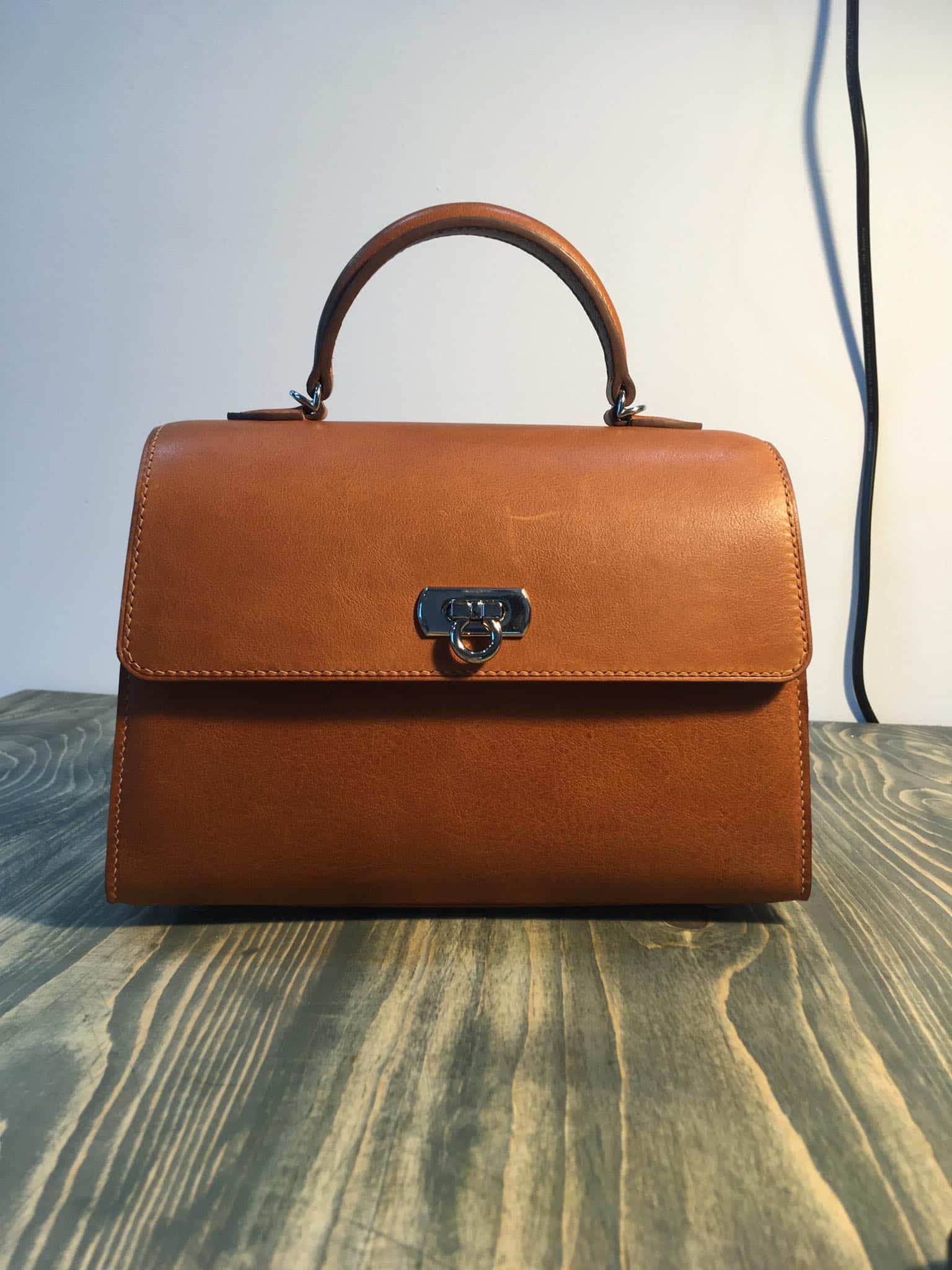
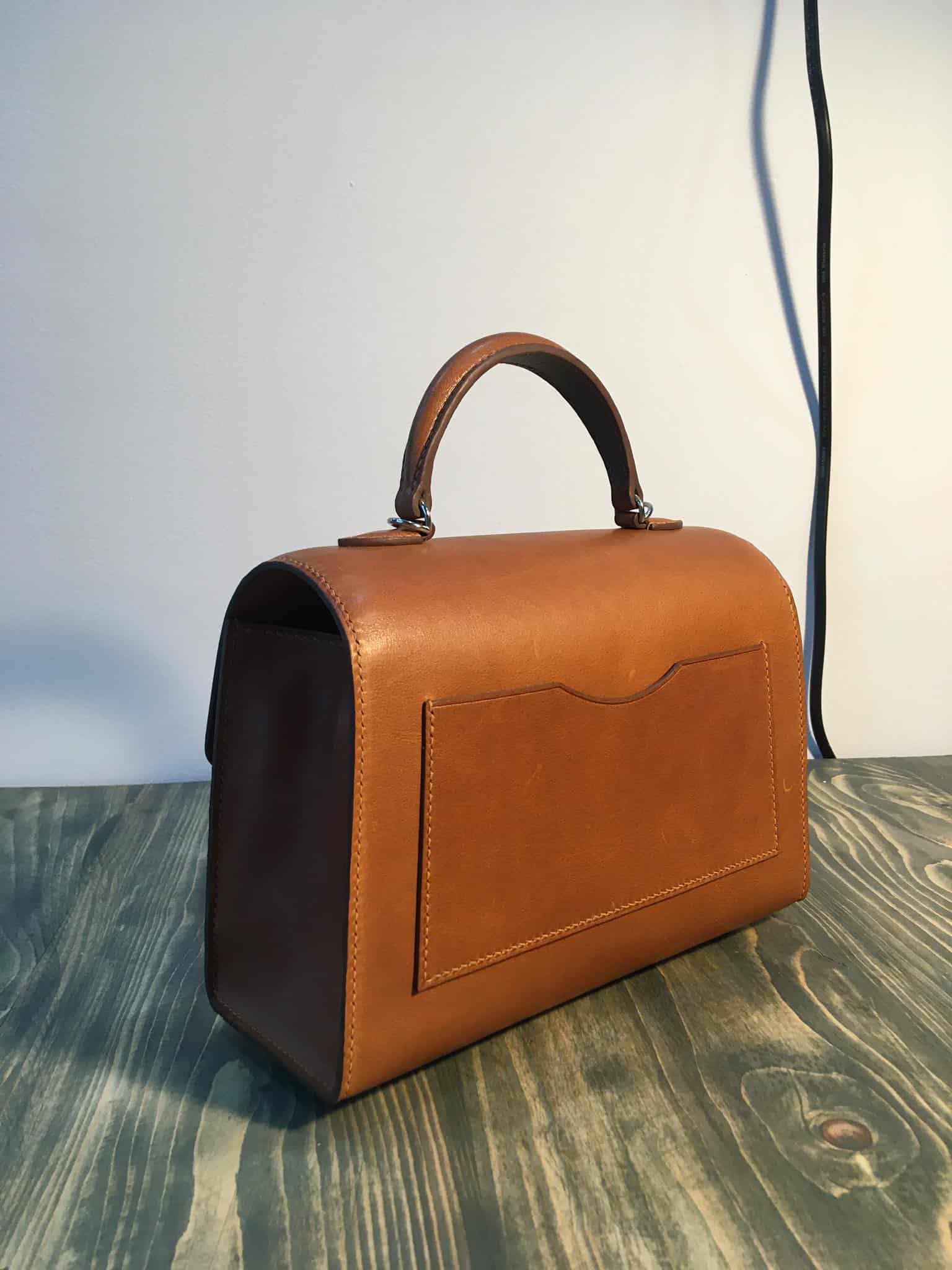
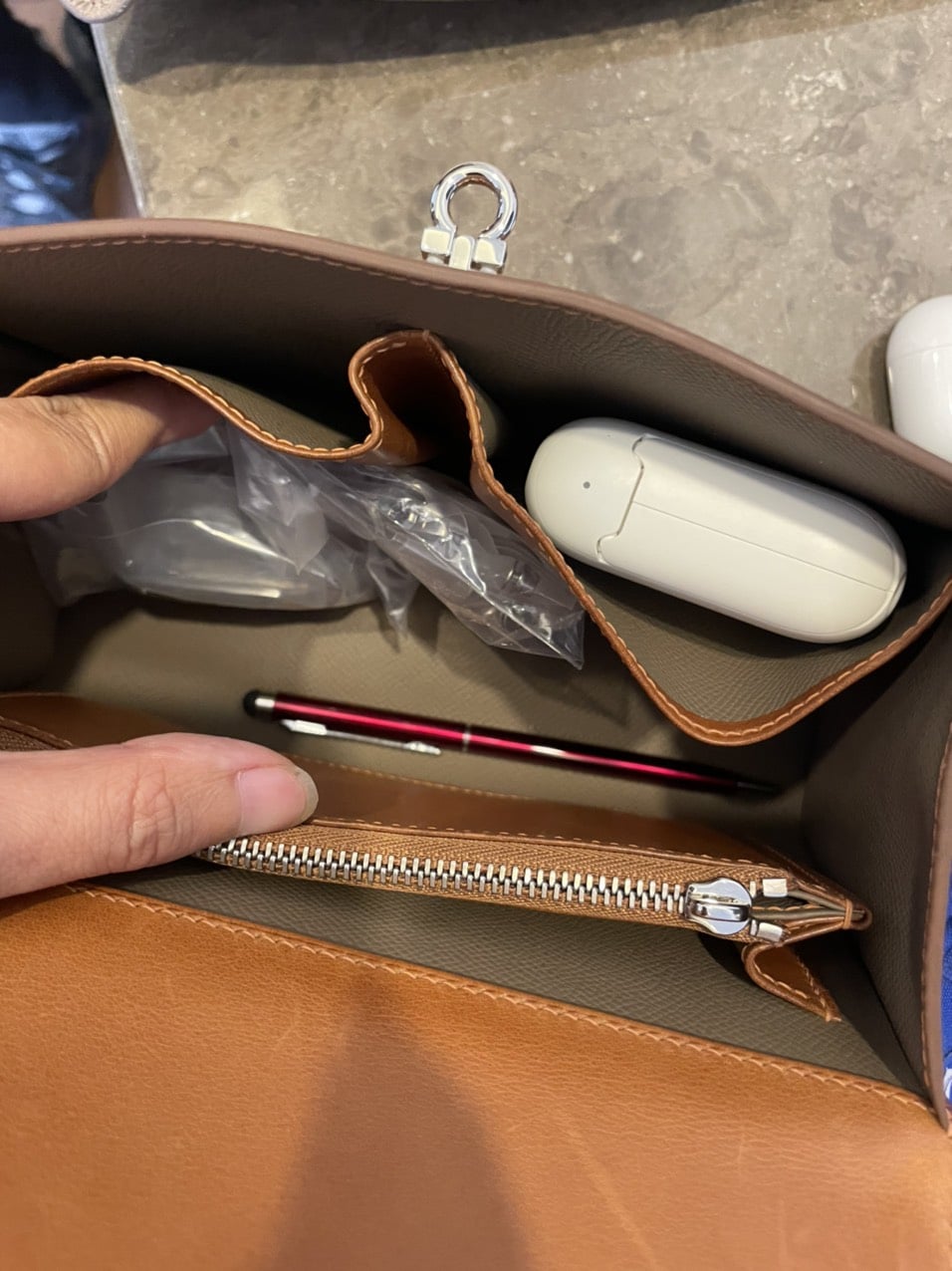
The overall shape is good and the exterior dimensions are perfect.
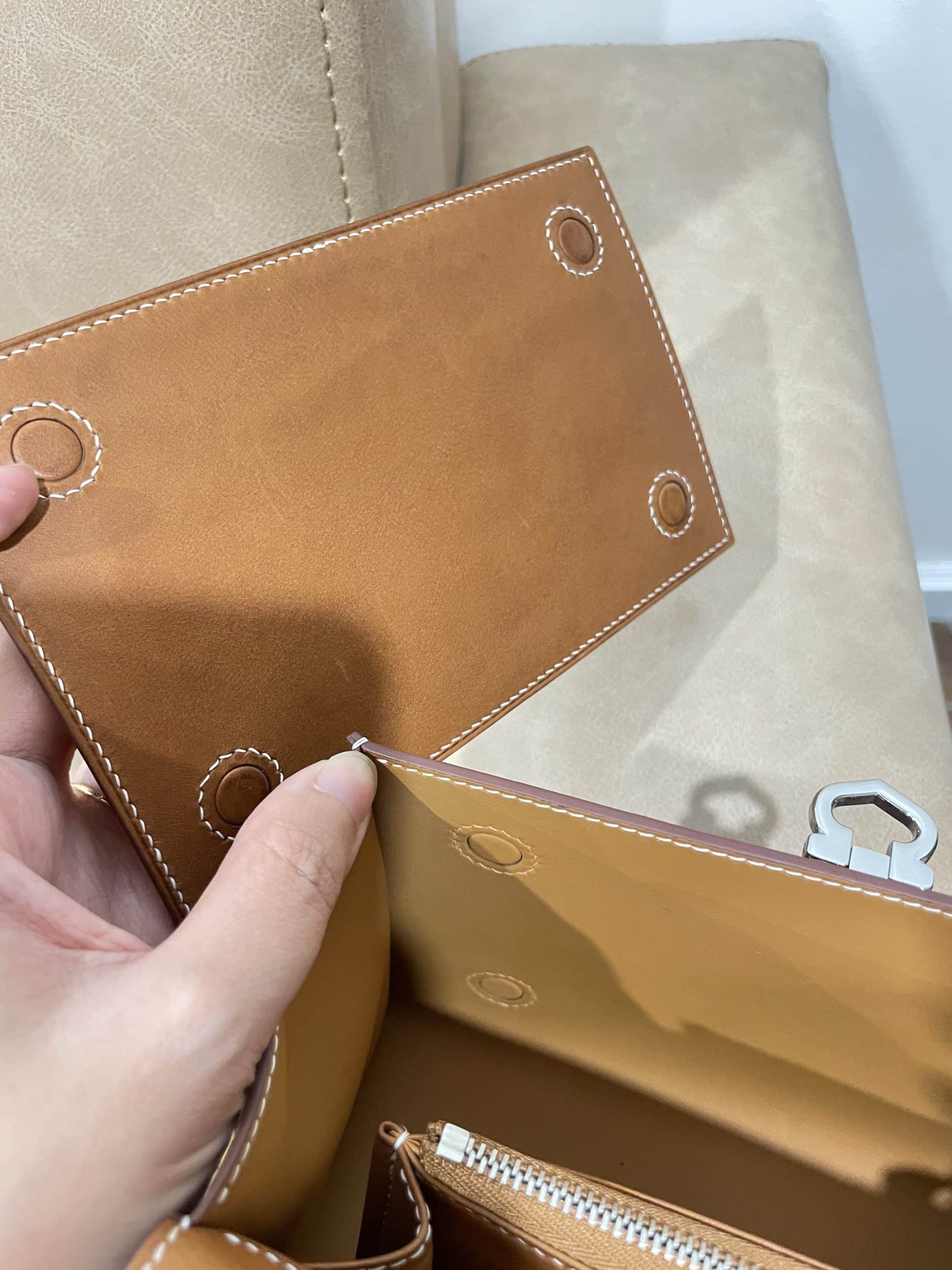
But there’s a small issue with the size of the interior pockets that gape. It doesn’t match my imagination. We discussed alternatives at length and came to the following conclusion: the pockets for Insta 360 Go 2 and Airpods Pro will be made on a removable panel, attached to the bag via four small magnets. It’s a very interesting solution because I don’t take out my airpods & camera all the time. If I don’t take them with me, the removable panel stays home. Also, my gear evolves. If I ever change devices, we can always make another panel suited to my new gear. However, with this new system, the lipstick compartment is out of the question—too complicated.
My logo stamp is too big for my bag, so I had to get another one made too.
Final result
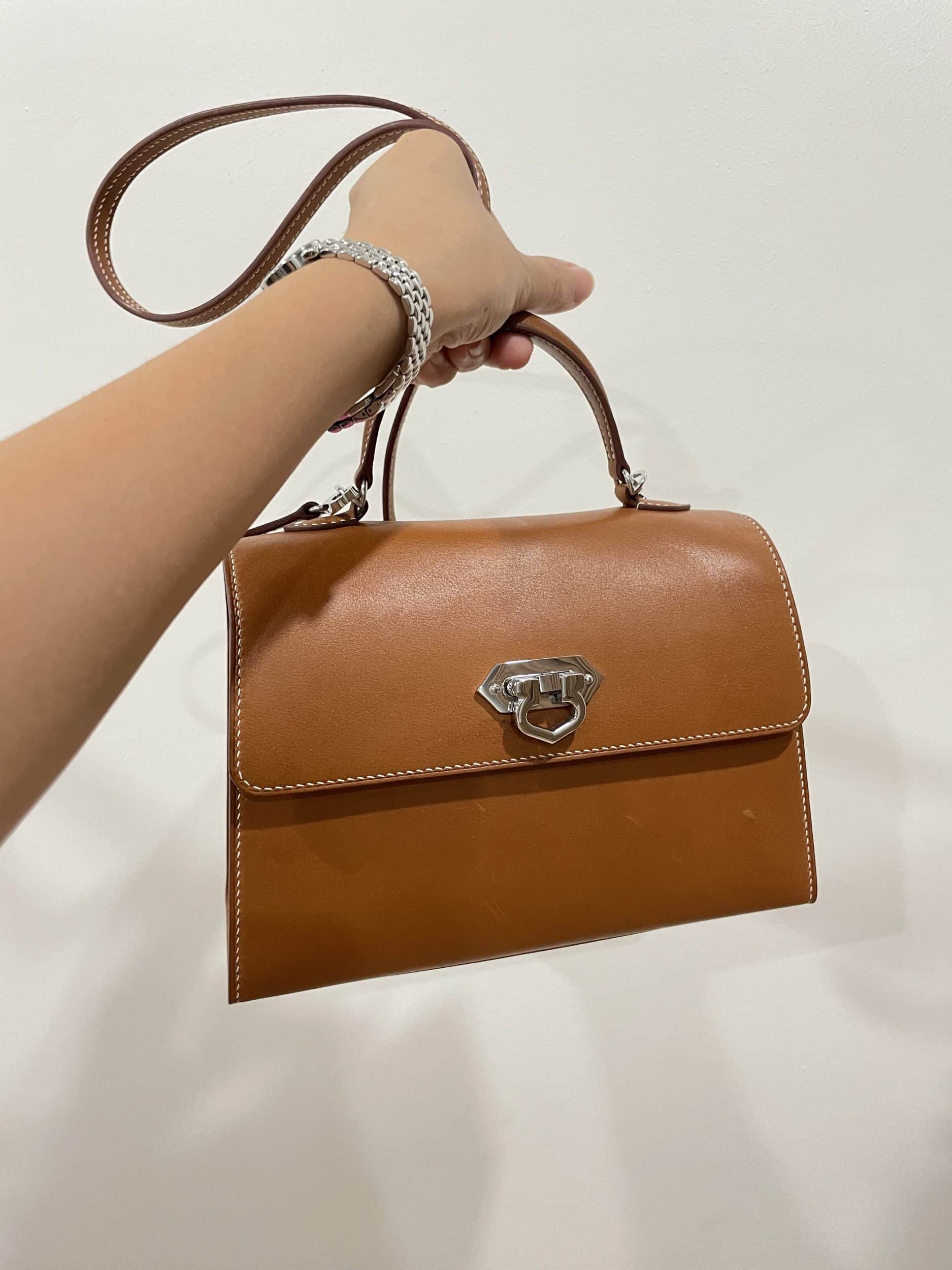
What do you think? Does it make you want to create your own bag as well?

