
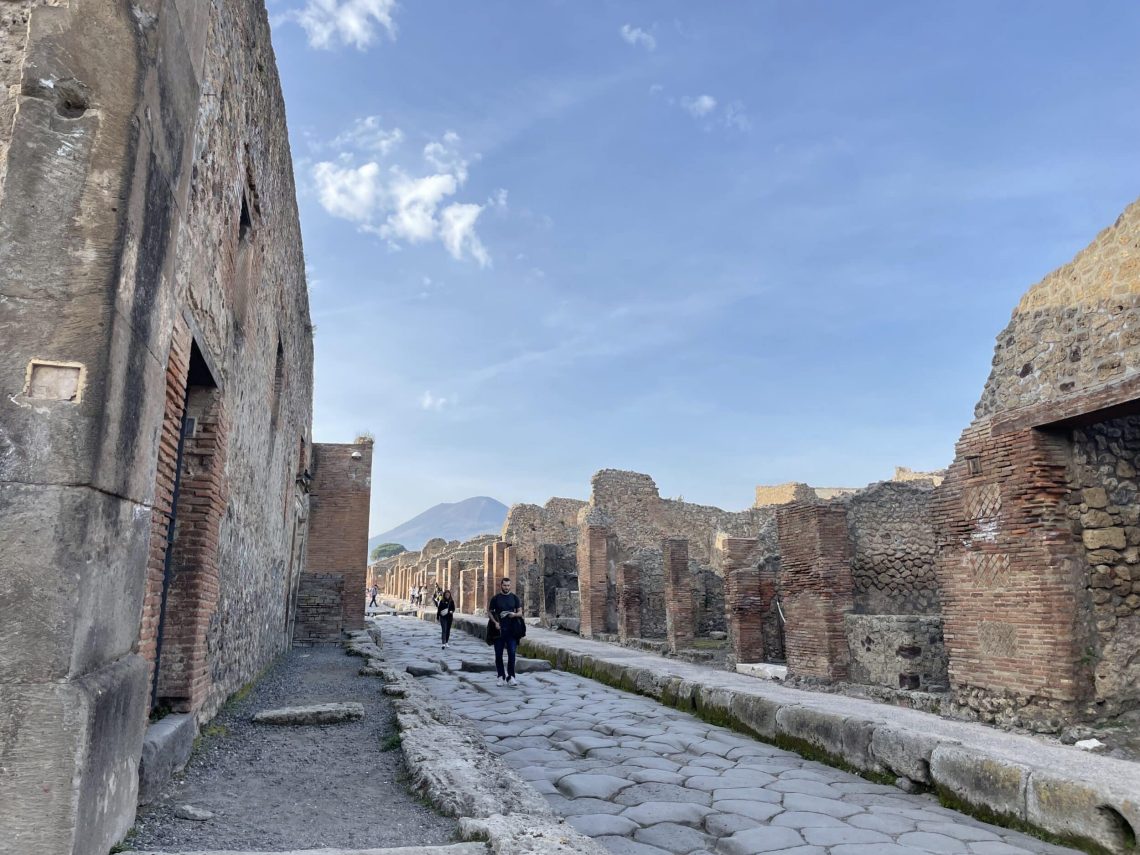
Pompeii, a gigantic site (Italy)
After Sicily, we fly to Naples and Pompeii. An Italian friend who specializes in volcanoes told us that the present danger isn’t Vesuvius but Naples: the Naples region is itself inside a volcano. And from the plane, it does look like that, indeed. Specialists see danger everywhere, but I hope he’s just being overly cautious.

We land in Naples first and immediately take a shuttle, which is 5 minutes from the airport, to Pompeii. The driver drops us right at a gate of the archaeological park. Unfortunately, our hotel isn’t near this gate but near the other gate. We walk along the park, can’t see what’s inside, and after 15 minutes, we arrive at the HABITA79 MGallery Pompeii (Booking link), a nice hotel that JB booked at my request to “compensate for Pompeii’s grimness.” Just the hotel bar is amazing.

We drop off our luggage. It’s barely 2 p.m., and we head straight to the archaeological park. The plan is to visit today (and tomorrow morning too if we want to go back). We’re given a huge map in French, and I also have my Rough Guide. But frankly, it’s one of the rare places where we should have opted for a guided tour, because the site is huge and you don’t always know which place to prioritize.
The map lists all the houses currently open to tourists (they open and close in turns for preservation), but we don’t know which house is more interesting to see, so we wandered around the site visiting places with 2 or 3 logos in the Rough Guide, trying to take the “shortest route”, but we also missed quite a few beautiful houses. Especially those near the main entrance, because we arrive from the south entrance and by the time we get near the main entrance, we’re already exhausted.
Our first visit is the enormous amphitheater. I’m smiling in this photo because the weather is nice and it’s the first time I’m bringing out my very first handmade leather bag, which I started and painfully finished. But after that, I’ll stop smiling altogether, because the place is too grim. Malta Palermo.

Several of us tourists stop on the path to take photos of THE CRIMINAL, the Vesuvius volcano, which seems very very far from Pompeii.

We are in 79 AD. Just before the eruption, the city was prosperous, well organized, with streets of unique dimensions (to prevent chariots from other towns from entering the city), houses elevated above the street (for cleanliness), and between 20,000 and 25,000 inhabitants. But on October 24, 79, Mount Somma (now extinct) buried the entire city under its ashes. Vesuvius was born from this eruption. Before the tragedy, there were some warning signs, including an earthquake on February 4, 62. Of the 25,000 inhabitants, 1,150 bodies have been exhumed, and research showed they died of asphyxiation, not from the ashes and cinders.
At a spot called “the Garden of the Fugitives”, there are 13 bodies that have been left in place. Others are just behind the souvenir shop at the south entrance where we came in (tourists arriving by train also use the south entrance). From a distance, I thought they were plaster casts reproducing the bodies found, but when I read the explanations, I let out a scream of horror and ran off, leaving JB to approach with other tourists. He says the expressions of horror are still visible. To explain concretely why these bodies are all white, you should know that the human remains are trapped in a thick layer of ash. When researchers discover one, they use a casting technique developed in 1867 by archaeologist Giuseppe Fiorelli. It’s a non-invasive technique for the site that involves making a cast of the victims by pouring plaster into the cavity. The plaster (or cement) then takes the shape, in relief, of the body that has decomposed in the volcanic cavities. So the plaster figures we see aren’t just plaster; they are truly the remains of victims, in their original position, evidence of the terrible suffering they endured at the end of their lives.

We still have in mind the famous image of the two bodies known as “the Lovers of Pompeii”, two entwined bodies, preserved somewhere. Frankly, I didn’t find the answer, I know they’re in a museum, but what’s the name of that museum? I’m not sure (maybe the Antiquarium of Pompeii?). Anyway, a DNA analysis conducted in 2017 suggested they were probably two men, but likely lovers nonetheless, according to the excavation director.
We then visit the villas where the walls, mosaics, and graffiti are still perfectly preserved. Some colors are still very vivid. There’s even a small brothel with very suggestive drawings, a heated communal laundry, ancient theaters, and roads that still seem perfectly functional. We also see calcined loaves of bread that still keep their original shape. They even managed to recover grape seeds and produce an “ancient wine”.


Cherry trees in bloom: a touch of sweetness in this gloomy place.


For a very long time, Pompeii was forgotten, and for 15 centuries only farmers took advantage of its fertile soil to cultivate. We actually rediscovered it recently, in the 17th century! And two-thirds, can you believe it? Two-thirds of this city are still buried under the ashes. In the middle of the visitable area, there’s a huge construction site where they are still digging, and new human remains are regularly found in this pile of ashes that stretches to the horizon. It’s only by going up to a viewpoint and getting some height that I realize what that uncovered third represents, and what the true size of Pompeii must have been, and I felt tears welling up in my eyes.


Maybe there are plenty of other places that really existed, mentioned in tales and legends, but that haven’t been rediscovered yet. Troy, for example, was considered a myth until it was found in Turkey. Maybe one day we’ll find Atlantis?
The site is so big that an afternoon is clearly not enough. We only visited a third, I think. We’re dying of thirst and heat. We could have gone at least as far as the Casa dei Vettii. However, we’re not about to go back the next day, as the place is so sad. I think I’ll go back one day with a private guide, to enjoy it more and to be better prepared. I didn’t expect to see the bodies on site, for example (admittedly, it’s rare, but I didn’t expect it).
Between Pompeii and Naples lies the Herculaneum archaeological park. We didn’t know that a replica of a villa in Herculaneum had been built in Los Angeles, so we didn’t think to visit the original (Villa dei Papiri).
JB treats himself to a pizza at the hotel to recover from the emotional experience. We spend a peaceful night in our hotel. My initial fear was that the town would be full of ghosts, but they’ve found peace after 2000 years. Nothing to report!

Instead of going back to Pompeii the next day, we make the round trip to Naples to visit this city, which we only knew through its famous pizzas, in a hurry.

