
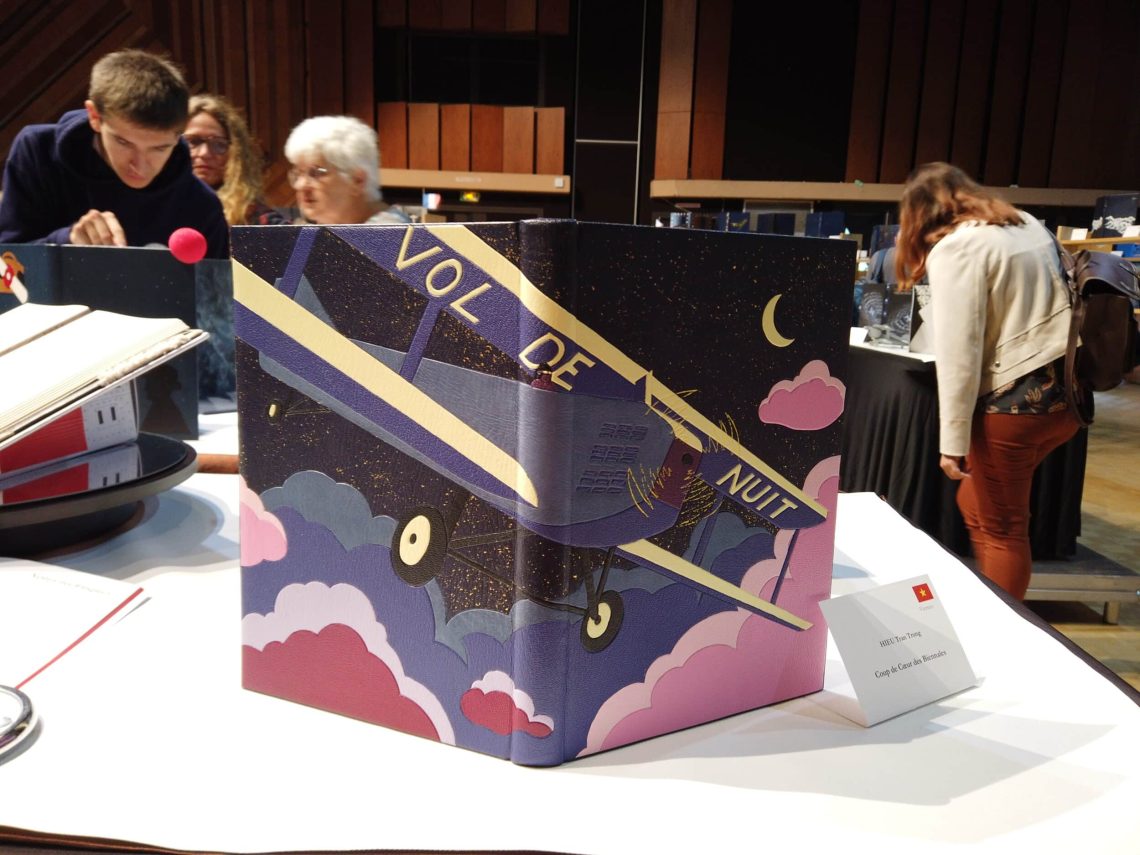
[review] World Biennial of Art Bookbinding 2024
I wasn’t supposed to go to the World Biennial of Art Bookbinding in 2024 because I was staying in the northern suburbs of Paris and had to go all the way to the end of the RER B line to attend. But a Vietnamese bookbinder won a prize and a mutual friend put us in touch. I went mainly as a favor. I did enjoy it a bit, but I’m glad I combined the trip with another event in Paris because 3 hours round-trip for that alone would have put me off.
It’s a bookbinding competition open to everyone: professionals and amateurs. Everyone has to bind exactly the same book (Night Flight by Saint-Exupéry for 2024), printed on fine paper, and you can include illustrations or not, as you choose. There are no limits; you do whatever you want with the book. According to the catalog I bought (15 euros), at least a third of the entries come from professional workshops/binders from around the world.
There are three areas: the main area showing all the participating books, an area dedicated to bookbinding schools, and an area for suppliers. I went on a Saturday, so the supplier area was different from the one on Sunday. The ticket costs 5 euros for the entire duration of the exhibition.
Well, I had no trouble finding the Vietnamese bookbinder’s book because all the prize-winning books are prominently displayed on tables, while non-winning books are on shelves. They lend you sticks with a mirror and light to better see the headbands, and you can go behind the shelves to see the endpapers. The books are opened almost 180 degrees so you can admire the covers, but also so you can see the flaws.
I’m shocked to see so many basic mistakes and immediately regret spending 1h30 on public transport to get there (+1h30 back). Mistakes that even a beginner like me can spot. I randomly check if these books with obvious traces of string on the covers, crooked endpapers, poorly made title pieces, asymmetrical headcaps, hastily glued headbands… come from amateurs, but I’m horrified to discover that it’s professional bookbinders who make them. I don’t know if it’s specific to this edition or every year, but that’s how it is. For me, it’s a big warning : the craft is dying.
This reminds me of a discussion between my bookbinding teacher and parents of students at the Estienne school, which specializes in art bookbinding, saying that such schools don’t train bookbinders, they lack technical mastery, they are just very creative and know the craft more or less well enough to design art bindings. I also recall an interview with a bookbinder from the Estienne school who said she took extra lessons with an old man to learn to “see” and perfect her skills. No wonder, if these pro binders don’t see their obvious mistakes and still submit their creations to the competition, it’s either (1) they don’t see them, or (2) they aren’t used to doing this kind of binding in their daily work. But you need practice, lots of practice!
There’s one book that won a prize, but I later find out on Instagram that the gilding was done by someone else (from another workshop). I don’t know the rules well, but in that case, should the gilder’s name also be credited? In any case, I clearly saw that the binders struggled with gilding; some letters are completely crooked. And if this person still won a prize by outsourcing the gilding to someone else, I think other binders should, next time, outsource that part to have a better chance of winning.
I’m very surprised to see a group of elderly Korean women. When you look at the number of books per country, you notice that some countries have stronger bookbinding clubs than others, and Korea is one of them. They are increasingly making a name for themselves; in leatherwork they are more perfectionist, and in bookbinding they aren’t super creative but make fewer basic mistakes and learn very quickly… I wouldn’t be surprised if in 20 years they create a second Hermès, cheaper and better quality. Especially since in Asian countries, tools are much cheaper. In France, to find an alphabet of the right size, you have to spend a fortune, whereas for a custom title piece, like “Night Flight”, I can order it made-to-measure and have it the next day in Vietnam.
As for my Vietnamese binder’s binding, it’s clearly not my style, but I understand why he won: he’s technically good, and his edges are unique. Many binders leave edges untrimmed or just color the top edge (because binders no longer seem to know how to gild edges either). And his “marquetry” leather is particularly well done. His sewn headbands are much better executed than other competitors’. I know where he buys his leather because we share the same supplier in Vietnam, and I must say that to achieve this result, he struggled a lot because we don’t have as much choice of leathers as in France.


I’m still glad I came because it’s one of the rare occasions where you see so many art bindings in one place, but I admit I expected a much higher general level from a technical standpoint. From a “creativity” perspective, it’s clearly super creative, but for me, you can’t build a creative house if it collapses afterwards. First, the endpapers must be well glued, the covers symmetrical, etc.
I trailed behind a grandmother and her grandson to listen to her explanations, as she showed him the prize-winning books and explained why, in her opinion, each one had won. The prize-winning books are truly well crafted, so at least they make the 5-euro entry fee worth it. And there are some very difficult techniques that I could never master in a million years.
Buying the catalog is recommended because it gives you a better understanding of the techniques used and the idea behind each book. The prize-winning books get a double-page spread in the catalog, while the others get a photo and a few lines.
I still took some photos of bindings whose concepts I liked… for example, those using parchment, others with a pop-up plane, or incorporating stained glass, or stones… I really like it when bookbinders incorporate knowledge from other arts.
What I like is the chance to buy books from previous competitions for 40 euros. It’s much more enjoyable to make a binding with sheets like that than to destroy an already-bound book. In fact, more and more fine presses are now offering bare sheets, so we can do our own bindings, just like in the good old days.
Here are a few photos I took. To zoom in, click on each photo.


At the supplier area, I’m thrilled to discover the trade of parer. It’s going to make my life easier both for leatherwork and for bookbinding.

And I was able to buy some parchment to learn illumination (about 40 euros for a goatskin parchment). Then comes a long ride on the RER B back to Paris. Fortunately, my sister invited me to see Katherine Ryan. We have dinner together at the restaurant next door and take an Uber back because I couldn’t take those long commutes anymore.

