

A Week in Bhutan, the Land of Happiness: Part 1/4
We’re taking advantage of being in Asia to fulfill one of our dreams: visiting Bhutan, the country whose people are said to be the happiest in the world, to understand their recipe for happiness.
Part 1: Travel Journal
Part 2: Practical Tips
Part 1: Travel Journal
Choosing the Agency
Although the cost of living is very low, visiting Bhutan requires a well-stocked wallet, because you have to:
- pay mandatory daily fees of $100/person/day, which go straight into the government’s pockets
- visit with a guide, there’s no way around it
- public transport is scarce, so you need to add a driver
Since we’re at the start of the monsoon season (late May – early June), there are few tourists (except the Indian neighbors who are on vacation), and we have a private tour for a week.
The agency we chose is called Bhutan Best Inbound Tour, it’s a Bhutanese agency. I read a very positive review online, and they respond super fast on Whatsapp. The price offered by the agency is cheaper than the rates quoted by Vietnamese agencies. The tour we chose is called “Classical Cultural Tour,” 7 days 6 nights, but I honestly think we could have cut the program down to 5 days 4 nights. The reason we opted for 7 days is based on the following reasoning: we’ll only go once in our lifetime, so we might as well enjoy it a bit more.
Buying the Plane Ticket & Payment
We’re currently in Vietnam, and there’s no direct flight between Vietnam and Bhutan. The nearest departure point is Bangkok. That’s why we decide to spend a night in Bangkok before flying to Bhutan the next day. Europeans or Americans usually go via Kathmandu in Nepal. The agency can book the plane ticket for us at no extra cost, and prices don’t fluctuate much (around $890/person round trip), but we prefer to book the flight ourselves.
As for payment to the agency, since they don’t accept online payments, we make a bank transfer via Wise, it’s faster (the money arrives 3-4 days later) and less hassle than going through our bank. Transfer cost: $43 for a transfer of $2240. You can use my referral link for a free first transfer. It’s the service we use systematically for international transfers (outside the SEPA zone) since our bank created unnecessary difficulties for paying for our trip to Egypt (requests for documents, extended delays, high fees, etc.).
The agency handles the visa application for us.
Once the payment is made and the visa is obtained, all we do is wait for our trip with excitement. Very busy with multiple activities in Vietnam, I don’t have a single second to research Bhutan. The program put together by the agency seems to match the photos taken by my friends who visited Bhutan, so I don’t make any special requests either. So we go and discover the country in “total surprise” mode.
Day 1
At Bangkok airport, check-in goes smoothly in a Peace & Love vibe because there’s no one!! We just see a Bhutanese guy loading a huge TV and conclude that there must not be a wide variety of TV equipment in Bhutan (and no Amazon!).
The plane is half empty, with mostly Indian passengers on board. The plane stops for 20 minutes in a tiny town in India, where all the Indian passengers get off. Others get on. Those continuing to Bhutan stay on the plane. The flight attendant checks that all carry-on bags on the plane have an owner present on the plane (to avoid one of the passengers who got off leaving a ticking package), then we continue our 30-minute flight to Paro, home to the country’s only and tiny international airport.
Paro airport is considered the most dangerous in the world (for landing). Poor JB, who’s been hitting the world’s most dangerous airports for a year now, first at Lukla and now today at Paro. Bhutan is all mountains, so their valleys are tiny. To land here, you have to fly between the mountains (not very high) in a fairly narrow corridor. But hey, the movements aren’t scary enough to scream, but it’s still a strong sensation. The landing is so technical that only eight pilots are authorized to land here (then again, when only 2 airlines fly here, with one or two flights a day, you don’t need 36,000 pilots). If a charter comes from Vietnam, for example, they’d have to pay one of these pilots. One of the authorized pilots is the father of the current queen.
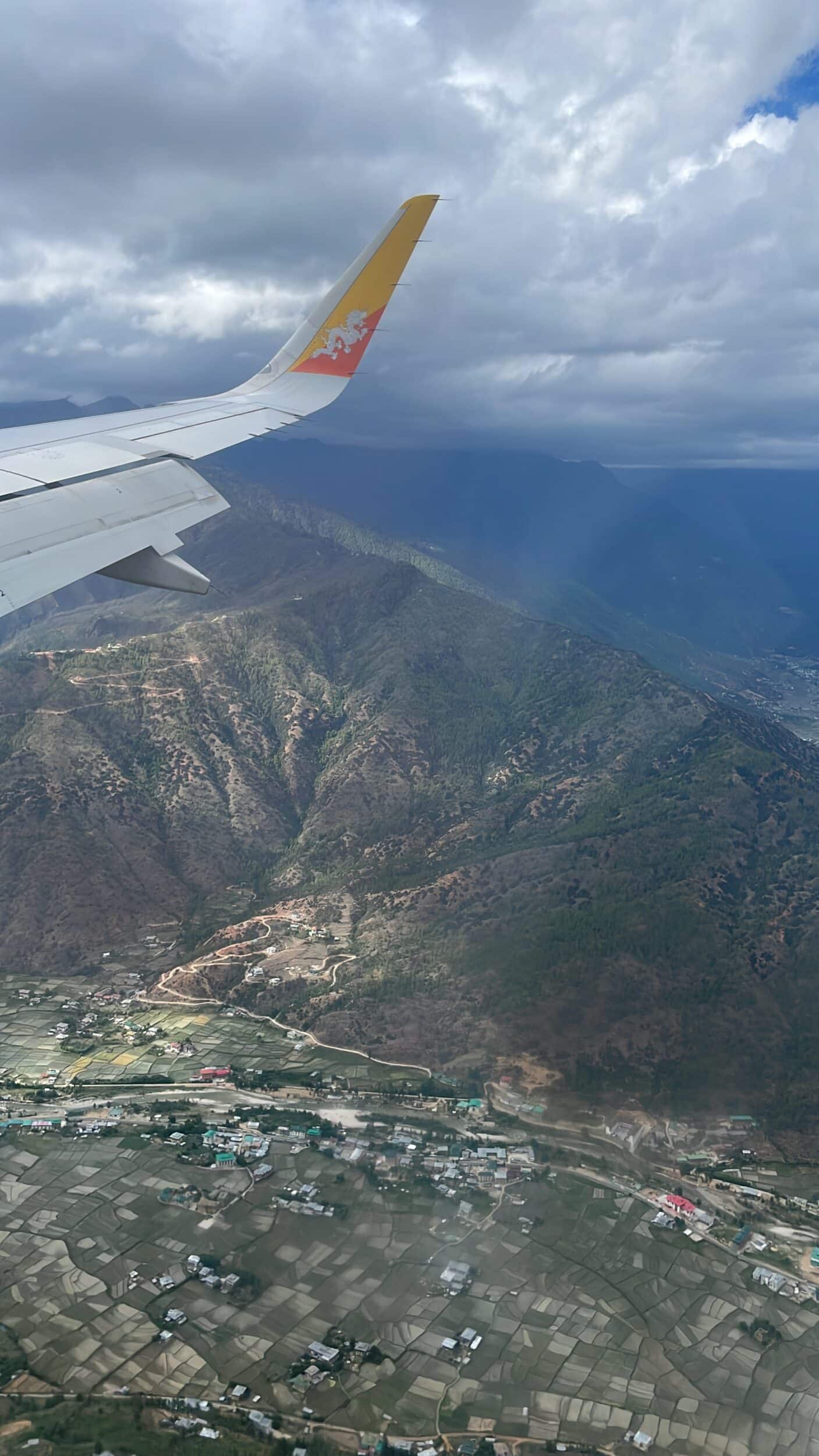
The plane always leaves earlier or arrives earlier in Paro because, with so few planes, they land and take off whenever they want. You’ll see, every time, they’re 40 minutes early! Our guide and driver seem to know this too, because despite our arrival 45 minutes ahead of schedule, they’re already there. The airport has free Wi-Fi, so we can communicate with them as soon as we land. No need to tell you how tiny this airport is. However, it’s super well decorated, in Bhutanese style, with two huge miniatures of two Bhutanese buildings at the baggage claim area. We see the Bhutanese unloading their bags, and one passenger even brought a lawnmower. Honestly, we still haven’t learned since our trip to Easter Island!!! We should have brought rare items to Bhutan (like 2, 3 plasma TVs), sold them to make back the cost of our trip hahaha.

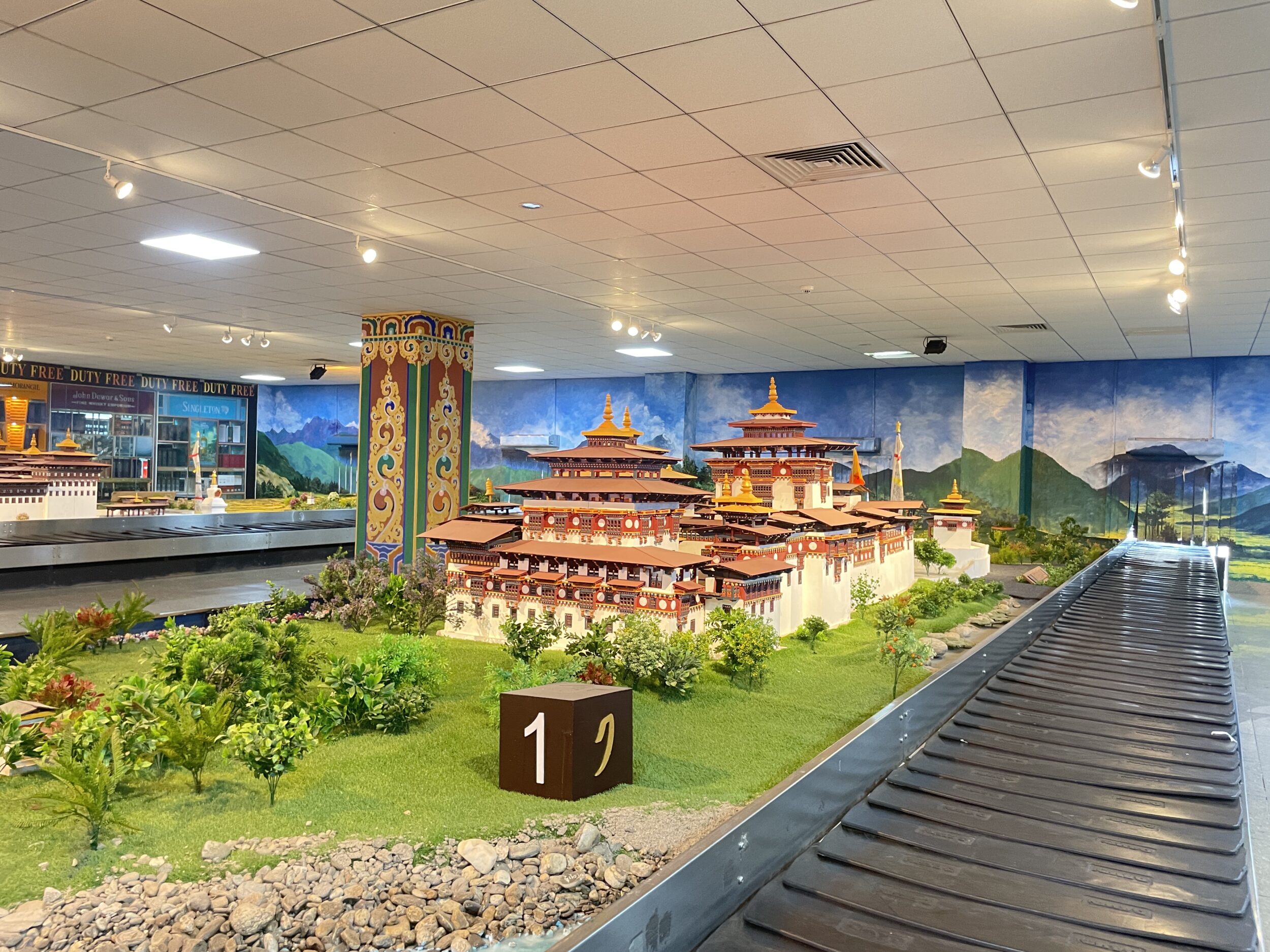
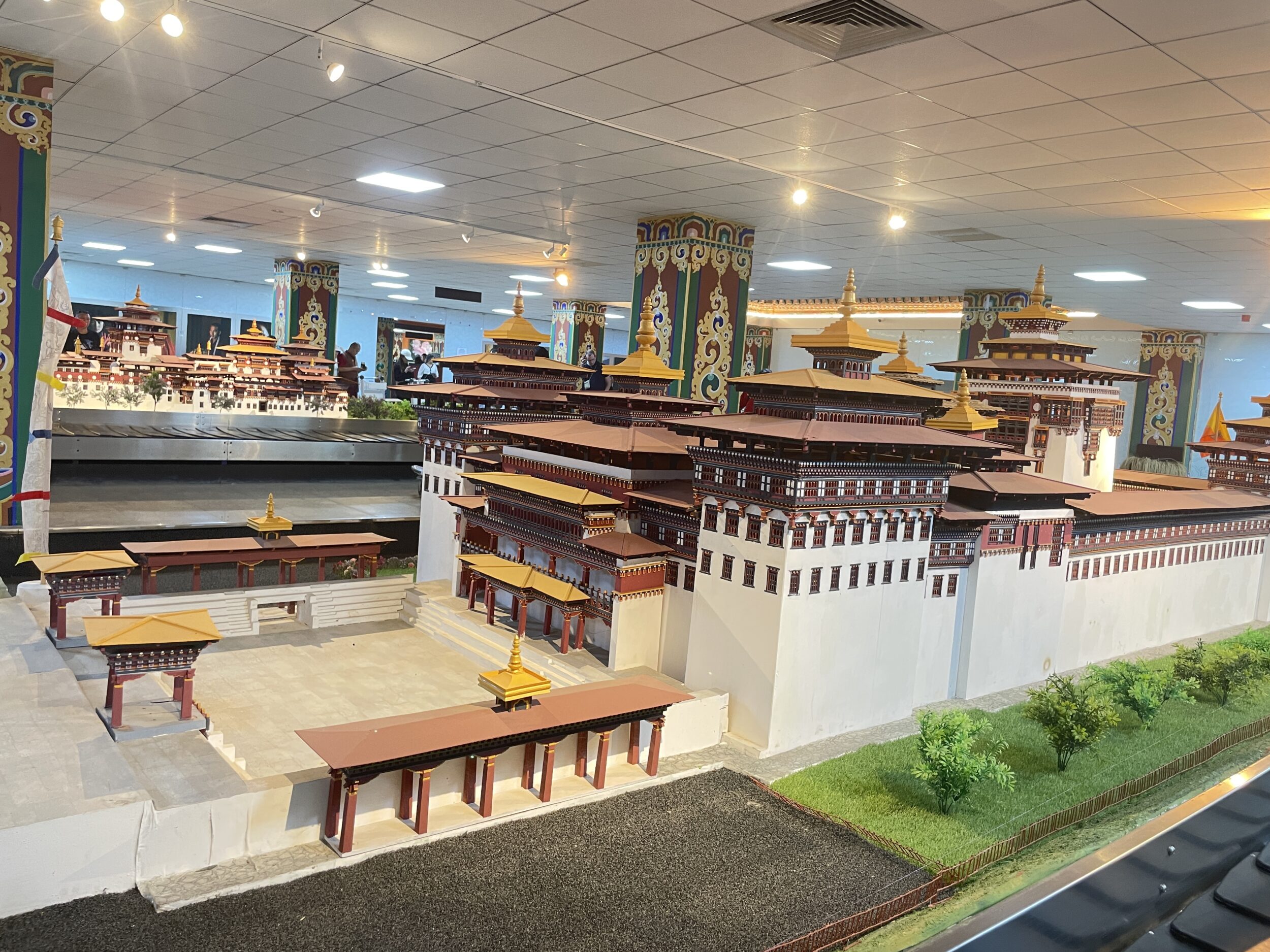
Our guide and driver gift us a white scarf the meaning of which will be explained to us later, but I can’t quite remember it. Anyway, the white color has an important meaning. We’ll wear this scarf every time we visit a temple because I read somewhere that it’s better that way. But it makes us extremely happy—I love it when we’re offered a flower necklace or something like that as soon as we arrive.
Tachog Lhakhang
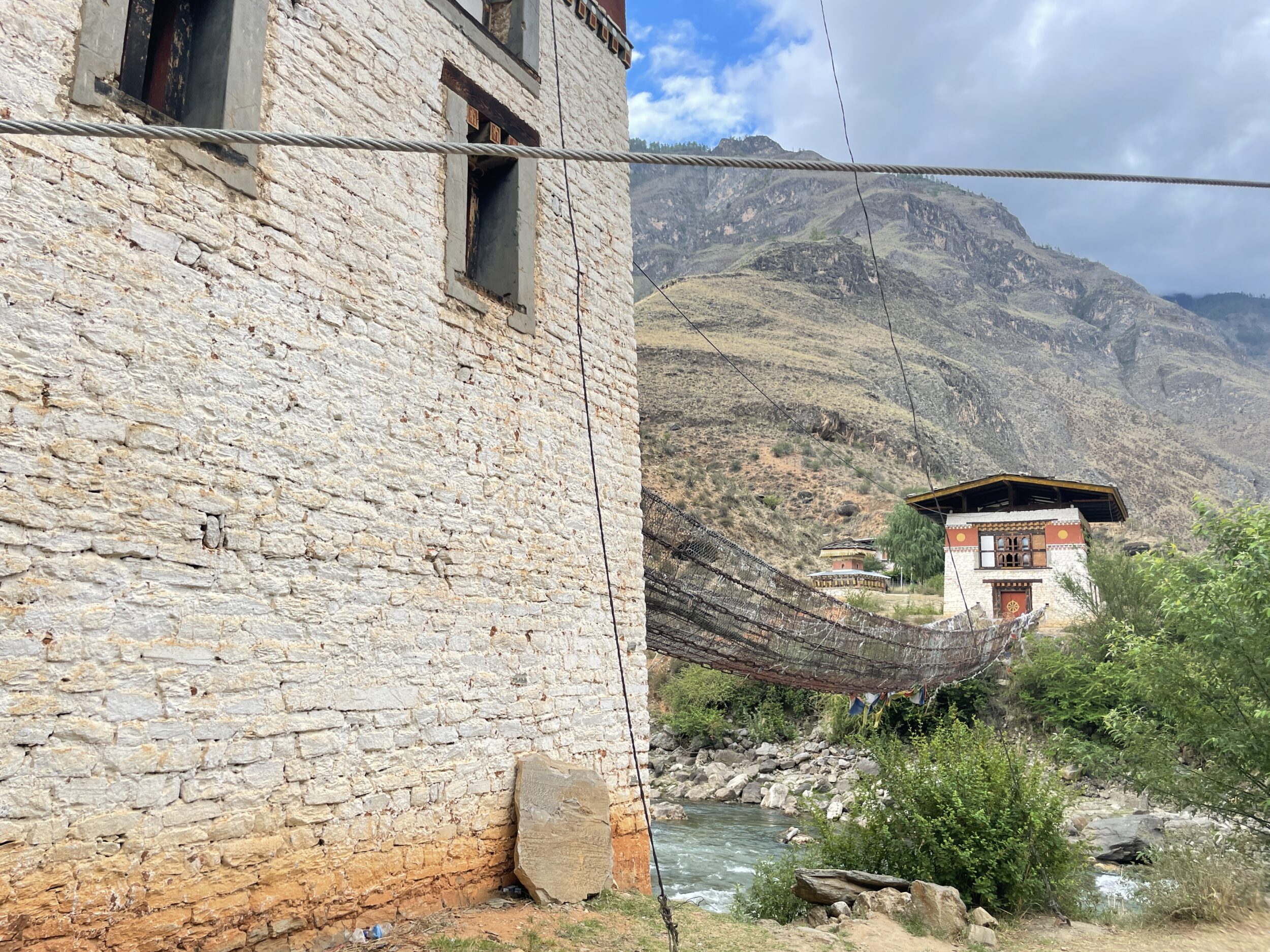
Even though we arrive in the middle of the afternoon, we still have enough time to visit a Buddhist temple. It’s a temple, but it still belongs to the descendants of Thangtong Gyalpo, known for building many iron suspension bridges in Bhutan. In fact, his bridge leading to the temple is still there, but we have to take the newer bridge just next to it.
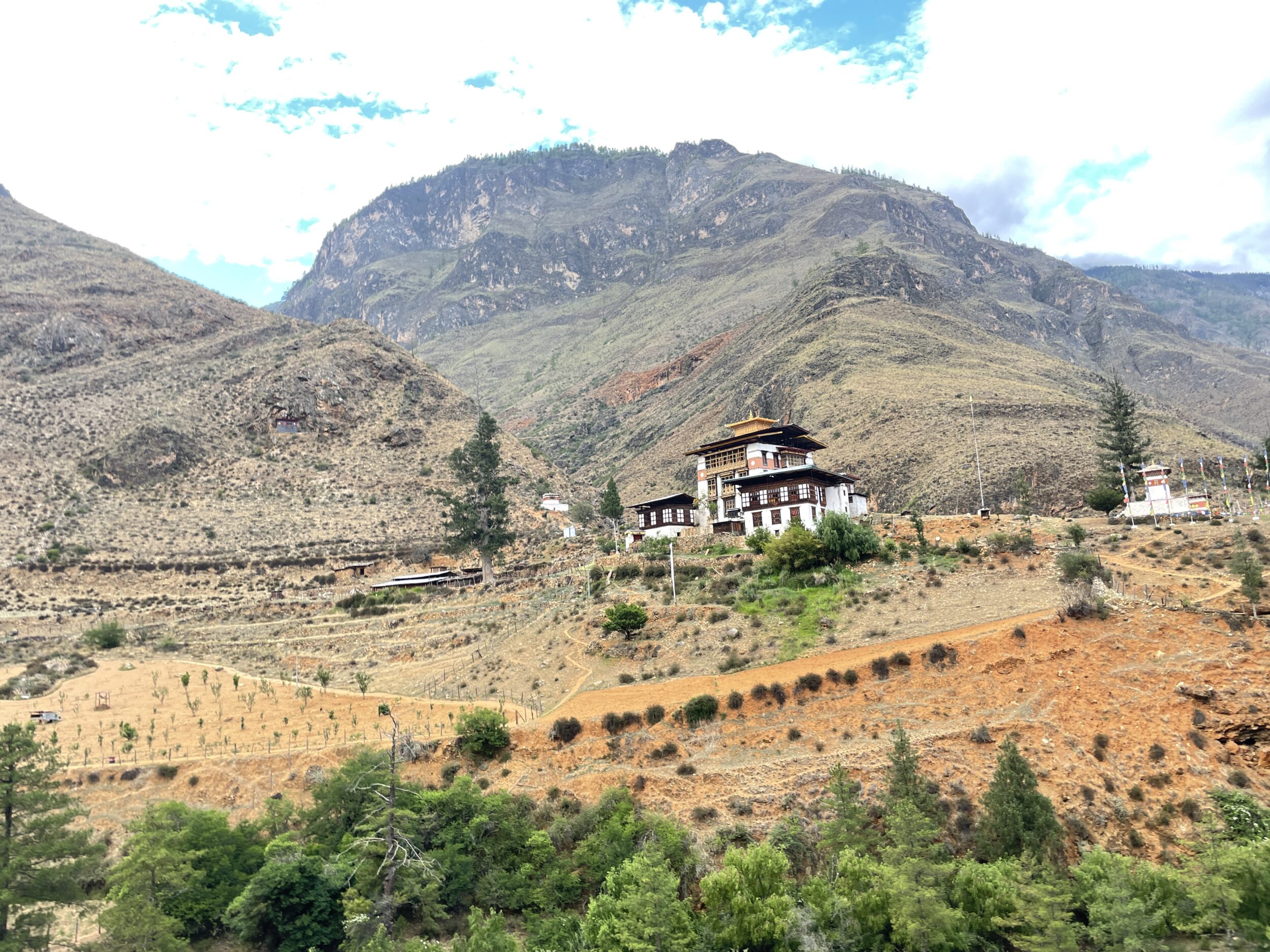
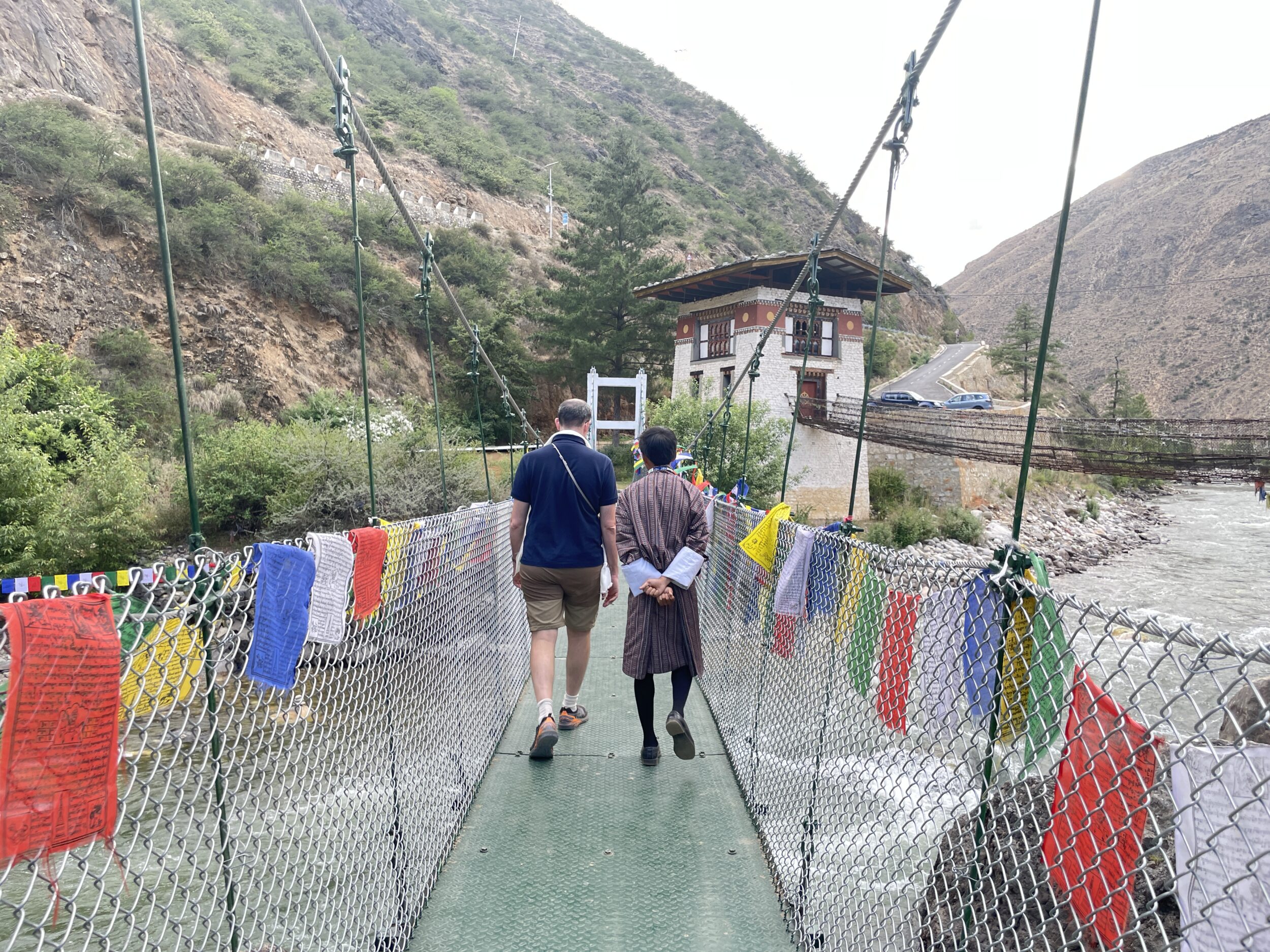
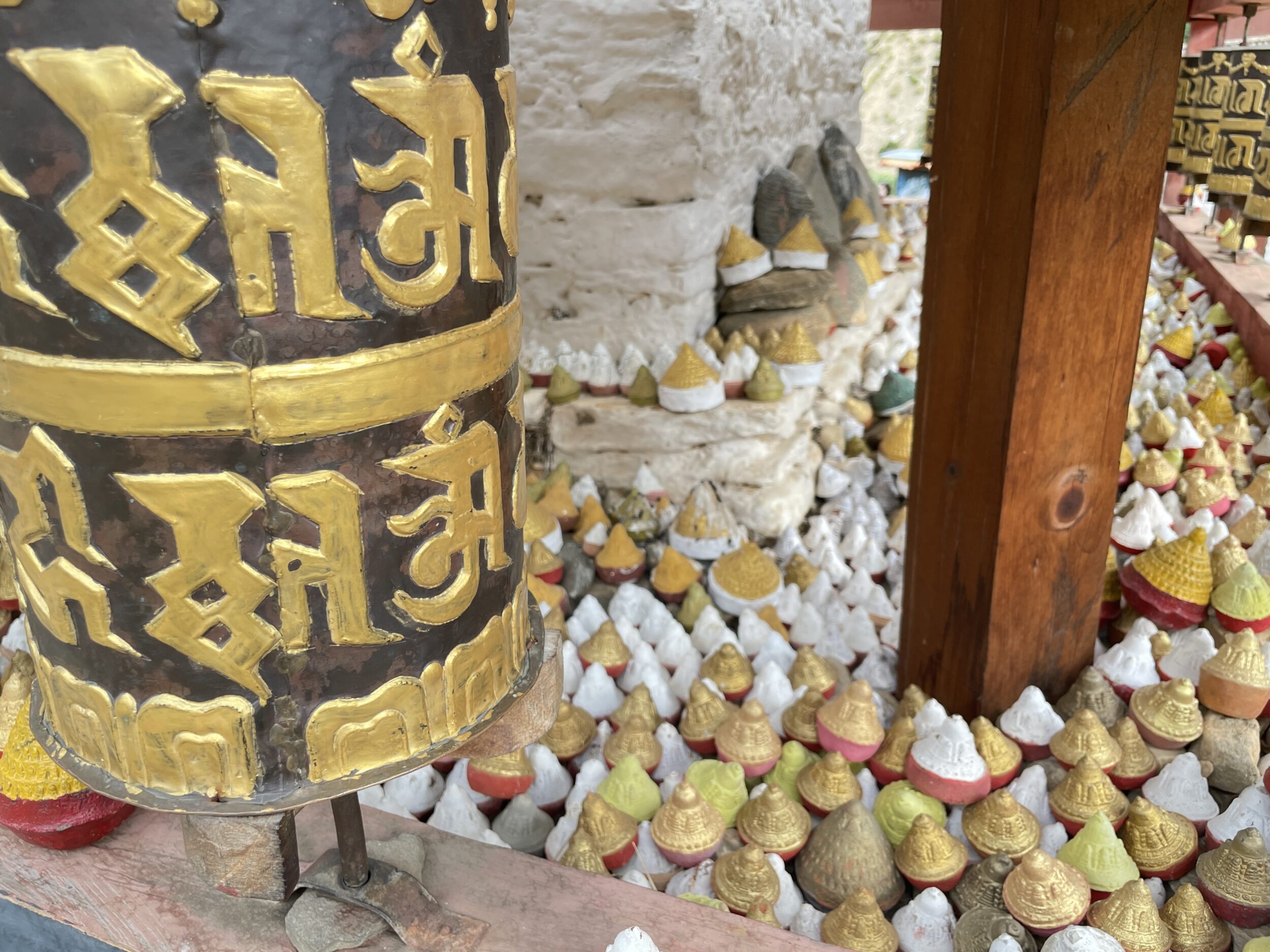
We see our first stupa and prayer wheels. The mantras are already written on the wheels; you just have to turn them clockwise while praying. There are lots of small stupas left here by believers. Our guide explains that after cremation, the ashes are used to form small stupas like this, and they place them all over the mountains. That’s why there are no cemeteries here, nor any cult of the dead.
For young children, it’s different—they are not cremated, but their bodies are taken to the top of a mountain, and the birds take care of them, as in Tibet. It’s a way of returning to Nature what belongs to Nature. This practice has been criticized in quite a few old adventure books; it seems cruel, but it makes sense. If I understood correctly, our guide and his wife had to take their young child’s body to the top of a mountain and leave it there. I can’t even imagine what that does to the parents.
The only thing that reminds one of the loss of a loved one is these huge white flags with prayers written on them. When they lose someone, they plant 108 white flags anywhere (it doesn’t have to be on their land; they can plant them in the forest, for example), until the flags are destroyed by wind and weather. The country has 800,000 inhabitants, so that’s a lot of flags to plant in the next 100 years. Sometimes we see flags planted in inaccessible places and we wonder how they managed to carry so many flags to such a remote spot.

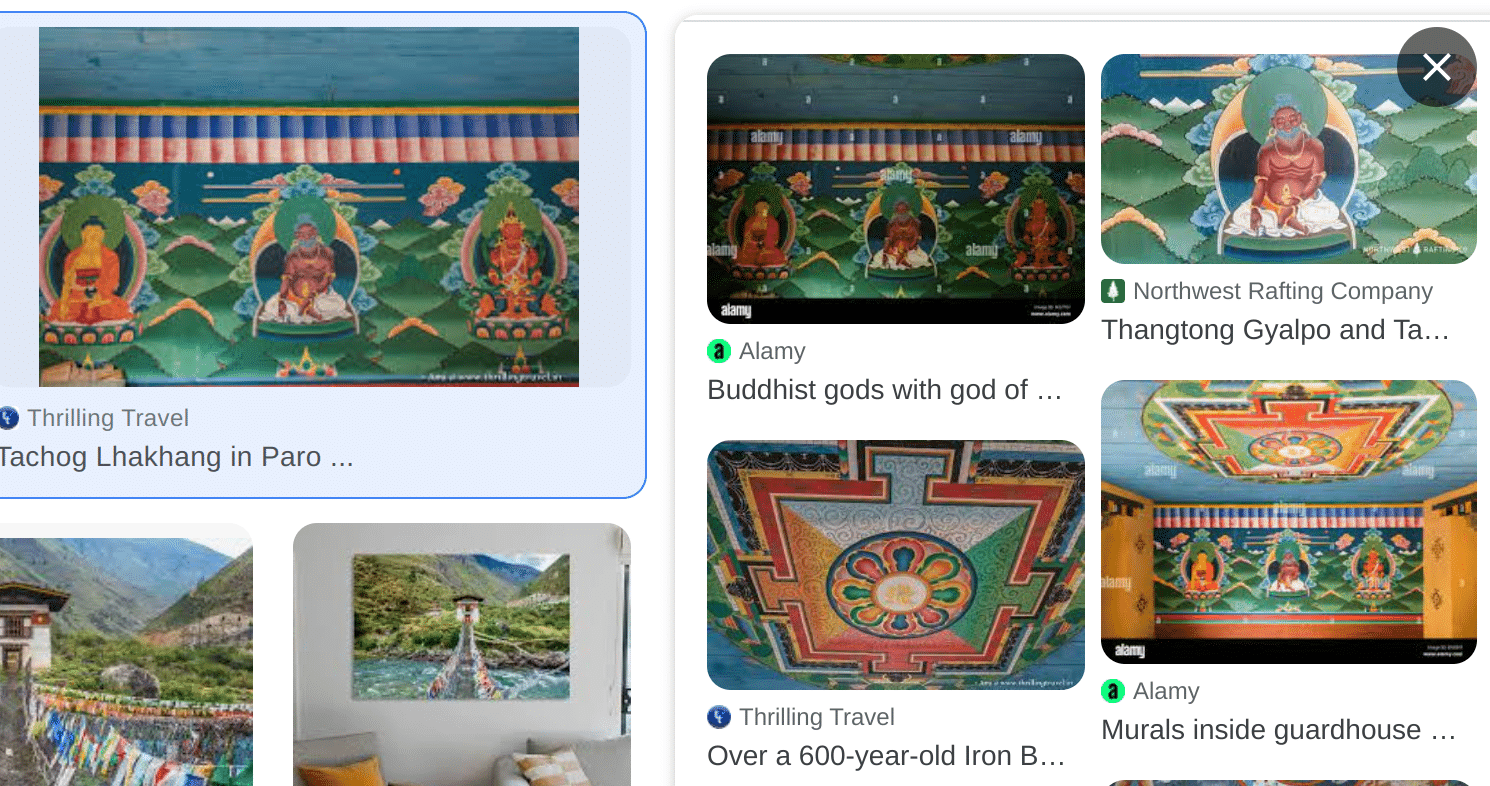
We only visit the main part with the statues on each floor; there are 3 floors in total. As everywhere in temples, you have to take off your shoes, and as soon as you take them off, you know you’re no longer allowed to film or take photos.
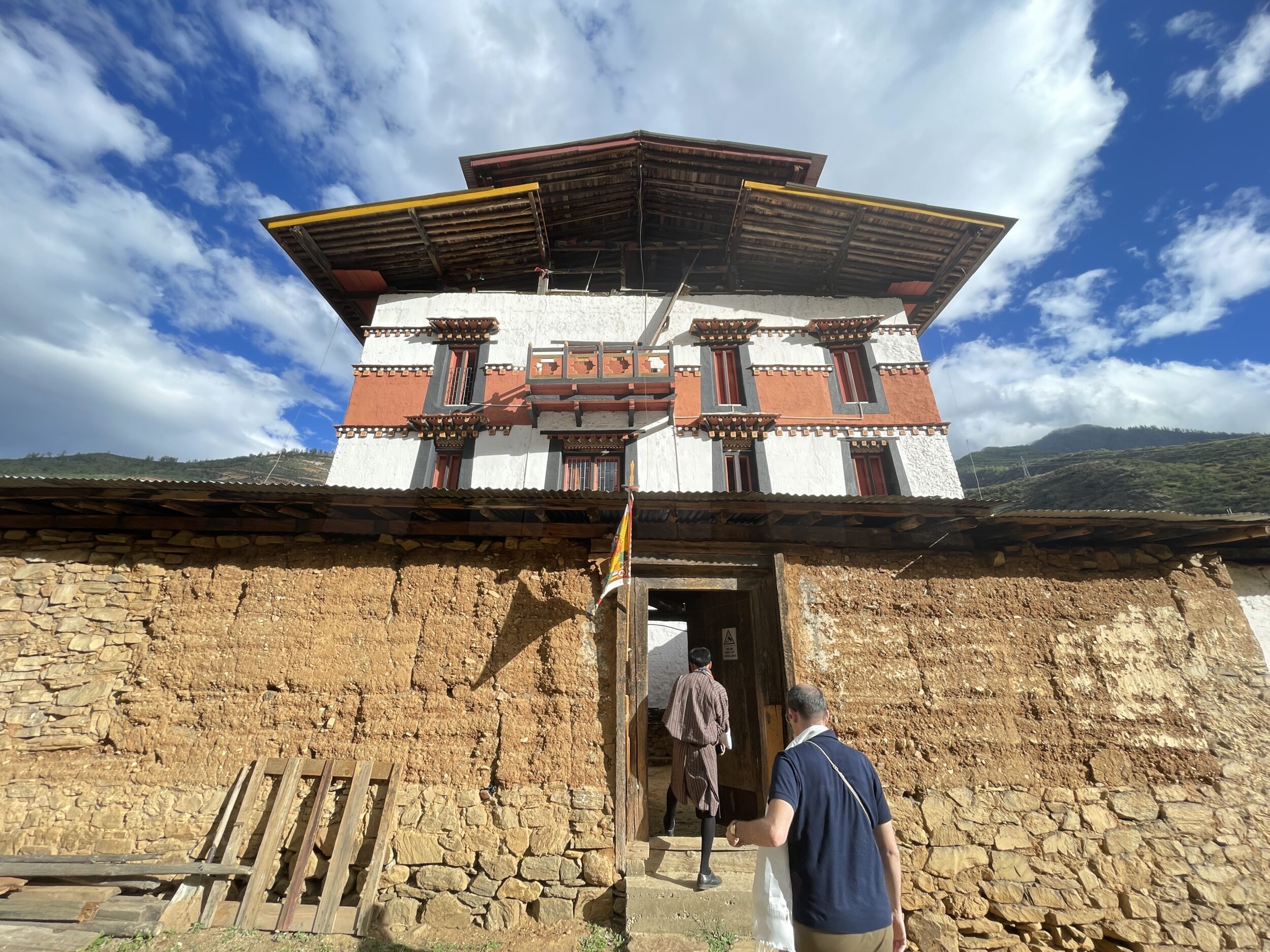
It’s a bit of a shame because I would have liked to show you the splendor of the interior decorations and the beauty of the statues, but you’ll have to come here to see them. It’s ultra colorful; everything is covered in designs, except the floor. There are even colorful fabrics hanging from the ceiling, and thousands of Buddhas painted on the walls. Here’s a screenshot I managed to get from Google Images.
There are two other Bhutanese women visiting at the same time as us. When I see them prostrating in our direction, I run to the other side of the room. I don’t understand why they prostrate in the opposite direction of the Buddha. Actually, in Bhutanese temples, you first prostrate toward the statue of the lama (sometimes there’s a real lama praying), then toward the Buddha. Our guide teaches us how to prostrate. You really have to touch the floor with your head; it’s very physical and hurts the back. You have to do it 3 times toward the lama, 3 times toward the Buddha. Suffice it to say we learned the proper manners but almost never applied them afterward.
Bhutanese Buddhist art looks a bit like Tibetan Buddhist art. There are sculptures that are a bit shocking due to their violence, fierce features, garish colors, or the presence of a woman attached to the said deity, something we wouldn’t expect to find in a temple. Anyway, we thoroughly enjoy the visit, and the guide assures us we’ll see this style throughout our trip, that “temples all look alike” 😀
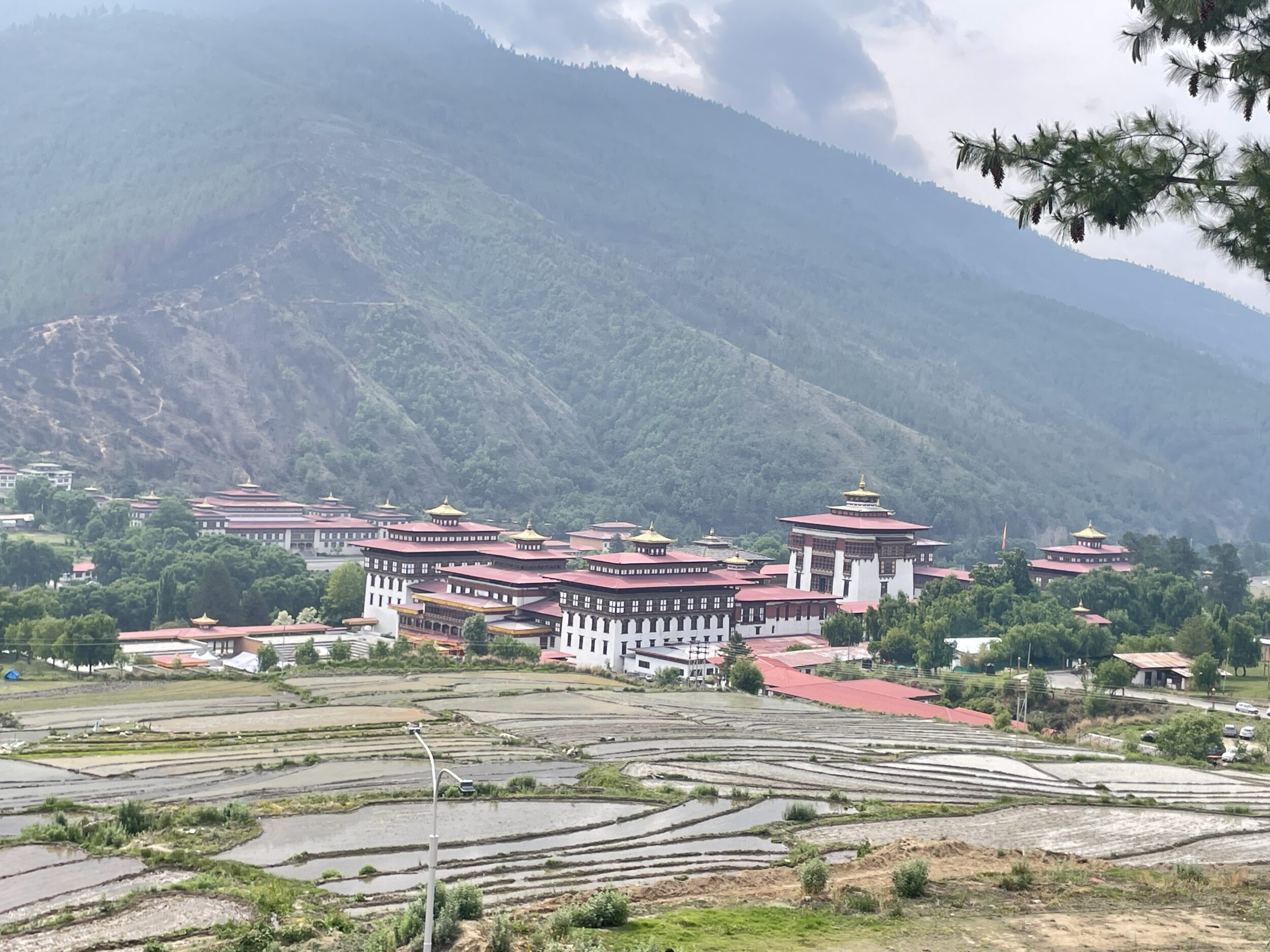
We spend way too much time here and unfortunately can’t visit Tashichho Dzong, which is only open to tourists between 5pm and 6pm. We only pass by the next day to take a photo from above. The dzong houses the throne room and several offices of the king.
We are on the 5th king. His father, the 4th king, is responsible for the country’s efforts to open up to the world and to transform the absolute monarchy into a constitutional one. The current king and his wife are loved by the people. During Covid, the king used his personal fortune to pay the salaries of the hundreds of thousands of Bhutanese who lost their income due to Covid. There were very few Covid-related deaths, mainly among people already suffering from other diseases. At the end of Covid, the king had lost a large part of his fortune, but he has risen even higher in the esteem of his citizens.
Here in Bhutan, they don’t look at GDP but at Gross National Happiness. There are several criteria to measure it, including forest percentage, air quality, but also surveys among the population.
Thimphu
Here we are in the capital, Thimphu. From a distance, the city looks like a small village, but up close, it’s much more modern and compact compared to the rest of the country. We’re surprised to see buildings that look traditional but are actually concrete. They tell us that all buildings in the country must have traditional-style windows, that they must not be too tall, but that we’ll get used to it and learn to distinguish modern buildings from old ones.
Here is the main square. They don’t seem to hang out late on the streets at night; we came to this square two nights in a row and it was super quiet. Our hotel is right behind the purple building.

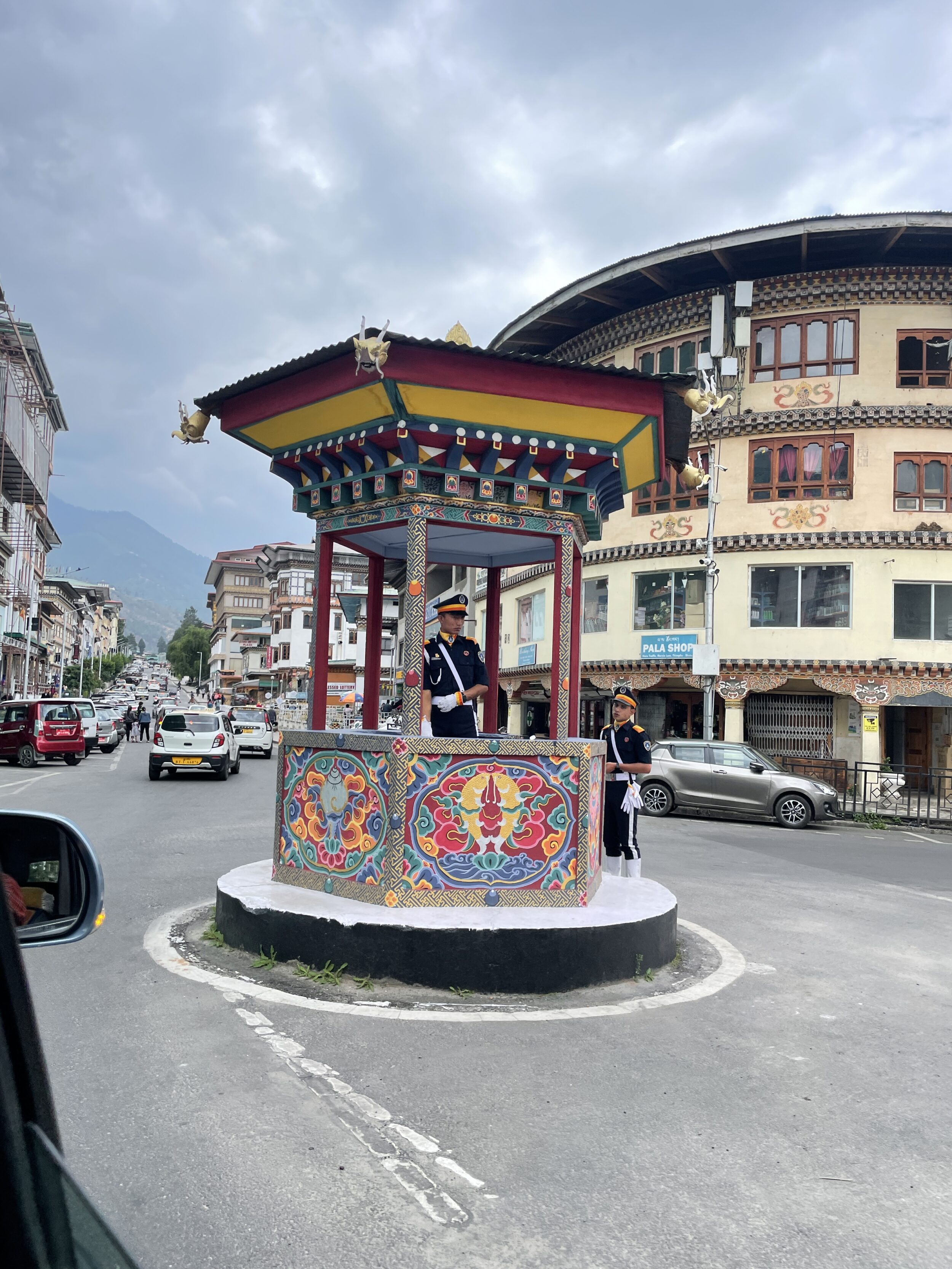
We’re told there are absolutely no traffic lights here. And no honking (unless there’s an imminent danger). It’s just roundabouts, and only one (famous) roundabout has an officer directing traffic with graceful gestures. When I took this photo, the officer was more busy chatting with his colleague than directing traffic. He saw me taking his picture and his look said something like “Oops, I got caught chatting.”
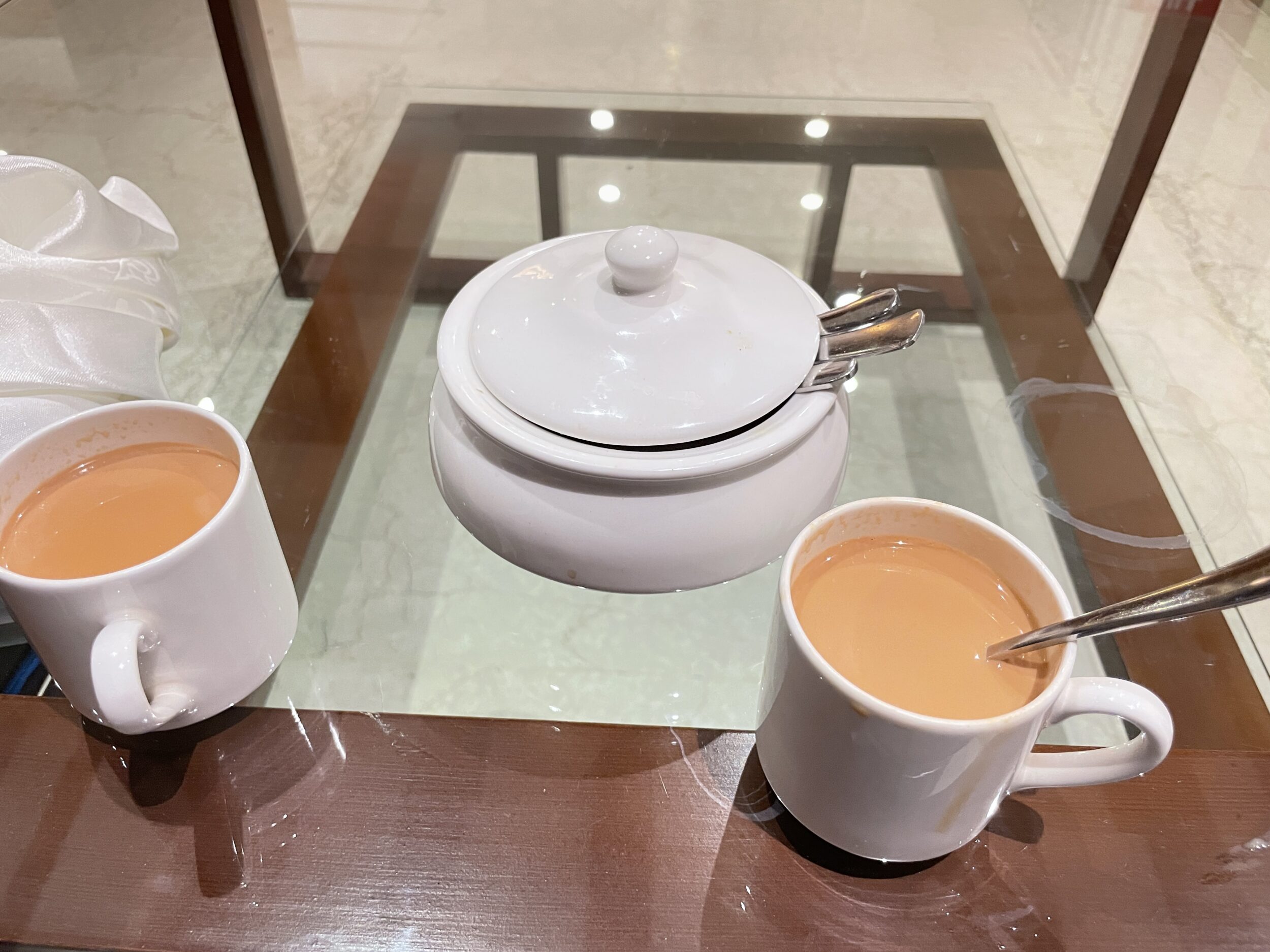
At the hotel, we’re welcomed each time with a “milk tea,” which JB doesn’t drink at all, and I hurry to drink his cup too because it’s so good (and we can always sleep later). We’ll stay 2 nights at this hotel in Thimphu.
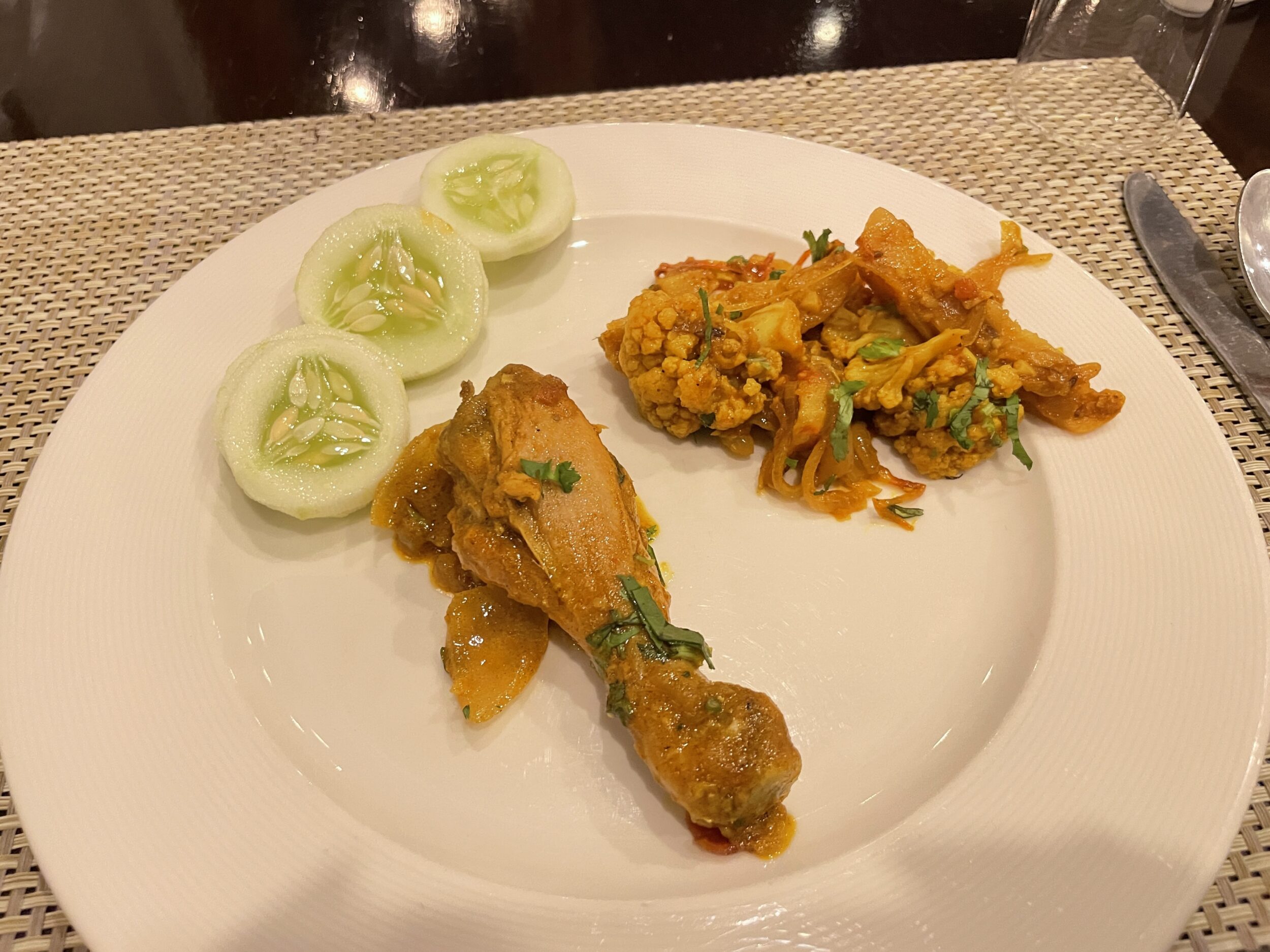
Unfortunately, dinner is an Indian buffet that doesn’t appeal to me much. JB, on the contrary, goes plate after plate. I read in reviews that some guests also didn’t like the Indian dinners and preferred to pay for outside restaurants themselves, which only cost between $5 and $10 per person.
At this morning’s temple, the guide had to give us change to make donations to the temple. We conclude that even though the tour is all-inclusive, we still need Bhutanese money, just in case… Withdrawing from ATMs costs a whopping 10% in fees! Our guide takes us to the main square where a tiny clothing shop at Norzoed Plaza offers exchange at a better rate than the official one (84 per $1 instead of 80). That’s where we feel really silly: we didn’t bring enough cash (in USD or EUR) because at the slightest imperfection on a bill (a pen mark, a tiny tear, …), the Bhutanese don’t want it. So out of the $300 we wanted to change, we could only exchange $200.
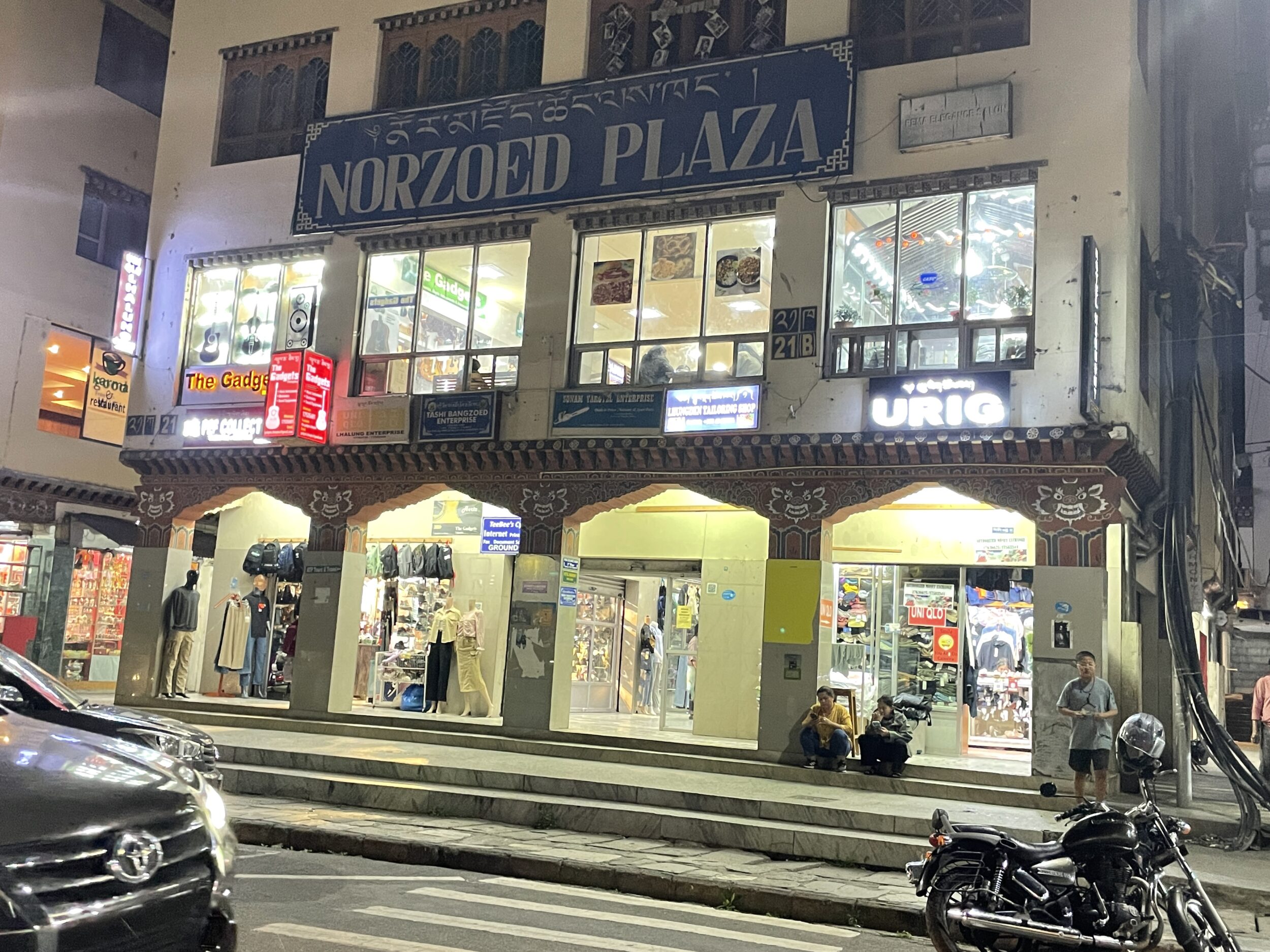
We also have to keep some USD to give tips to the guide and driver, so we feel a bit silly and stuck, because we’re too tight on cash.
Day 2
National Memorial Chorten
In the itinerary, we were supposed to visit this place on the first day, but since our plane arrived too late, we’re visiting it today. This stupa was built by the third king, Jigme Dorji Wangchuck, and is dedicated to world peace and prosperity. Its proximity to downtown and its small size are much appreciated: many devotees walk around it 108 times while praying. They have a wooden necklace with exactly 108 beads to count the number of rounds. Each time they complete a round, their finger moves one bead. It’s ingenious! As everywhere, you have to visit in a clockwise direction, so we’ll always be directed to the left and walk around without ever turning back on our steps.

On the left side, there are huge prayer wheels and a bell on top. When a wheel completes a full turn, the bell rings, I love that!
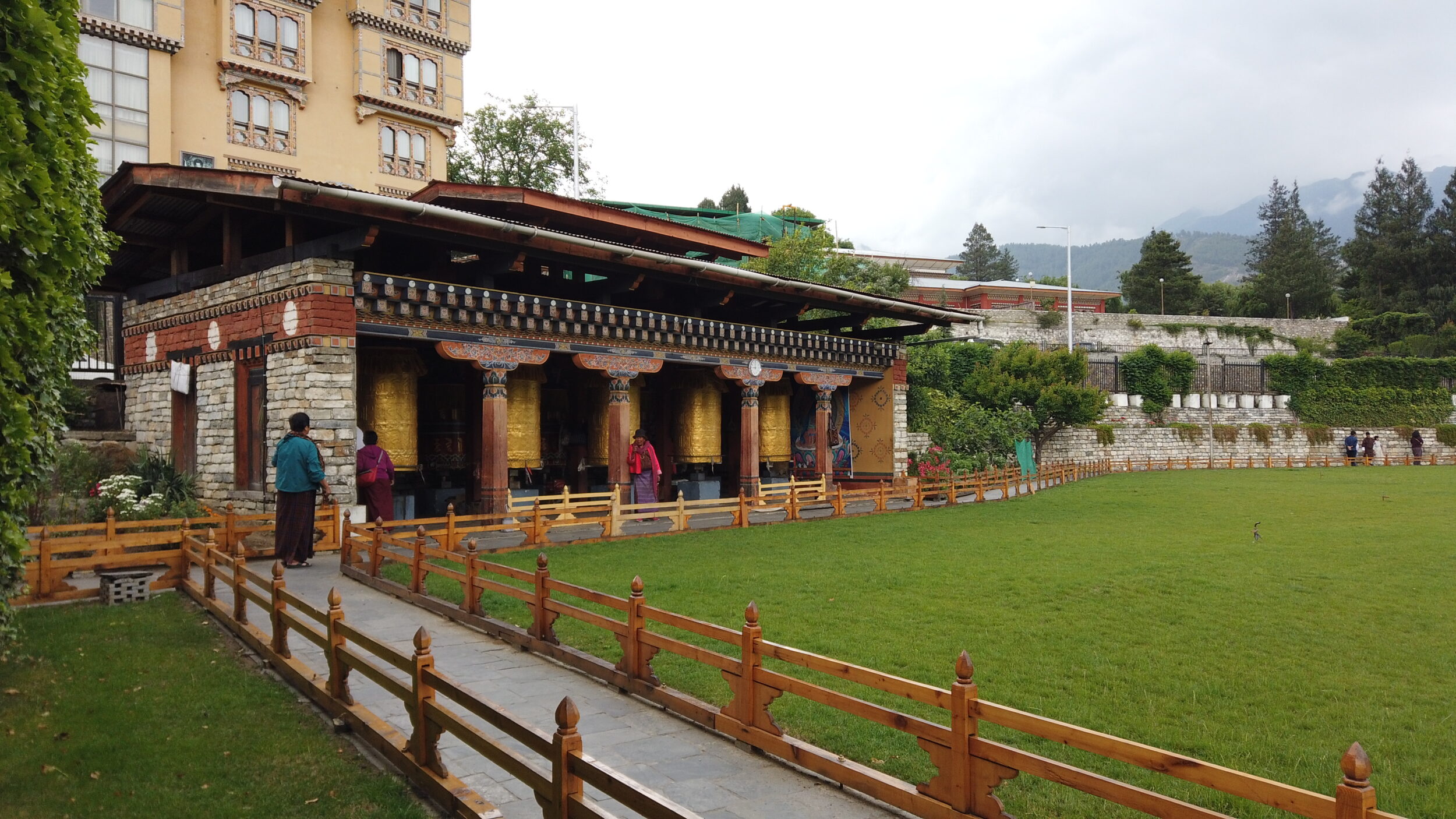
Then there are “butter lamps,” butter lamps that use edible butter but it doesn’t taste great. The Bhutanese light them at home. To avoid fires, they place these lamps in a pretty safe metal structure. But in temples, they are in a more or less open hall so that you can enter and light a lamp (for a fee). There are lamps that can burn for a month!


Buddha Dordenma
We visit a statue of Buddha on the mountainside, visible for kilometers.
Everything is beautiful, even the entrance door!
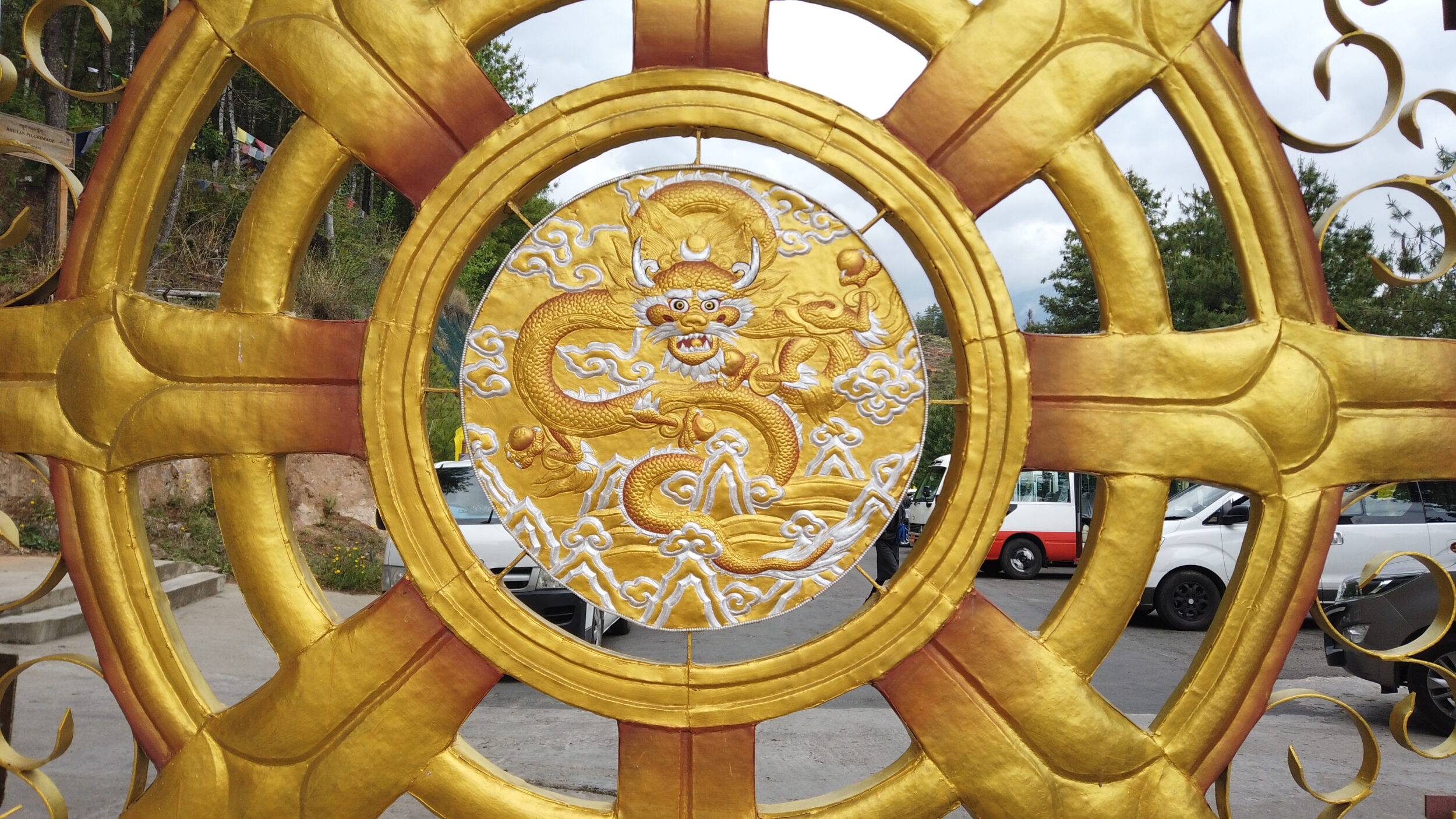
I don’t remember exactly how many meters it is, but at least 30 meters. The interior can’t be photographed, but it’s very very very beautiful! There are small Buddha statues that can be purchased for a minimum of $200 and will then be placed on shelves. The murals are rich and detailed, the statues inside are really impressive. This place is a bit like the Vatican of Thimphu; sometimes lamas come to explain religious texts and there are thousands of people listening. Now that we have cash, we can make offerings everywhere. JB watches the locals and tells me they give between 5 and 20 Nu. So we’ll do the same. However, they might leave 5 Nu. at every offering spot, so be prepared with lots of small bills if you want to do that.

Again, I’ll show you photos from Google Images:
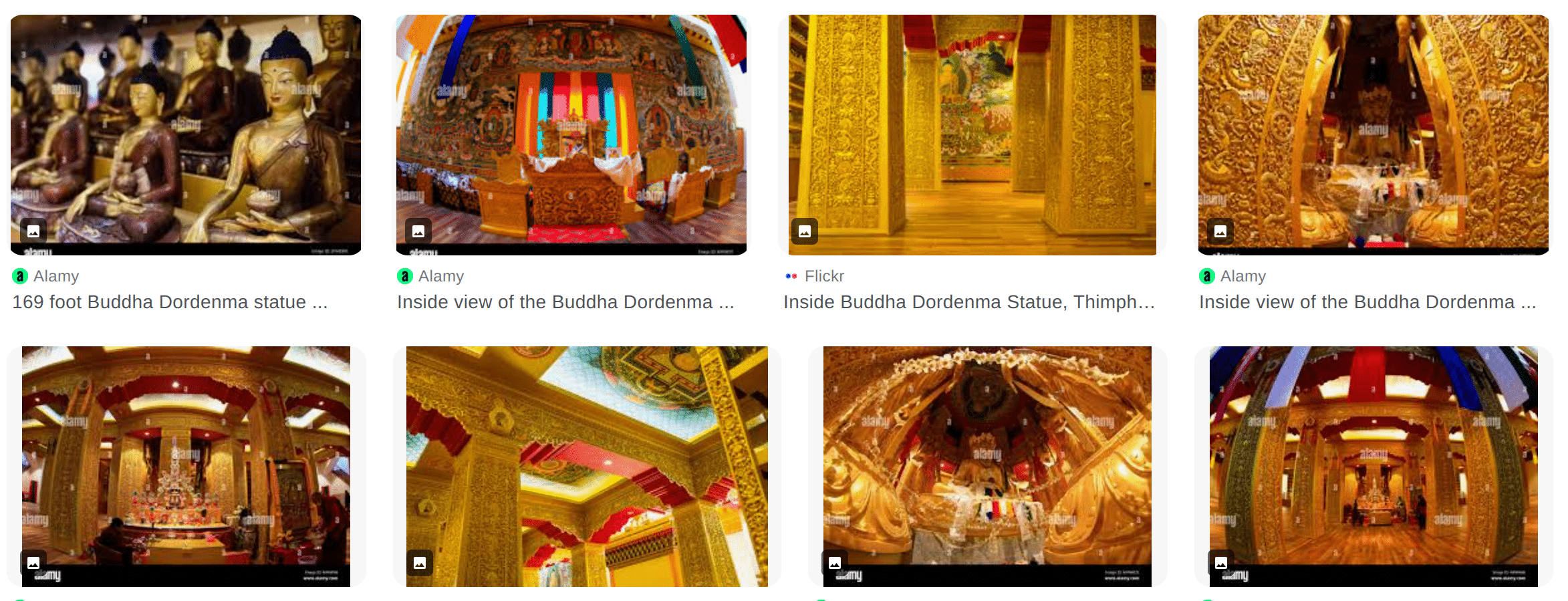
From the hill, we have a nice view of the surroundings. You can notice that a large part of the hills in front have no trees. It’s not due to human destruction; it’s just that there were too many pines and they burn quickly 🙁

The yellow flags with prayers printed on them belong to the king. You can notice that these flags are always placed where there’s wind. If there’s no wind, the prayers won’t be carried and won’t benefit anyone.

Takin sanctuary
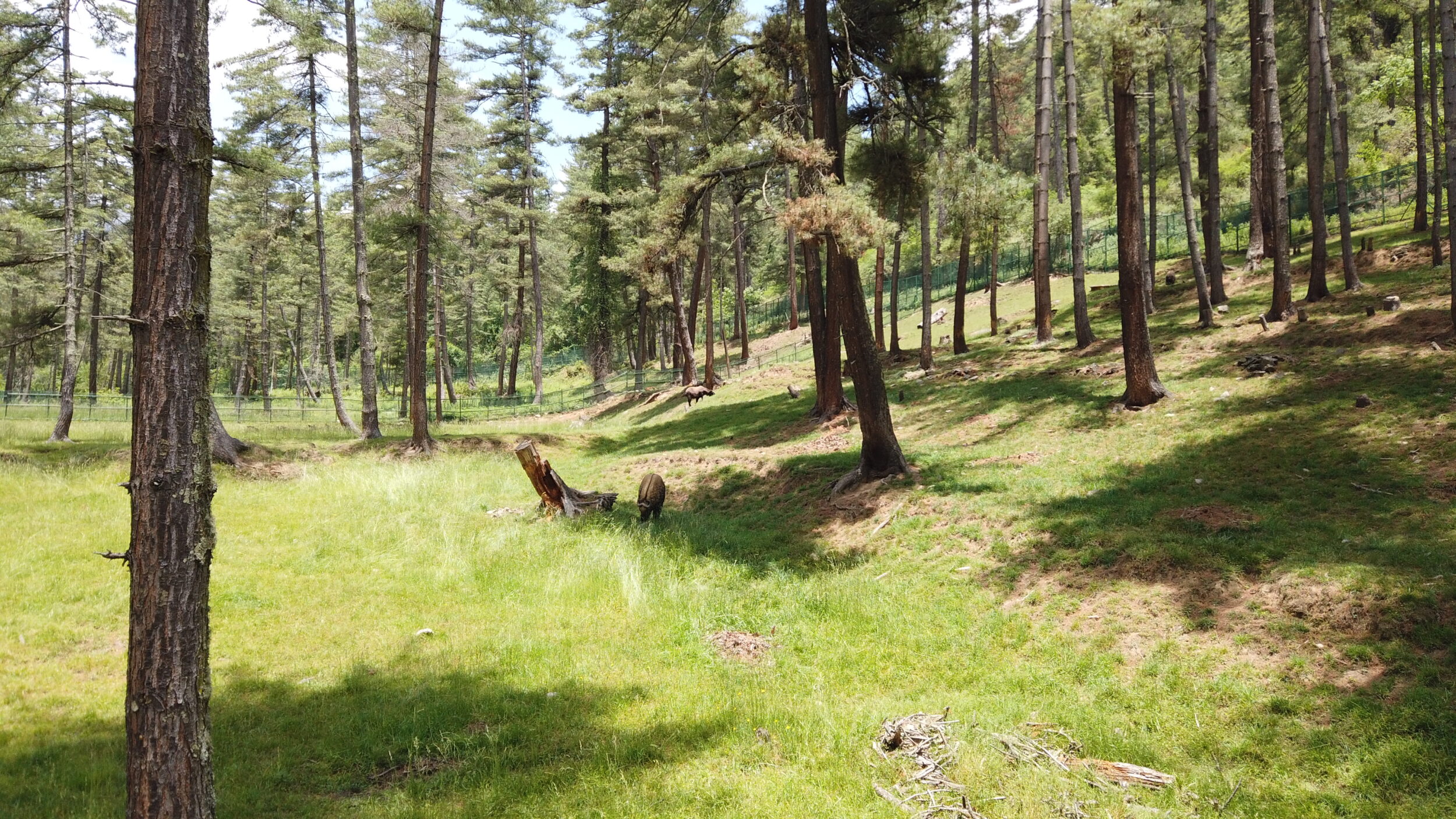
We go to a wildlife park to see the Takin, an animal present in Bhutanese legends. There’s a model at the entrance.

The park is fenced and the animals can be far from or near the entrance. Today, they will be super far and we’ll have to walk a bit to see them, which annoys me because I haven’t gotten used to the altitude yet. I’m having a lot of difficulty breathing.

There they are! As big as the model at the entrance. They are very peaceful apparently, vegan, and lazy. In the park, there are also some deer, some pigs, and a shady café that looks very nice.

The Post Office
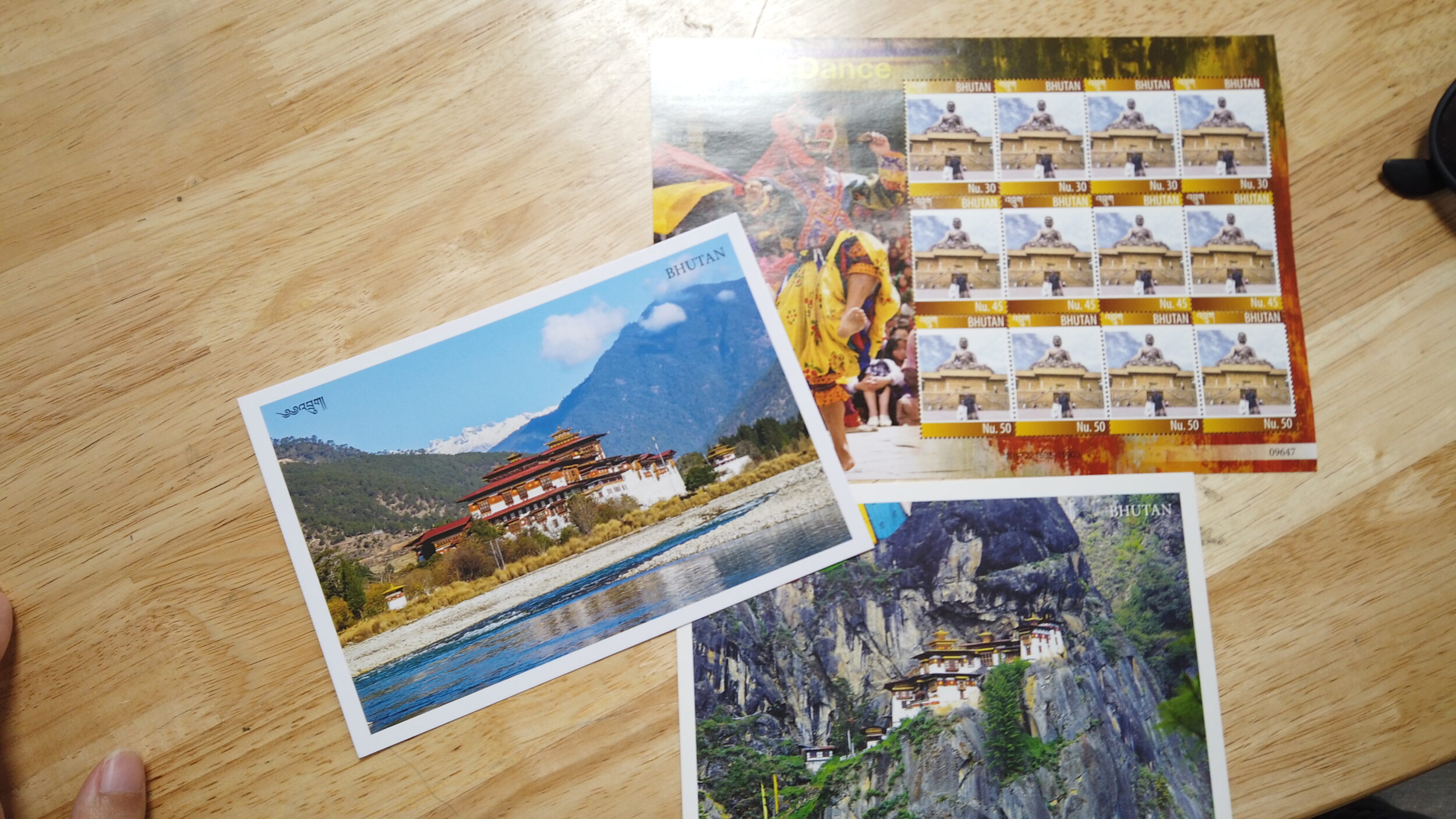
We then head to the post office. Since the 1960s, Bhutan has been making stamps more original than the last to attract philatelists and thus boost economic activity. You can even have personalized stamps made. Not just as a souvenir—these stamps are usable! I know it’s not very visible, but that’s us on the stamps hahaha. All for 500 Nu. And it only takes one stamp (30 or 50 Nu) to send a postcard all the way to France!!! (about 50 euro cents). Apparently, European postal services will cover the difference for all parcels and mail coming from third-world countries (including China, hence a huge loss for La Poste with all those Alibaba parcels and other such nonsense).
Handmade paper
This workshop wasn’t part of the program, but the guide and driver asked what I liked, and I said “crafts,” so they brought me here. I’m over the moon! If Japanese washi paper is made from kozo bark, Bhutanese paper is made from laurel bark.

The branches are soaked in water so the bark can be easily removed.
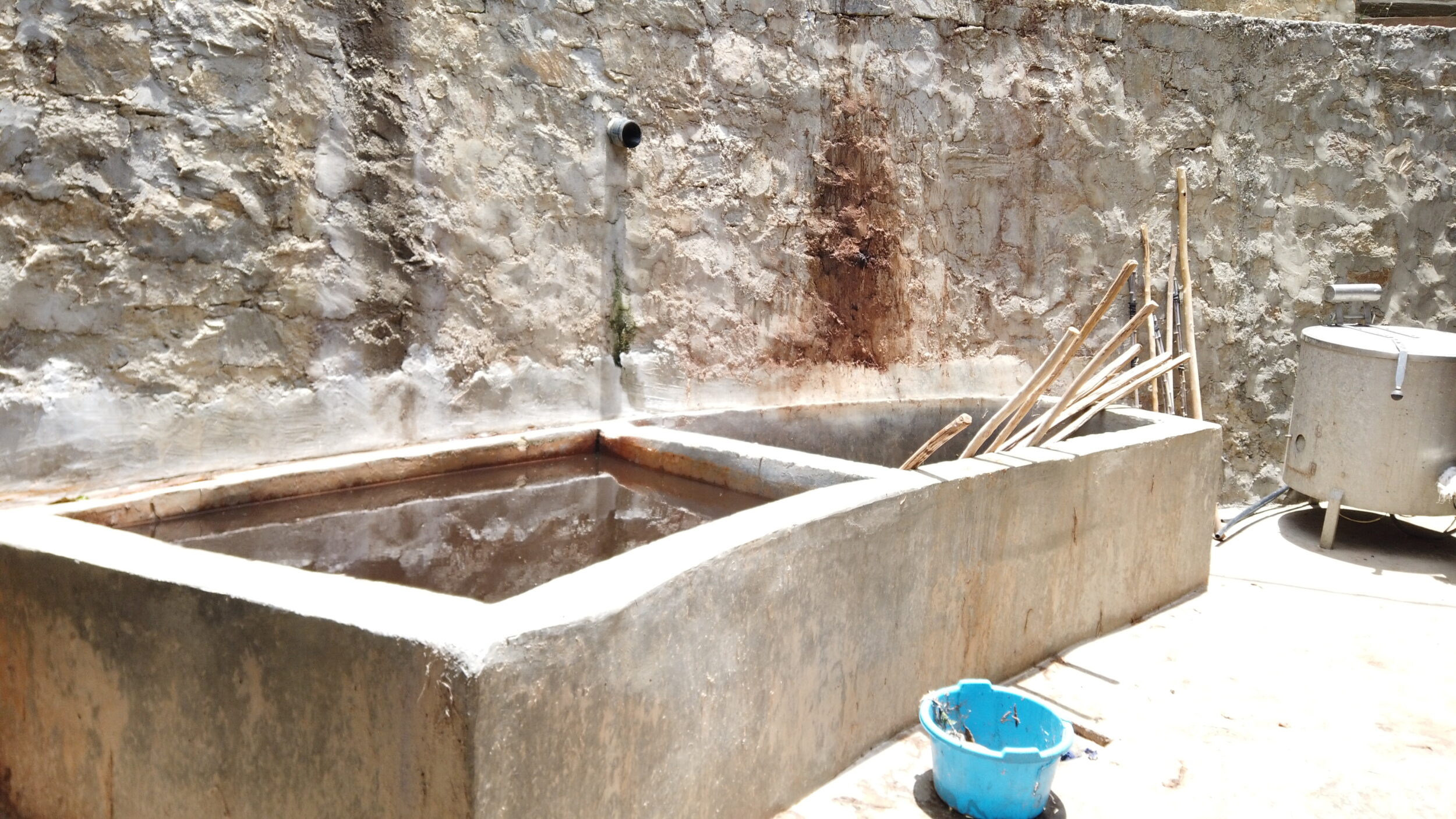
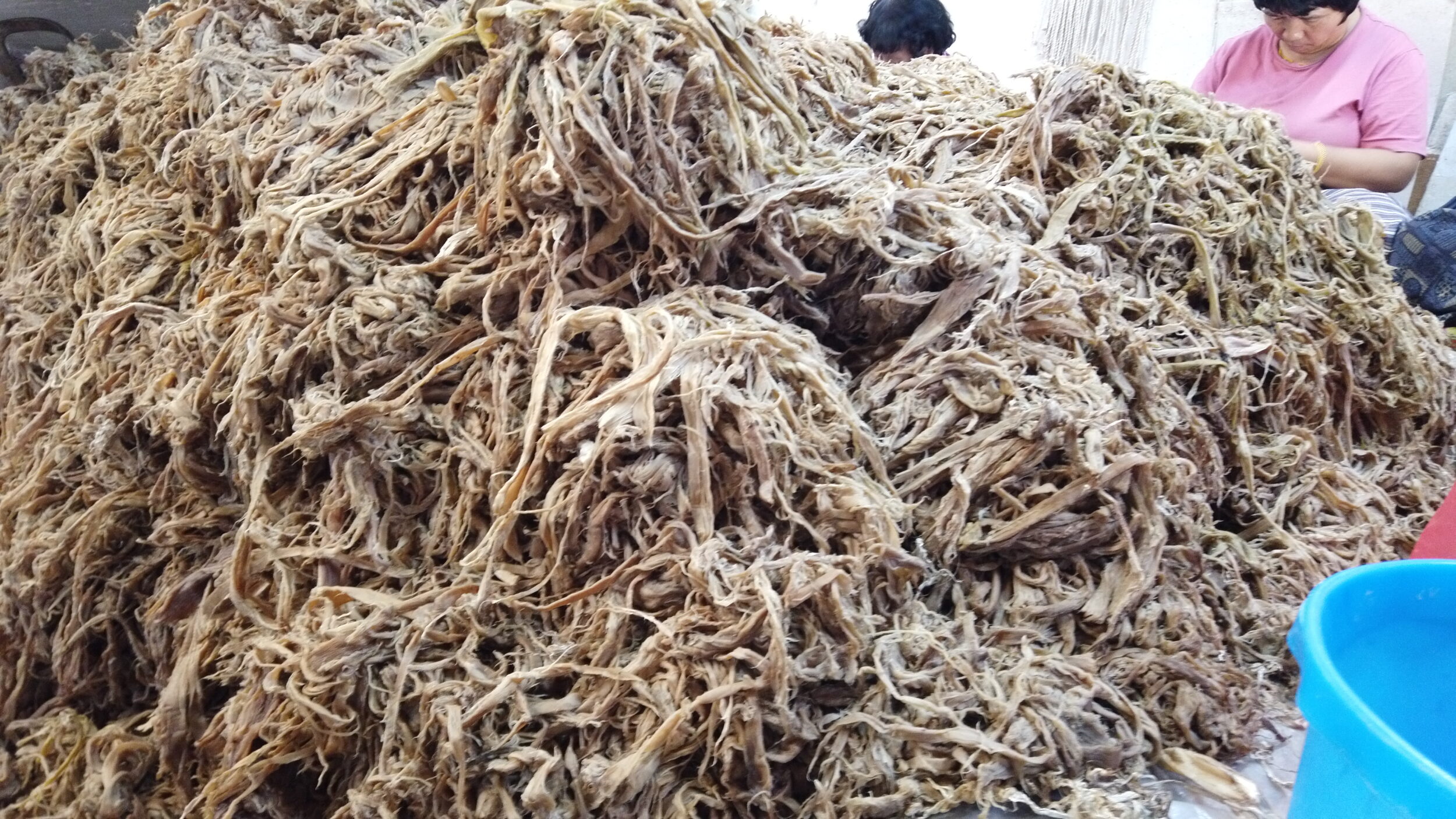
Then, the only machine used here is to grind the bark into a pulp.

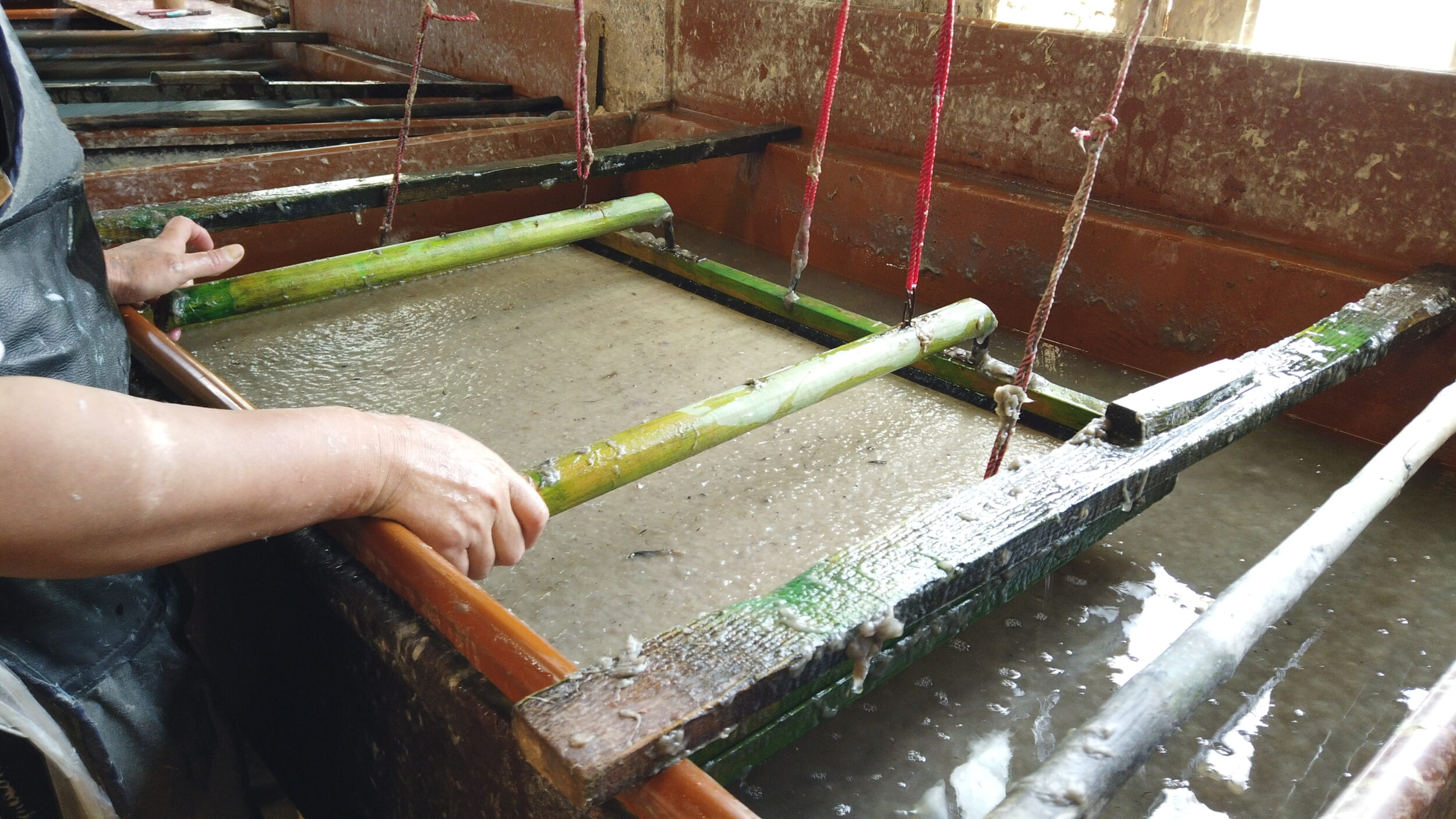
The pulp is mixed with another sticky plant-based pulp. Each sheet is handcrafted by dipping into the mixture. The mixture can be colored or not, and you can add flowers or leaves, or not.
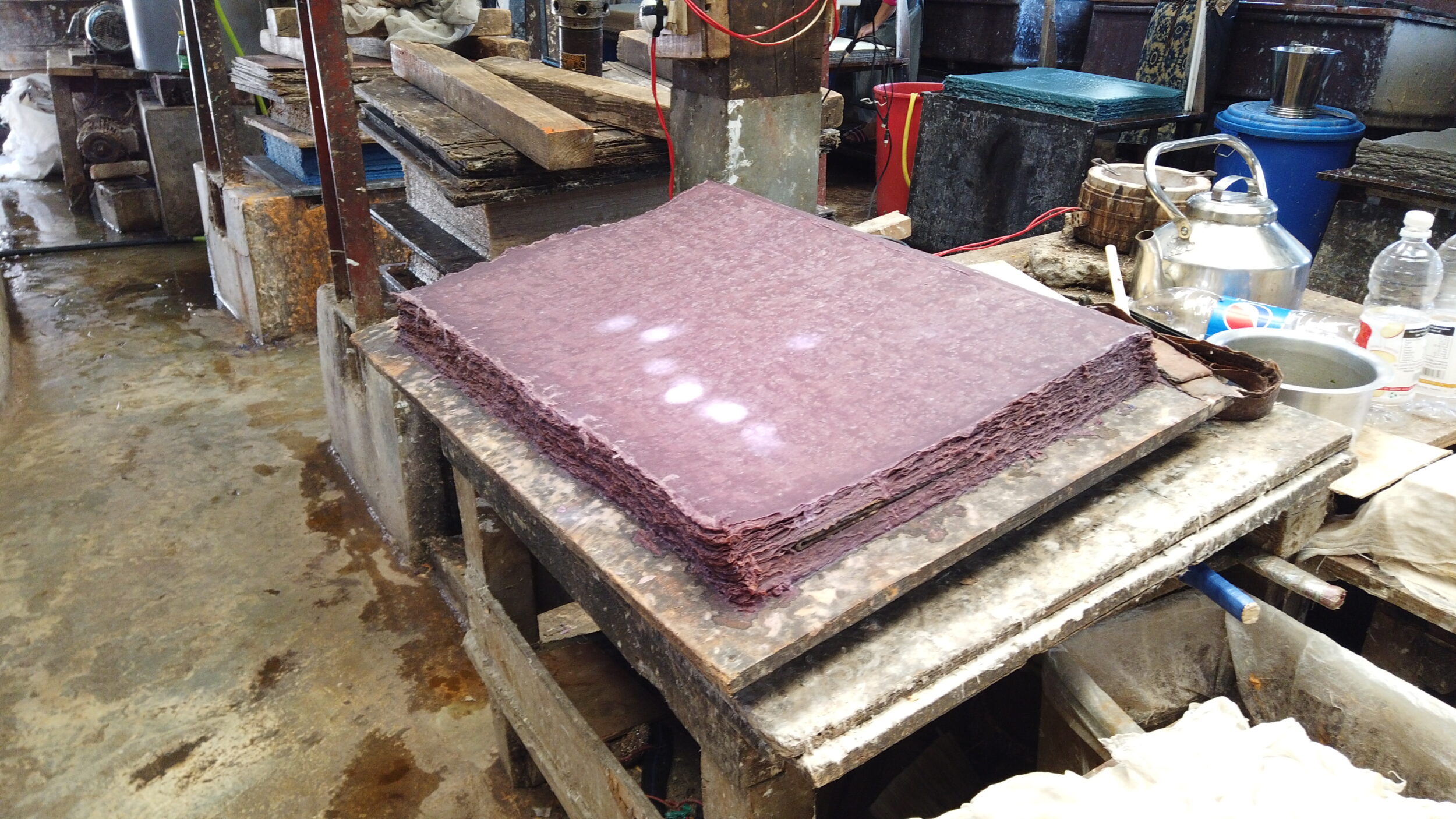

Then, they are dried individually on these heated metal plates.

The souvenir shop is pricey (1 sheet = more than 1€), I paid 1000 Nu for 10 sheets, but I buy them anyway because who’ll get the chance to come back? Normally, these handmade sheets are used for religious drawings or writing religious texts (in rectangular format); they must be used for quite precious purposes, not just for writing your shopping list.

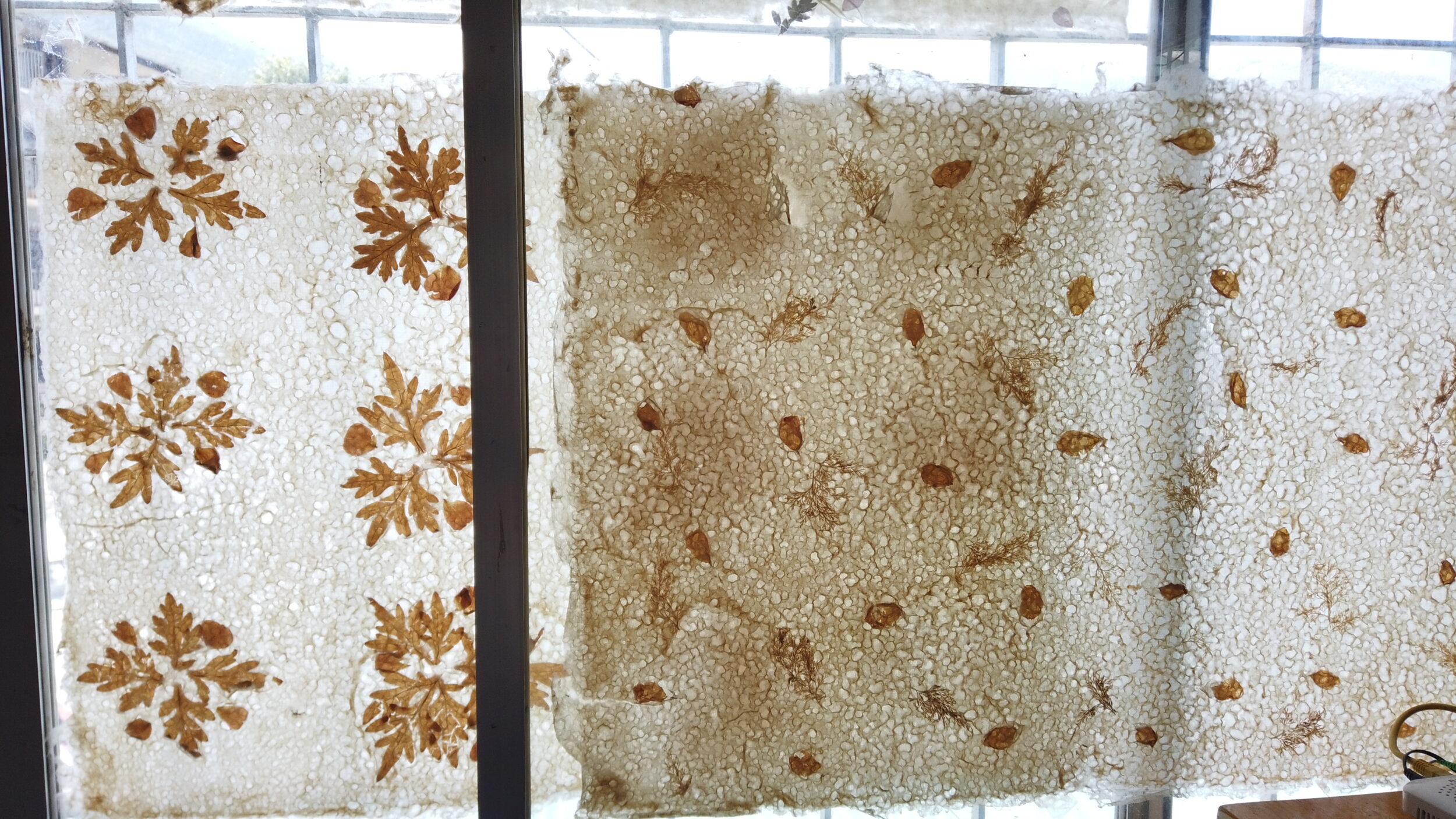
There are other sheets with holes, or decorated with leaves, so pretty. To get those “holes,” before lifting the sheet, they spray it with a showerhead, which pierces through the bark layer. The sheets stay sturdy but have that nice effect.
Folk Heritage Museum
We visit a museum that is actually a traditional 3-story house. It shows how Bhutanese people live. At the entrance of the house, there’s always a huge wooden penis statue, meant to ward off the evil eye.

Inside, we see a demo of traditional weaving. The scarves sold here cost only 800 Nu. I doubt they’re handmade.

The first floor is for animals, the second for food storage, and the third has a kitchen and a huge bedroom where the whole family sleeps together on the floor. It’s the typical layout of a traditional house. Because of the smoke, the kitchen is usually all black, but the heat from the kitchen also warms the adjacent bedroom. That helps in winter when it snows quite a bit in Bhutan. On the third floor is also the room dedicated to deities, where the annual ceremony takes place. My guide says all Bhutanese call on monks once a year. An astrologer will calculate the dates and tell him when to hold a ceremony at home. He’ll invite a monk, the musicians, and the ceremony also attracts neighbors who come to enjoy the blessings. Such a ceremony costs a fortune!
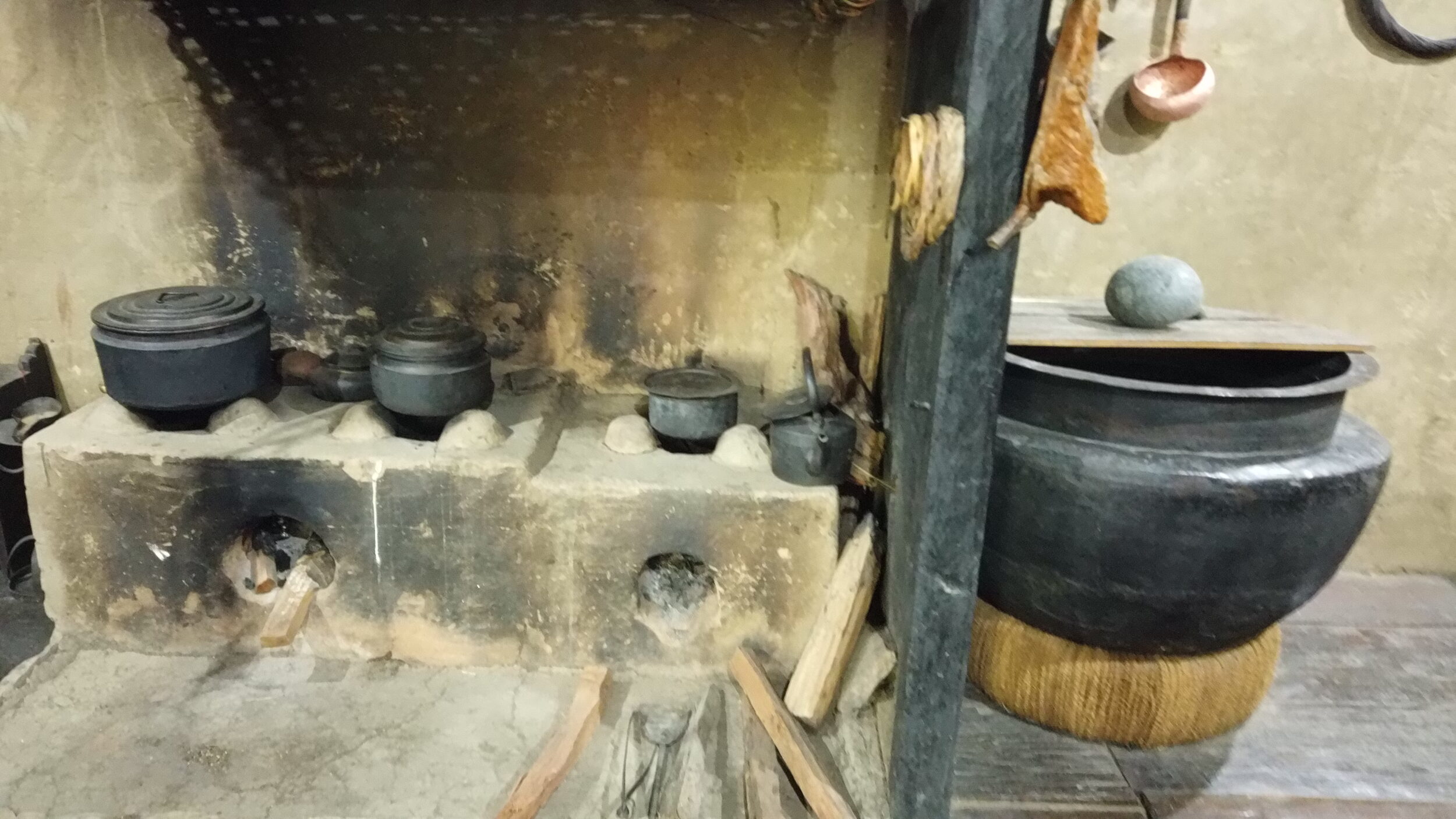
The museum’s restaurant serves Buddhist food. For us, it’s not vegan; we have the choice of “beef, chicken, fish, or pork,” and since we’re not sure if we should pick one option or several, we answer at random “beef,” “fish,” and “pork,” and we get all three. Actually, in Bhutan, you can choose all 4 options if you want 😀 It’s one of the best meals of our trip, even if the pork is mostly fat, but it’s good fat (like smoked bacon, dried over the kitchens).

National Institute for Zorig Chusum
We then visit a center for traditional arts (mostly religious) where about a hundred students and teachers work to create masterpieces in the 13 disciplines taught at the school (painting, wood carving, metal repoussé, embroidery…). To get the diploma, you need to spend between 4 and 6 years here; there are dormitories.
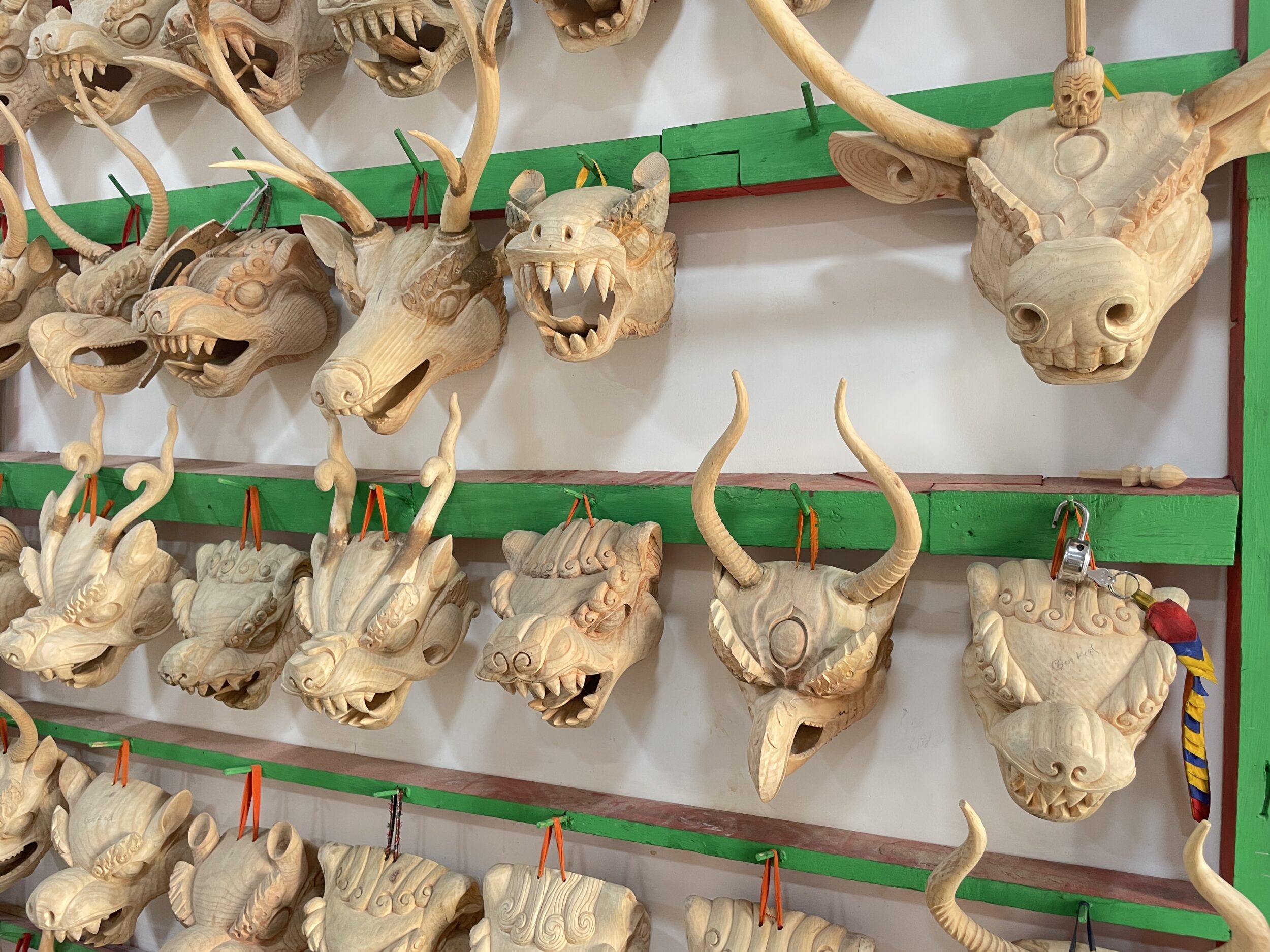

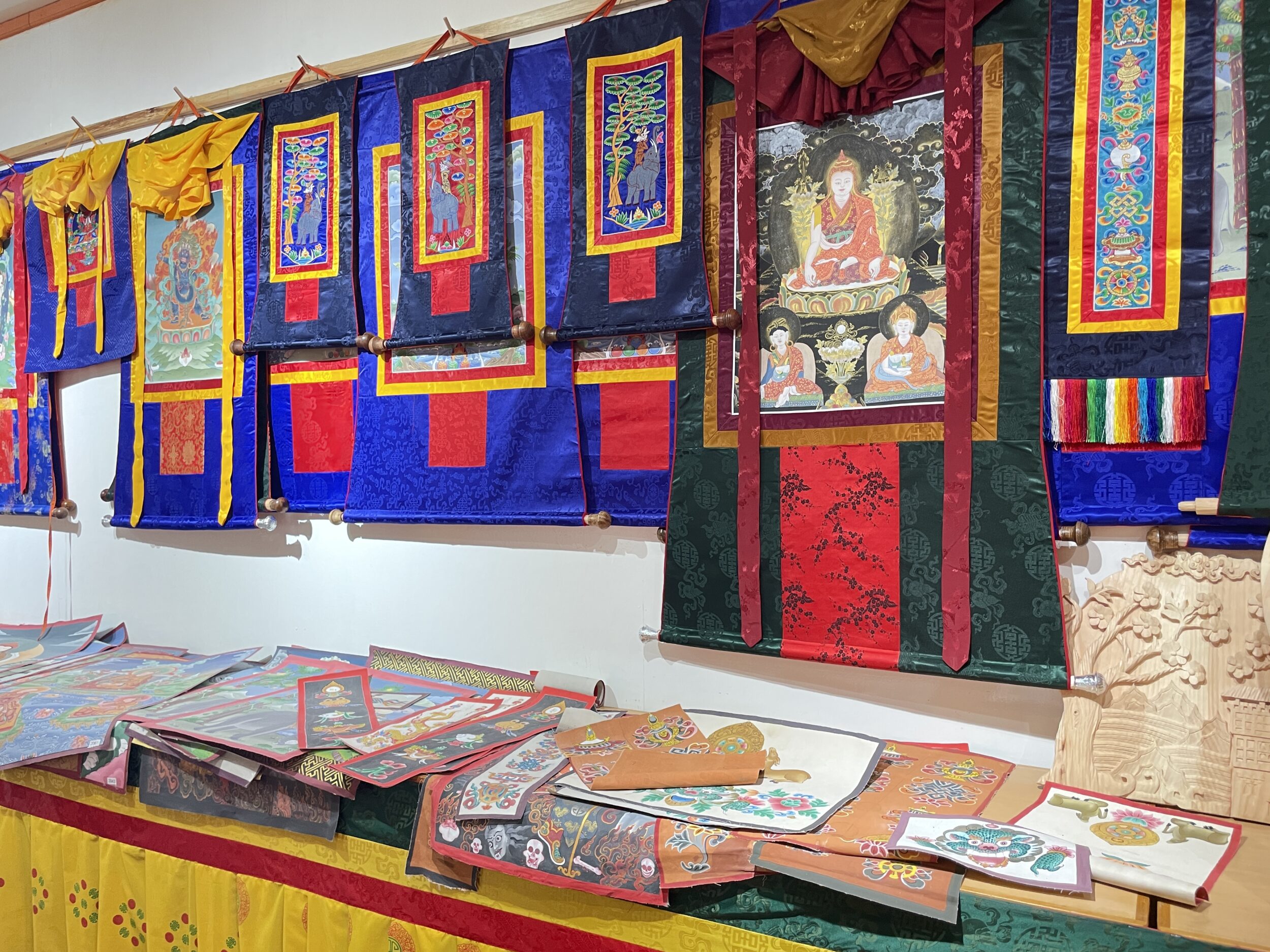
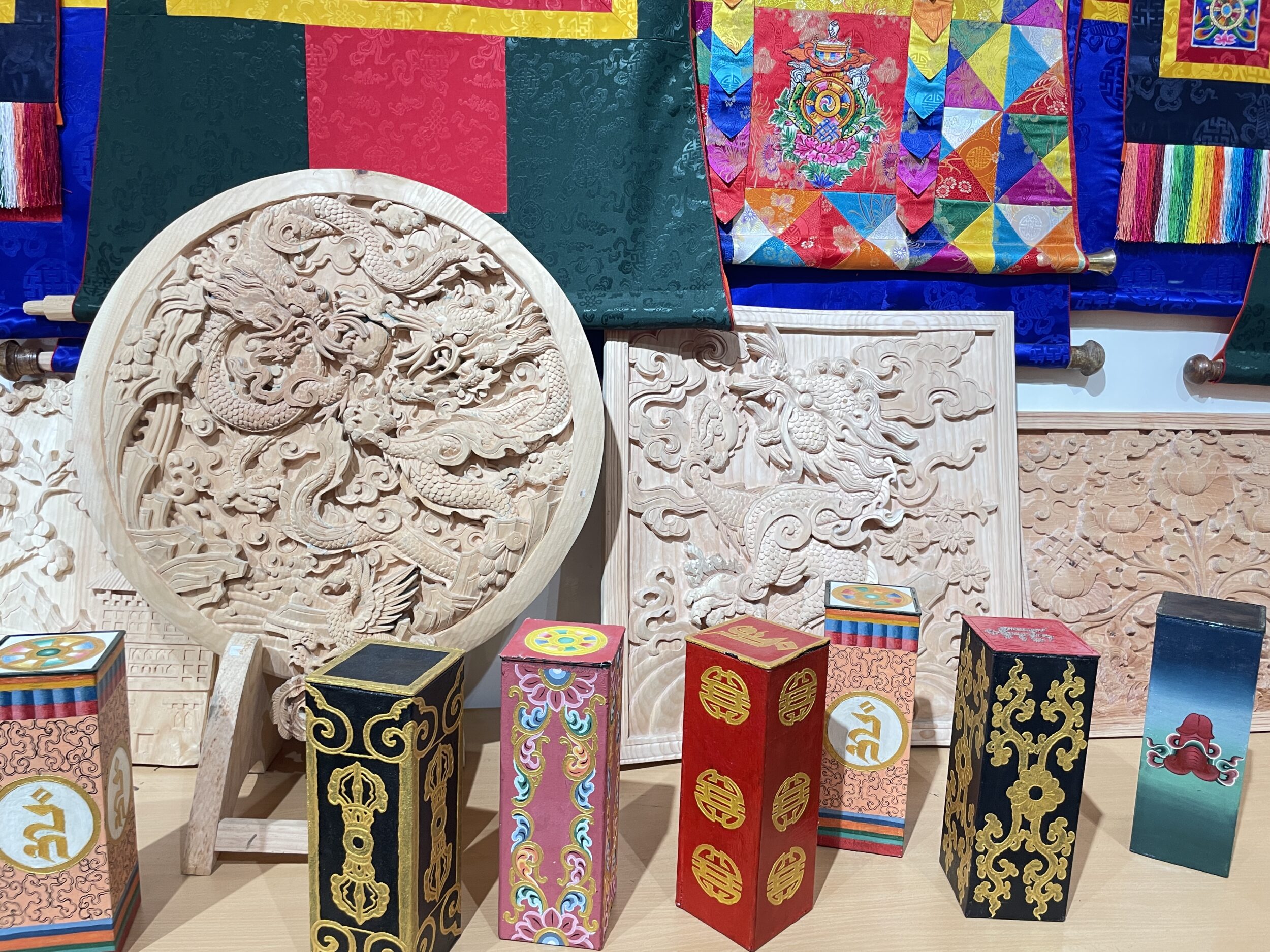
Religious art is codified, and we were able to observe a class drawing the famous painting “The Four Friends” depicting four animals helping each other. They must start by drawing the structure (very precise) in pencil. Thus, all students’ paintings look alike. In the mandala class, same thing, you must respect the proportions; you can leave a tiny bit of room for creativity, for example, the color shades differ slightly, but it remains codified. That’s why the murals and sculptures in temples are like exact copies, because they all come from the same school. I didn’t dare ask the price of a mandala, but it seems very expensive as it takes several weeks to make one. Moreover, mandalas aren’t hung on the wall like paintings; they are stuck to the ceiling.
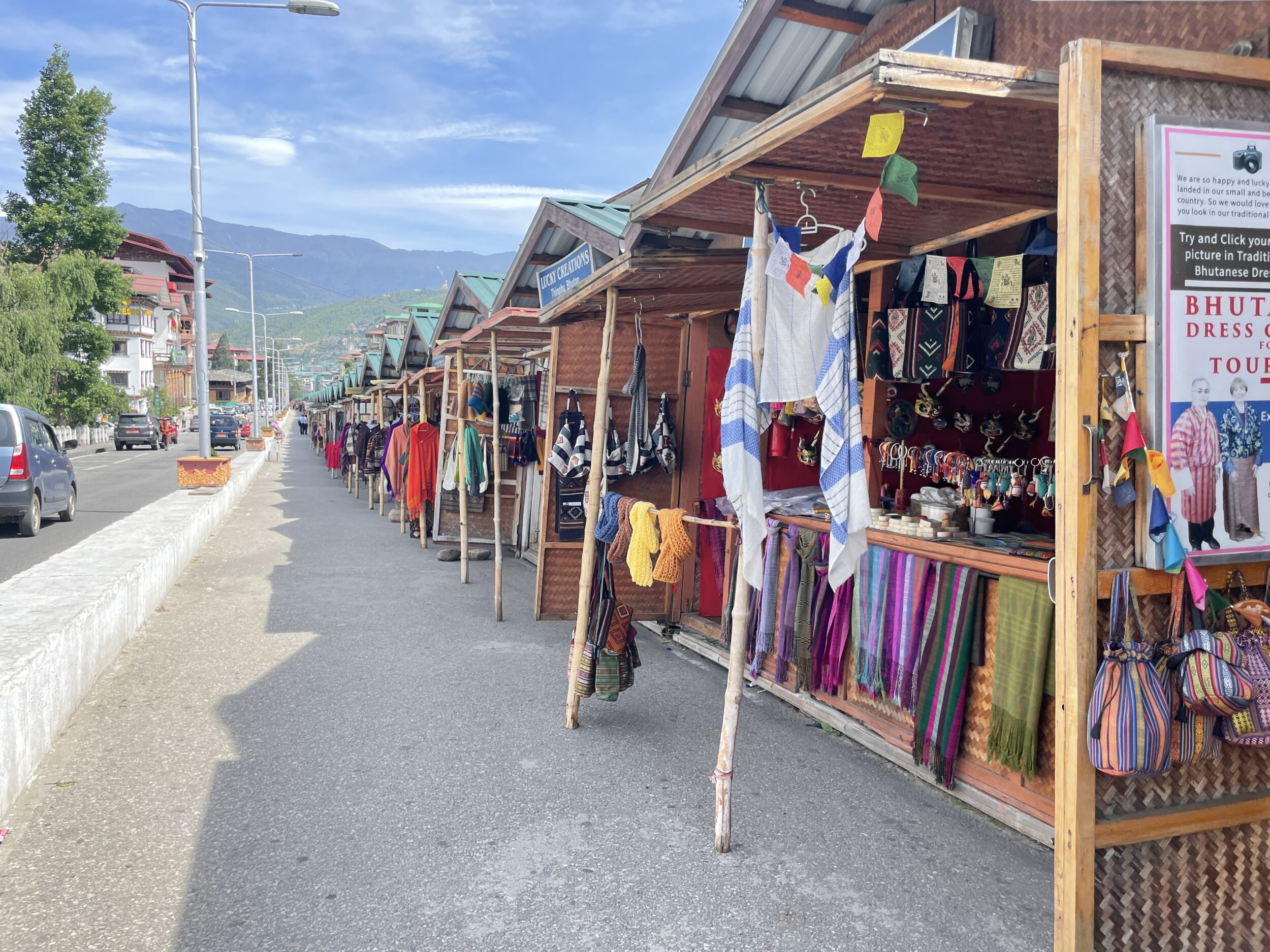
We’re taken shopping (for souvenirs) to a street with 60 shops in a row. I admit nothing really interests me; I already have too much stuff. I wanted to buy a cashmere scarf, but cashmere doesn’t come from here so I couldn’t get my hands on one.
Local market
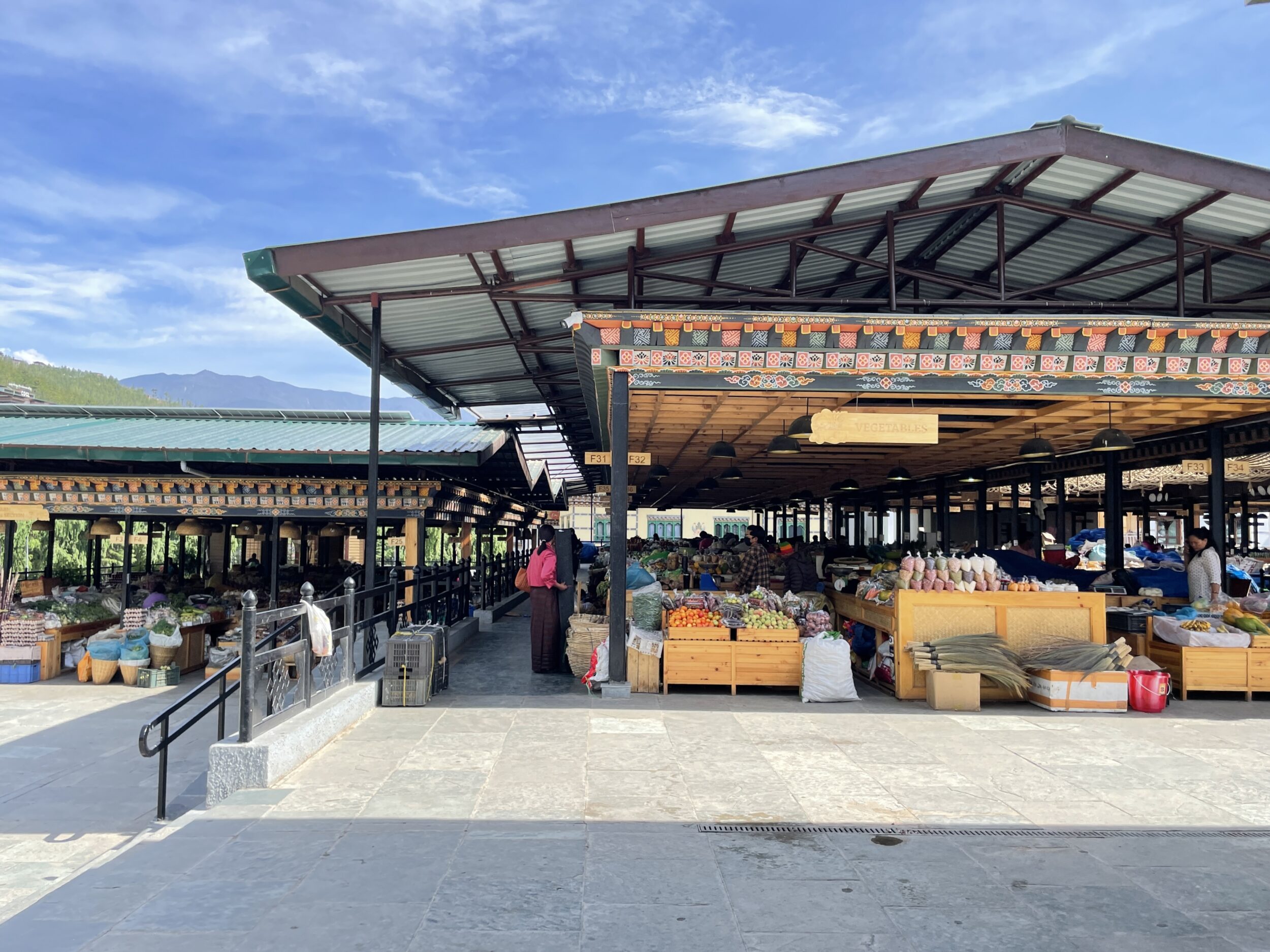
We quickly visit the local market and discover, among other things: fermented cheese that looks like candy.
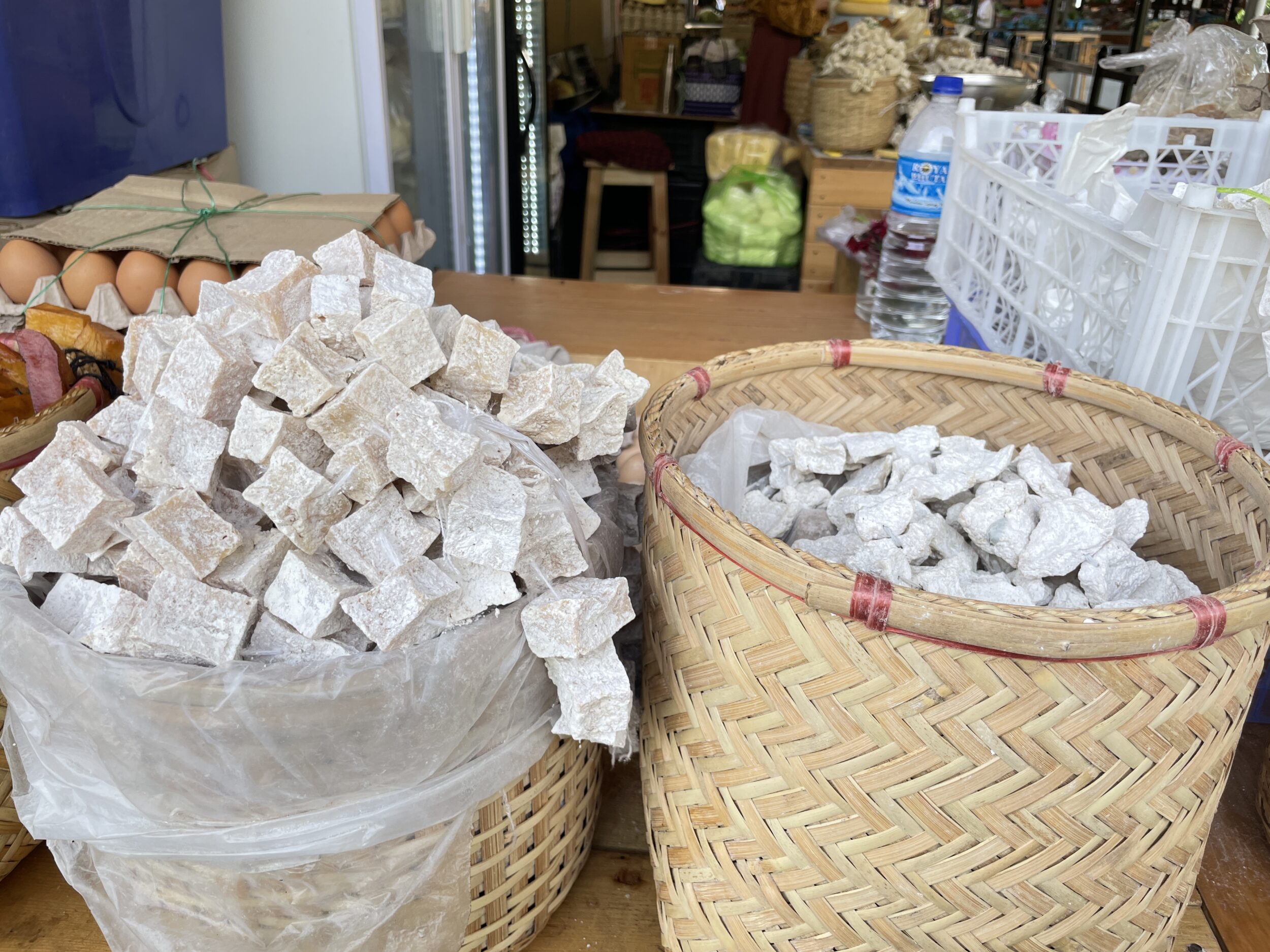
Normal cheese that looks like bread.

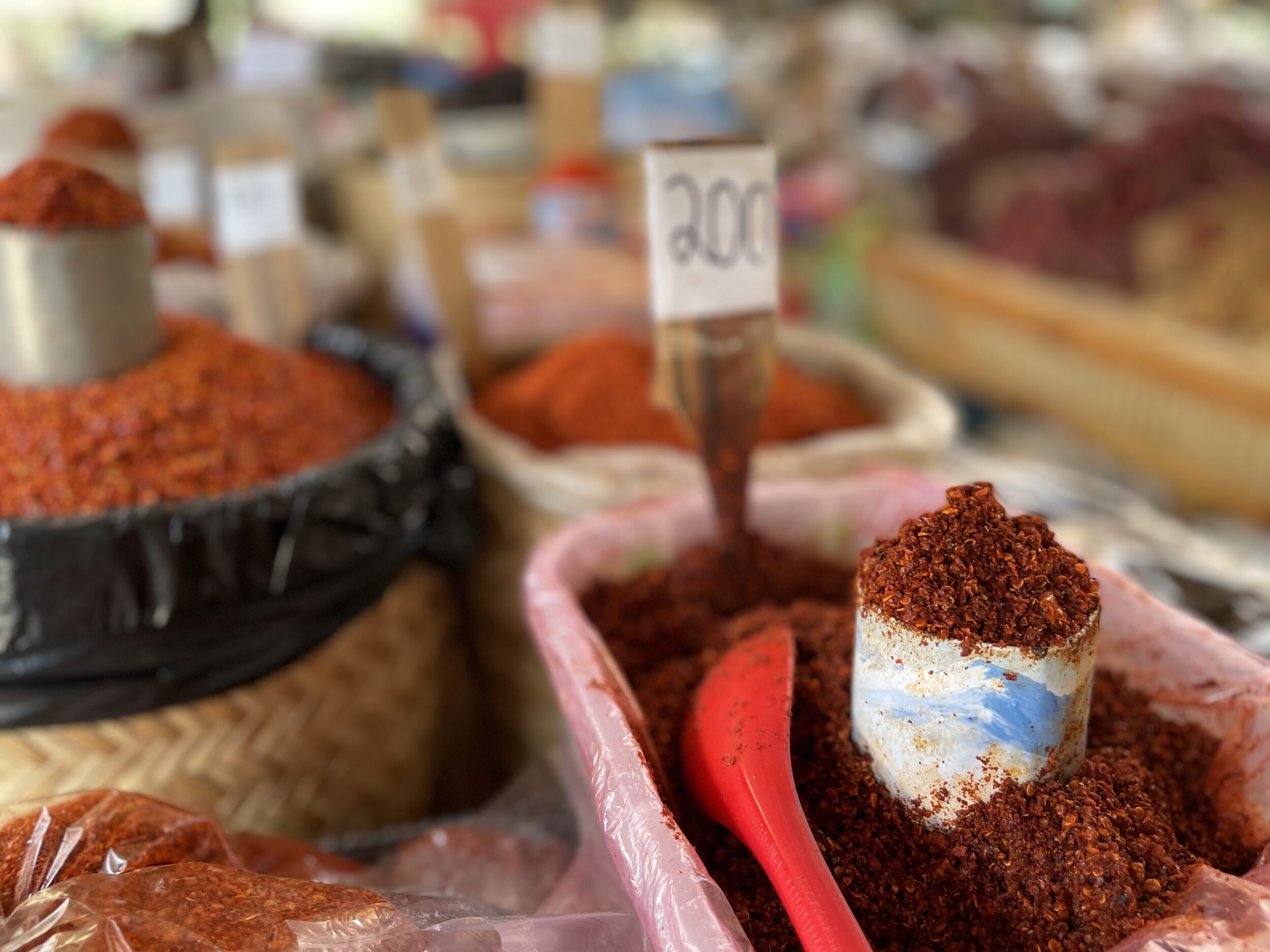
All kinds of chili.
The famous butter for butter lamps.
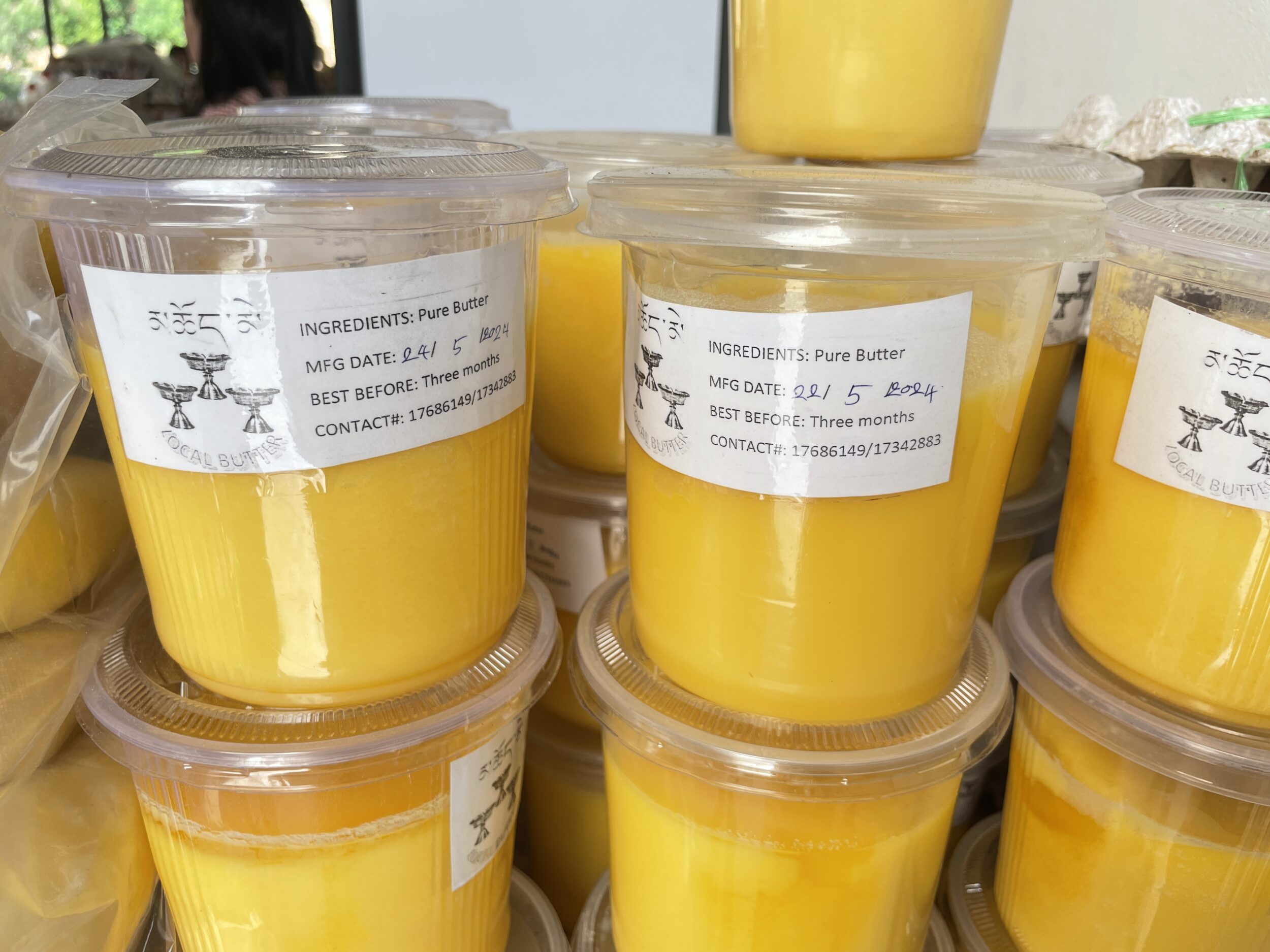
Vegetables we’re served at the table but don’t necessarily know the name of.


Archery
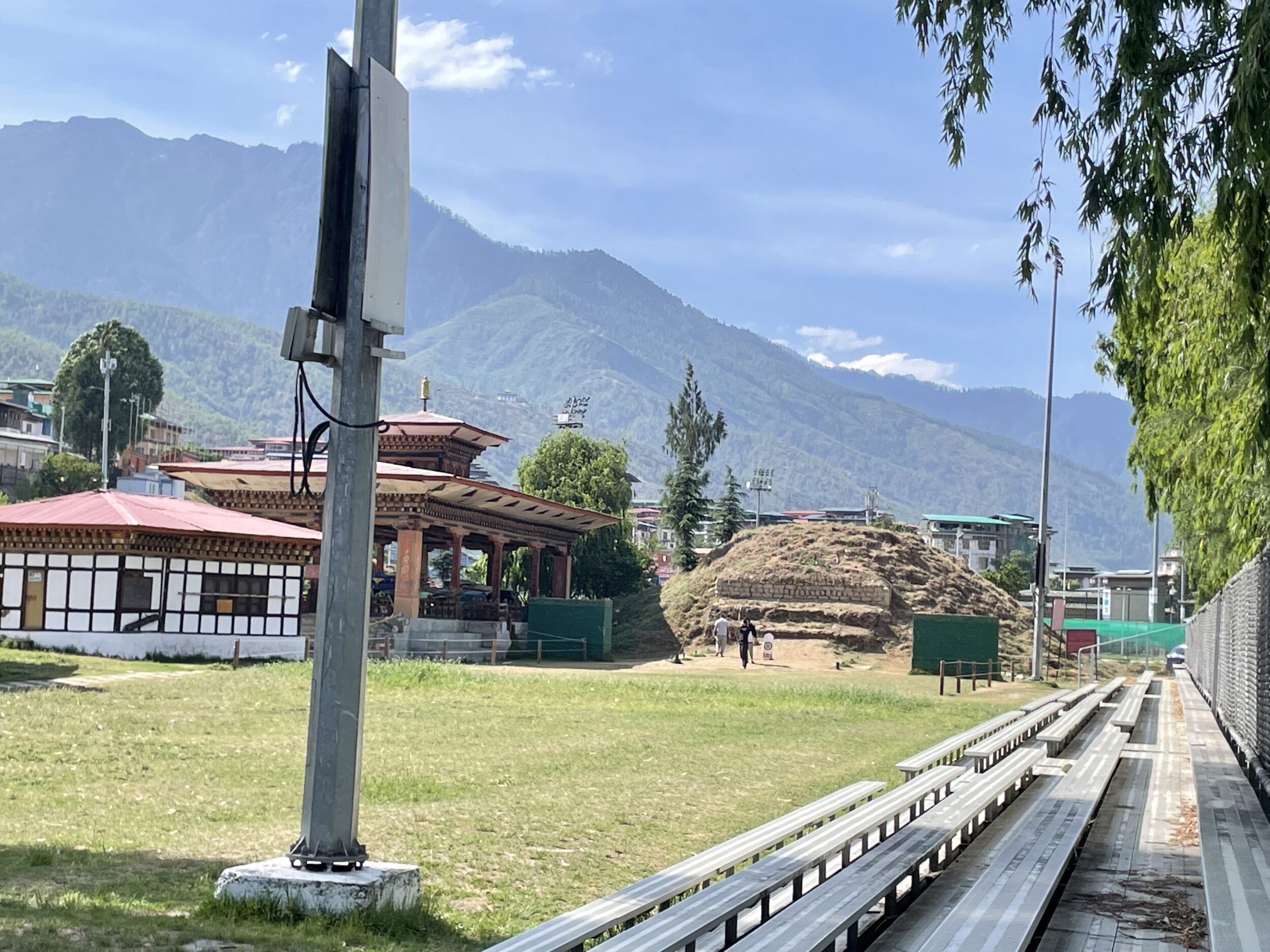
Next, we are taken to see a place where enthusiasts practice traditional archery. The target is 130 meters away and they are incredibly good! As spectators, we can’t even see the arrow in flight and also have trouble seeing where they land. They are good shooters and yet they don’t win anything at the Olympic Games because it’s not the same distance 😀
After that, we head back to the hotel super early because we are extremely tired. The altitude did us in.
In the evening, again Indian food this time, but there’s no more buffet. The hotel serves us exactly the same dishes as the day before (buffet), but I don’t know why, when it’s put in individual bowls, it becomes incredibly appetizing and I eat with much more appetite than the day before 😀
Okay, a word about our hotel, they don’t seem very professional. Not only did they forget the reservation made by our agency, but when we asked for a bottle of water in the evening, they delivered the bottle the next day, waking us up at 6 a.m.!! At 10 p.m., they ask us to choose what we want to eat for breakfast and at what time. We’ll end up leaving with empty stomachs after a 30-minute wait. Anyway, I think in big cities, the service leaves much to be desired, but in small towns, the structures are smaller and they manage much better!
JB reads in the local newspaper the “problems” of the country. It’s such a problem-free country and the headlines talk about the risks of the monsoon season which hasn’t arrived yet, and the 300 Indians who arrive in Bhutan every day. There are even testimonials from various tourists complaining about the lack of infrastructure at the land border (only one office to pay the entry fees, only $12/day for Indians vs. $100 for us). It’s chaos with 300 Indians OMG OMG! Besides, we are reminded every day that there is an invasion of Indian tourists because it’s their holiday period. It makes us laugh so much, if they only knew how many tourists hang out in the streets of Paris every day!! 😀 I would love it if one day, the headlines of French newspapers only complained about such minor problems. And of course, not a single line about crimes, because there are none!
Part 2: Practical Tips
Our agency is called Bhutan Inbound and we opted for their 7-day 6-night tour but I think 5 days would have been enough. It’s a completely private tour because we are in the low season (late May – early June).
Cost: $884/person for round trip from Bangkok
$1120/person for the 7-day 6-night tour, all inclusive, visa included
Plan for $100 in tips for the driver, $120 for the guide
And personal expenses (depending on what you want to buy), we spent about $100/person on incidental expenses.

