

Journal of a trek to Everest Base Camp (Nepal)
I’ve always dreamed of going to Everest Base Camp. The opportunity came up this year and I went with my brother Vincent. Anh stayed in Europe.
D-1 – Wednesday, October 4, 2023: departure tomorrow!
After 3 weeks of preparation in the Massif Central, a few days of sightseeing in transit in Abu Dhabi, 3 days in Kathmandu to meet our agency (which lends us some gear), perfect our equipment, and do some sightseeing, we’re ready!
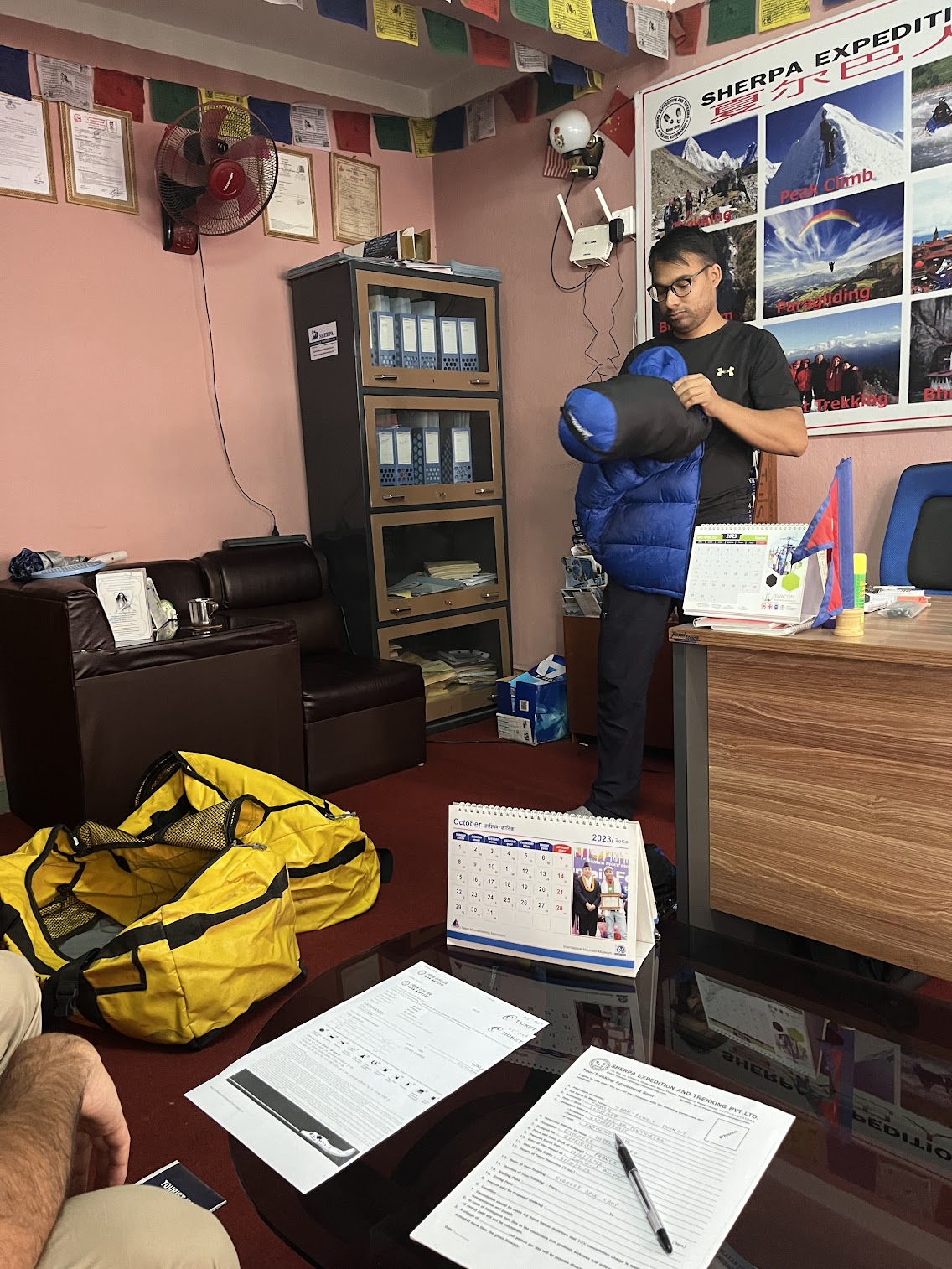
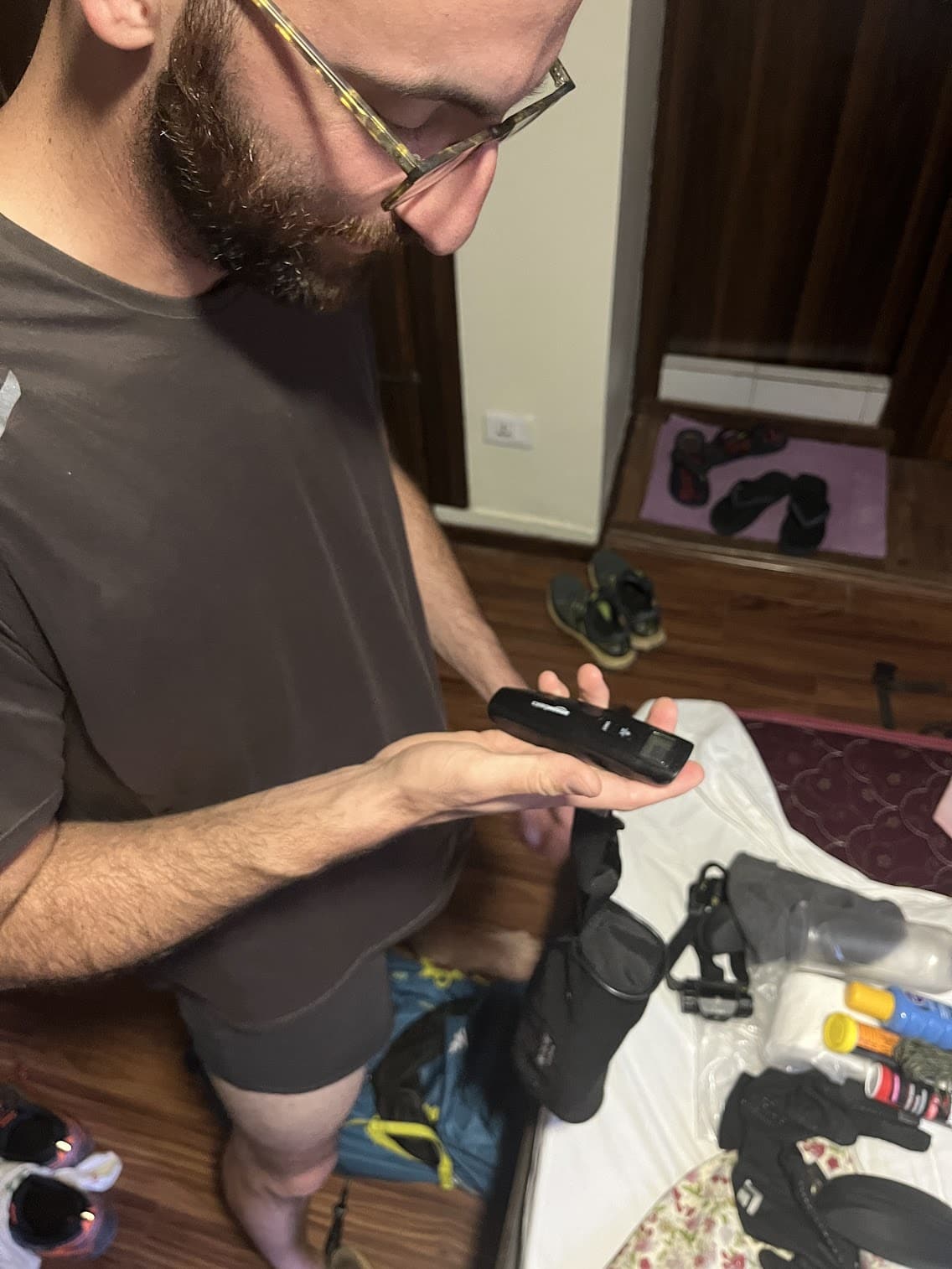
Yesterday and today, we’ve packed and repacked our two personal bags: one that will be checked in on the plane and given to the porter, 10kg max, and one for us as carry-on, 5kg max. It’s all about the grams, and we were pretty glad to have a luggage scale. I learned that my rolls of TP weighed 150 grams each, that’s a lot!
On top of the trek apprehension (will I handle the altitude? Is my gear warm enough? Am I physically prepared enough? …), there was the worry and uncertainty about whether we could even leave. Yesterday and today were very rainy and most flights between Kathmandu and Lukla have been cancelled. Several hundred trekkers are waiting.
We’re supposed to leave tomorrow morning, the forecast is good, but Ram, the agency manager, is already talking about plan B: taking a helicopter, doing a 4-hour drive to depart from Ramechhap, the other airport that serves Lukla, …
So I spend a good part of the day freaking out, checking the weather forecasts every 15 minutes.
We’ve been talking about doing this trek with my brother Vincent for years, and we’ve been decided for 10 months. Now, we want to leave!
We can’t wait for tomorrow!
D 0 – Thursday, October 5, 2023: Flight to Lukla?
Woke up at 6:15am. After freaking out all day yesterday, I surprisingly slept well. The sky in Kathmandu is clear and the weather in Lukla is good all morning, we’re sure we’ll be able to leave!
6:45am: A driver picks us up from the hotel and we arrive at the airport about half an hour later.
At the airport, we first wait at the counter of the airline Sita Air Ltd without knowing when we’ll leave.
The area where we’re waiting is where the check-in counters are. It smells like adventure! We see the counters of Budva Air, Tara Air, Yéti Air Lines, Guna Airlines, … so many airlines on the blacklist (all Nepalese domestic airlines are!). A little less than half of the counters are for helicopter flight check-ins!
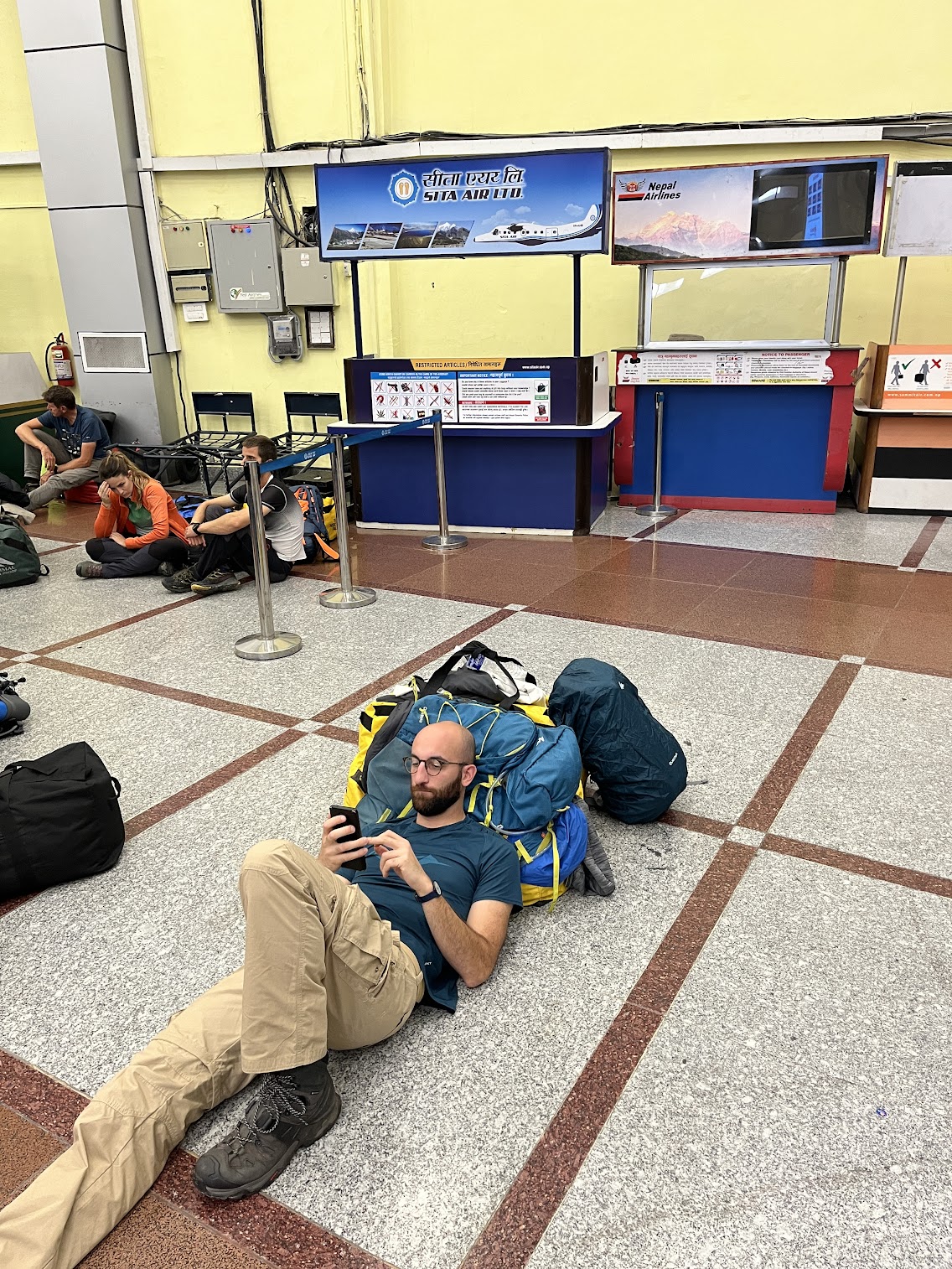
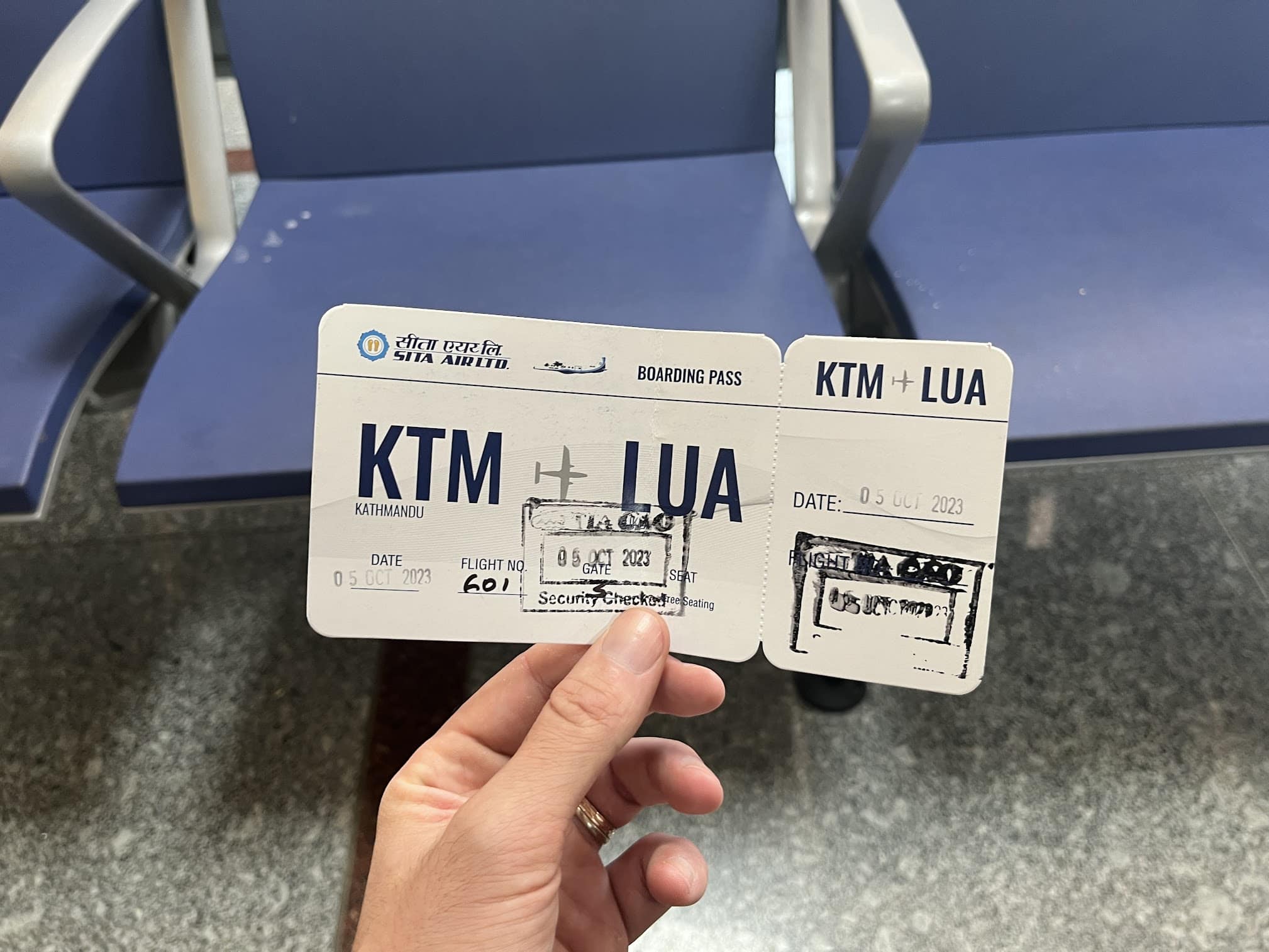
At 9:30am, after a good two-hour wait, our counter opens. Our bags are weighed, we’re a few tens of grams over, but it’s fine. And there we go, we have our boarding passes ! We still don’t know what time we’ll leave, but we’re sure it’s today!
We wait at the boarding gate and Ram, our agency contact, tells me via WhatsApp that we should leave around 10:30am. It’ll come fast!
Alas, time passes, and still no announcement…
We finally figure out that, following the cancellations of the last two days, a lot of tourists went to Ramechhap. The company’s two planes are doing Ramechhap – Lukla round trips to clear the backlog before coming to pick us up in Kathmandu.
At 11:45am, after almost 5 hours of waiting, we’re finally there, a flight to Lukla is announced. We go to the boarding gate. No luck, the flight leaving is 603, we’re on 601.
We watch enviously as the 603 tourists leave by minibus to their plane. We’re convinced we’re next, and Ram tells me that our plane is on the way and will arrive in 15 minutes.
More than an hour later, we’re shocked to see the 603 passengers come back, they didn’t leave!
It’s infuriating: the weather is nice in Kathmandu, it’s nice in Lukla (we can see a live webcam of the landing strip on YouTube), but on the way, the weather deteriorates, and the takeoff authorization doesn’t come. We console ourselves a bit by saying that at least they’re careful about safety.
But we’re starting to understand that the departure is very compromised.
Finally, at 3pm, the weather turns in Lukla and the flight is cancelled, after almost 8 hours of waiting!
The waiting is one thing, but the uncertainty is torture. We were convinced we’d leave and were attentive all day, ready to jump out of our seats to go. We had no information on site and only Ram gave us some news via WhatsApp. How long it was!
Talking with a few fellow travelers in the same boat puts things in perspective. For some, this is the third consecutive day of failure. We learn that others drove four hours to Ramechhap, couldn’t take off, and now have to make the return trip (there are so many stranded tourists that hotels there are fully booked). Some travelers will have to try to reschedule their return flights home because they hadn’t accounted for this kind of delay.
We’re glad we gave ourselves some buffer: our return flight is only a week after our trek was supposed to end. Still, we really want to get going!
At 5:30 PM, there’s an emergency meeting at the agency. Poor Ram is doing what he can, but he’s not a magician—he’s just had three consecutive days where most of his clients couldn’t fly out. We understand that with all the delays stacking up, tomorrow is likely to bring the same kind of hassle as today, even if the weather forecast looks fairly promising.
We finally settle on the option that seems to give us the best chance of leaving: paying a supplement to skip the flight to Lukla… but by helicopter!
Even if this is the most favorable option, it’s not guaranteed either… but we’ll see tomorrow!
Day 0 – Friday, October 6, 2023: Helicopter to Lukla?
After yesterday’s grueling day, a driver picks us up from the hotel at 7:30 AM to head to the airport.
Everything goes smoothly: the weather looks good, and the head of the helicopter agency is waiting for us.
We were worried about a sudden price change (we have to pay the helicopter agency directly), but we’re charged the rate agreed upon yesterday ($180/person). The group of five passengers is complete to fill the helicopter.
We get our boarding passes, weigh our bags, and weigh ourselves before being told to wait at the boarding gate, where someone is supposed to pick us up 30 minutes later.
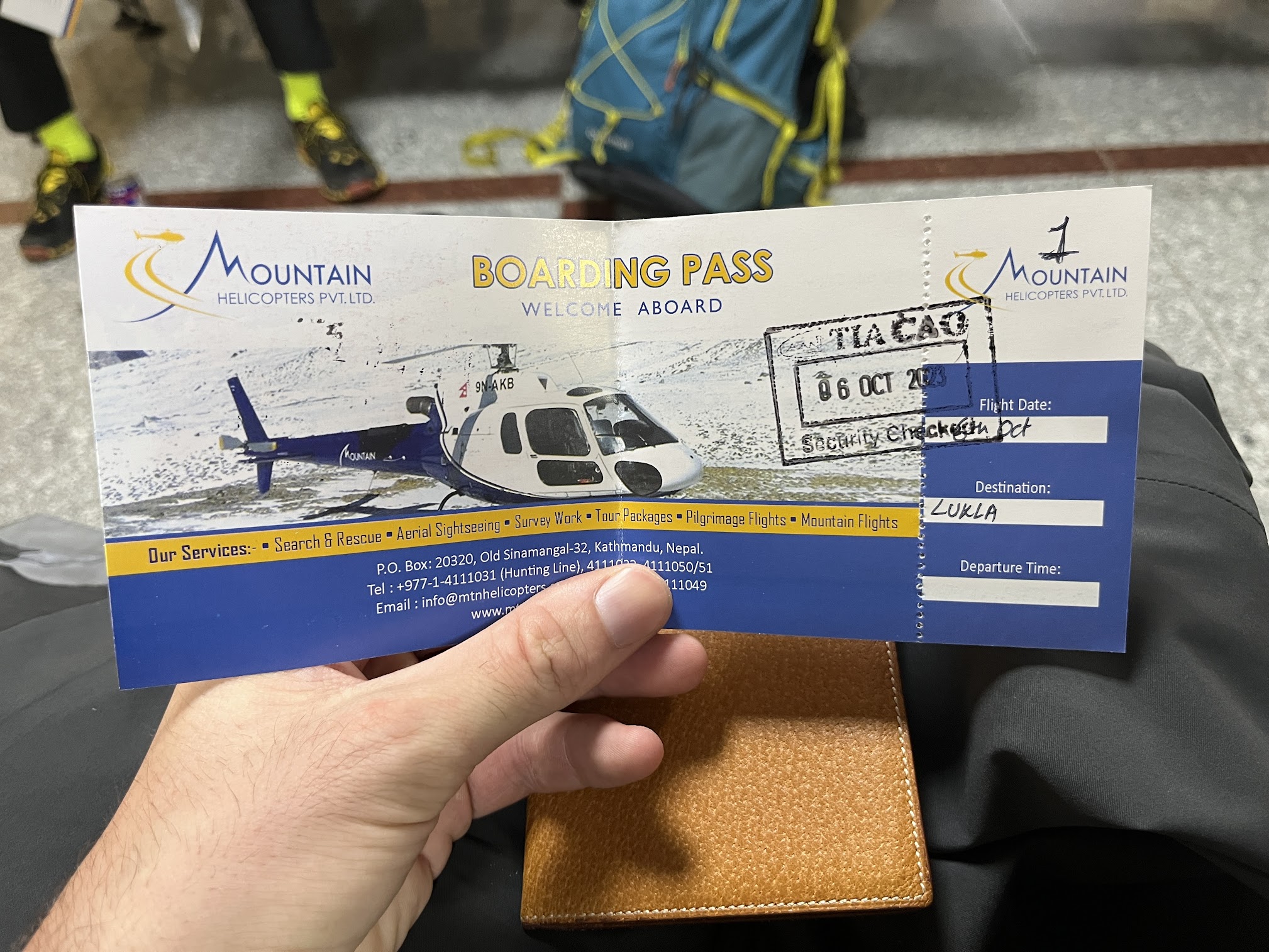
It’s actually an hour later that someone comes to get us. We board a van that takes us to the heliport at 9:30 AM.
After a 30-minute wait, we see a helicopter land from Lukla—looks like it’s ours!
Five Israeli tourists step out, looking exhausted.
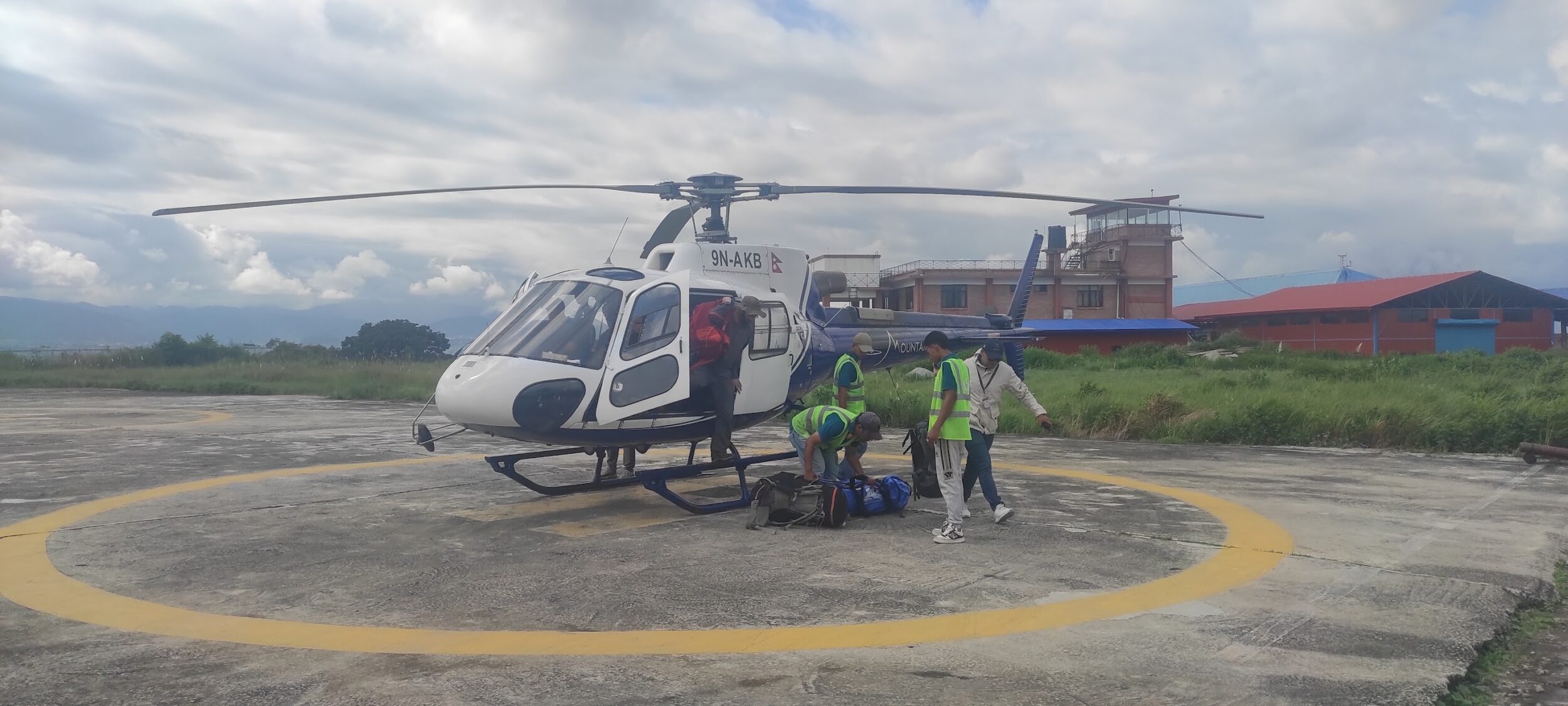
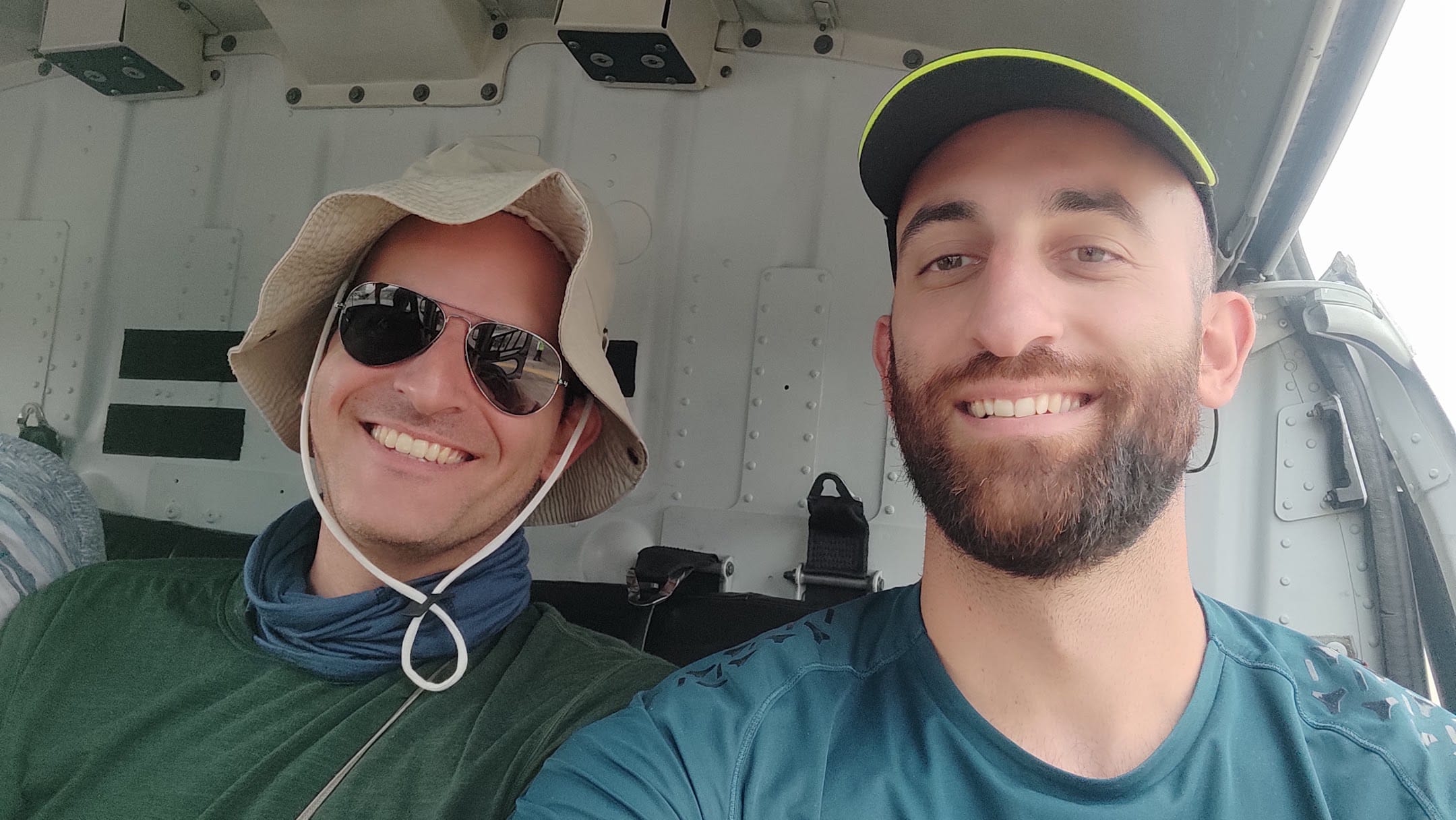
The technicians refuel. The Australian pilot gives us some safety instructions. We board, ready to take off. We’re ecstatic and send a few messages to let our loved ones know.
The pilot runs through his takeoff checklist, then requests clearance from the control tower.
We hear him reply, “OK, stand by.”
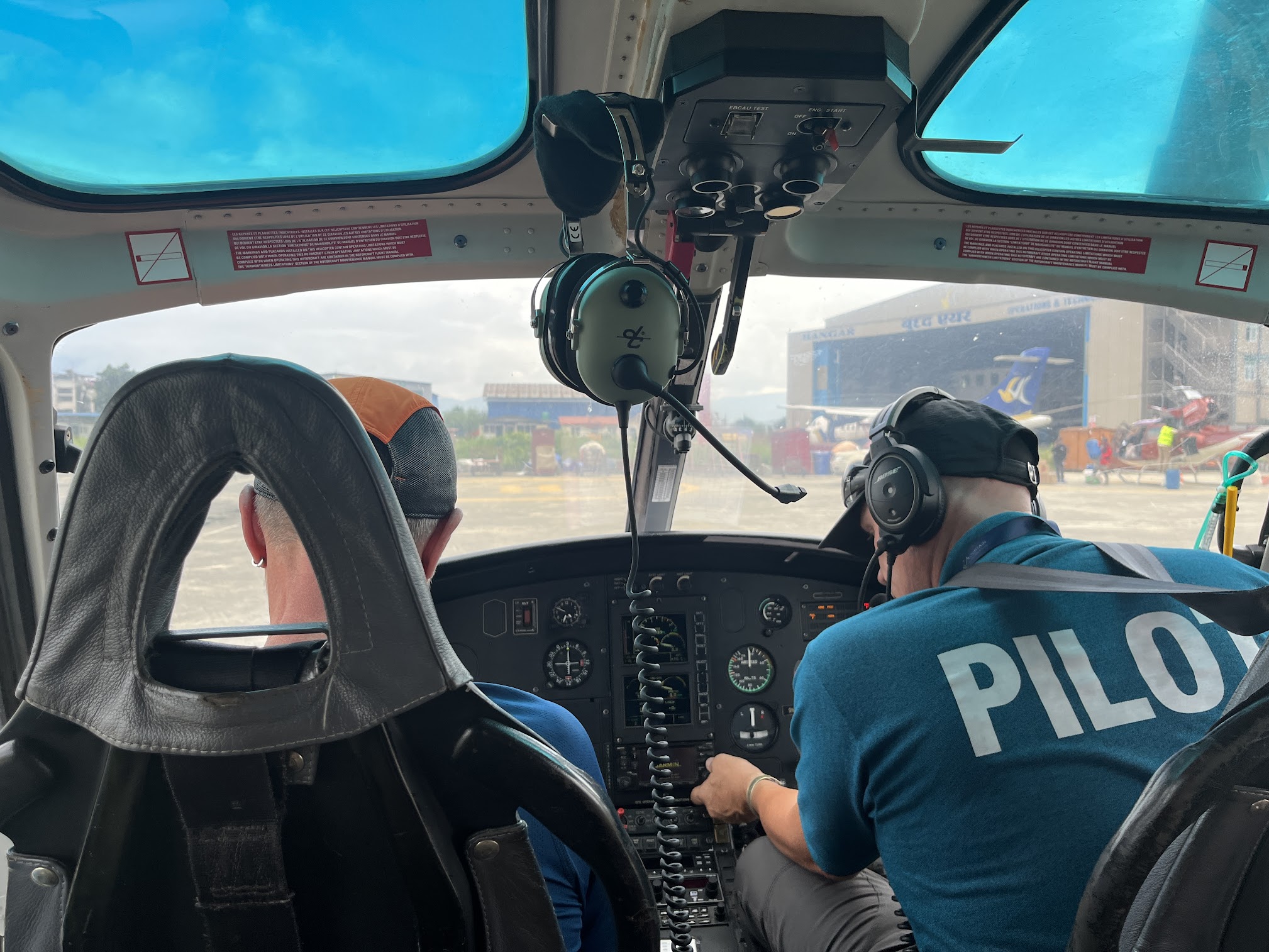
A real disappointment!
The takeoff clearance doesn’t come. And it never will. The pilot doesn’t quite understand why; as far as he’s concerned, it’s perfectly flyable. He grumbles about the incompetence and bureaucracy of the Nepalese civil aviation.
After another hour of waiting, they come to get us and take us back to the boarding gate.
We’re told to wait until 3 PM for a possible new weather window, but we don’t hold out much hope—we can tell our chance has passed.
Unsurprisingly, the flight is eventually canceled; we head back to the hotel.
We stop by the agency again. Ram is doing his best but seems to be running out of options.
The weather forecast for Saturday and Sunday suggests it might be possible to take off by helicopter until 10 or 11 AM.
We try to negotiate being among the first eligible passengers, since flights can depart from 6 AM.
But no luck; Ram has to coordinate with the helicopter agencies. They use prioritization criteria we don’t know. Plus, several helicopter companies have recently been suspended for breaking rules, so there are fewer seats than usual.
Tonight, there are long faces. The exhaustion from waiting, the frustration of having no control over the situation, the emotional rollercoaster.
We were convinced we’d leave when we got to the airport yesterday. After that first failure, we were much more skeptical today. Even at the heliport, we stayed wary. But once in the helicopter, watching the pilot run through procedures, we really believed it!
Even though we have some buffer, the schedule is starting to tighten. Plus, we now want to build in a few extra days before the return. It would be silly to miss our flight back to France because we’re stuck in Lukla due to weather!
We’ll try again tomorrow and Sunday.
If we still haven’t left, we’ll think about a plan B. Maybe the Annapurna trek? A fantastic trek too, even if we’ll need to get over the disappointment.
Day 1 – Saturday, October 7, 2023: Lukla!
This morning, we wake up with mixed feelings. The weather looks okay in Lukla until noon. But we don’t dare believe it anymore after the setbacks of the past two days. Also, we’d have preferred an earlier departure time. Last night’s announcement of a hotel pickup at 8:30 AM for a 9 AM arrival at the airport was a cold shower.
At 8:05 AM, just as we’ve ordered our breakfast omelet, I get a message from Ram saying our driver is already there.
Without a second thought, we jump out of our chairs, apologize to the kitchen, and grab our bags to leave as fast as possible. The hotel manager tries to explain that the driver can wait, that he’s early and just stopping by to say hello. I reply that good weather waits for no one!
So we’re at the airport at 8:30 AM and we check in at the helicopter company’s counter. They ask us to wait, and we understand that a group is going before us.
Our three fellow helicopter companions from yesterday arrive (a Russo-American from our agency plus an Australian couple). But then an Indian guy from our agency also needs to squeeze in. We sense a moment of uncertainty among the company’s employees. Eventually, a group of five is formed, and the Australian couple will be on the next flight.
We get our new boarding passes, go through the weighing procedure, and it’s back to the departure gate.
Pretty quickly, the group ahead of us is called, we can’t believe it!
We only have to wait half an hour. At 9:50 AM, we’re called. We get back into the small van to the helipad.
First good news: the group before us isn’t there, a sign that they were able to take off.
Just a few minutes of waiting, and a helicopter in our company’s colors lands. A pilot change, and we find our Australian pilot from yesterday.
A company employee addresses the pilot: ” no briefing, nothing, go ! “.
We hurry to get into the helicopter. We hear the pilot asking for clearance; Vincent and I exchange a glance—this is exactly when everything fell through yesterday.
” All is clear “, it feels good.
The pilot starts the engine, and we think we’ve made it. A few seconds pass, which feel like an eternity, but that’s it, we’re taking off!
This takeoff lifts a huge weight off my shoulders Instantly, I had started thinking about a plan B, wondering how I’d get our money back from the helicopter company, preparing to negotiate with Ram about the price difference between the Everest Base Camp trek and the Annapurna one, … All those worries are gone!
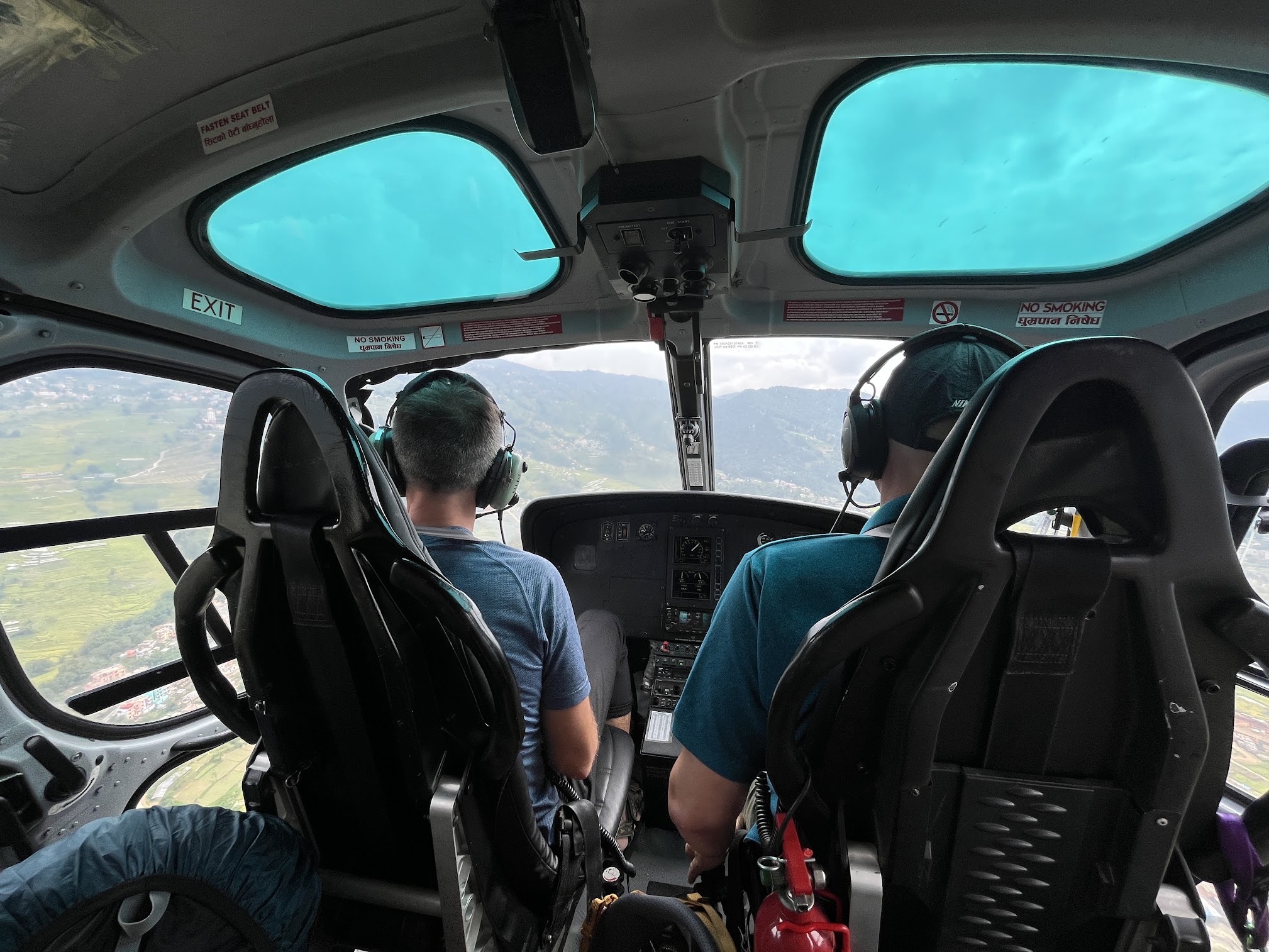
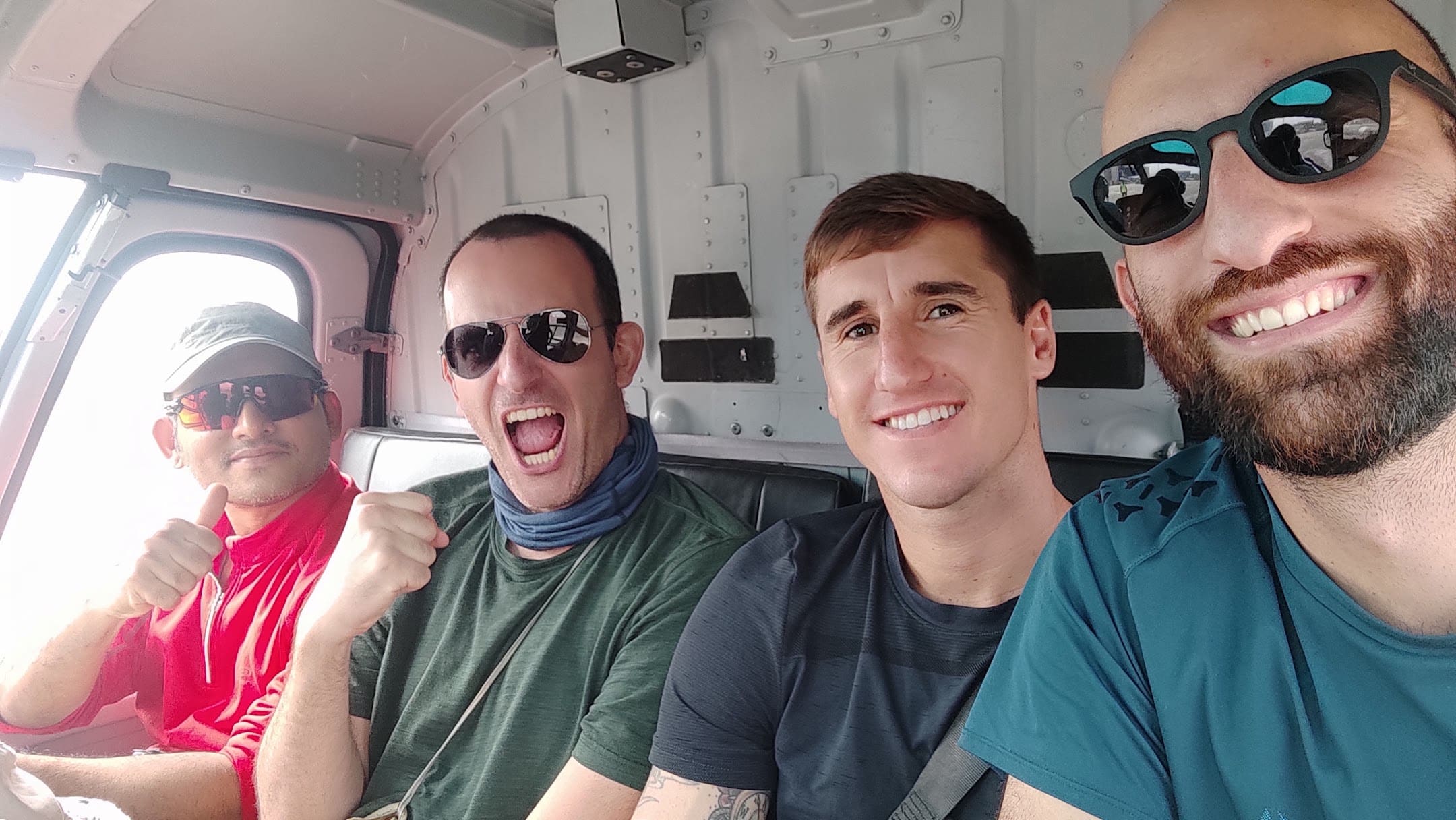
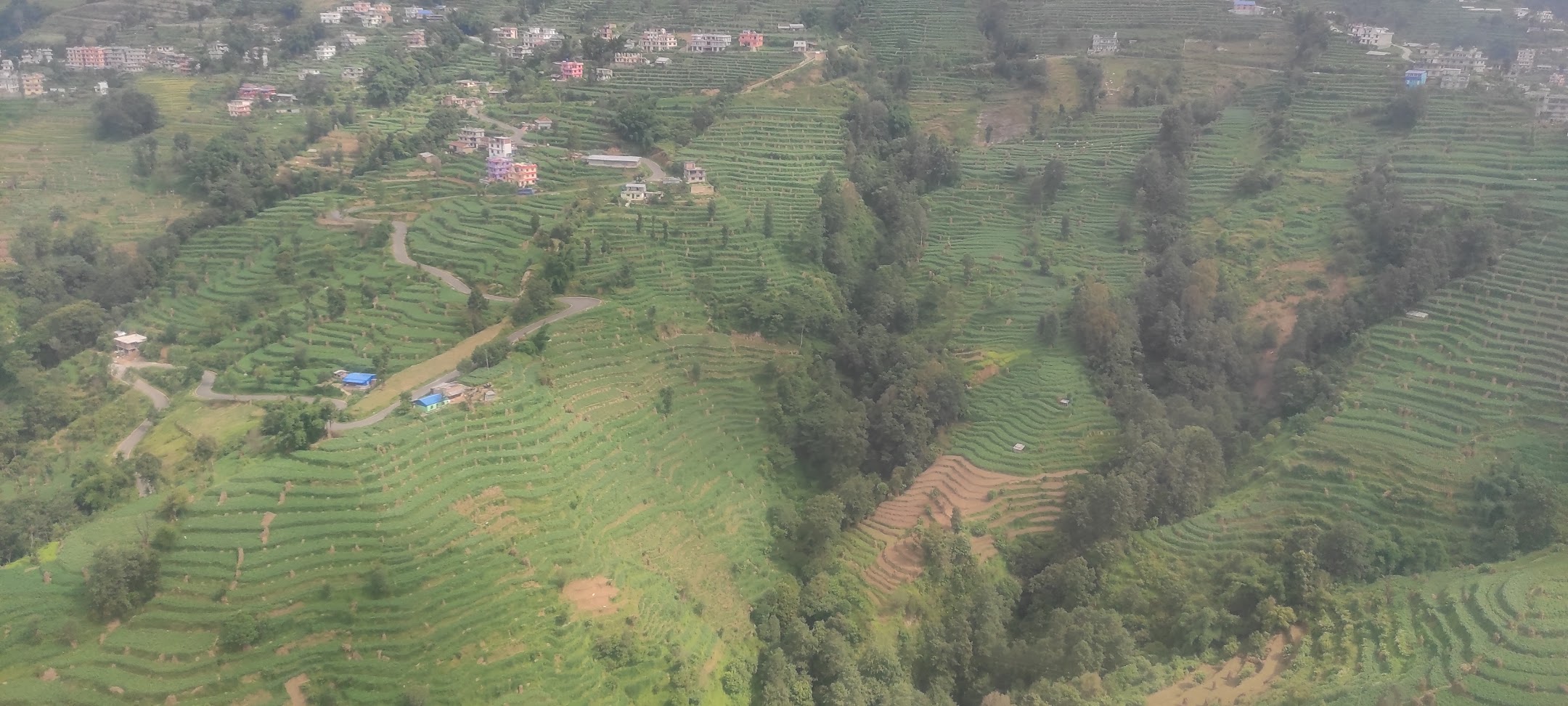
After about an hour of flying, we land on what looks like a garden, I even see someone running as we land to remove a sheet that was drying.
A moment of surprise.
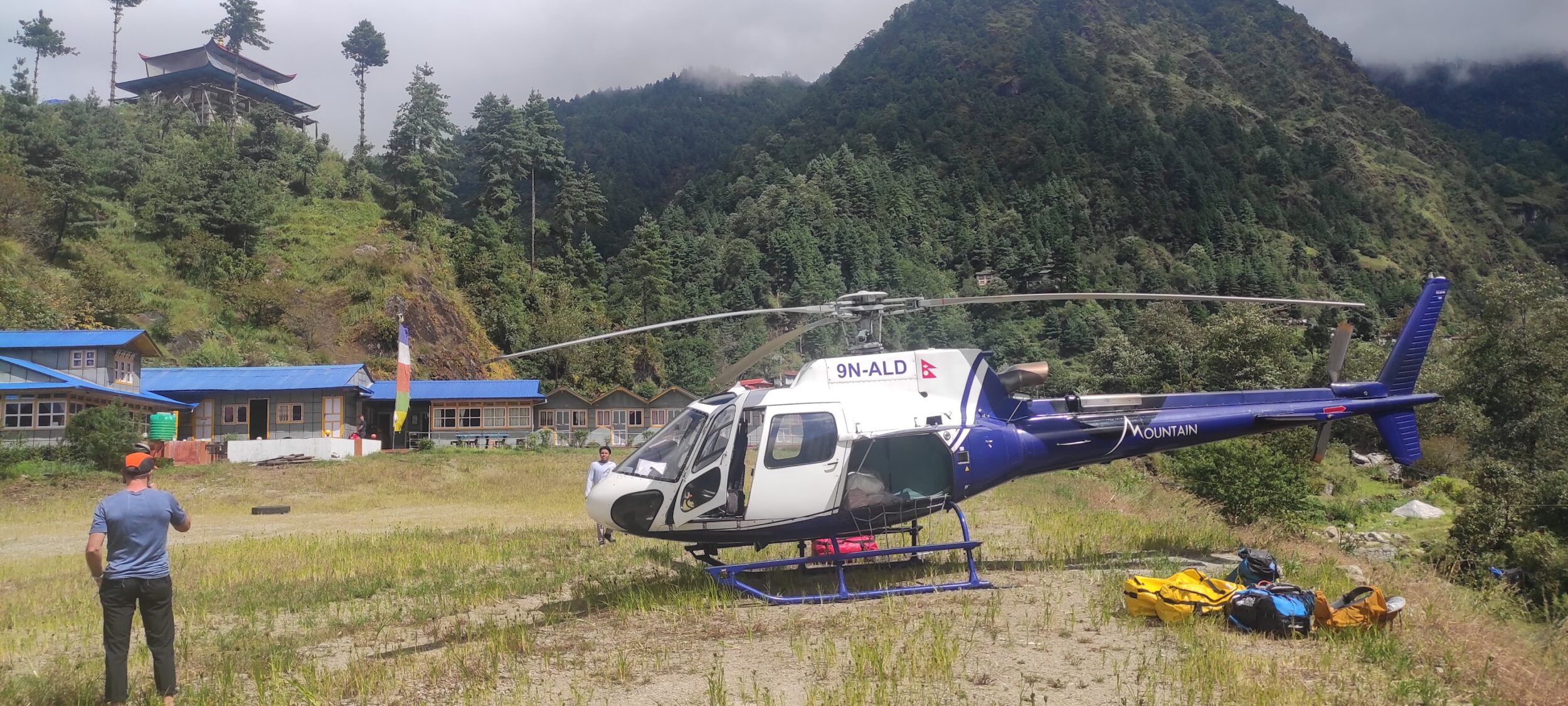
Indeed, our pilot announces that we’re not in Lukla! Due to clouds, the Lukla airport closed while we were in flight.
We land below Lukla, in the garden of a tea house (name of the lodges that line the trekking routes in Nepal) called Hôtel Surkey Helipad. In the village of Chaurikharka.
We have no phone signal, except our Indian companion who manages to send a message to Ram. He tells us that our guides and porters waiting for us in Lukla will come down to meet us, that they’ll be there in about 1 hour 30 minutes.
Even though we’re not yet in Lukla, Vincent and I are thrilled! We’ve spent too much time in Kathmandu; this time, we’re here!
This unexpected landing in “treasure map” mode even adds a bit of spice to the adventure.
It’s almost noon, and since we skipped breakfast, we’re hungry! We sit down at the tea house and order soup.
Just 10 minutes later, our pilot tells us that the weather is improving, that there’s a window to get to Lukla but we need to be quick; it can close at any moment.
I hastily pay for our soup, which we never get a chance to enjoy. Vincent rushes to bring our bags to the helicopter and… falls flat on his face! More scary than anything else; it would have been a real shame to get injured now and have to go back down to Kathmandu!
We take off and gain altitude quickly. The flight lasts barely a few minutes, and we land in Lukla (2,804 meters above sea level), at the legendary Tenzing Hillary Airport.
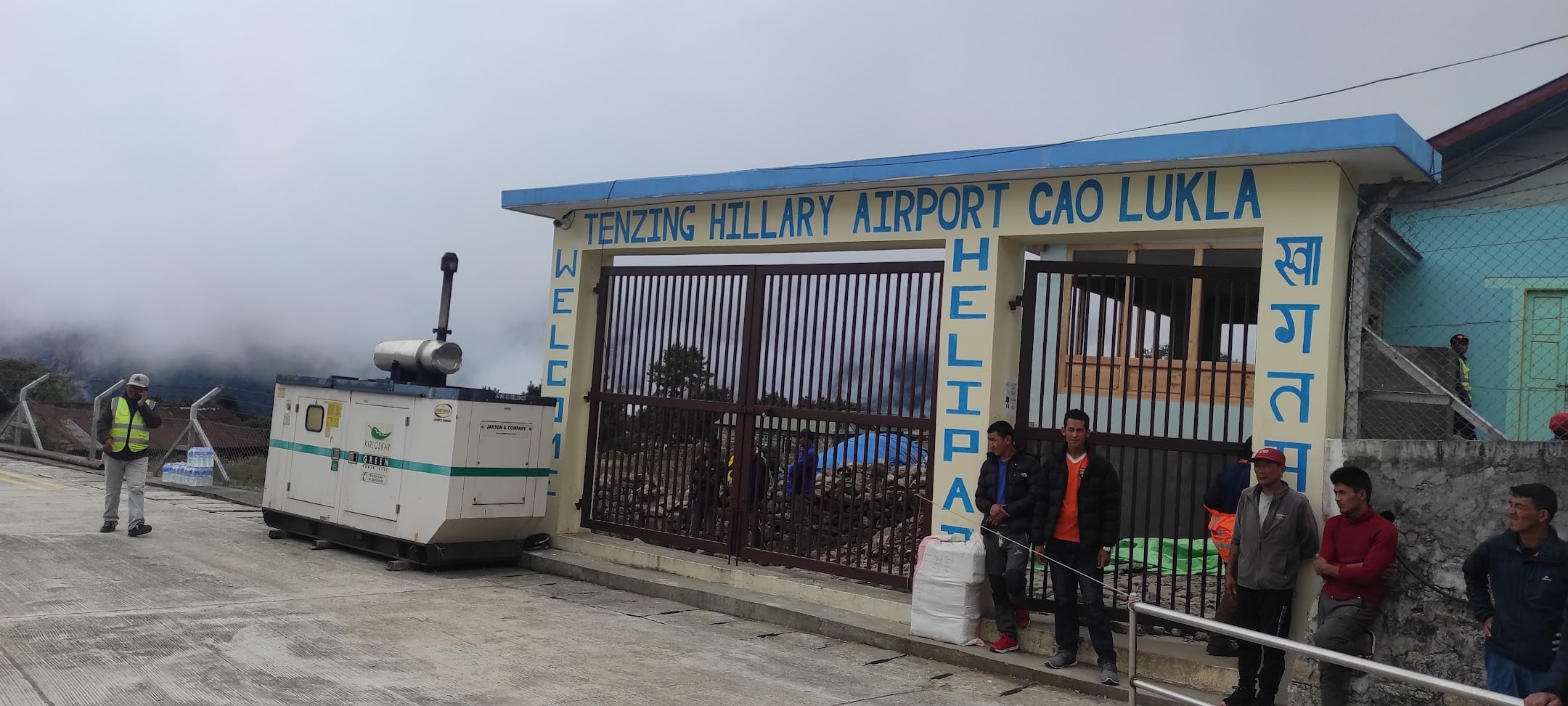
Airport staff rush over and talk with our pilot. We didn’t quite catch what was said, but not sure our pilot had asked for landing permission 😀
Everything happens quickly; barely have we disembarked than five other passengers replace us. Vincent was this close… to forgetting his sunglasses inside, retrieved at the last second by an airport employee. Huge stroke of luck! One more today.
A guide from our agency recognizes us thanks to our agency-branded bags. He explains that our guide and porter have started heading down to find us… that they turned back and will take a while to come up. In the meantime, we’ll have lunch.
We enjoy our first Dal Bhat, the first of a long series. It feels good and it’s delicious.
We meet our guide (Rinzi) and our porter (Buddha) who arrive.
We’re happy to run into our Australian couple, fellow sufferers of the last two days, who had asked if we were twins. They managed to get a flight.
Everything is falling into place after all! And since there have been no flights either yesterday or today, and probably not many tomorrow, we figure there won’t be many people on the trail. We’ll have it to ourselves!
And off we go! We’re starting the trek!
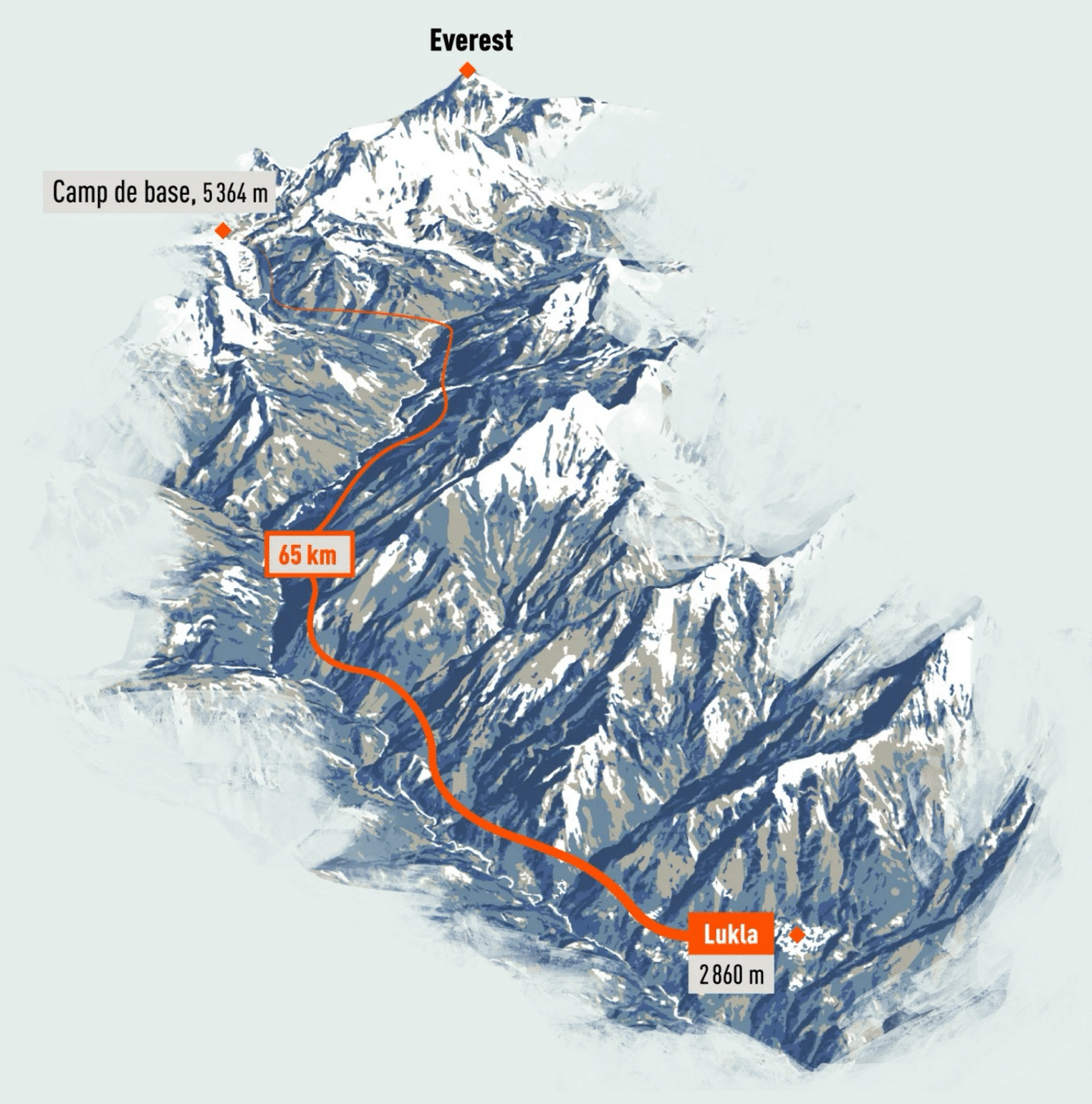
The first day is relatively easy, as we’re descending. Lukla is at 2,804 meters and we’re going to Phakding (2,604 meters). But it’s perfect for getting into the swing of things; the last few days haven’t been very active, and we need to get used to the altitude.
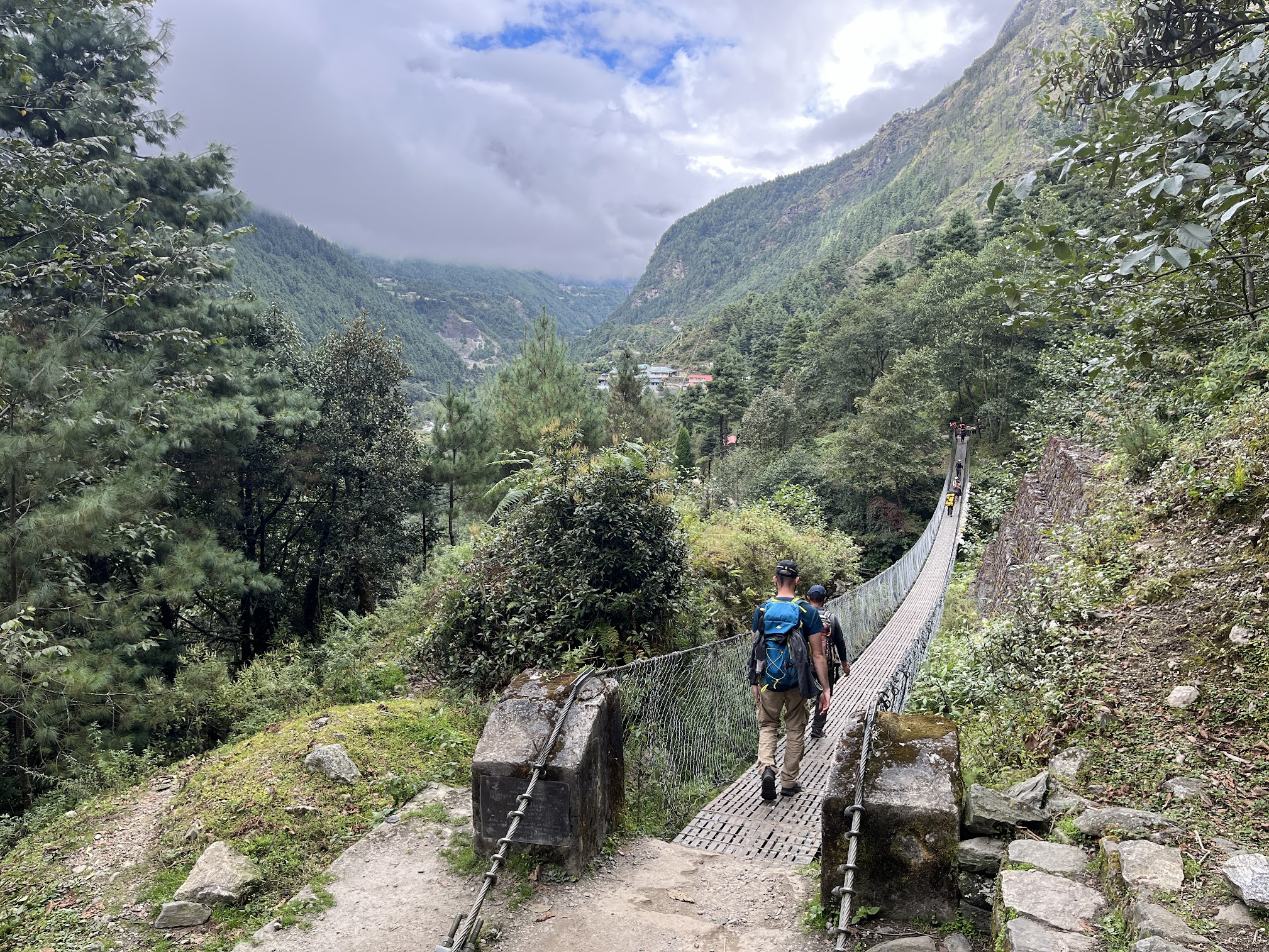
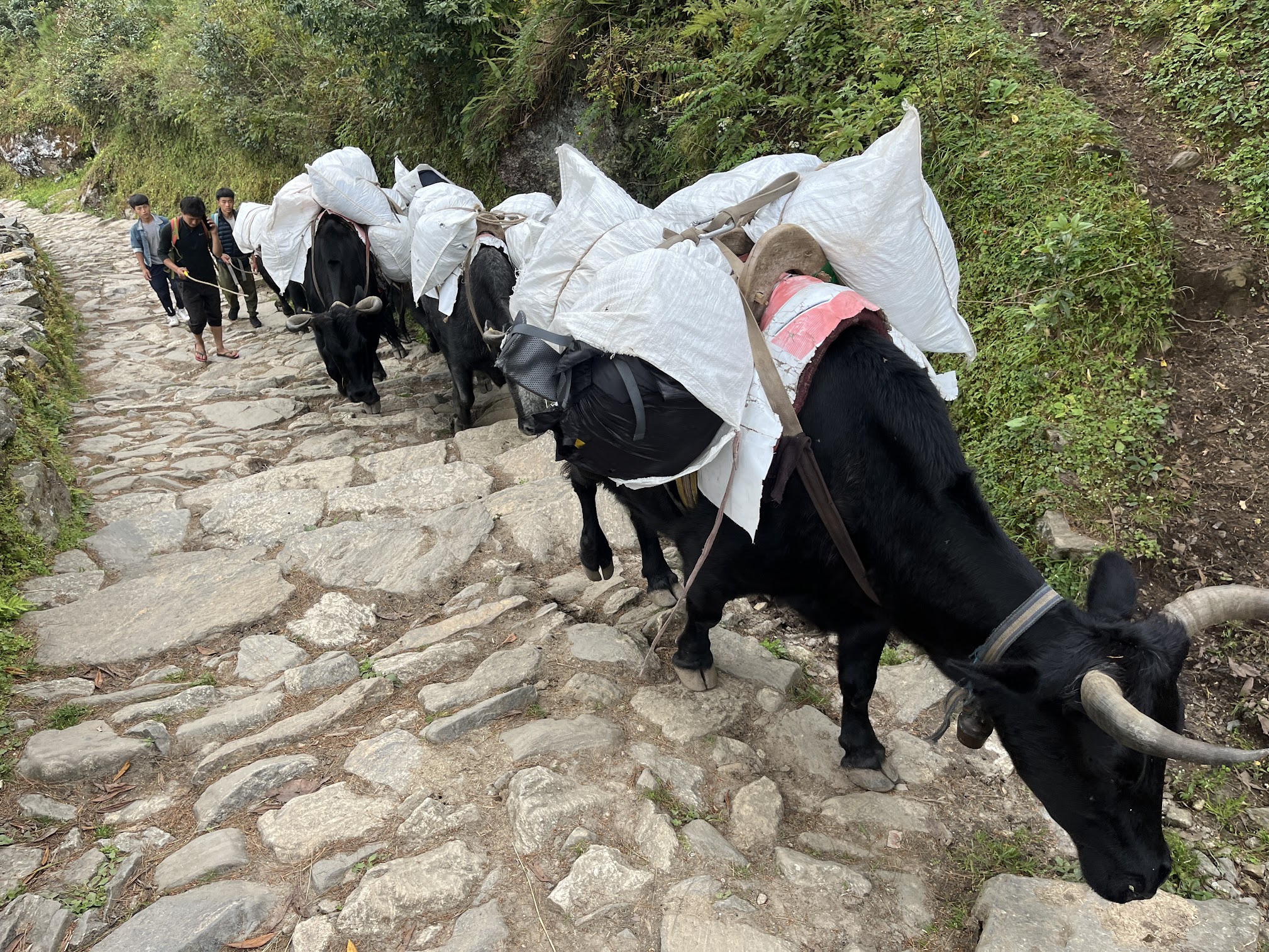
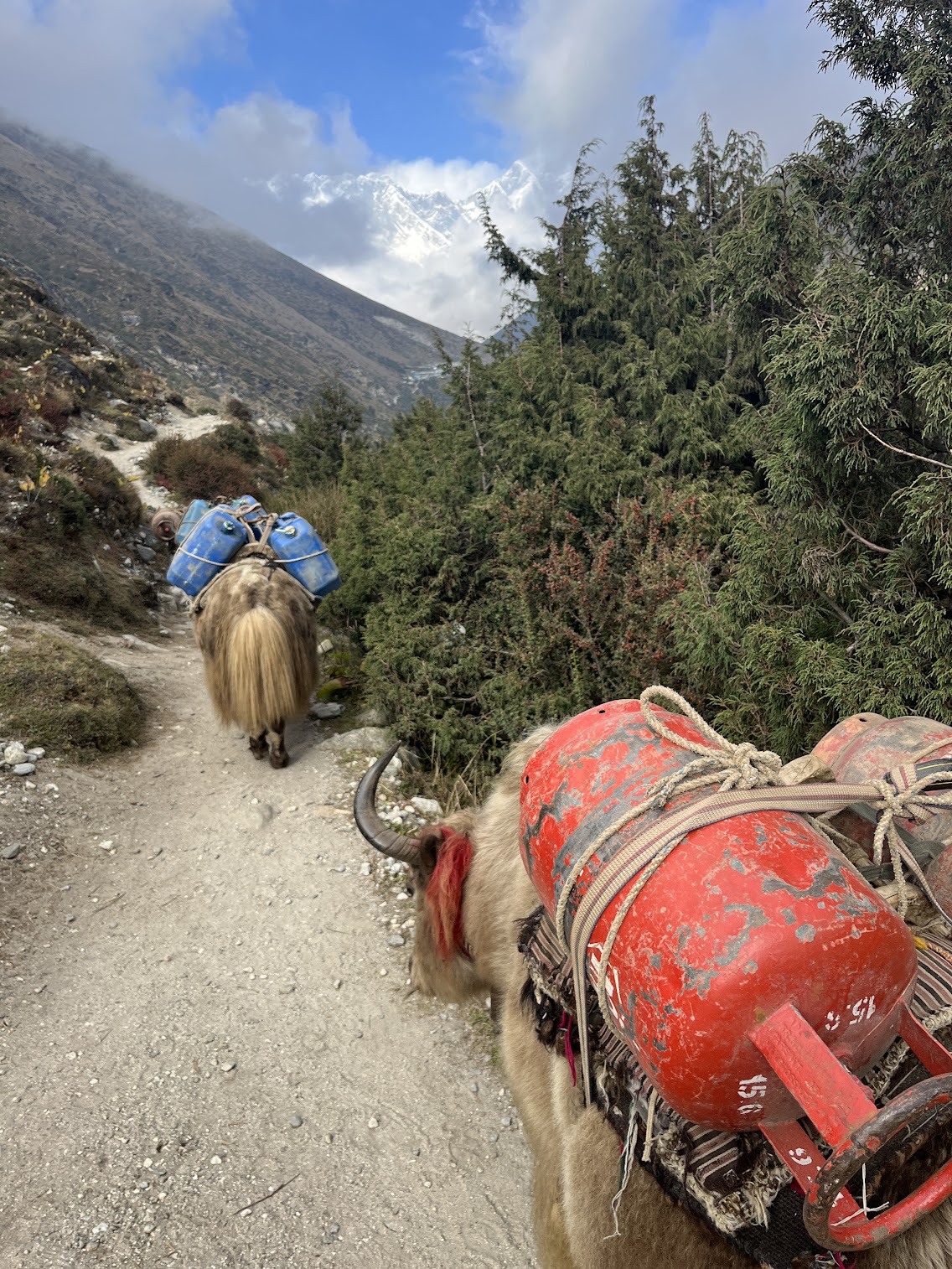
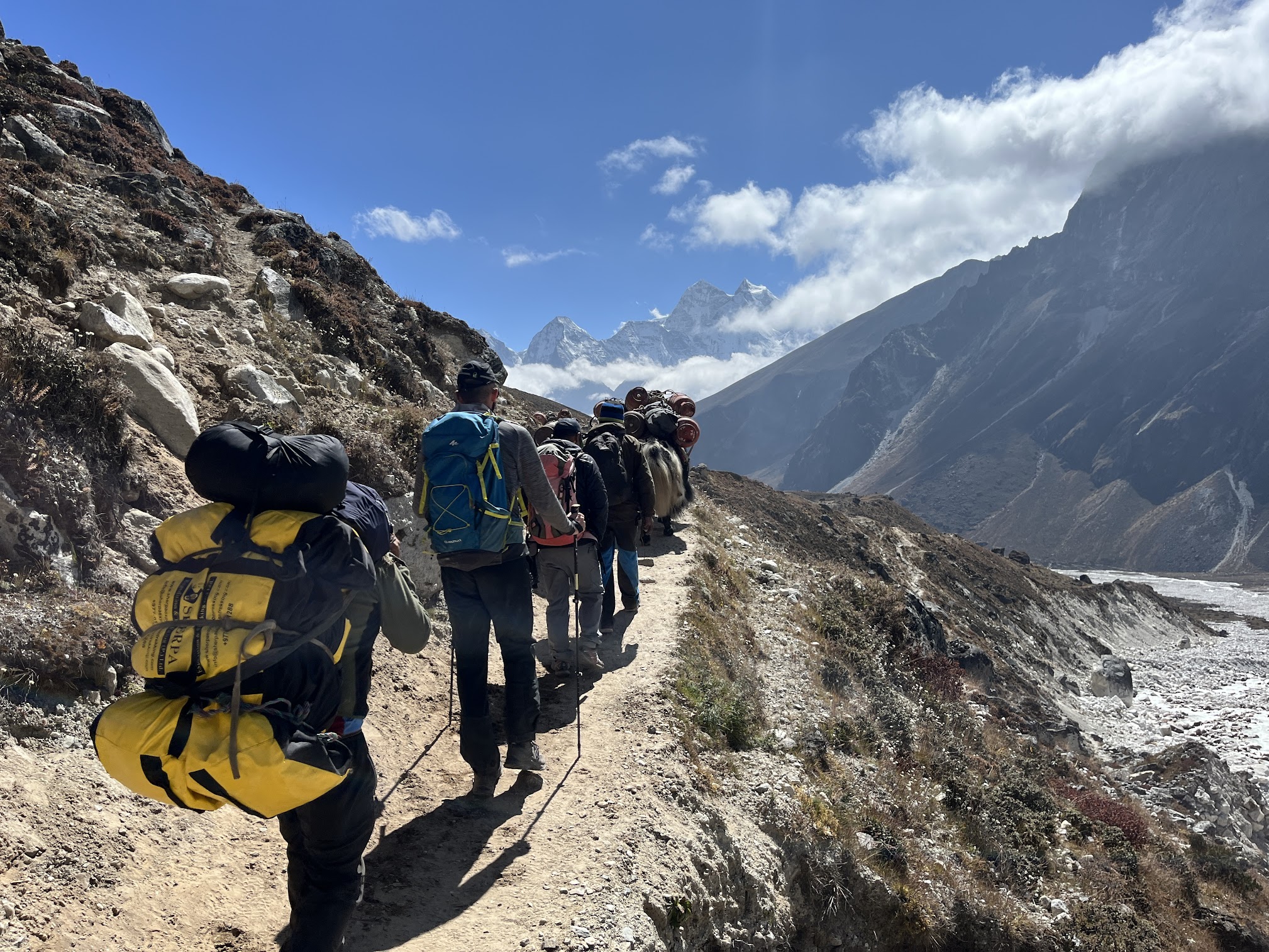
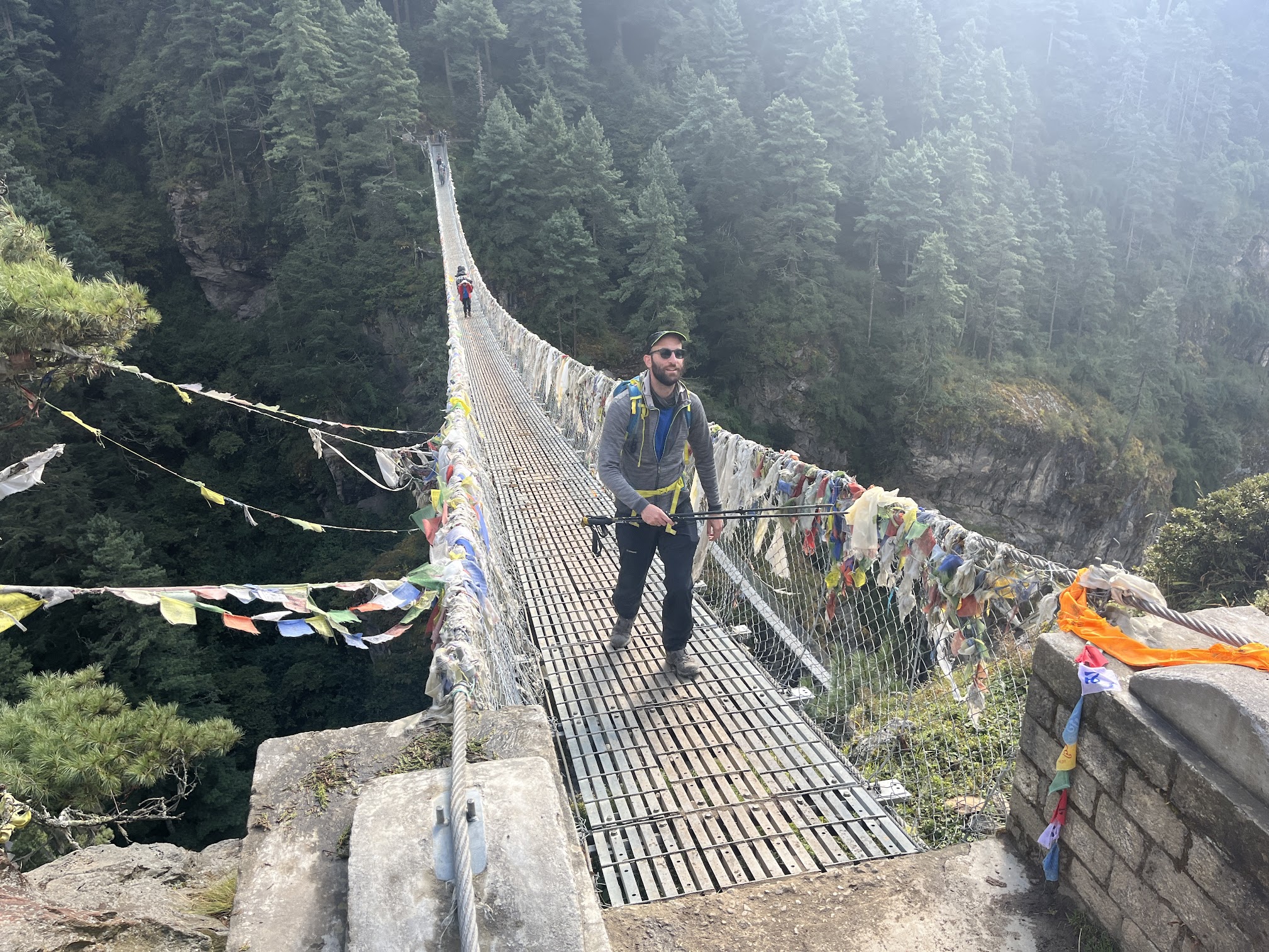
We cross our first suspension bridges and pass numerous porters carrying loads more impressive than the last. We see dzo (a cross between a yak and a zebu) carrying gas canisters. The atmosphere is amazing! We also pass trekkers who are finishing and heading back to Lukla. Suffice it to say, they’re not looking as fresh as we do! It gives us a little taste of what lies ahead.
At 3:30 PM, we arrive at our tea house: Sherpa Eco Home Lodge.
It’s royal treatment: we have a room that locks. Clean toilets, electricity…
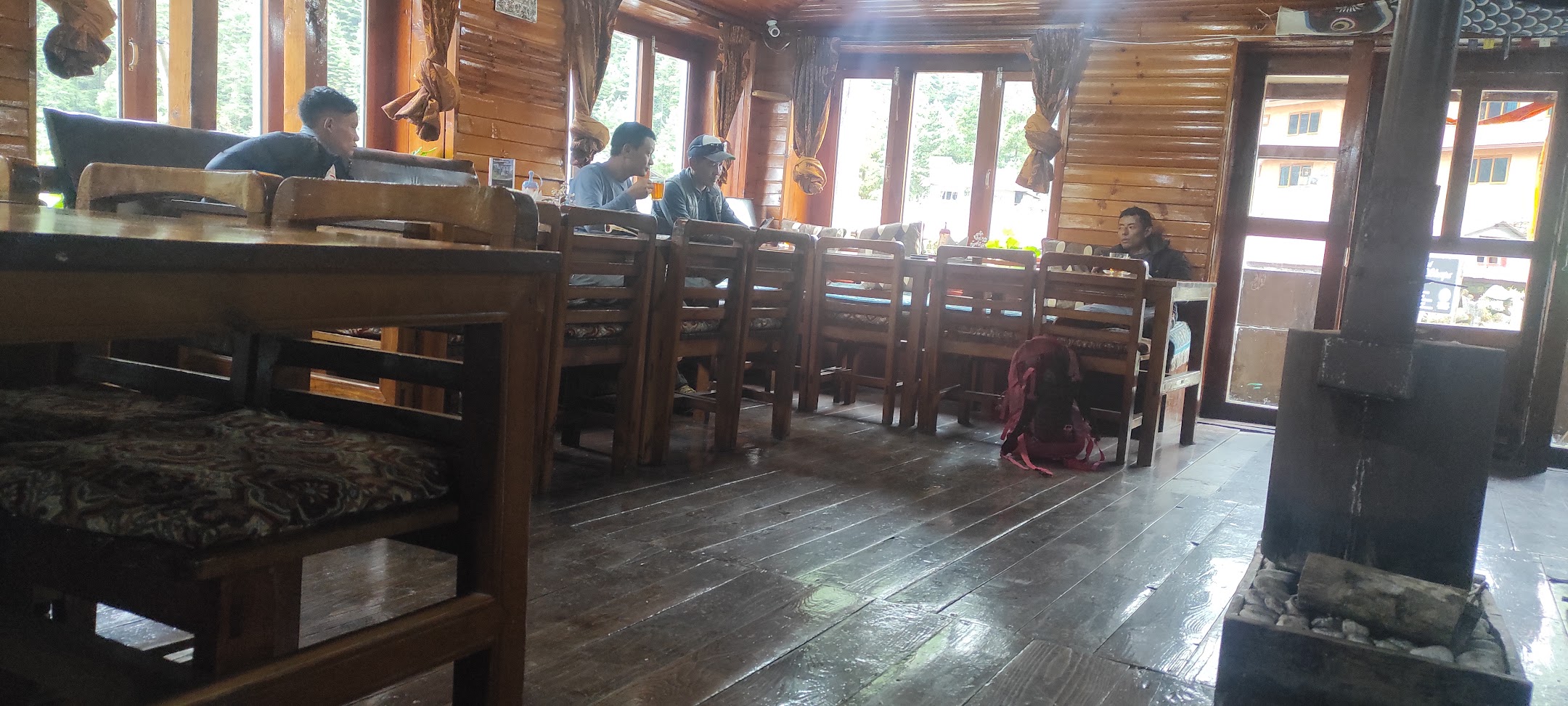
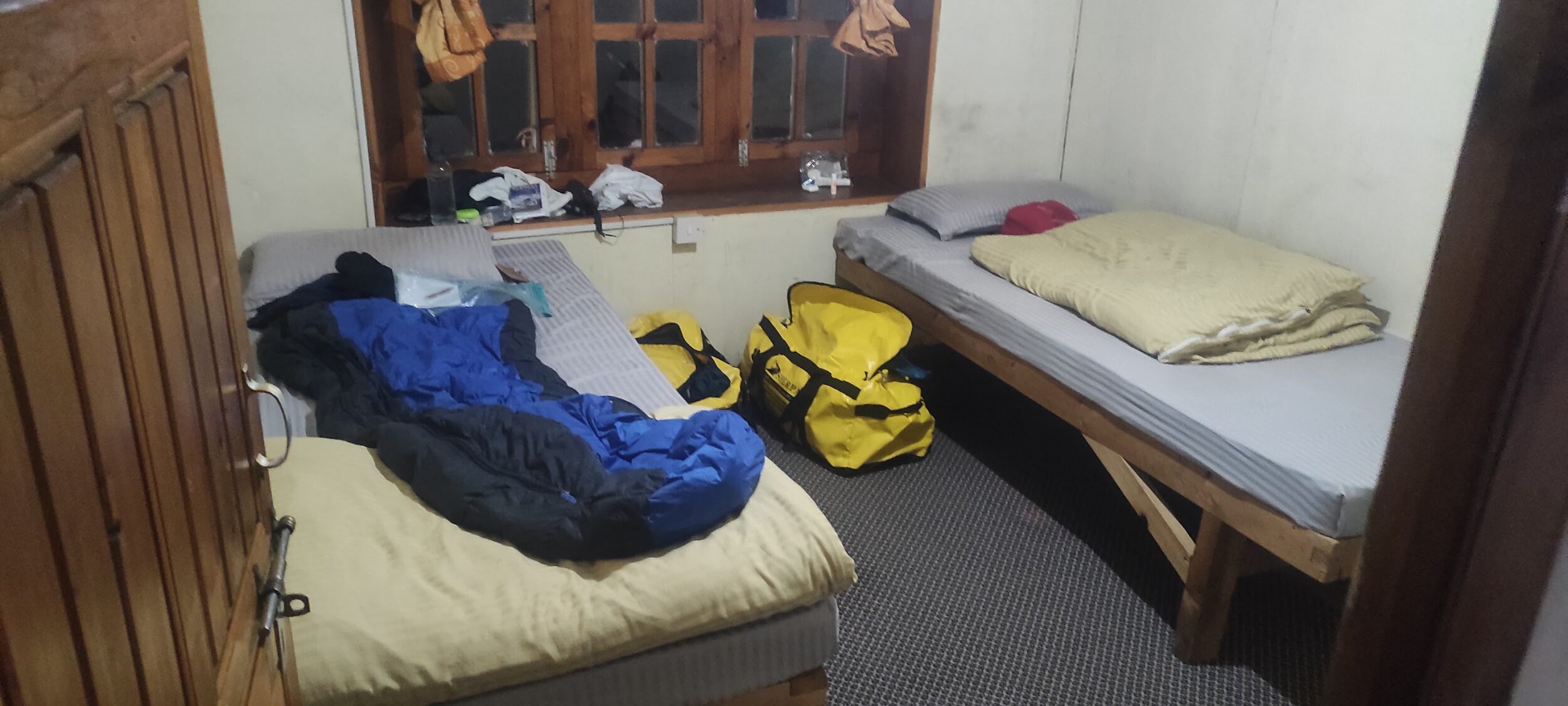
If we want, for an extra fee, we can charge our devices, take a shower, and even have Wi-Fi!
Since we hadn’t yet filled our camelbaks (water bladders in our backpacks that let us drink hands-free through a hose), we certainly haven’t drunk enough (four liters a day is recommended!).
We order a thermos of hot water with ginger, honey, and lemon. I’m not usually a hot drink person, but this is delicious! We decide this will be a good habit to get into every day when we arrive at our tea house at the end of the day.
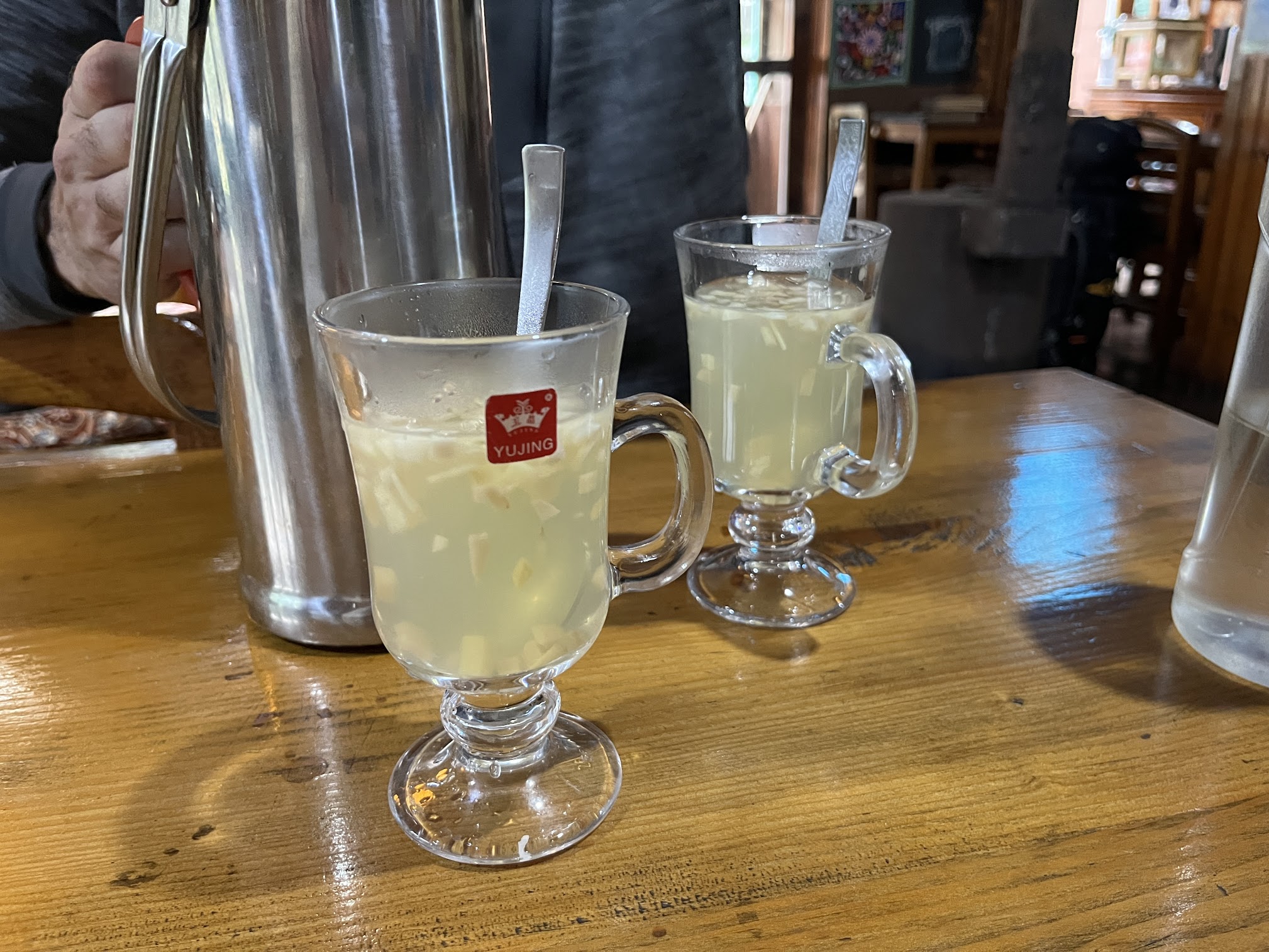
We each have a 2-liter camelbak and a 0.8-liter bottle. Plus the “end-of-day” thermos and soup at meals, we should be close to the four liters.
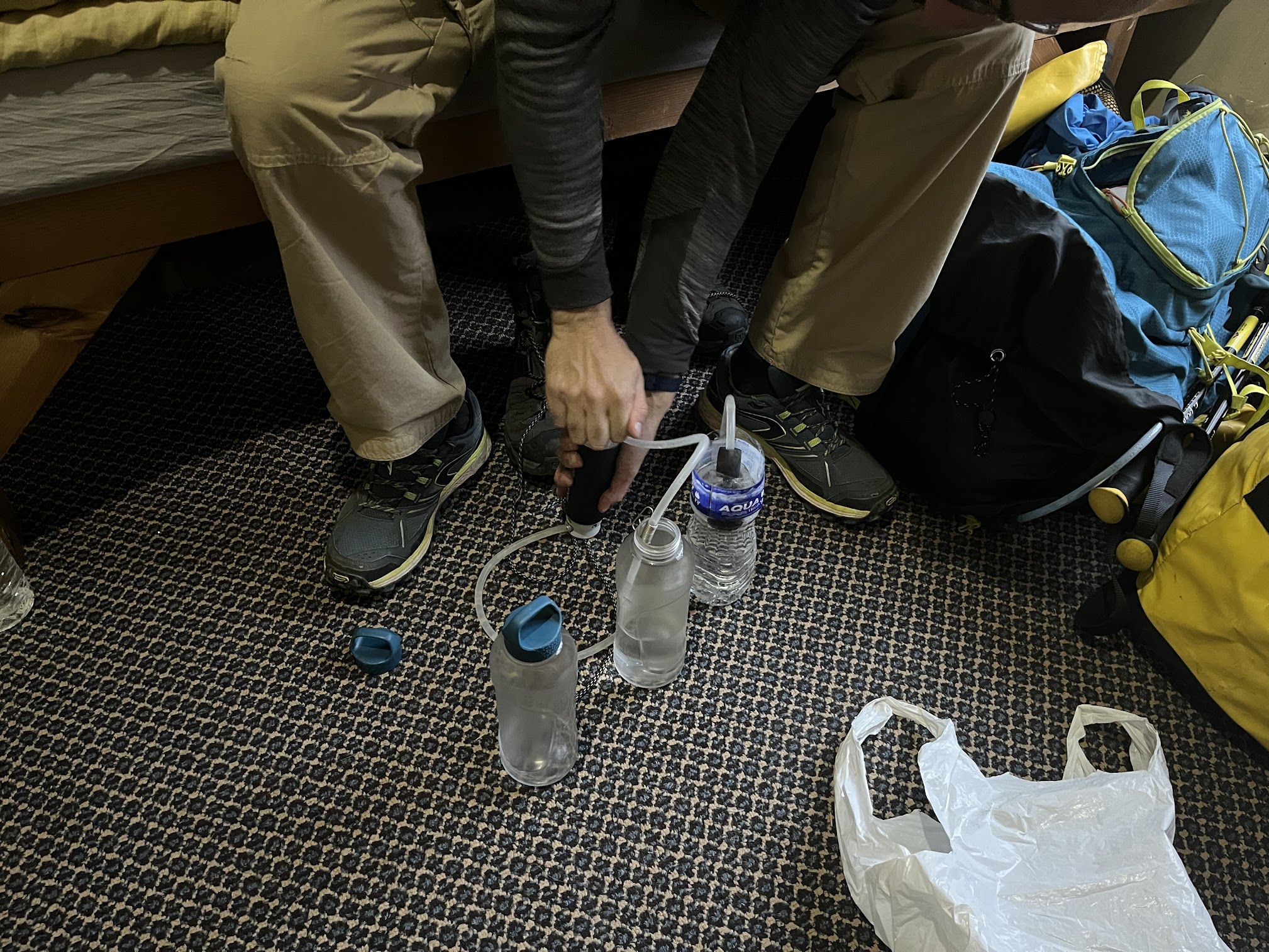
We step out for a short walk, then head back to our room for our first water chore.
To get drinkable water, there are four options:
- Buy water bottles along the way. Given the amount of water we need to drink, and since the price increases with altitude (makes sense: it’s all carried up by humans or animals), it could end up being a serious budget. Not to mention the waste generated; someone will have to carry your empty bottles back down.
- Use purification tablets and accept water with an unpleasant taste.
- Use a filtered water bottle: practical, but requires frequent refilling due to small capacity.
- Use a water filter: can be expensive and heavy.
Since Vincent already had one, he brought it along, and that’s what we’re using. The process takes about twenty minutes, worsened by the very low water pressure from the tap, but we’ll get the hang of it and speed up.
At 6:30 PM: first dinner. We order garlic soup as a starter; apparently it’s good for altitude sickness. And a dal bhat.
This dish is typical Nepalese, consisting of rice, some vegetables, a piece of meat, a flatbread, and a lentil soup. Not only is it delicious, but it’s also filling. Plus, it’s the rule with dal bhat: rice and soup are unlimited!
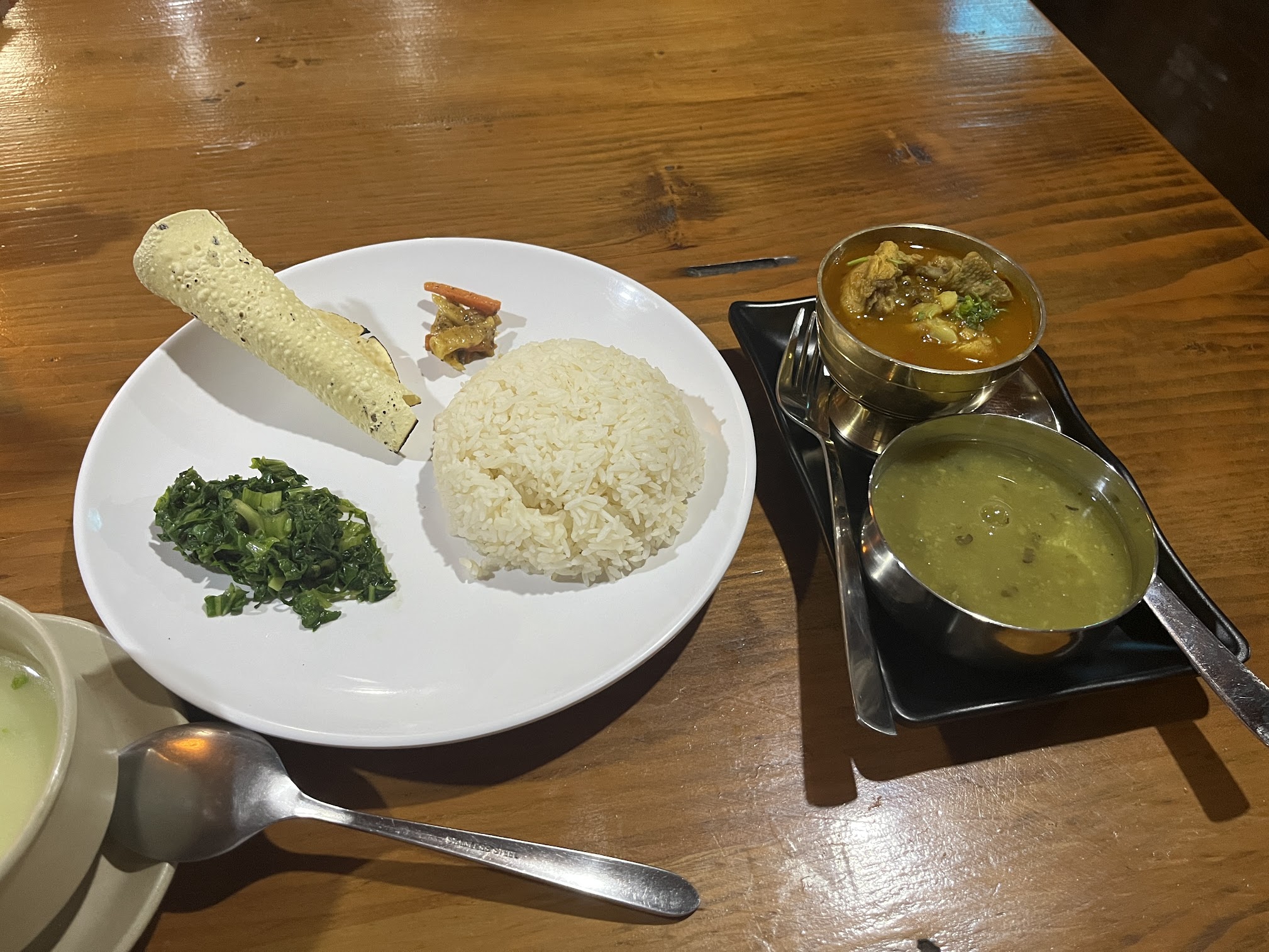
We’re so happy with this first day! This morning when we woke up, we didn’t dare hope we’d be here tonight!
Tomorrow is the first real day of climbing, with about 800 meters of elevation gain to Namche Bazar (3,440 meters above sea level). The last “big town” before heading to base camp. We’ll stay there two nights to have a full day of acclimatization to the altitude.
Day 2 – Sunday, October 8, 2023: heading to Namche Bazaar (3,440 meters)
We went to bed early last night, around 8 PM, and slept well. Despite each of us waking up two or three times to… go to the bathroom to get rid of all the fluids we drank during the day.
It’s not too bad for now because the temperature is very pleasant (I slept in my short-sleeved pajamas), but as we gain altitude, the temperature will drop, and it will quickly become less fun.
Vincent wakes up with a sore throat; we hope it goes away quickly.
7:30 AM: breakfast. I have a cheese omelette; it’s a bit small in quantity, so I’ll choose something else next time. It looks paltry compared to Vincent’s porridge, which could feed a whole family for the day.
8 AM: we start our real first day of trekking. Yesterday was truly easy.
We’re a bit surprised to see so many people.We wonder where all these people come from, given how complicated it’s been to get to Kathmandu in the last few days. We’re setting a good pace early on and quickly overtake the large groups (especially Koreans), whom we won’t see again for the rest of the day.
We cross several dizzying suspension bridges (including the legendary Hillary Bridge), pass by waterfalls and, thanks to the good weather, catch a glimpse of our first summit: Thamserku, at 6,608 meters.
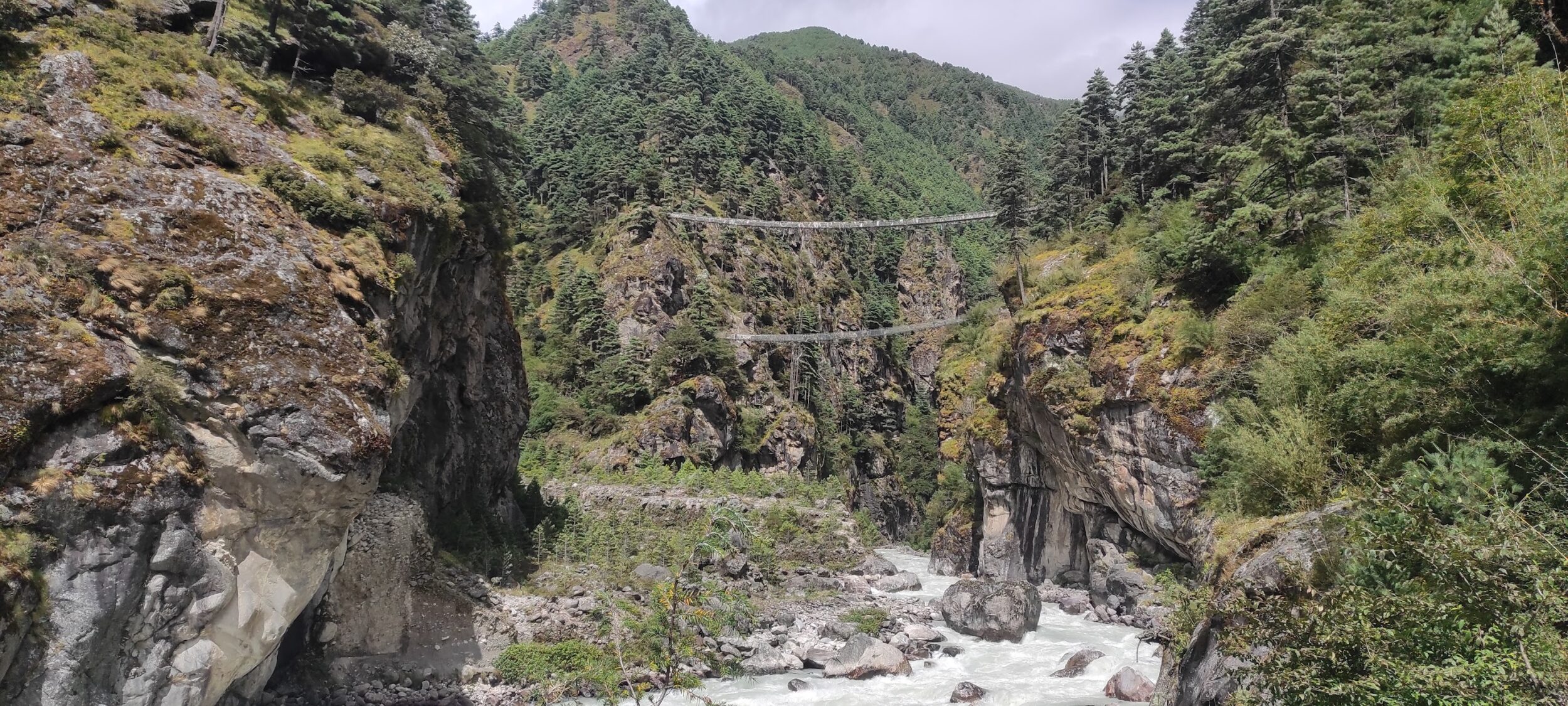
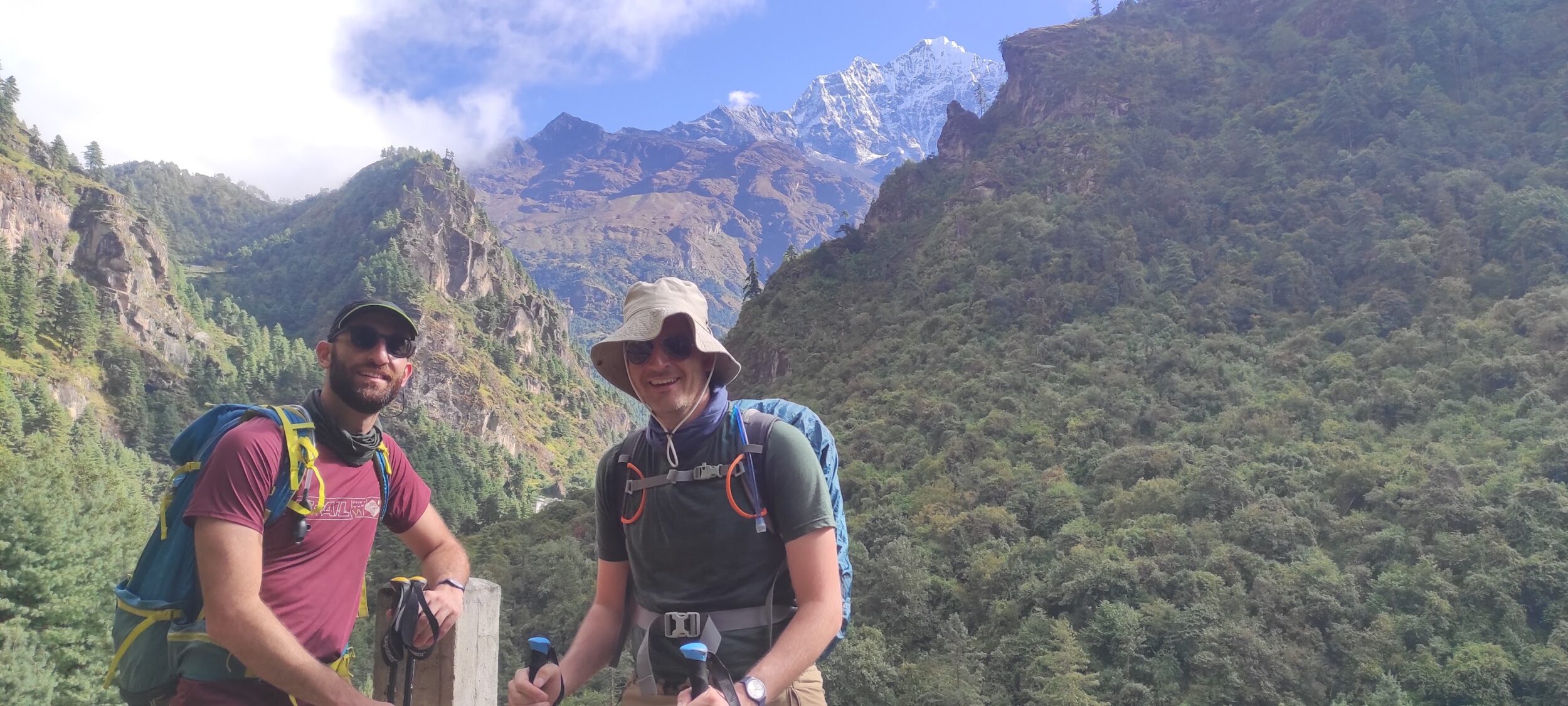
It rained last night, but this early morning is sunny, and we’re having a bit of trouble regulating our temperature: should we wear one layer? Two layers?
At one point, we decide to take off our second layer, and steam rises from Vincent’s back, like a chimney. Our guide finds this hilarious.
During these first few hours, we go up, then down. It’s a bit frustrating because despite our efforts, we hardly gain any altitude, while our destination for the day is 800 meters higher than our starting point.
At 9:40 a.m., we arrive at the entrance to Sagarmatha National Park. Our guide takes care of the administrative formalities, while military personnel quickly check our bags, asking if we have a drone. Their use is prohibited, unless you pay for a permit of $1,500 USD.
We run into Sergey, our Russian-American companion, who is quite upset about having to leave his drone behind, hoping to get it back on the way back.
Shortly after, at 10 a.m., we stop for lunch at the Buddha Lodge. We enjoy a delicious combo of rice, vegetarian momos, veggies, and french fries. Along with what will become a staple: a ginger/lemon/honey cup.
If we’re having lunch so early, it’s probably because we’re about to tackle the hard part: non-stop uphill climbing to Namche.
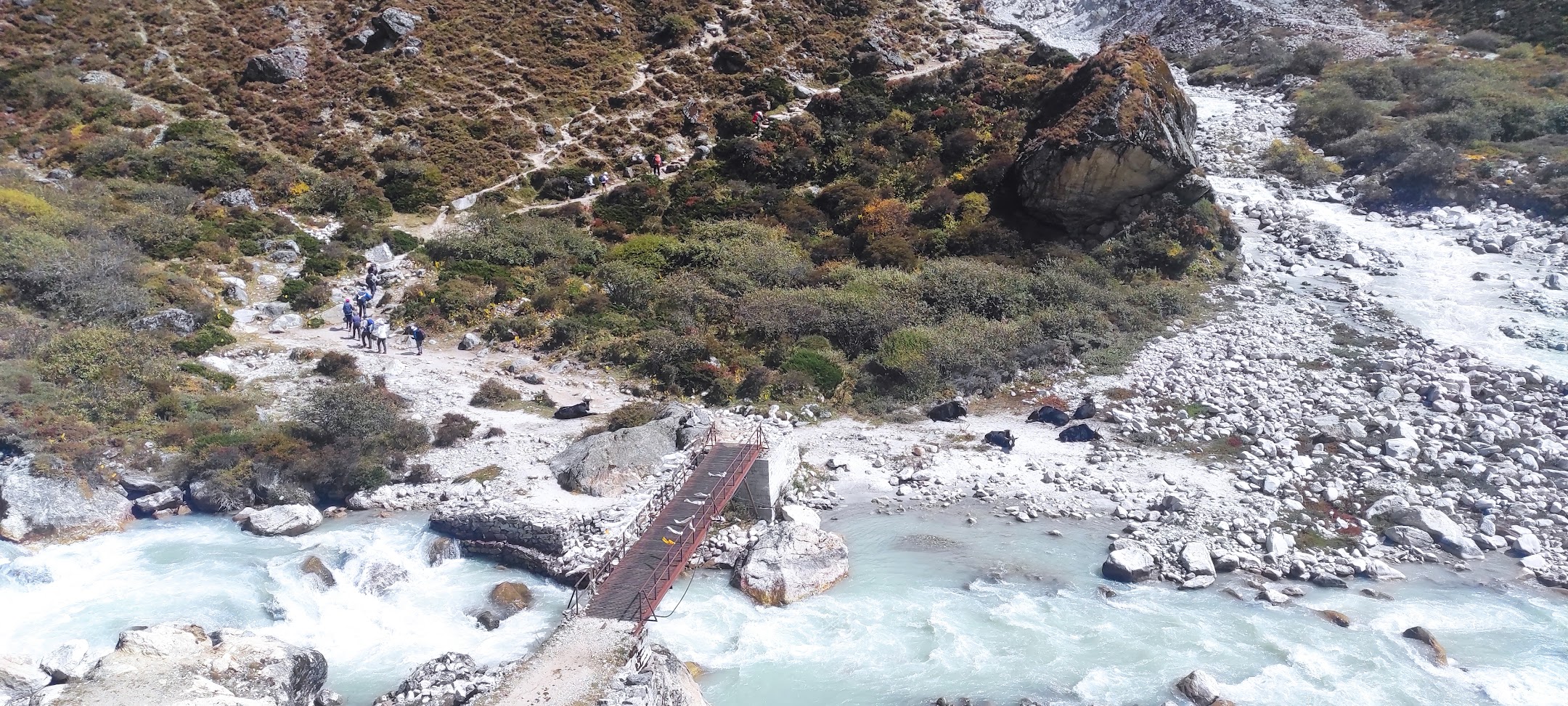
We cross several more suspension bridges. On one of them, there’s even a traffic jam! Caused by a herd of Dzo moving at its own pace.
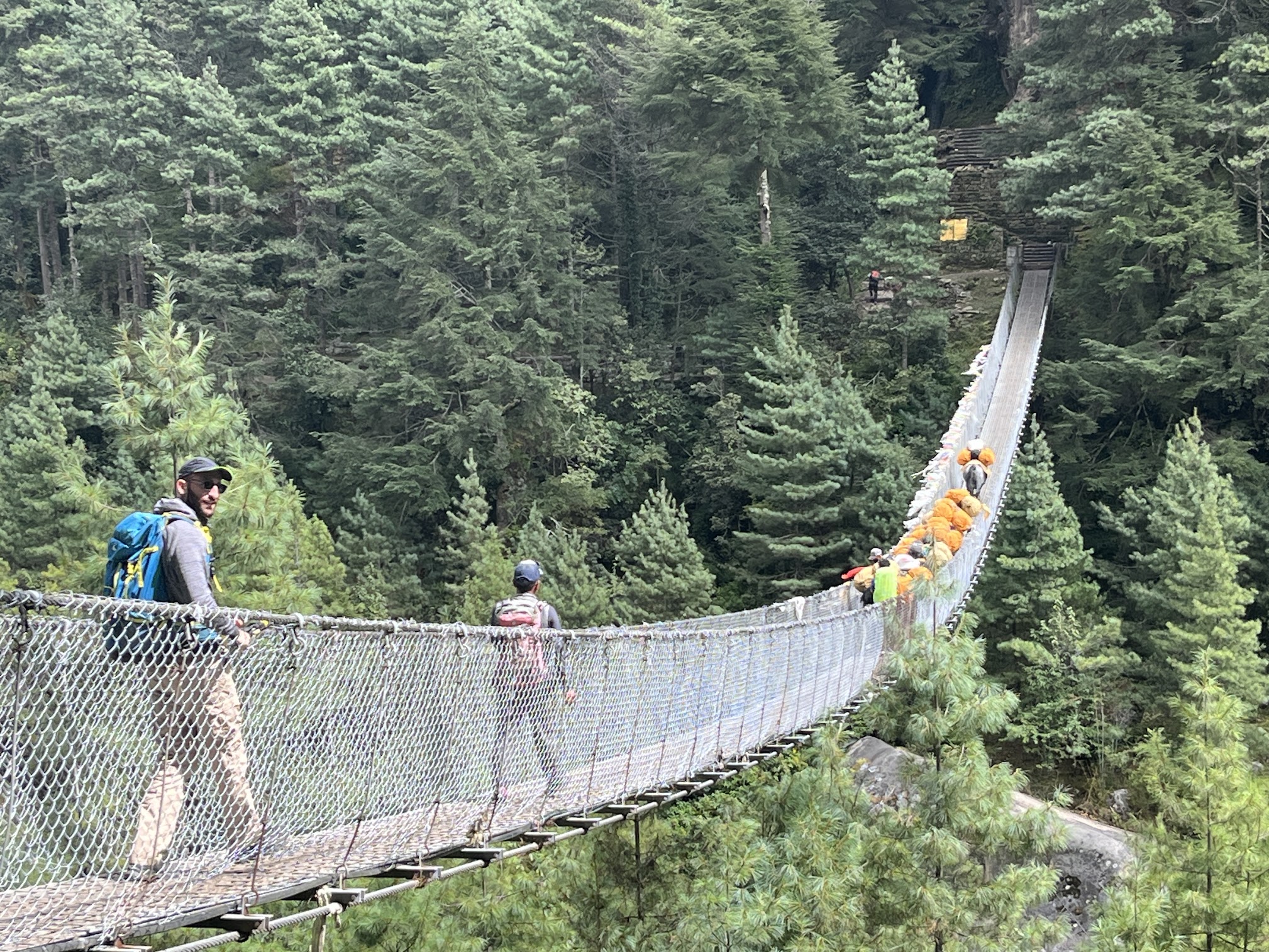
I can assure you it’s much more pleasant to wait in traffic behind a herd on a suspension bridge than in a taxi taking us back from Kathmandu airport, where we spent the whole day hoping for a flight to Lukla!
It’s a steep climb, and I have to dig deep. We try to keep a slow, steady pace so our heart rates don’t spike.
A 12h30 : Namche Bazaar is in sight. It’s quite impressive to have a “real town” in this environment. It’s the last place on our route where we can find ATMs. We wonder how the funds get there—by helicopter, probably. There are schools, pharmacies, a hospital, a helipad, and more.
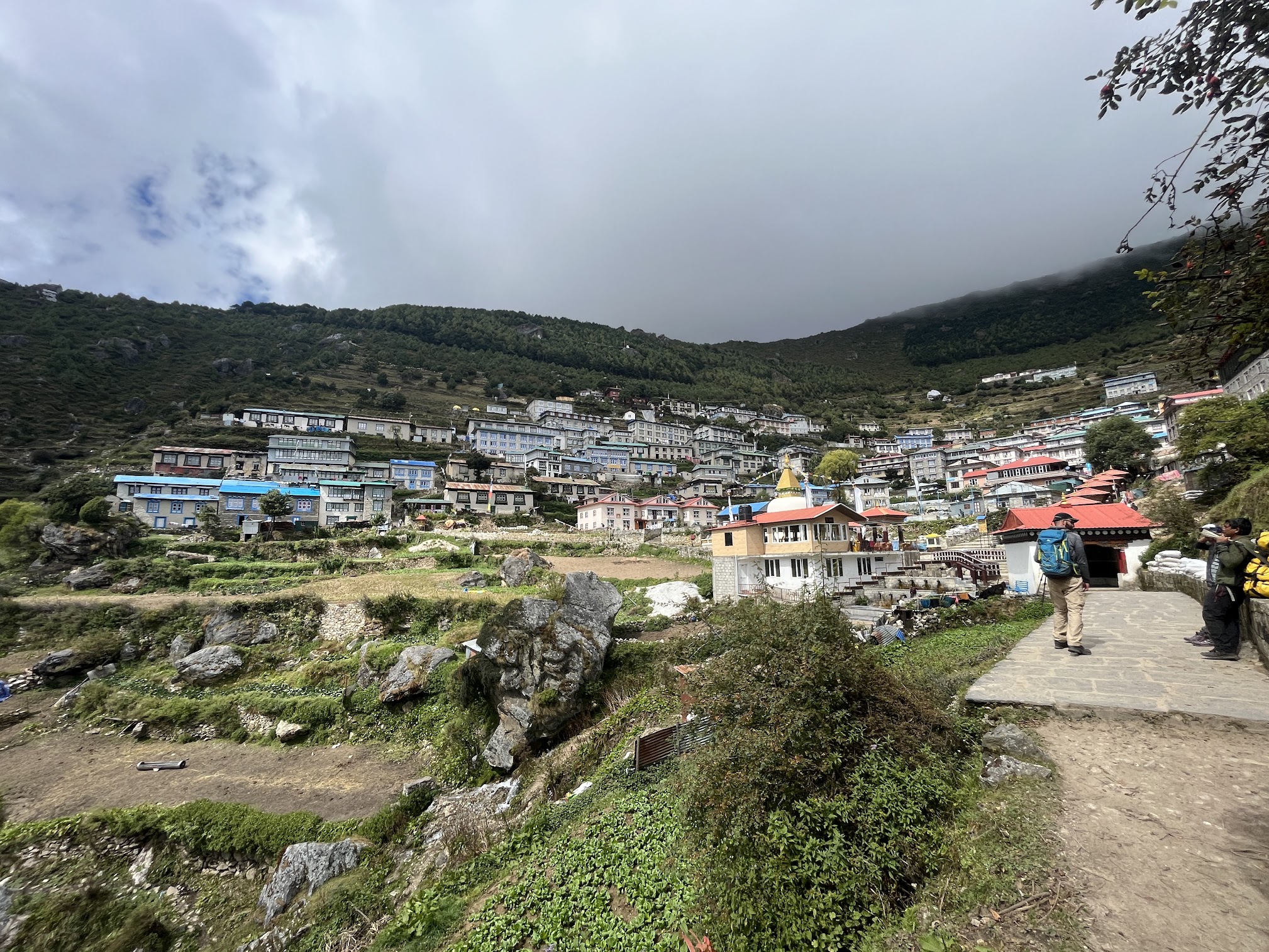
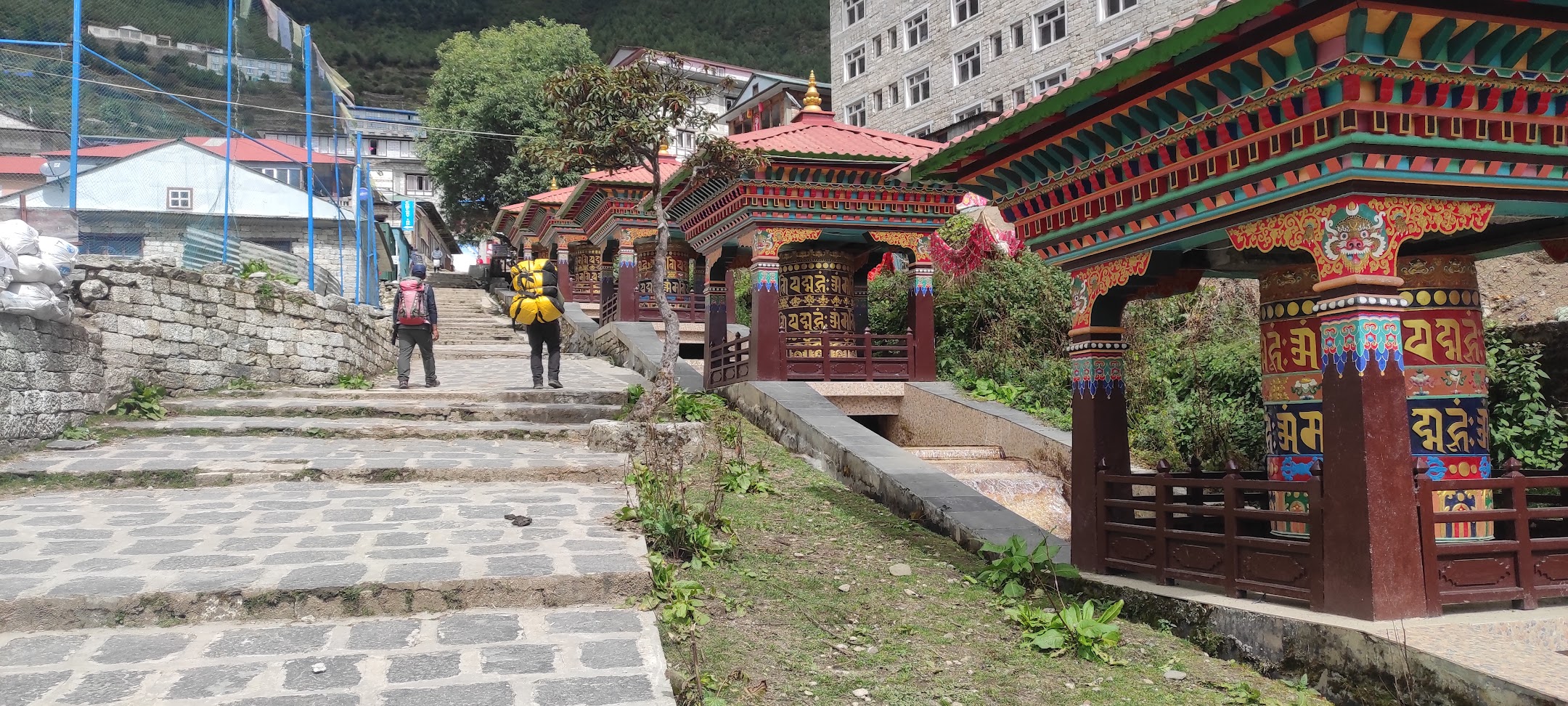
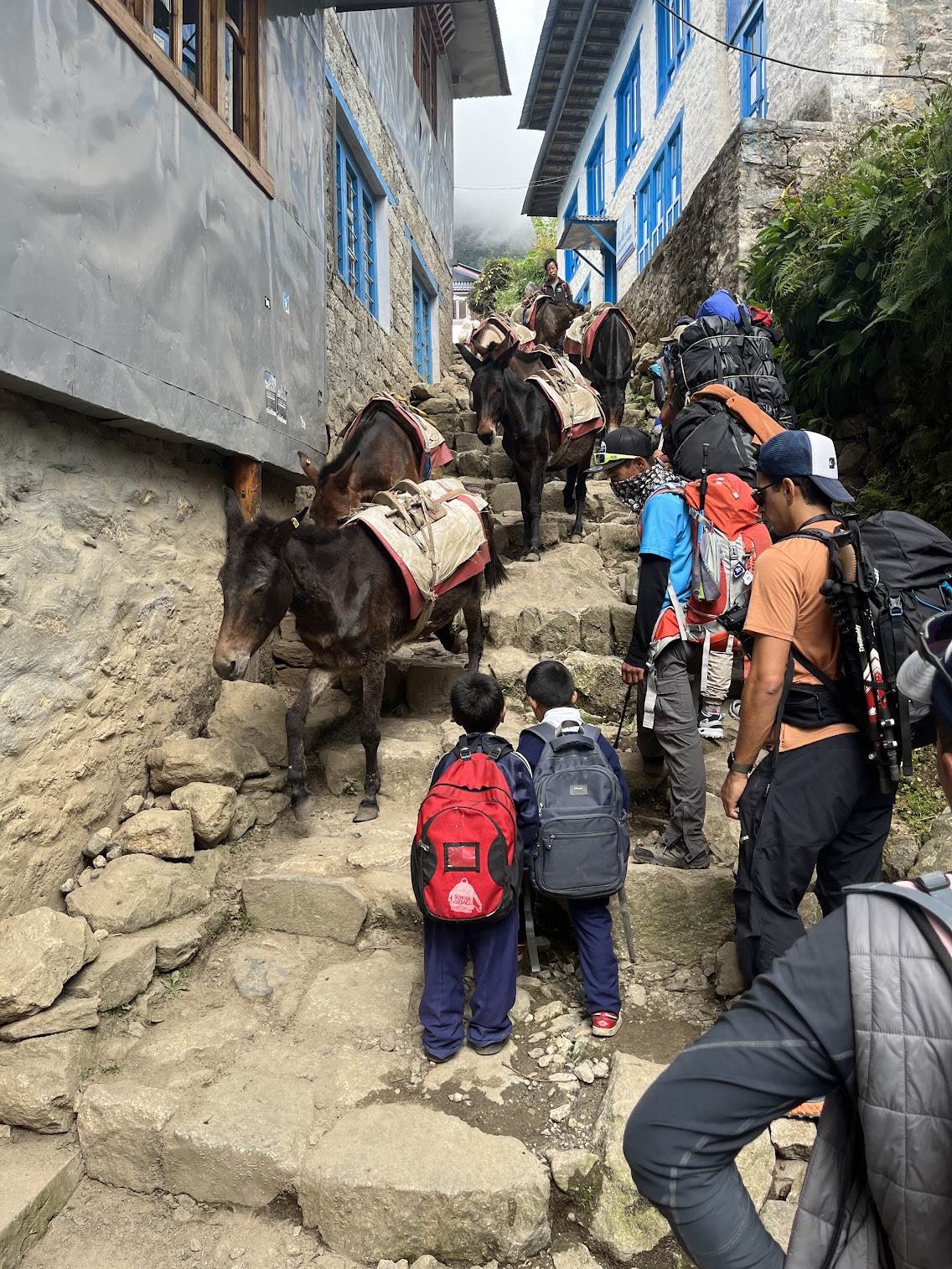
We pass by a pharmacy, and Vincent buys something for his sore throat. The pharmacist tells him it’s very common for people “like us” who pick up bacteria we’re not used to.
Namche is also a town where you can find unusual services : horse rentals, helicopter bookings, oxygen rentals!
We arrive at our tea house just before 1 p.m.: Sona Lodge & Restaurant.
With the altitude, and maybe slight dehydration, I have a mild headache. I check my CamelBak: I’ve only drunk one liter on the road. Vincent, even less.
So: a little nap, followed by the already traditional thermos.
We learn that today again, no plane has landed in Lukla. We’re even more glad we quickly decided on the helicopter. With delays piling up, it might become a scramble to get one.
For the record, a group of about fifteen Koreans arrived at our tea house in the afternoon. Accompanied by seven dzos , each carrying four or five bags. We’re surprised this group is so heavily loaded.
We understand during dinner: the Korean group eats… Korean. They have their traditional kimchis. But on top of that, they have their own dishes! Plates, bowls, glasses, chopsticks… all in metal, like in Korea. Incredible!
In the evening, we even hear them using a hairdryer for a good half hour.
Everyone has a different approach to tourism 😀
Tomorrow, we’re staying in Namche Bazaar, a welcome day to acclimatize to the altitude!
Day 3 – Monday, October 9, 2023: Acclimatization day and a view of Everest!
We wake up around 6:30 a.m. The night was pretty good, broken up by some trips to the bathroom.
My mild headache from the previous night is gone, and Vincent still has a sore throat. He tells me I was breathing in a jerky pattern during the night, which is quite symptomatic of the body trying to adapt to the altitude.
Looking out the window, we see clear skies and a beautiful view of a magnificent snow-capped peak we hadn’t seen the day before.
Even though it’s not very cold yet, with the humidity, our clothes aren’t drying. It’s pretty annoying; we knew we’d have to deal with dirty clothes, but putting on soaking wet ones every morning…
Today is an acclimatization day. But acclimatization doesn’t mean rest!
Rinzi tells us to put our down jackets in our bags, as it might be cold higher up. That must add 2 kg to the bags we’re carrying, we can feel it on our shoulders!
We leave around 8:15 a.m. to climb 400 meters in elevation. And this time, it’s a steep and continuous climb. No flat or downhill sections to catch your breath.
Vincent is fine, but it’s hard for me, I’m suffering. It worries me a bit for the rest of the trek to be struggling on an acclimatization day. I hope it does the trick. We’ll see what tomorrow brings.
We pass our Korean group, who must have left half an hour earlier. That reassures me a bit; our pace isn’t ridiculous.
As we progress, we get an increasingly impressive view of Namche Bazaar.
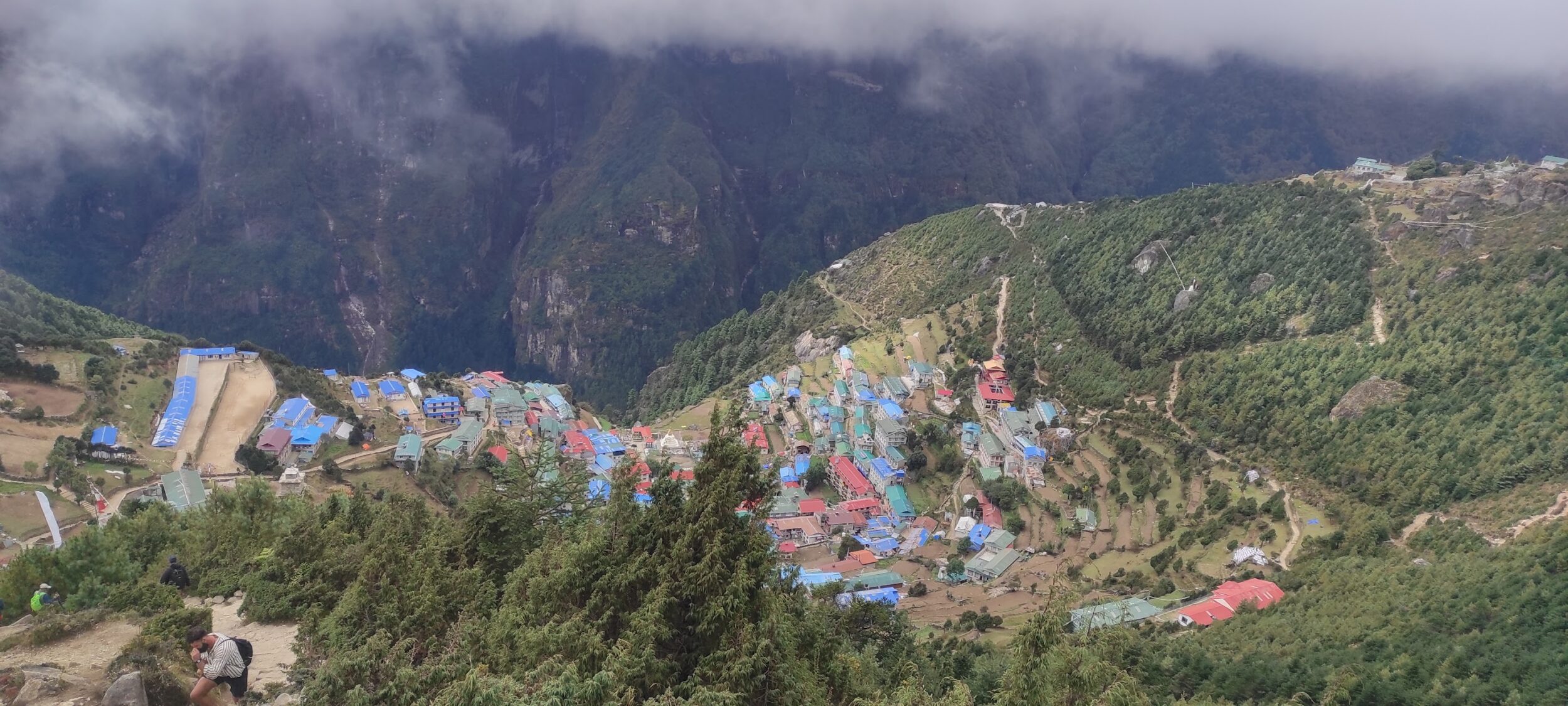
And around 3,800 meters, we see what’s on the other side; the sky is clear and we can perfectly admire several peaks, including Lhotse (8,516 meters) and Everest (8,849 meters)!
Even though we were unlucky with the weather at the start of the adventure, the stars now seem to be aligning. Some people do the Everest Base Camp trek without ever getting to see Everest…
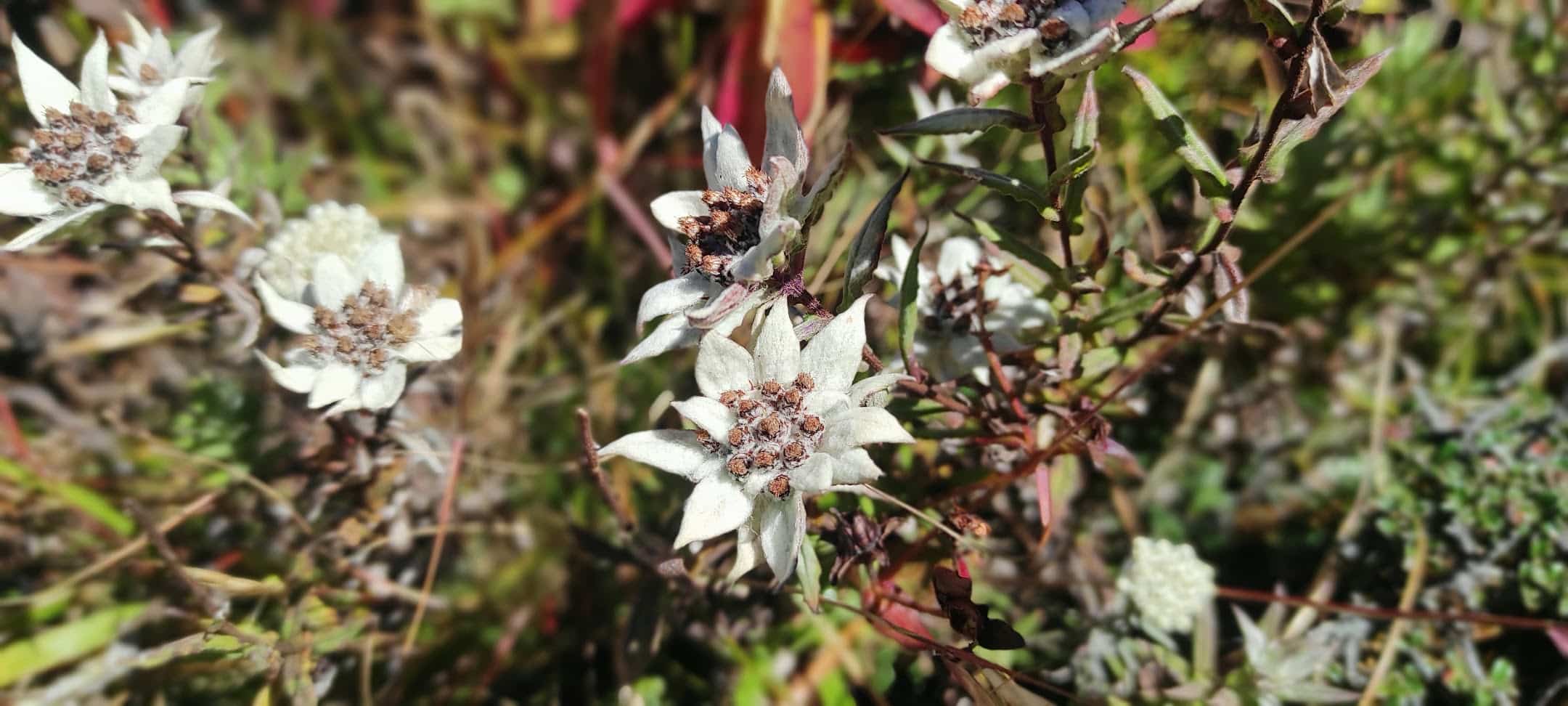
We finally reach a flat area, a trail along the hillside that lets me catch my breath. We discover with surprise hundreds of edelweiss flowers. While it’s a protected species in France, it grows like weeds here.
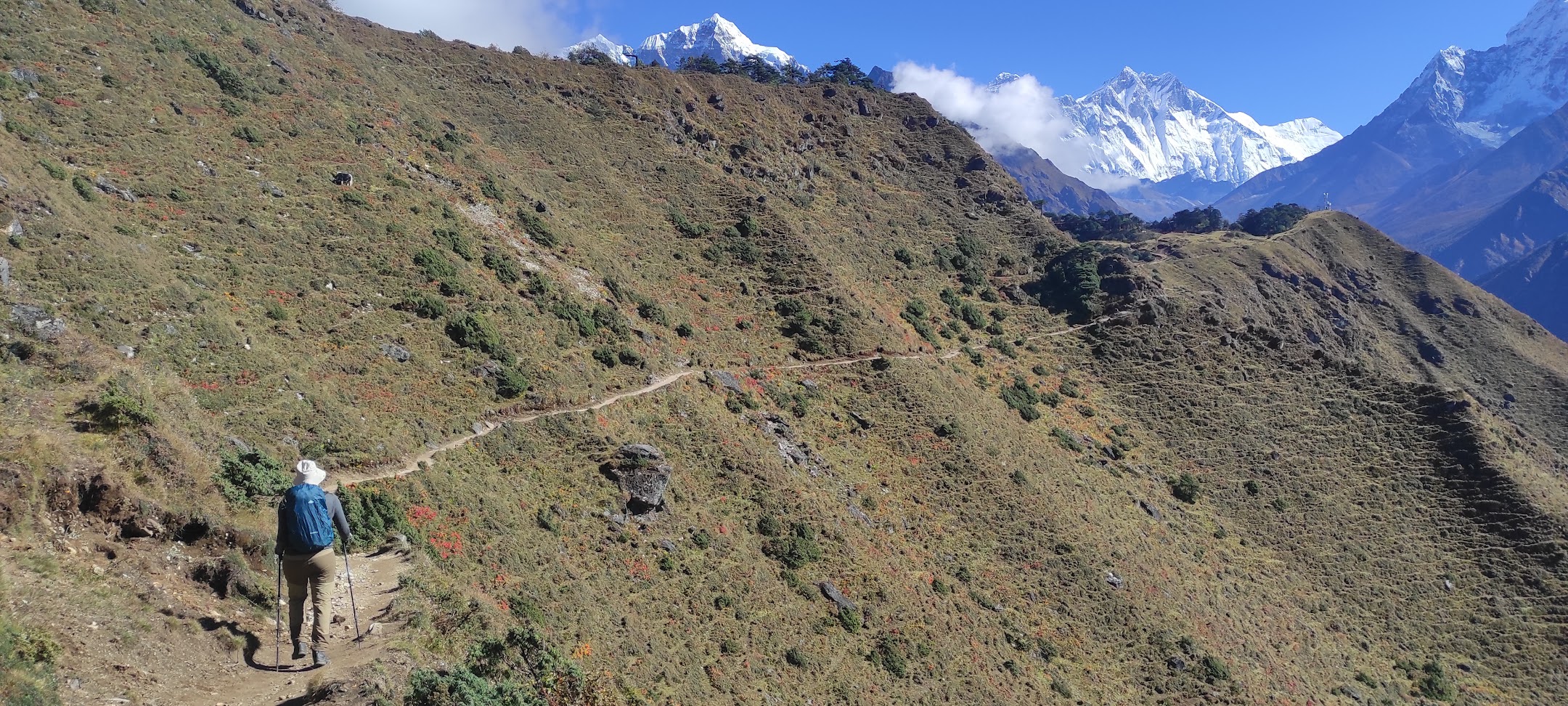
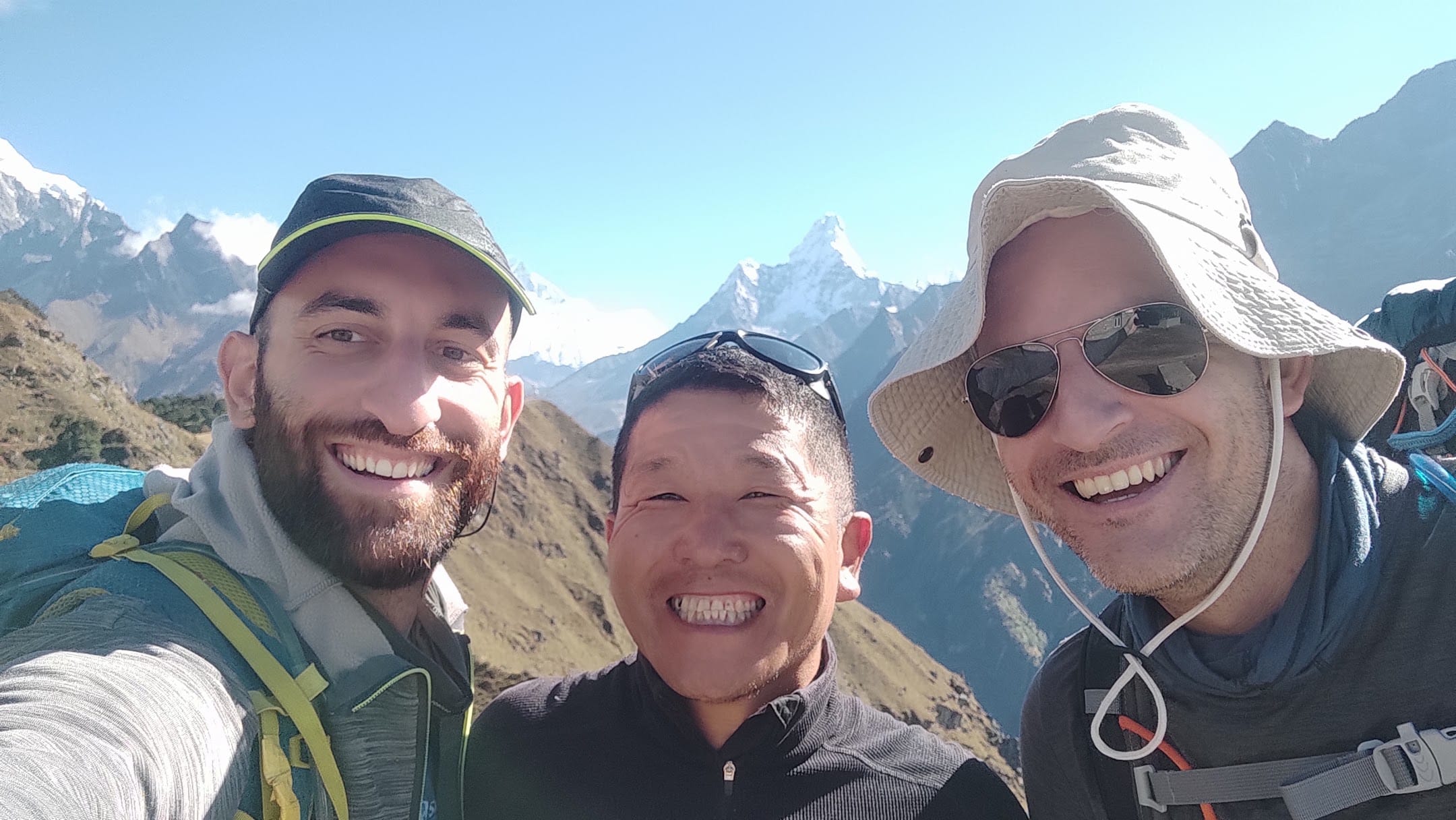
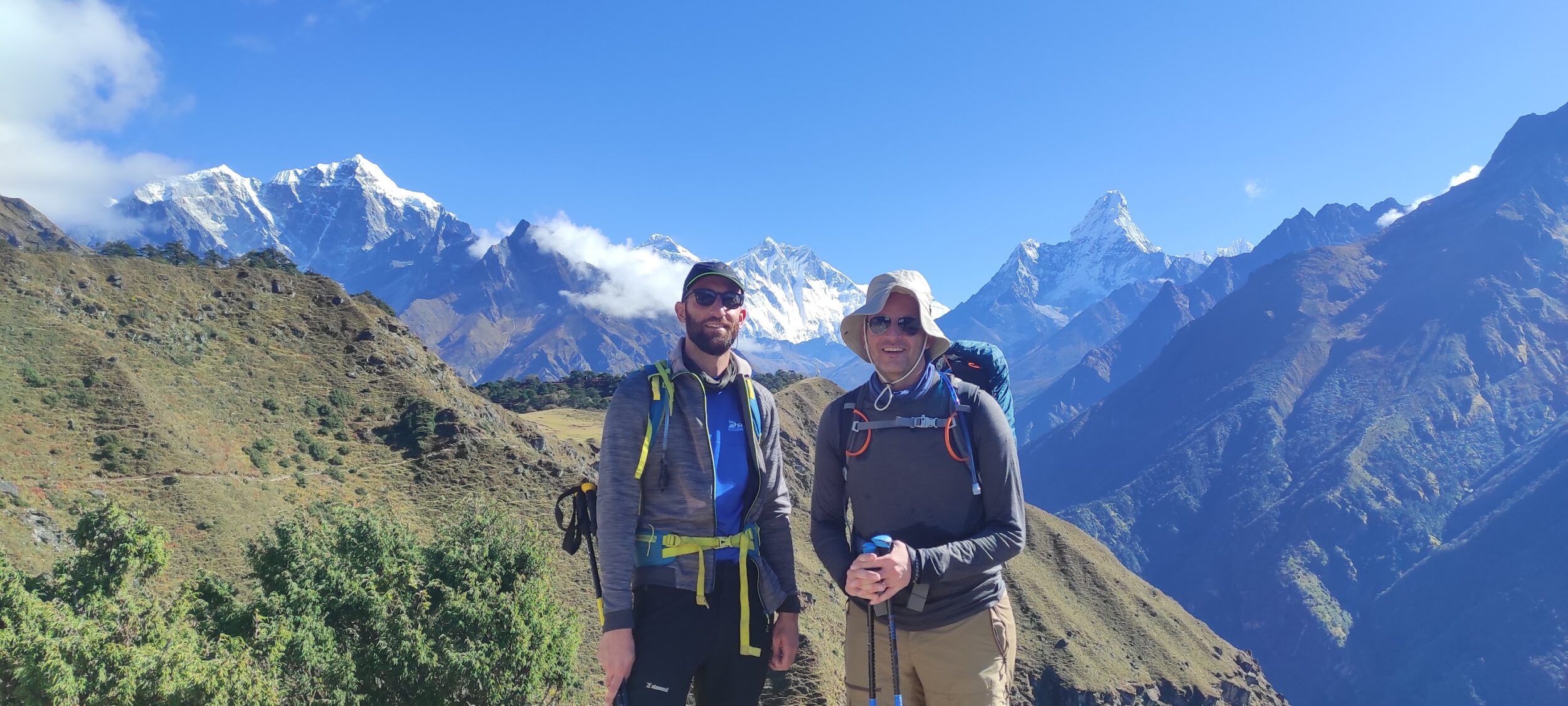
Then we arrive at the famous “Hotel Everest View” (3,880 meters). This hotel is famous because it’s listed in the Guinness Book of Records as the “highest hotel in the world.”
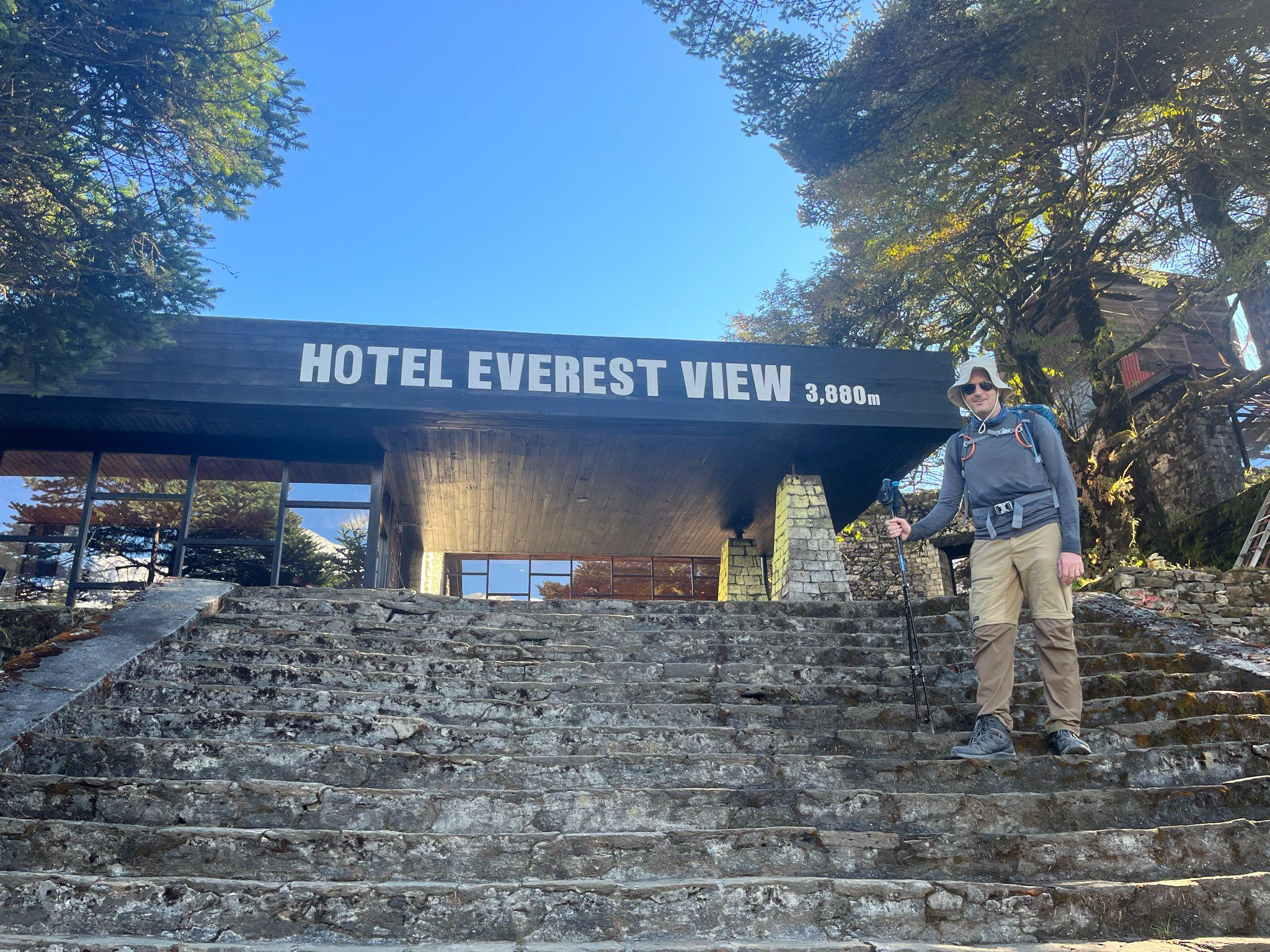
That’s marketing bullshit, because I’ve already slept in a hotel in Potosi, Bolivia, a city at 4,000 meters. It’s possible, however, that it’s the highest 5-star hotel in the world.
This hotel has a picture window and a terrace with a spectacular view of Everest. I would have liked to visit the hotel, but access is logically reserved for guests. Visitors can however enjoy the terrace and buy a drink. So we have the leisure to admire the peaks for about an hour, until the clouds roll in and completely block the view.
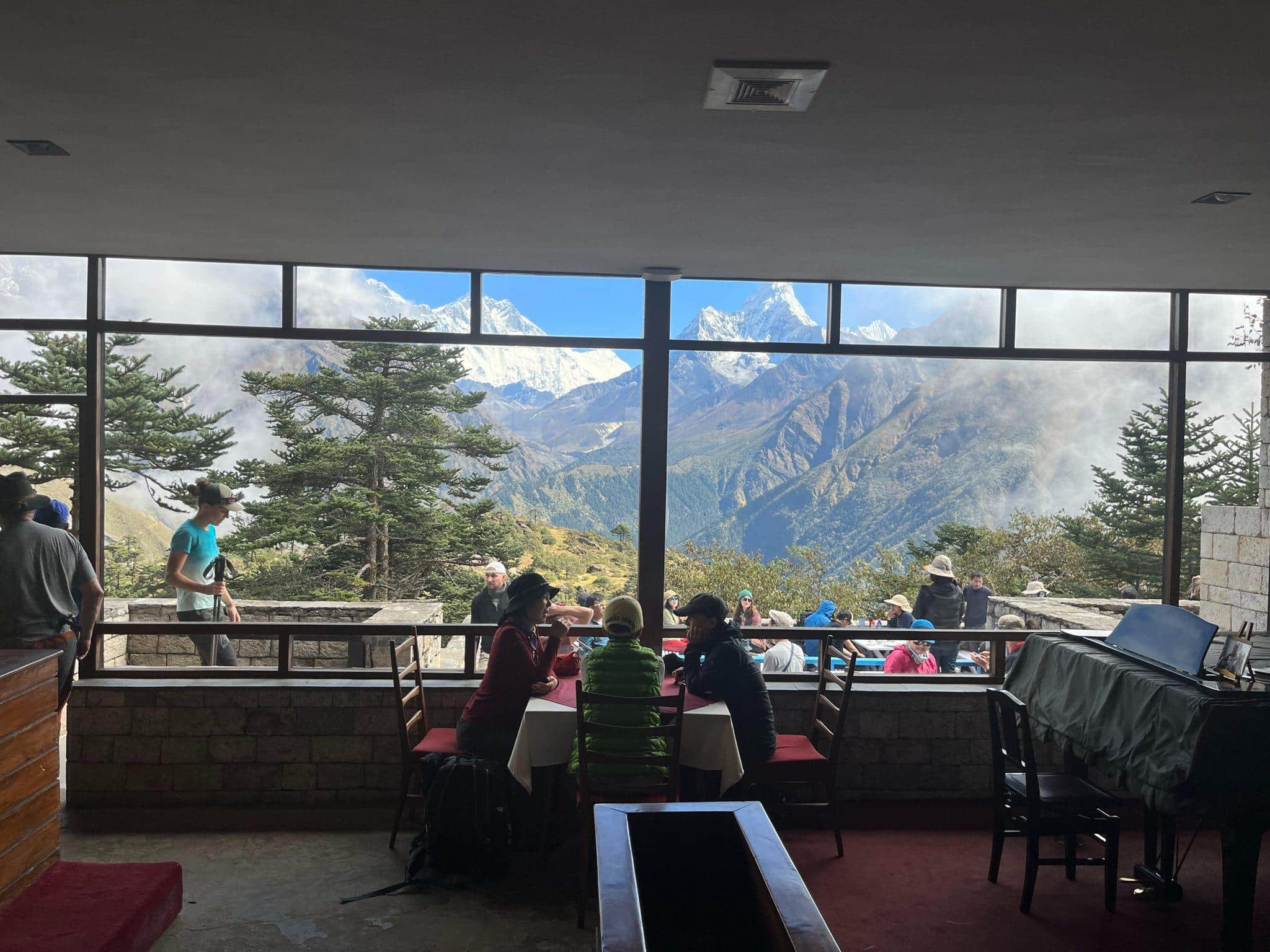
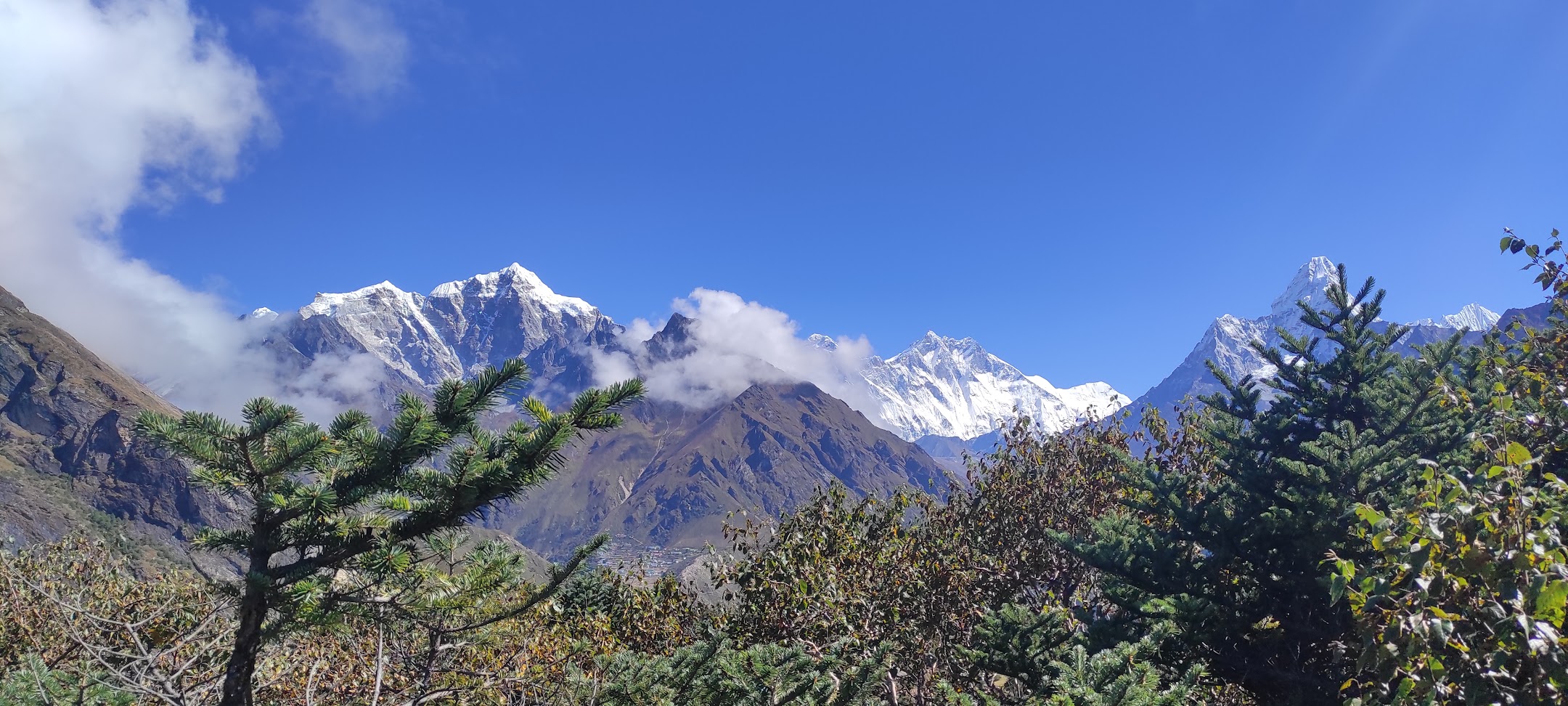
On the way back, we run into our Korean friends sitting at a table; they brought their own biscuits!
On the way down, we stop at the “Tourist Visitor Center,” which shows us a short video explaining that tourism is a blessing for the region, but it has a major downside: waste.
A lot of work has been done on this issue in recent years: about 10% of plastic waste is used to create souvenirs that tourists can buy. 90% of the waste is brought back down to Lukla, then to Kathmandu to be recycled. And since everything is carried by porters, the center offers tourists the chance to carry small 1 kg bags of plastic back down to Lukla. We’ll try to do that when we pass through Namche on the way down to Lukla.
We’re back at tea house just before noon.
After lunch and a quick nap, I go get a shave at the barber shop next door. This will save me from returning to Kathmandu with a two-week beard. Tourist price: 1,000 NPR (I had paid 800 in Kathmandu, in the touristy area already), but it’s not every day you get a shave in the Himalayas!
As long as we’re getting clean, might as well treat ourselves to a hot shower ! The first one in three days, and we’ve sweated a lot in between. Most (all?) tea houses offer showers, heated with gas bottles. They cost extra (500 NPR at our tea house). But above a certain altitude, it’s so cold that it’s not recommended to take one, as you might freeze while drying off. Namche might be our last chance to wash for a while. Vincent and I take advantage, and it feels great!
Vincent goes back to the pharmacy to buy some medicine; his sore throat is starting to go away. He thinks it’s just a cold.
No major aches or pains to report for now. Our feet are already well used to our shoes (or vice versa). We’re glad we wore them daily for three weeks in the Massif Central last month. I just have a slight strain in my right knee, from a small slip on the way down earlier. It’s nothing serious; hopefully it’ll be gone by tomorrow.
As I write these lines, I’m sitting in the dining room of the tea house. The Korean group arrives to enjoy a little snack: shrimp chips. I dare to hope they’re from Kathmandu and not Seoul, but it’s totally mind-blowing.
Despite the nice weather this morning, Lukla remained shrouded in clouds. The flights between Kathmandu and Lukla stayed grounded. We feel for those who must be despairing down below.
Tomorrow, off to Tengboche (3,870 meters)!
Day 4 – Tuesday, October 10, 2023: en route to Tengboche (3,870 meters)
Woke up at 6:30 AM, and I had the best night’s sleep since the adventure began. Went to bed around 9 PM, then woke up at 10:30 PM to use the bathroom, grumbling to myself that I’d be up every two hours. But after that, I slept straight through!
For Vincent, the night was rough—his nose was completely stuffed (you could hear it!). He’s not the only one; the higher we get, the more you hear people coughing or sniffling. No issues on my end, knock on wood.
His sore throat, however, is starting to fade.
I applied tiger balm to my knee last night and again this morning. I was afraid it would get more painful once the knee got cold, but it’s fine.
The acclimatization day seems to have done its job; our breathing is smoother than yesterday.
The view is completely obscured this morning; we’re in the clouds.
We leave around 8 AM.
The start of the day is a series of fairly gentle descents and ascents. Given my struggles yesterday, I try to adjust my pace: a brisk step on flat and downhills, and a very slow but steady step on uphills to avoid getting winded. Vincent and Rinzi let me take the lead to match my speed.
After an hour of walking, we arrive at Sanasa which sits at 3,600 meters. We’re surprised; that means we’ve already gained almost 200 meters since Namche, and we barely felt them. That reassures me a lot—I didn’t dare mention it yesterday, but I had some nausea on yesterday’s climb, and I feel much better today.
The sign announcing Sanasa also informs us that we’re 34 kilometers and 21 hours of walking from our goal: Everest Base Camp!
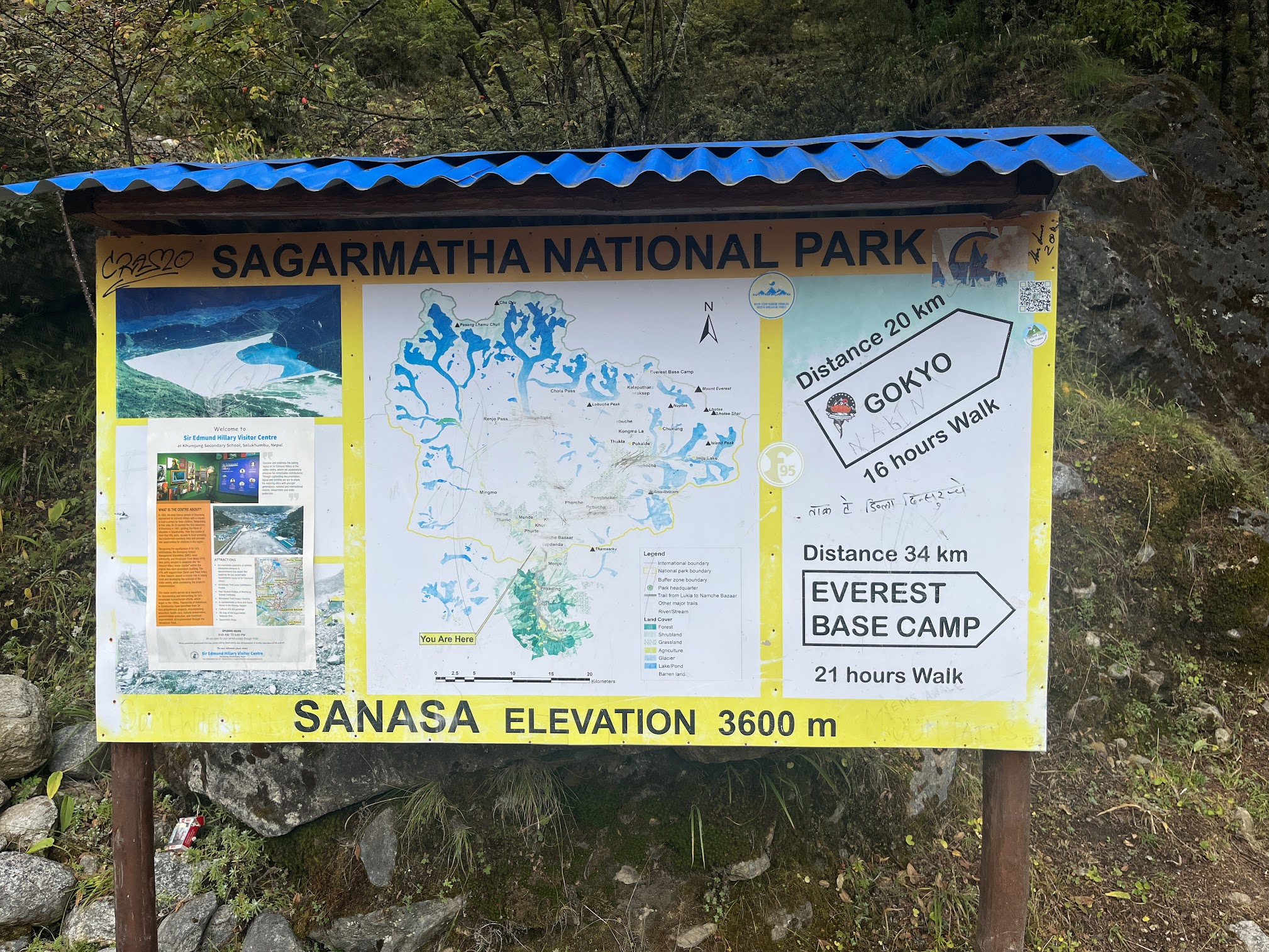
Just as I’m happy to have gained 200 meters, a loooonnnnnnng descent follows down to Phungi Thanga (3,250 meters). We’ve just descended 350 meters, which we’ll have to climb back up later!
We stop for lunch; it’s only 10 AM, but we’re already starving.
The kitchen takes a while, giving us time to recover before the big challenge of the day: a brutal climb of 600 meters of elevation gain.
Though it was cloudy this morning, it’s now very sunny. I think this is the first time we’re wearing just a T-shirt.
Around 11 AM, we’re off again. We pass a checkpoint where an entry fee must be paid. Rinzi suggests we start the climb while he handles the paperwork.
This climb is quite steep with many switchbacks (it feels like a mountain stage of the Tour de France), and there’s no way to know when it ends; you can’t see the top.
I ‘switch off my brain’ and progress step by step at a very slow but steady pace. We pass many trekkers who need to catch their breath. We only stop briefly to add a layer of clothing; it’s getting cold.
After about 1.5 hours of climbing, we spot our porter Buddha waiting for us, which probably means we’re close to the finish!
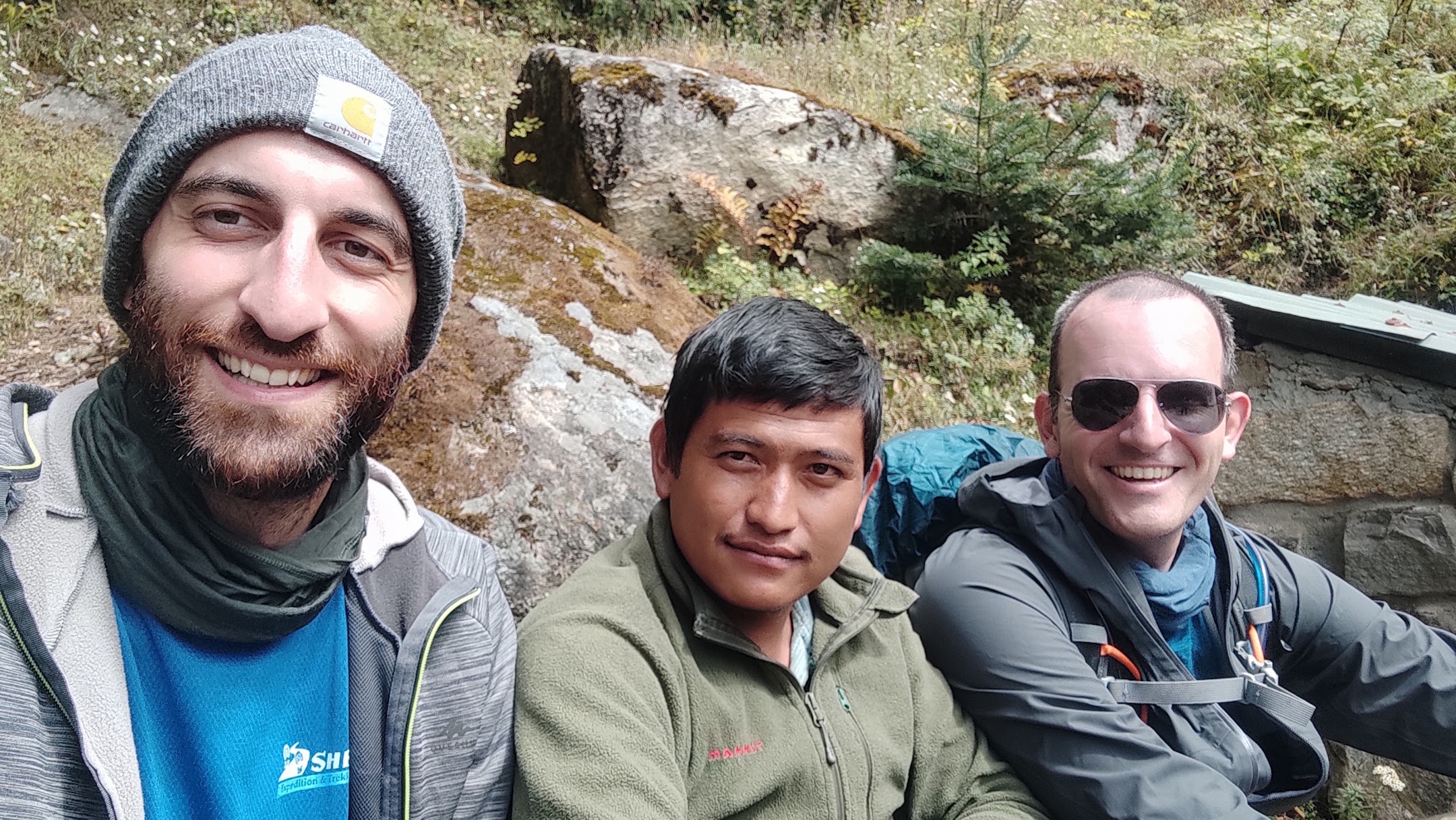
We have to wait a few moments for Rinzi, who hasn’t caught up since handling the checkpoint formalities. We joke that we can slow down if we’re going too fast for him. He finds it hilarious. In reality, he was stuck at the checkpoint for 30 minutes.
Indeed, it’s only a few more minutes of walking before arriving at Tengboche (3,860 meters). It’s 12:30 PM.
I’m really pleased with this trekking day; it reassures me as the difficulty ramps up with altitude and cold in the coming days.
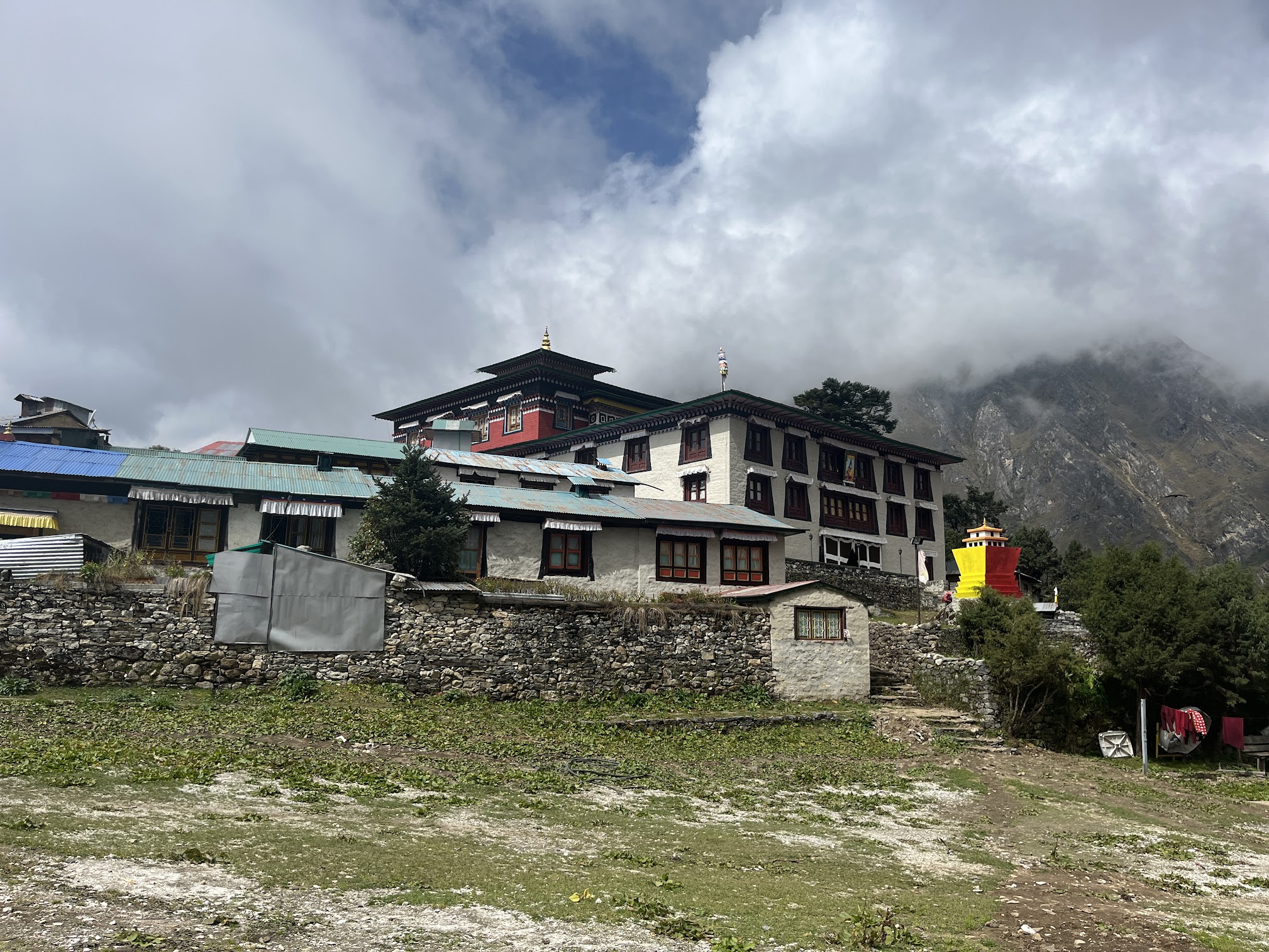
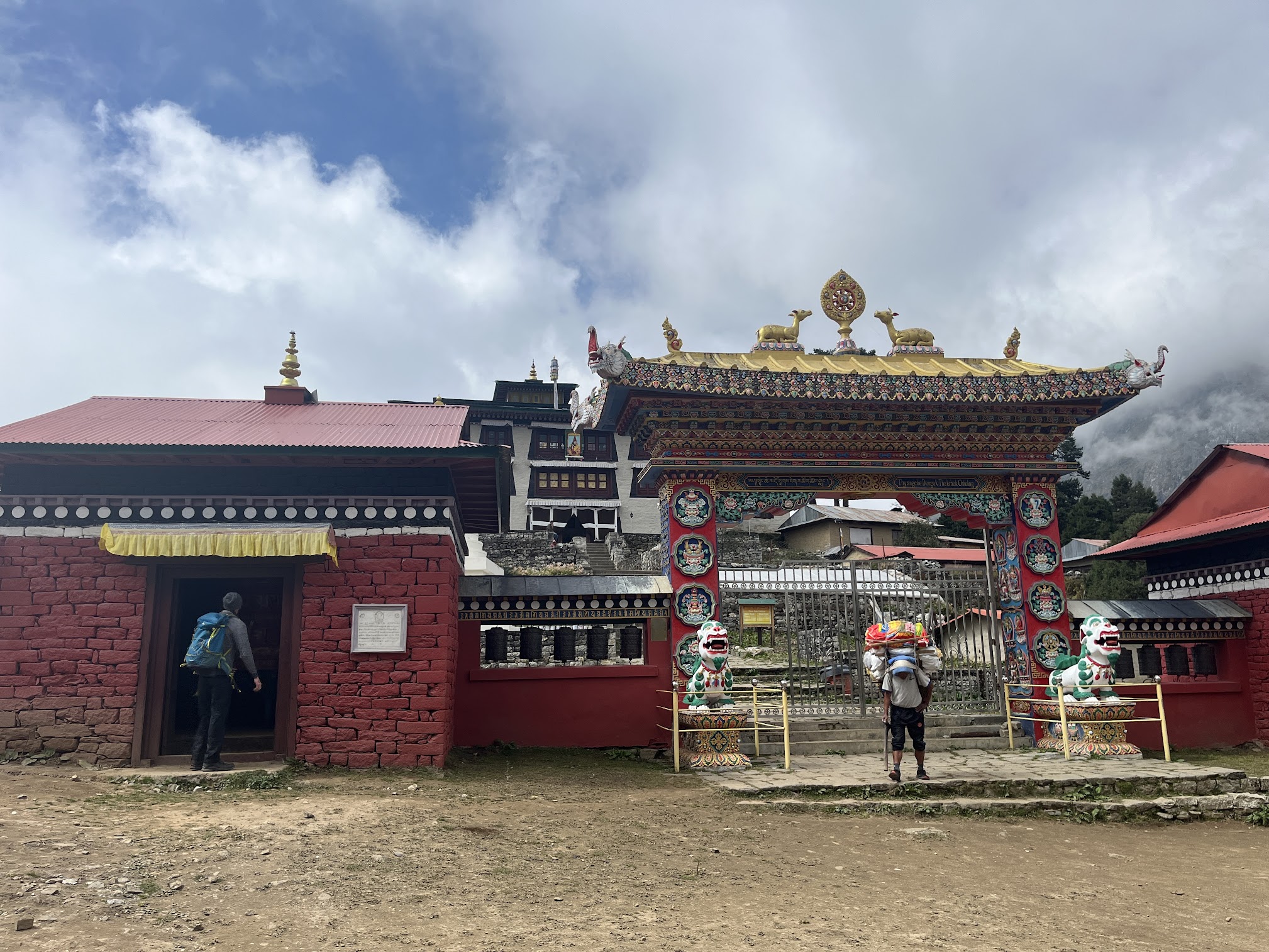
We pass a monastery, and our tea house (Tengboche Guest House) is right next door.
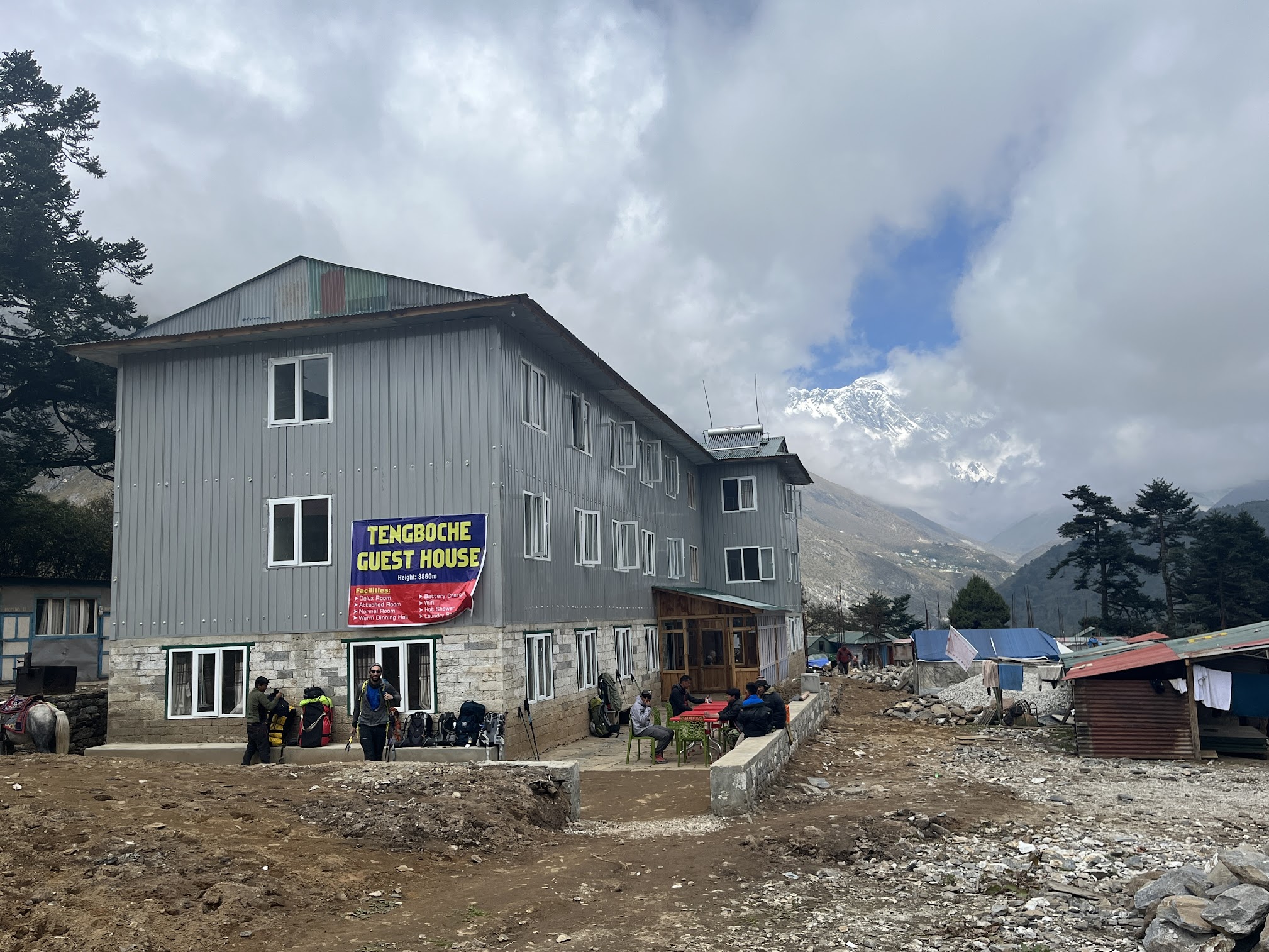
There aren’t many tea houses here, and several are under construction. Ours is quite strange, as it seems half-finished. Our room resembles a construction site prefab—no furniture inside, bare unpainted wood. But on the bright side, we have a free electrical outlet (usually it’s paid) and free Wi-Fi (it’s almost unusable, but it’s unusual for it to be free).
After a few minutes to settle in and get changed, we go to visit the Buddhist monastery. We’re lucky enough to stumble upon a ceremony. A dozen monks are chanting. It’s quite repetitive, in a monotone, but it’s soothing and invites introspection. Photos are forbidden, so this beautiful memory will stay with us. It’s a real stroke of luck to have witnessed this.
The extra 400 meters of altitude compared to Namche are noticeable. Breathing is harder, and we get out of breath climbing the two flights of stairs to our room a bit too quickly.
The tea house rooms aren’t heated. Tonight, for the first time, it’s really, really cold.
Heading down for dinner, we appreciate how effective the traditional wood-burning stove in the center of every tea house dining room is—it’s super warm!
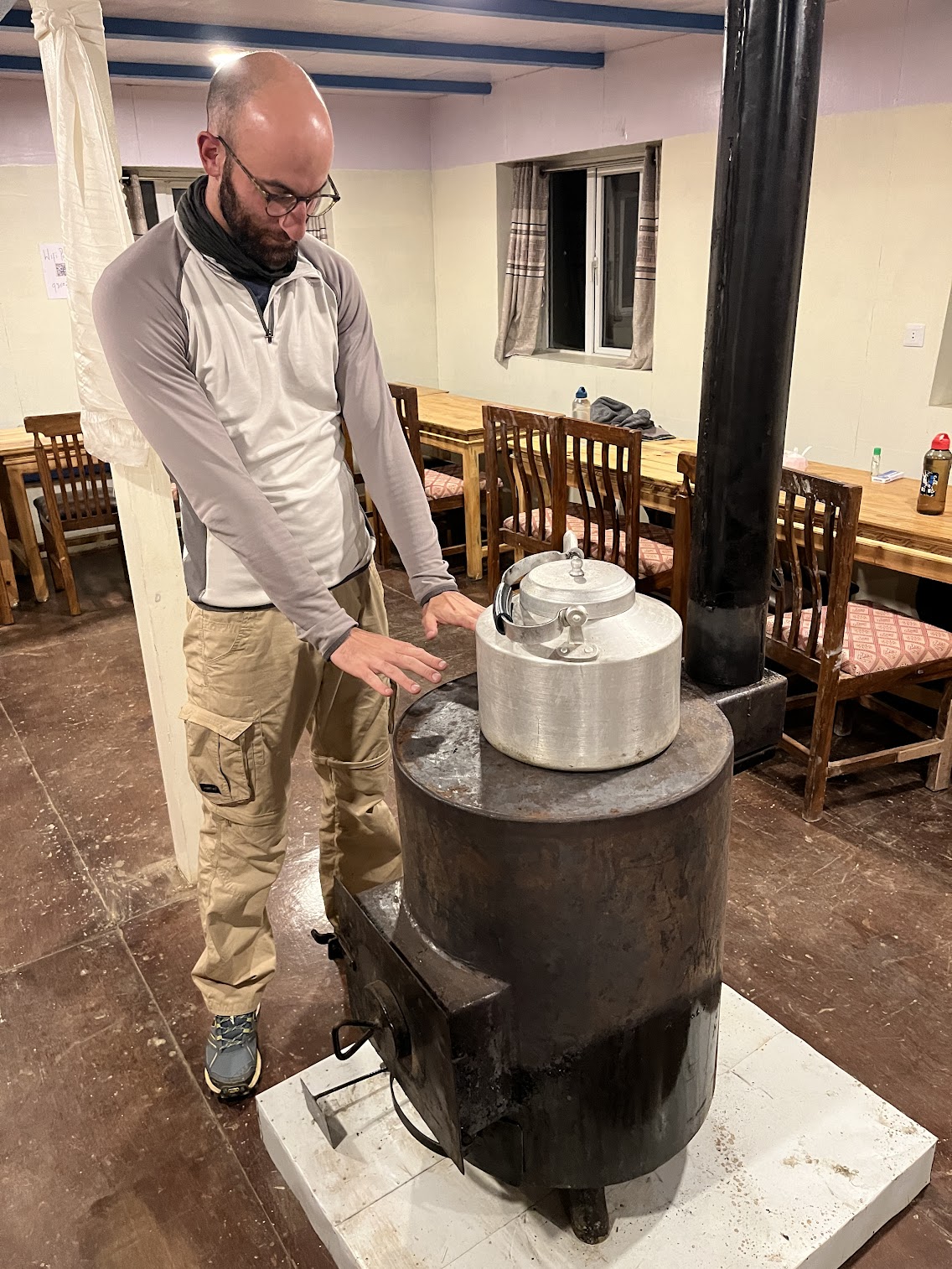
While our meals lack variety (almost always a delicious Dal Bhat), tonight we’re treating ourselves to a pizza!
This is the last meal where we’ll allow ourselves to eat meat, as from tomorrow, we’ll be above 4,000 meters. At these heights, meat takes several days to arrive. Given the state of the cold chain and sanitary controls, it’s recommended to skip it. So it’ll be a vegetarian diet for the next few days!
Tomorrow, off to Dingboche at 4,460 meters!
Day 5 – Wednesday, October 11, 2023: we cross the 4,000-meter mark!
Wake-up around 6:30 a.m. The night was pretty good. As the temperature starts to drop, I switched to “cold” mode for the first time, putting on my long-sleeved merino pajamas and using the down sleeping bag lent by the agency.
It works—I woke up at 1 a.m. (to go to the bathroom, of course…) sweating!
Vincent’s cold is improving, although he wakes up with a sore knee.
Half-asleep, I make a wrong move and bang my right hand against the plywood wall, ending up with a splinter in the worst place—under a fingernail.
I manage to get it out by hacking away with Vincent’s tweezers. Good thing he had some; my Swiss Army knife had been sacrificed in the quest to shed grams.
Yesterday’s pizza was good but very (too) filling—it’s been sitting heavy on both our stomachs.
The weather is gorgeous and we have a stunning 360° view of several peaks, including Everest!
We leave around 8 a.m. and start a relatively easy route, with false flats going up and down. All day, we progress with Everest clear in front of us.
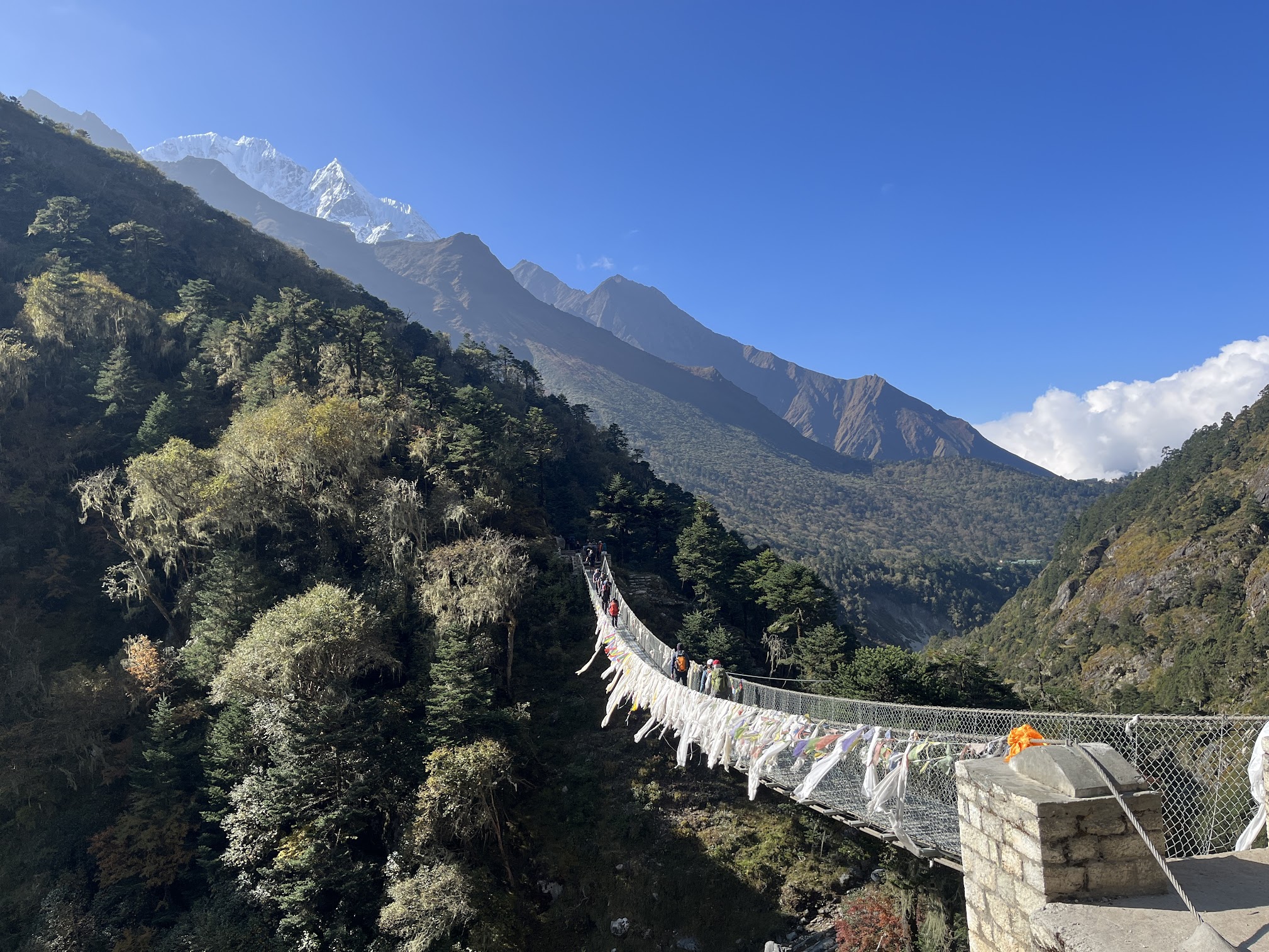
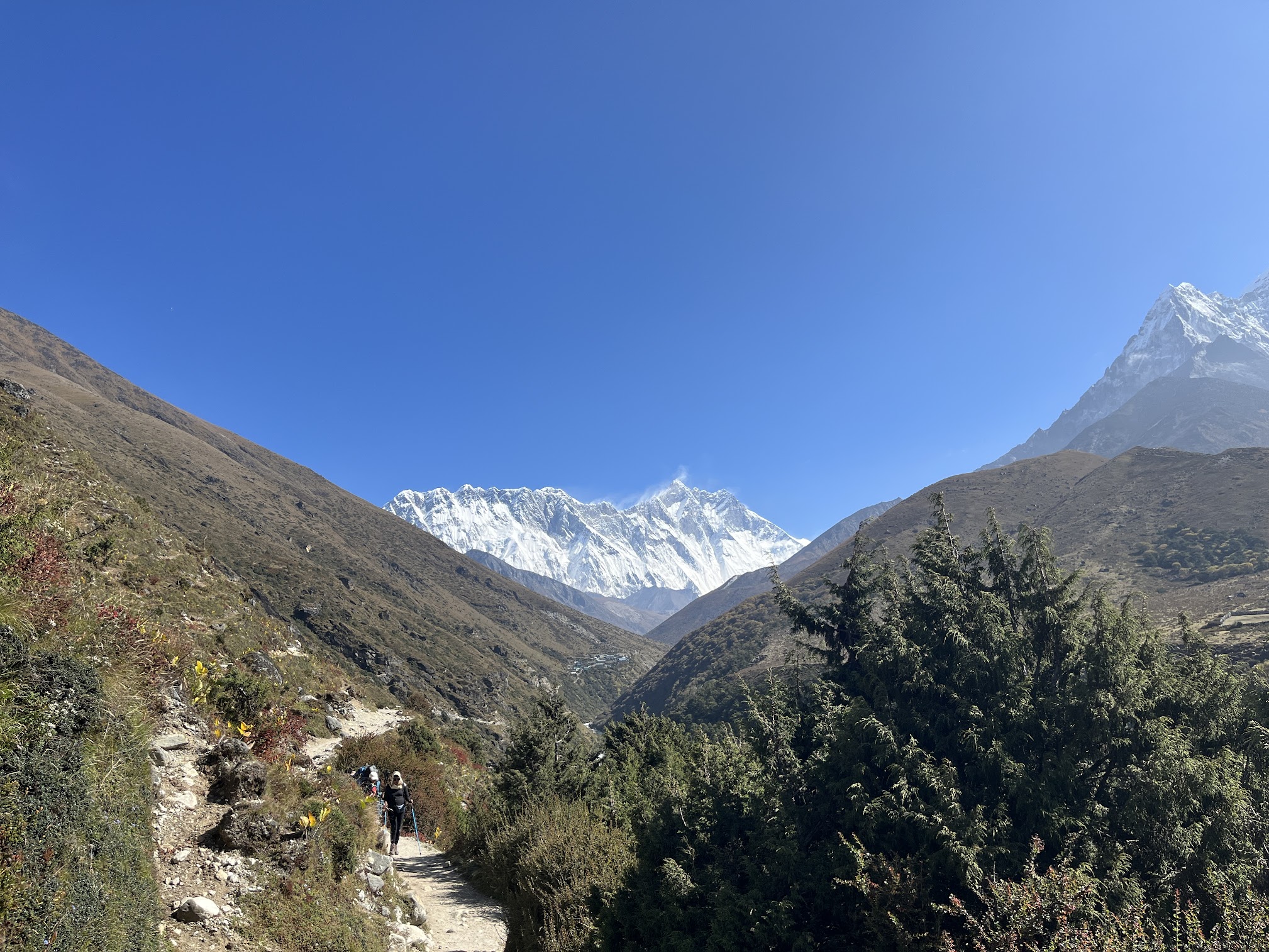
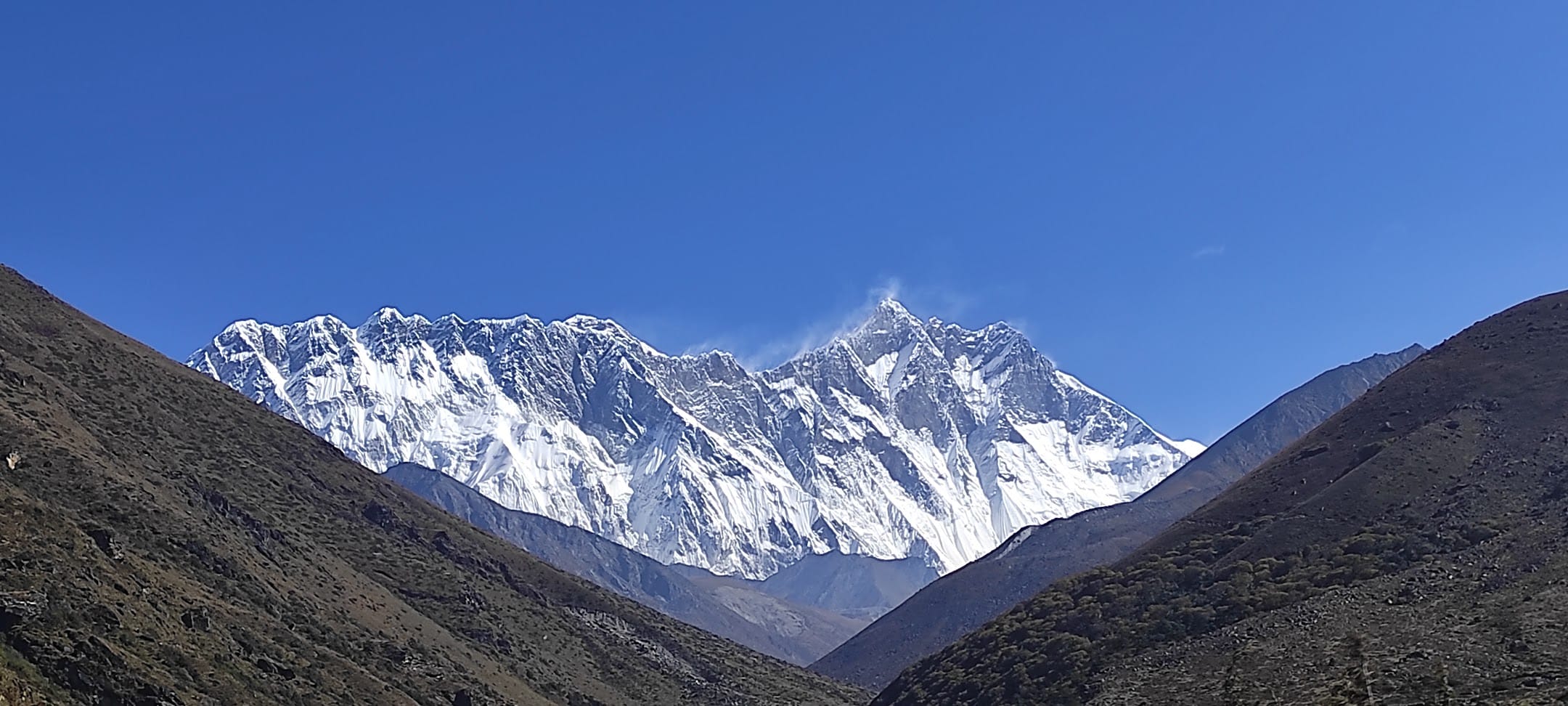
We spot our first Yaks—we hadn’t seen any until now because this species prefers higher altitudes. If Anh were here, she’d have plucked their wool to make her scarf.
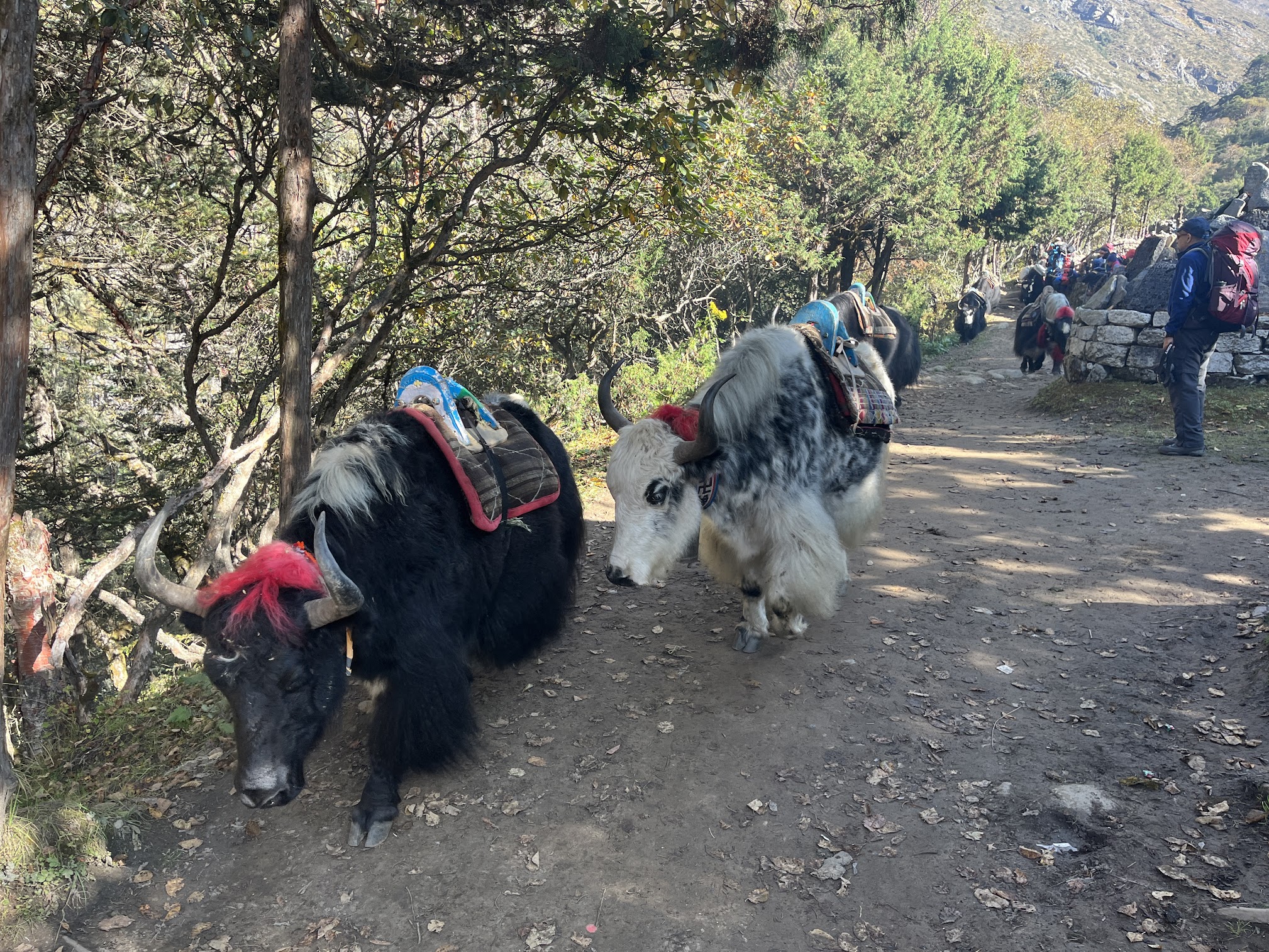
At 9 a.m., we cross the village of Pangboche and also cross the 4,000-meter altitude mark.
The path is quite narrow, and several times we’re slowed down by herds of Dzos that we struggle to pass.
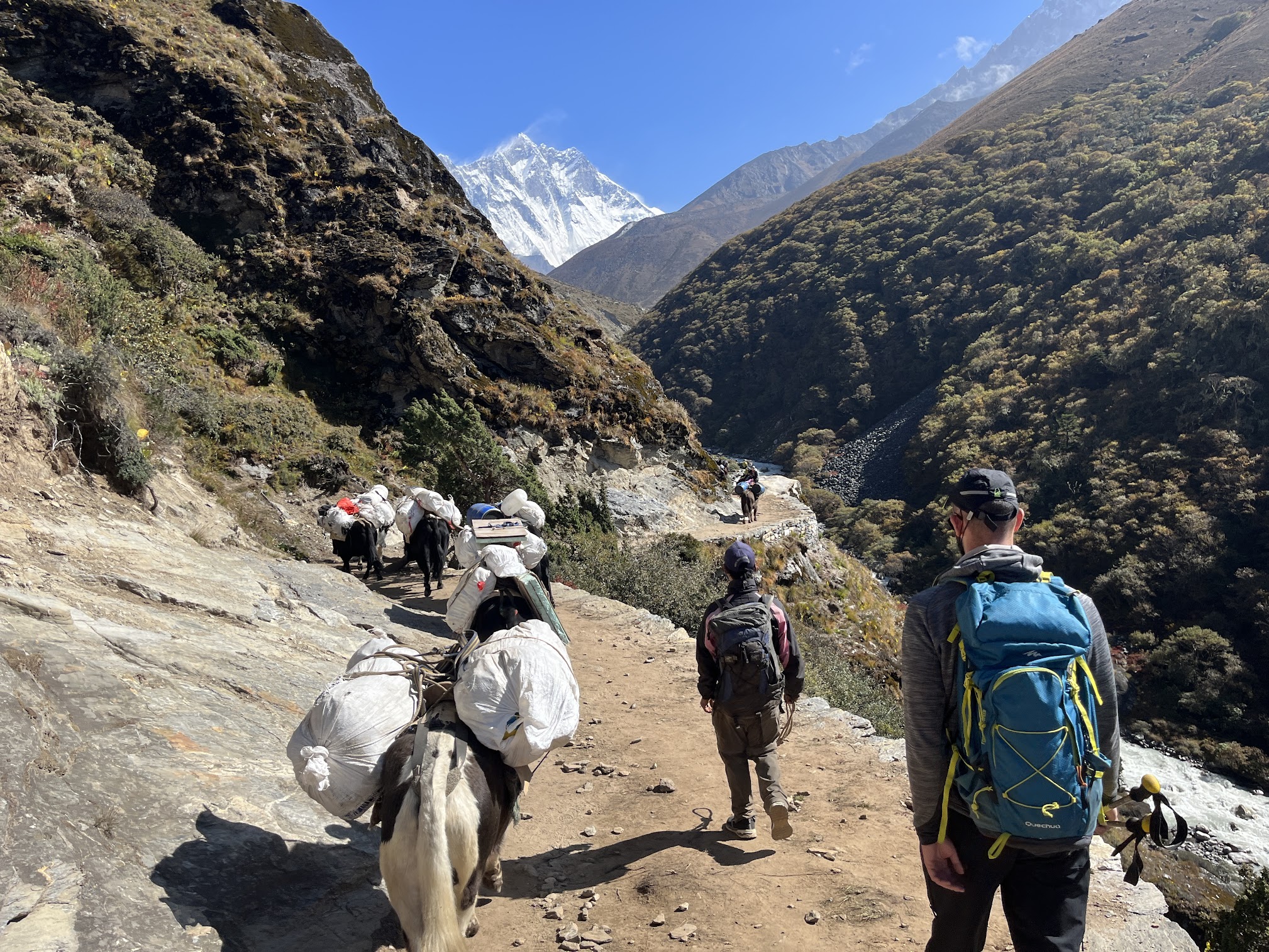
At 10 a.m., we stop for lunch in Somare, more or less at the same altitude.
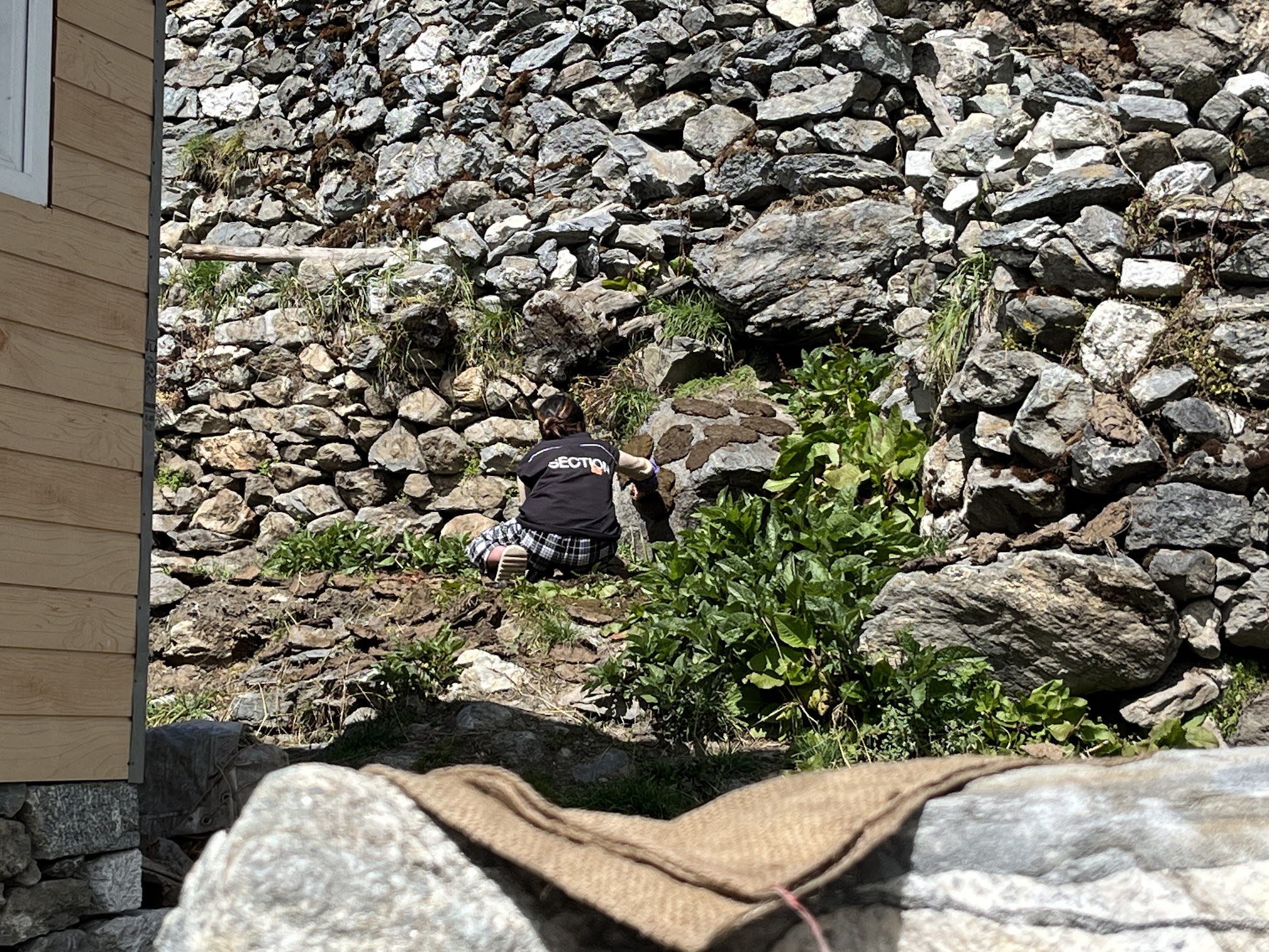
While waiting for our meal, we watch a woman preparing “dung cakes” that she leaves to dry in the sun. Once dried, these cakes are used to fuel the stoves.
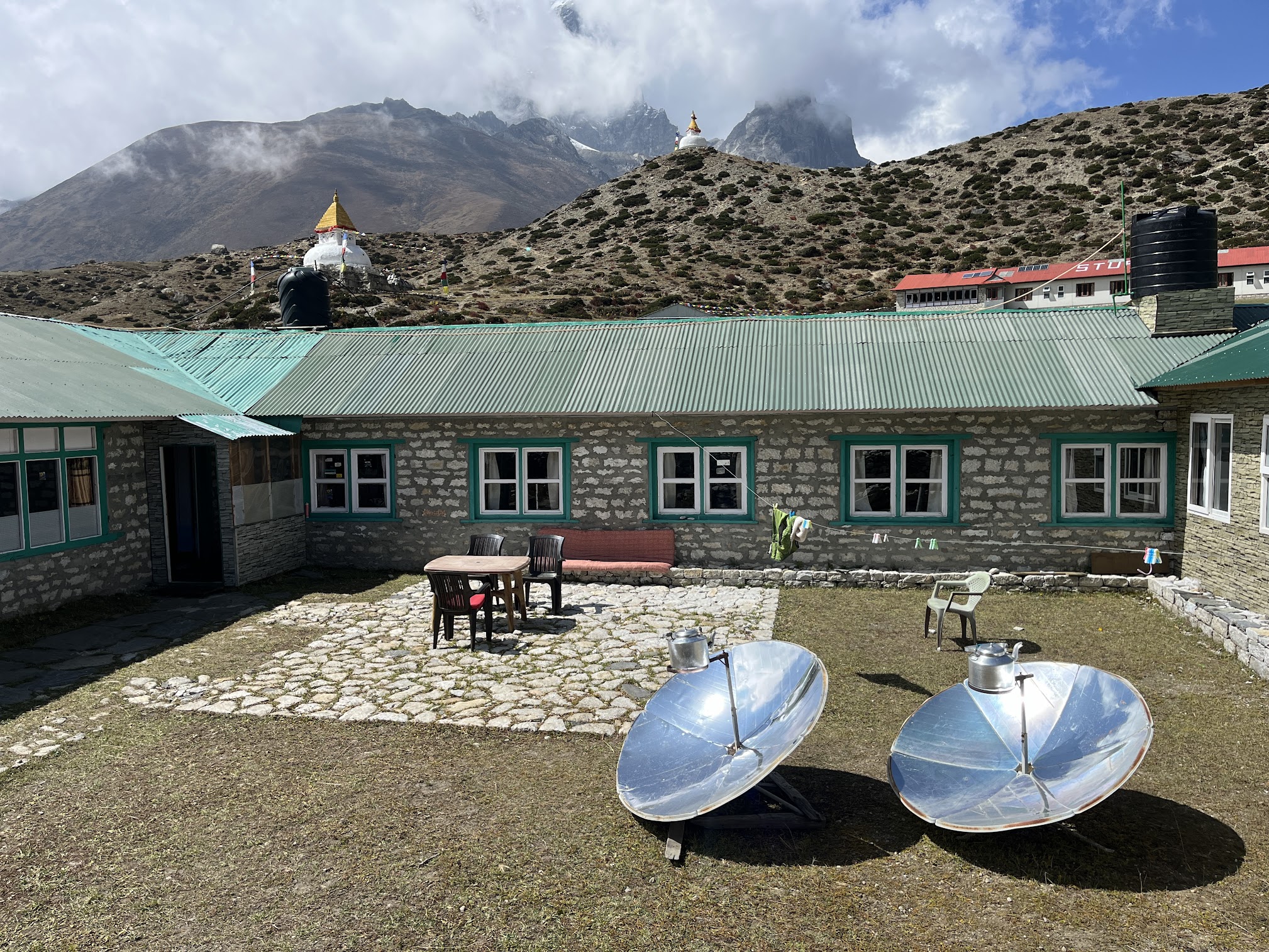
We also discover an aluminum contraption that looks like a satellite dish. It’s a solar cooker—you place a coffee pot on it and patiently wait for the water to boil.
With the good weather, it’s a real parade of helicopters overhead. Yet, still no flights between Kathmandu and Lukla! It must be over a week since there have been any!
Then we’re off for over 400 meters of elevation gain to reach Dingboche. Our agency’s itinerary said: “The last hill into Dingboche, and at this high altitude, is challenging!”. As if the first 4 days weren’t already!
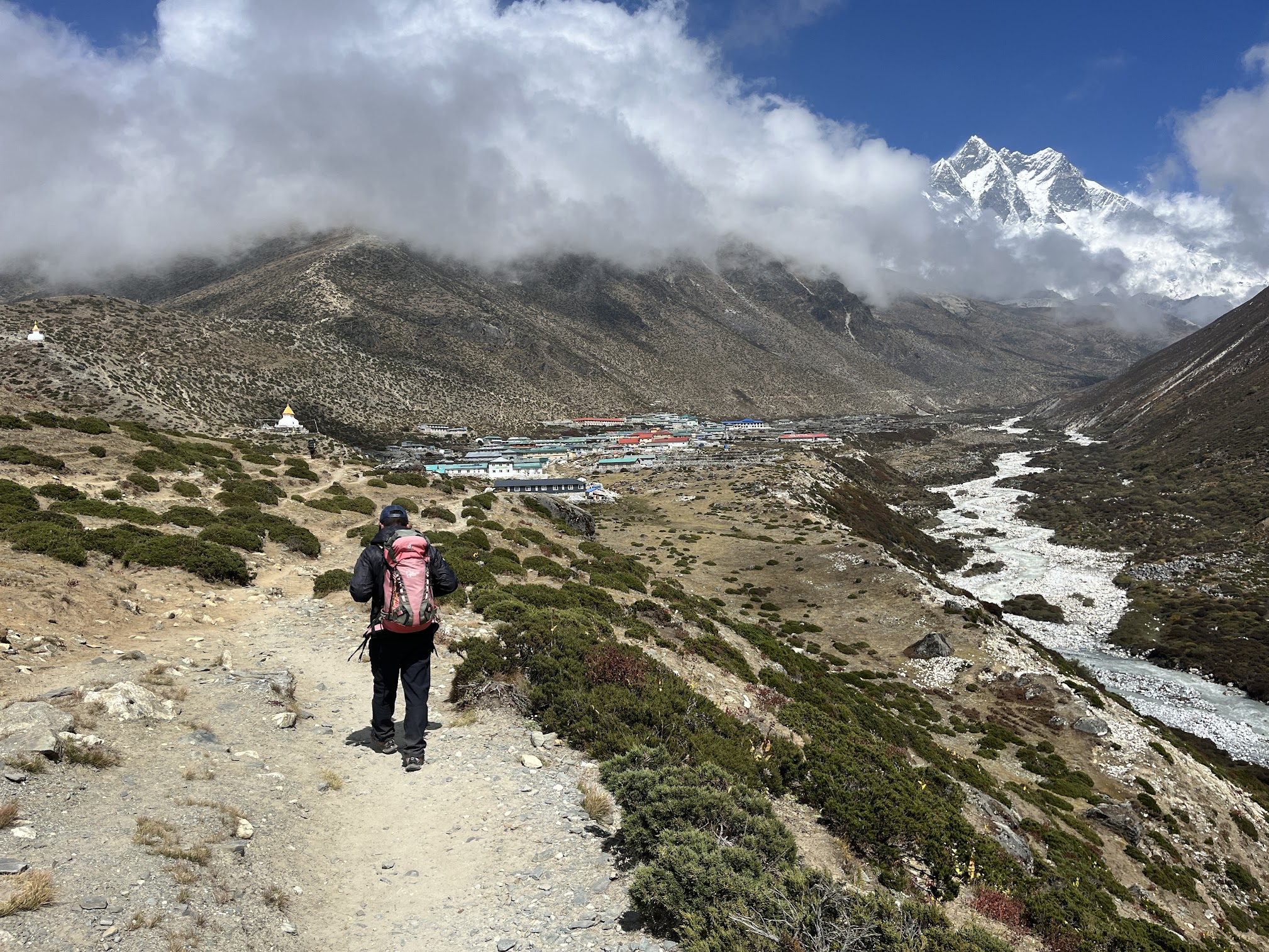
Indeed, the first part, for about an hour, is quite tough. I switched off my brain, like yesterday. The last 30 minutes are easier, on a sort of plateau with a gentle incline, where we’re almost alone and can admire the view.
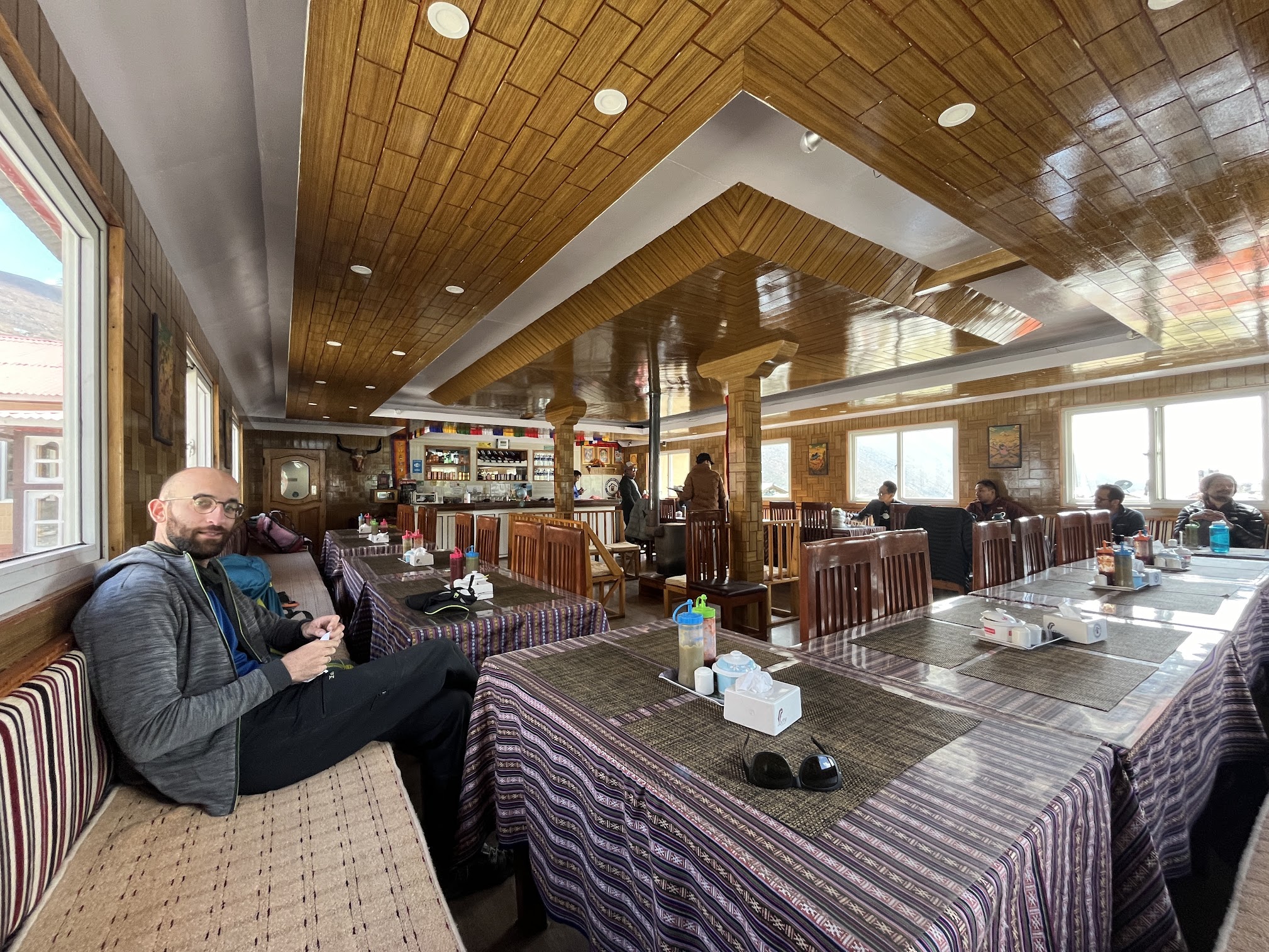
We arrive in Dingboche (4,460 meters) at noon. Our tea house (Hotel Tashi Delek) is really great.
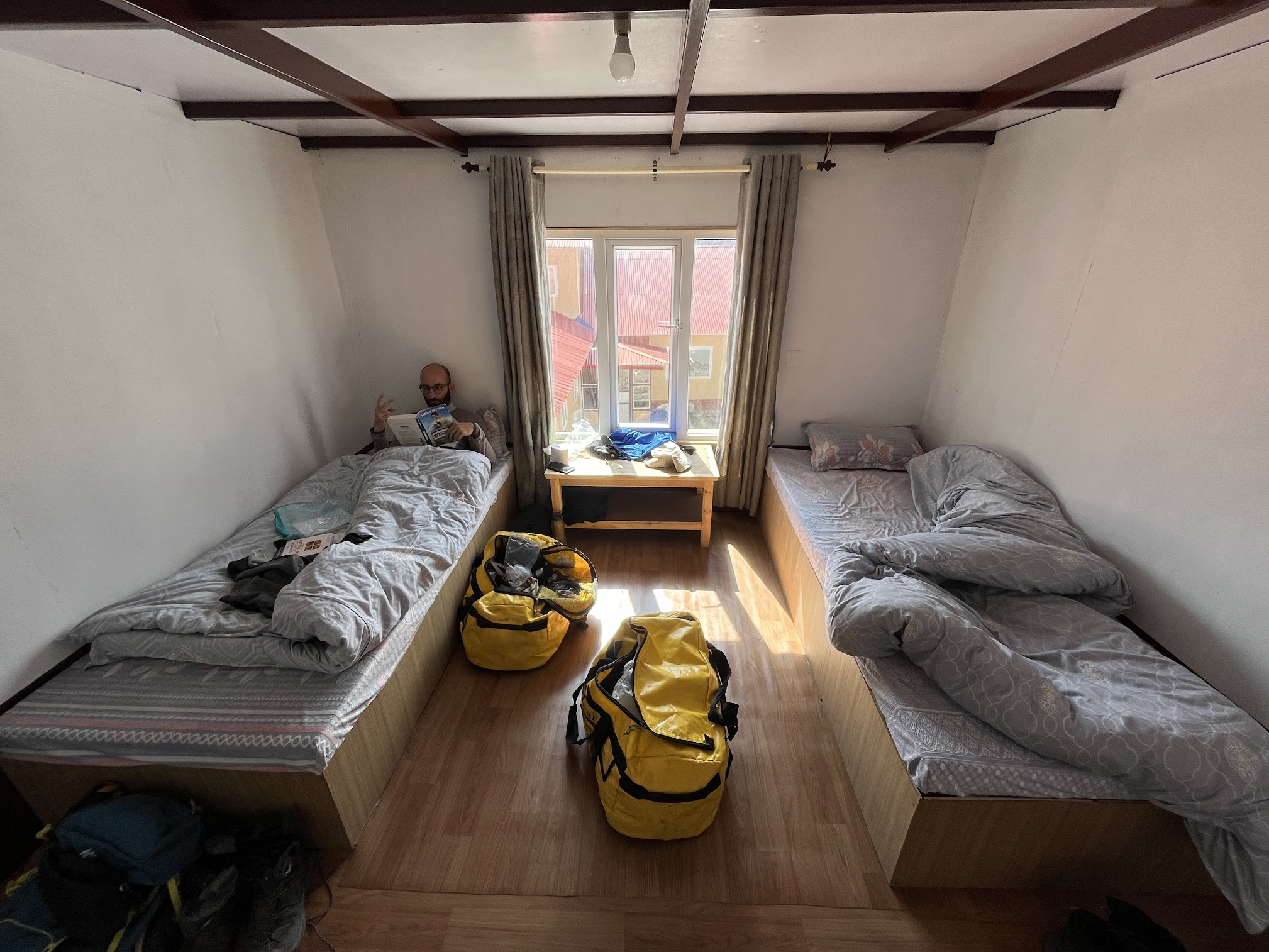
We’re surprised by the mild temperature, even though Google Weather showed below freezing. In our room, hit by the sun, it’s almost too warm! We’ll see what it’s like tonight.
Even though the walk went well, we’re feeling a bit out of it from the altitude. We’re staying here two nights to acclimatize, which is a good thing.
Arriving in Dingboche, we passed by a French bakery. Of course, we went to check it out. The place is only “French” in name. Still, we treated ourselves to a chocolate snack to regain our strength.
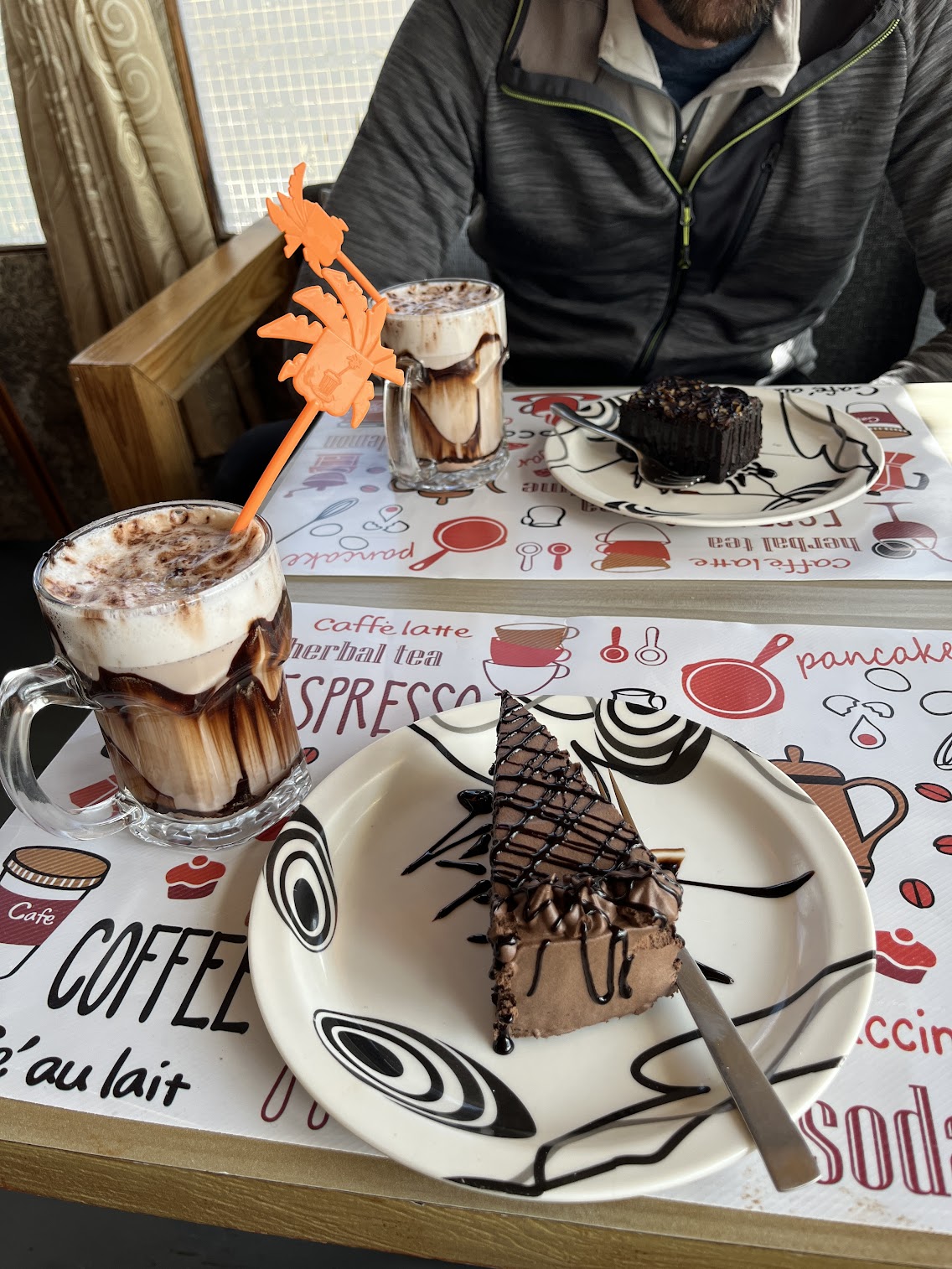
These little Himalayan tourist villages offer surprising services.
A café offers “free phone charging” if you spend at least 400 NPR.
No phone signal here, but you can buy WiFi access.
Our accommodation offers horse rental.
…
Tomorrow is an acclimatization day, we’re supposed to climb 300 more meters before coming back down to Dingboche.
Day 6 – Thursday, October 12, 2023: 5,100 meters!
Woke up before 7am, Vincent’s alarm says it’s 8°C in the room.
With our great sleeping bag, we’re not cold, but getting out of bed to get ready is tough.
Vincent didn’t sleep all night. Despite the fatigue, I also took a long time to fall asleep. Probably the altitude; our breathing isn’t normal.
In the breakfast room, it’s also quite cold. We hear more and more coughing and sniffles around us. Vincent’s issues are resolved. I’m lucky to still have no health problems; I haven’t taken a single pill since the start.
It’s an acclimatization day, but again, we’re going to climb hard. The agency’s plan says we’ll climb “Nagarjun peek” up to 4,730 meters, which can be extended to 5,100 meters if we’re well acclimatized. The guide immediately talks about going to 5,100m. We like to think it’s because he senses we’re up for it 😀
I plan to do like the last two days: climb at a slow, steady pace and do it all in one go.
I’ll soon be disillusioned, how hard it is! The slope is steep, but it’s mainly the altitude that knocks me out. My heart rate climbs quickly, and recovery breaks don’t bring it down as much as expected. At 5,000 meters altitude, we only absorb 53% of the oxygen compared to sea level.
Extra difficulty: we can’t see the summit! Several times I ask Rinzi if the peak we see is the summit, but the answer is always no!
Vincent is doing quite well; he even cracks jokes, which I’m incapable of.
Rinzi is a bit annoying; he literally has his hands in his pockets. He left without a bag or water.
I start counting sets of ten steps in my head. Telling myself that at the end of each set, I’d have gained a few meters. But my steps are so tiny that it probably doesn’t amount to much. I’m so out of it that I often keep counting “11, 12, 13, …” instead of starting over.
I can barely appreciate the beautiful lakes below.
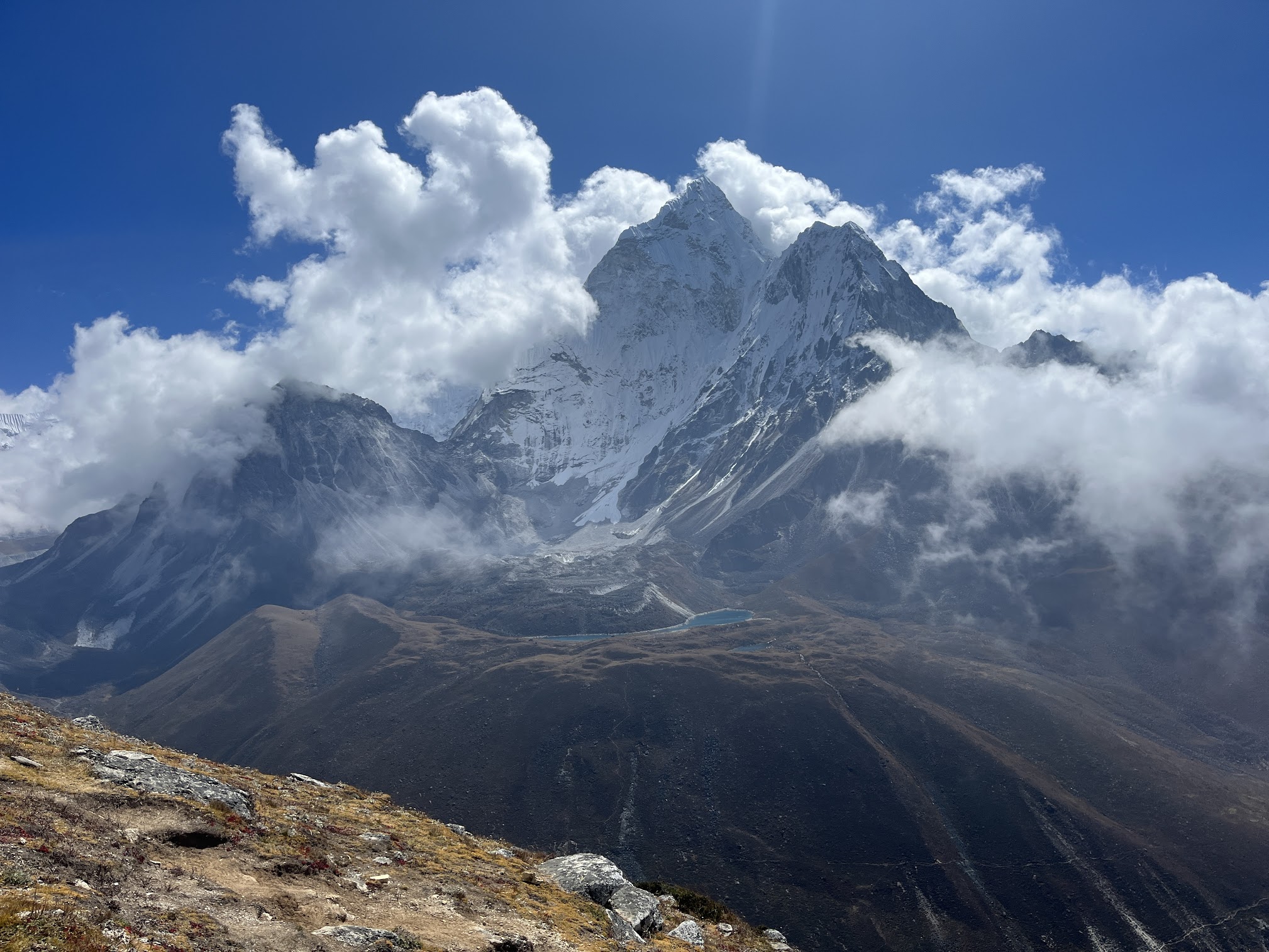
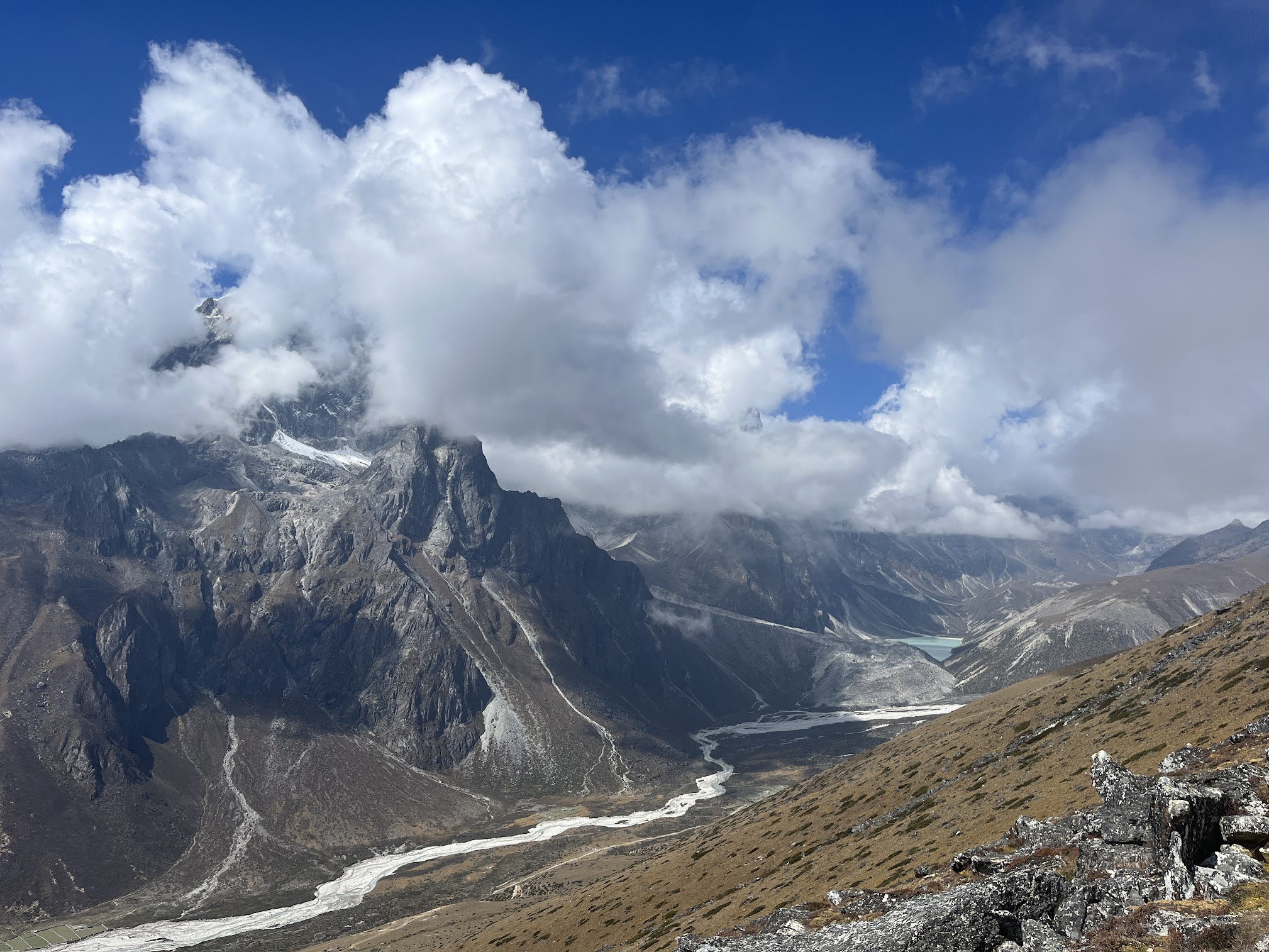
Since I can’t see the summit, I occasionally ask Rinzi the altitude from his watch’s altimeter. At least it’s progress. Not fast enough, but progress!
Yesterday we noticed we were passing many people and rarely the opposite. Despite my pace and sorry state, that’s still true today. I reassure myself as best I can.
At 10:20, after a bit over 2 hours of effort, we’re at the summit! This one I really had to dig deep mentally!
5,100 meters, it’s the altitude I reached in Peru under much simpler conditions. Vincent’s record set at Margherita Hut (4,559 meters) is shattered.
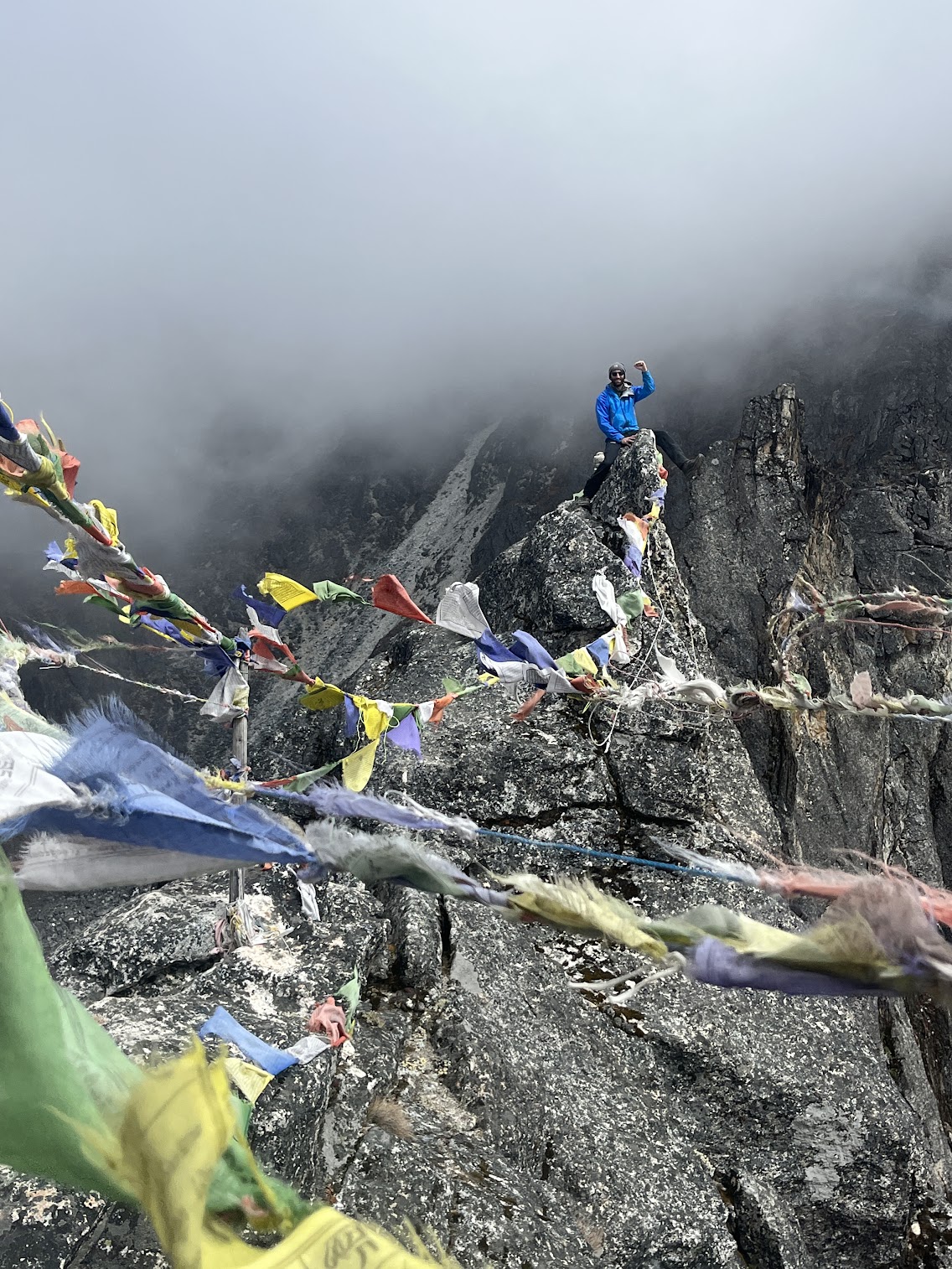
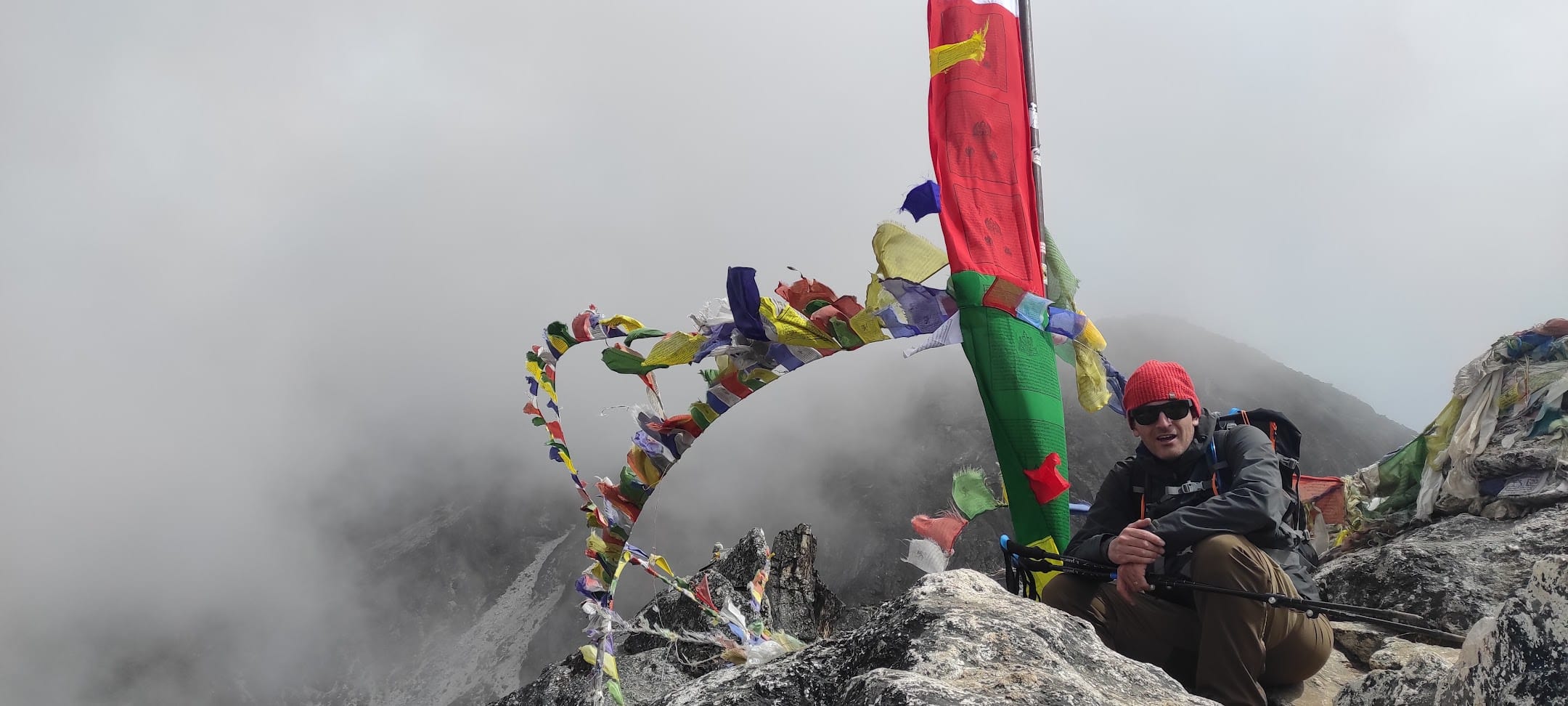
The sky is cloudy, but when the wind shifts, we get a clear view of several peaks for a few moments.
Time to start descending. It’s endless! Throughout the descent, we have a bird’s-eye view of Dingboche, which looks like a Playmobil village. It takes a long time to look human-sized again.
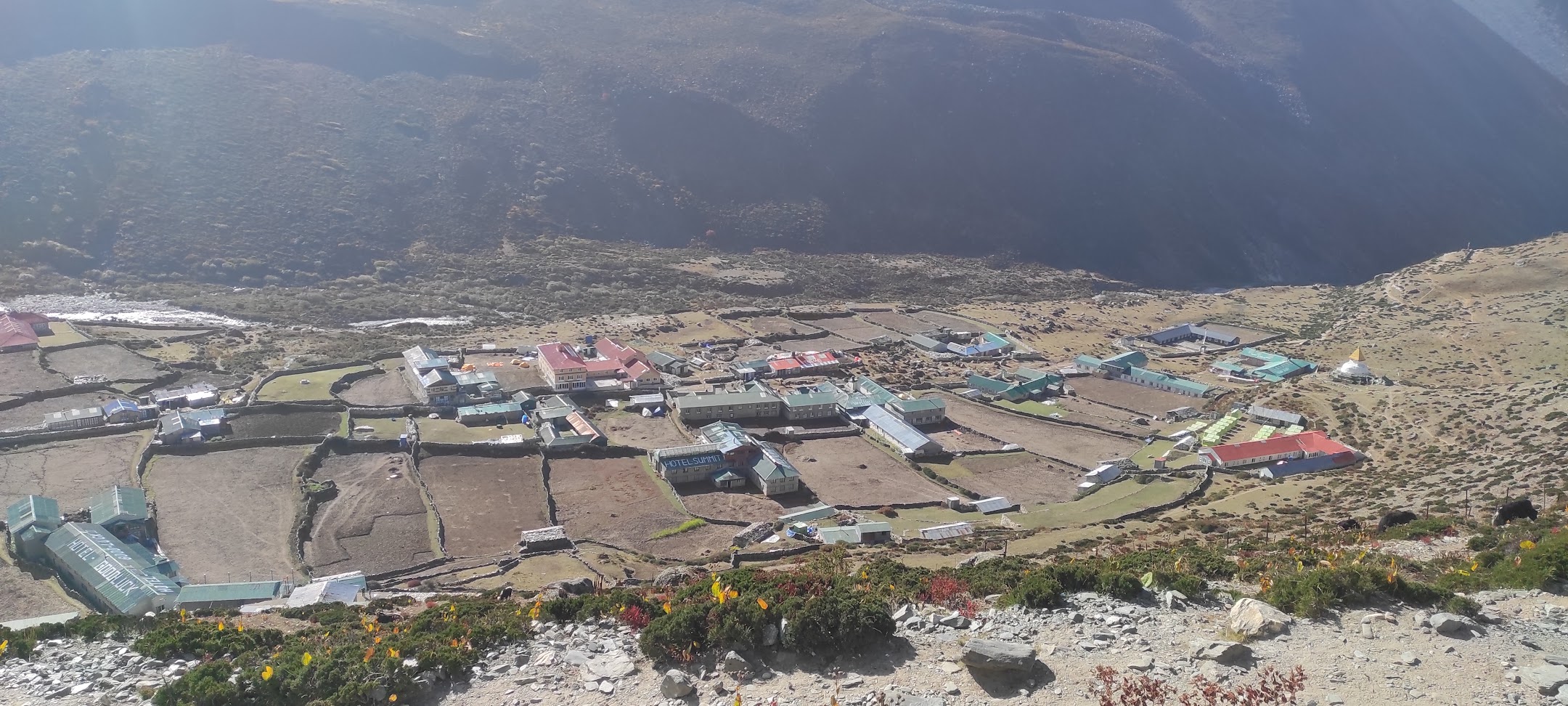
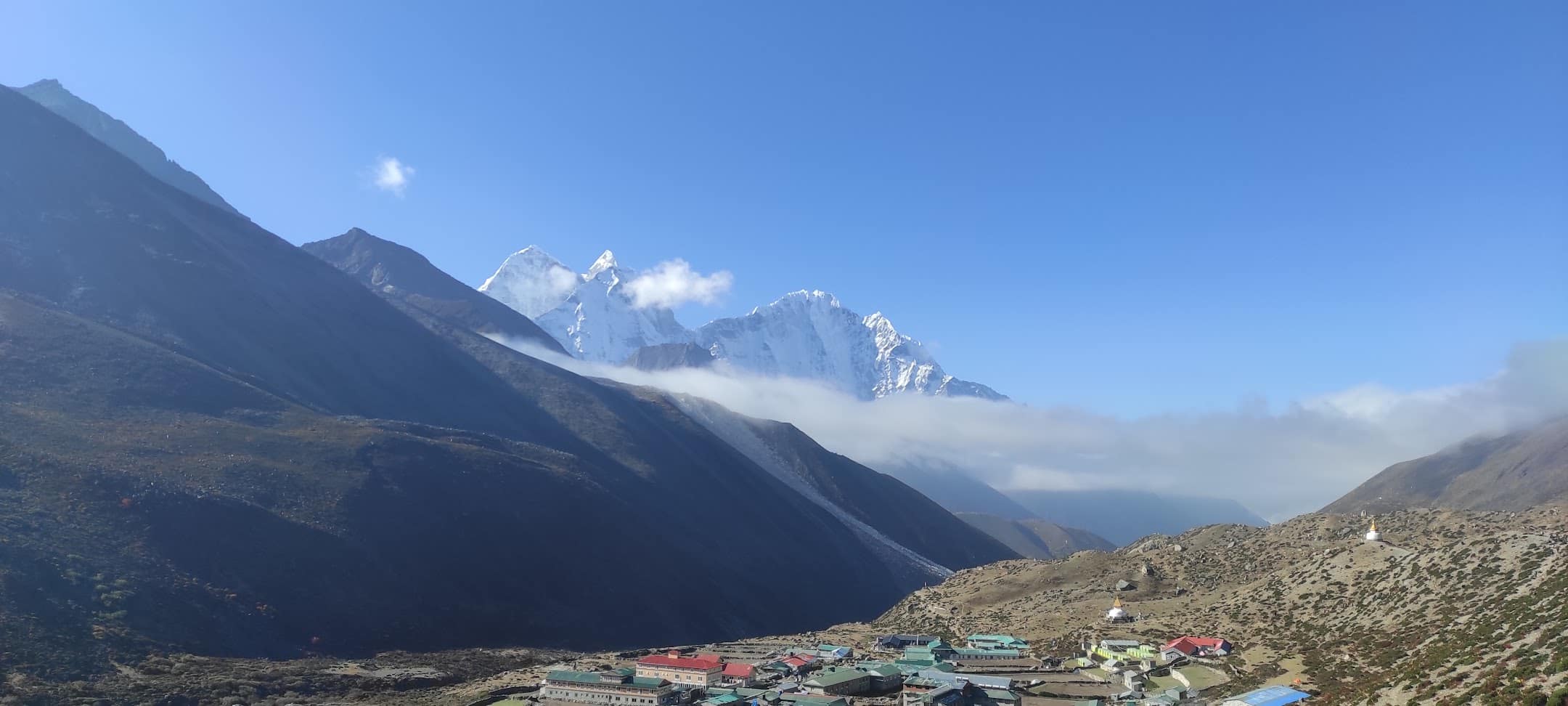
Lacking clarityI’m being very careful to take it slow on the descent, because one wrong step can turn into a big ouch. It’s pretty hard on the knees, and my right little toe is making itself known.
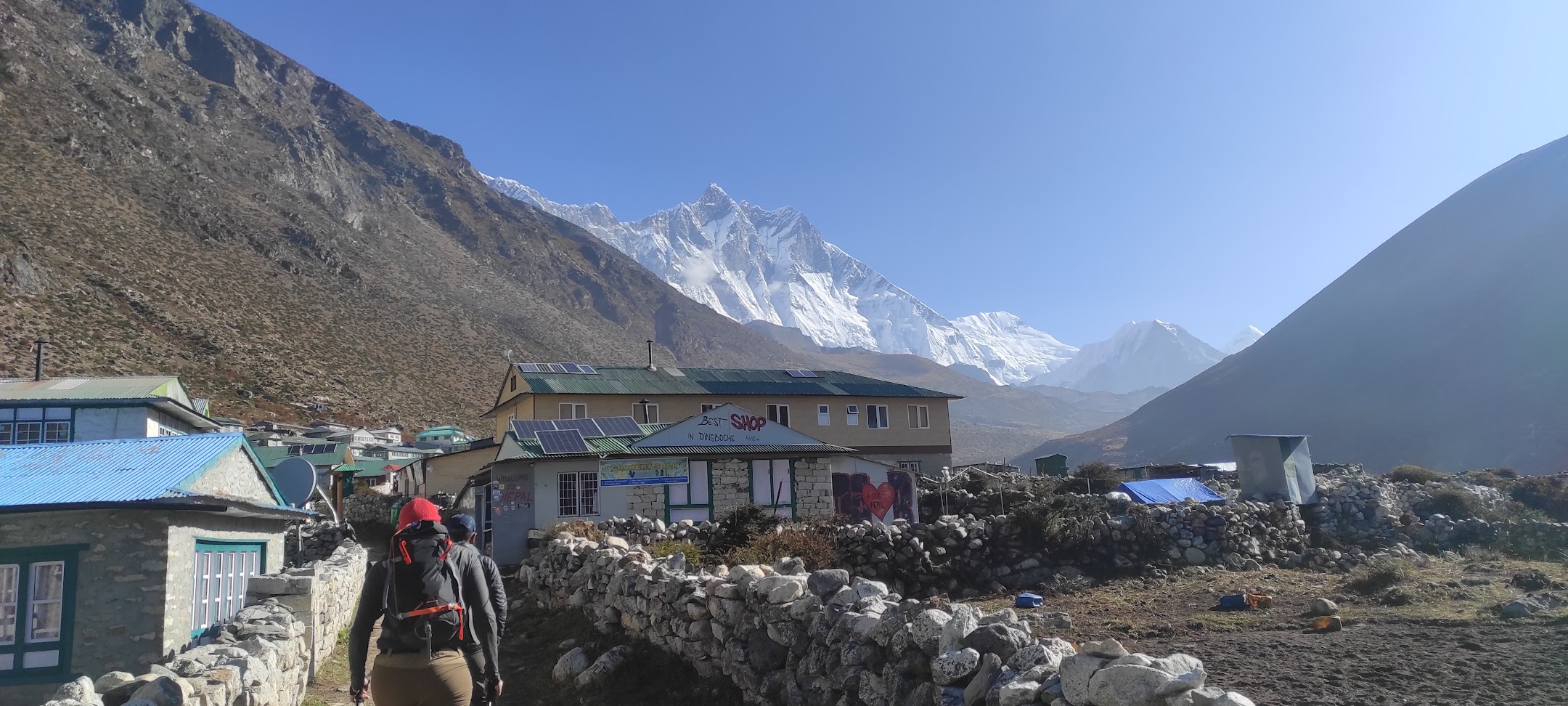
It’s past noon when we get back to the tea house for a well-earned lunch. We’re both exhausted. Vincent, who handled the climb well, lost steam on the way down.
I really struggled on the acclimatization day in Namche Bazaar before powering through the following two days. I hope it’s the same this time, because the next three days are going to be tough.
In the afternoon, we take advantage of the pleasant weather to treat ourselves to another hot shower. The next one will probably be in four days, in Namche, on the way back.
Tomorrow, we’re heading to Lobuche (4,900 meters).
If all goes well, the day after tomorrow, we’ll be sleeping under a tent at Everest Base Camp!
Day 7 – Friday, October 13, 2023: Lobuche!
I wake up just before 7 a.m., and I actually slept pretty well.
Nights are still tough for Vincent, who even locked up his knee — that’s all we needed!
We set off around 8 a.m., and I can feel a rough day coming. I’m getting winded very quickly, even though the start of the trail isn’t really that hard.
It’s so frustrating to think we’re struggling because of the altitude when we’d easily handle a similar trail 3,000 meters lower.
It’s hard for Vincent too, who’s dealing with accumulated sleep deprivation and a headache.
After a rough start, things improve for me, and at 9:40 a.m., we arrive in Thukla, at 4,620 meters.
Rinzi suggests we have lunch here. We’re not hungry at all, so we just grab a hot drink to regain some strength.
The main challenge of the day actually starts from here: 300 meters of steep climb over rocky terrain. Given how we felt earlier, we’re dreading this big chunk.
But it goes better than expected — I find my slow, steady rhythm. Vincent is bounding like a gazelle and pulls ahead.
Once again, we’re passing people left and right. We asked Rinzi about it. He confirms that our slow but steady pace, sipping regularly from our CamelBak and taking very few breaks, is far more effective than most groups that stop constantly for a drink.
During the climb, we pass a porter finishing his break. His load is so heavy that he struggles to hoist it onto his back. Those guys are incredible!
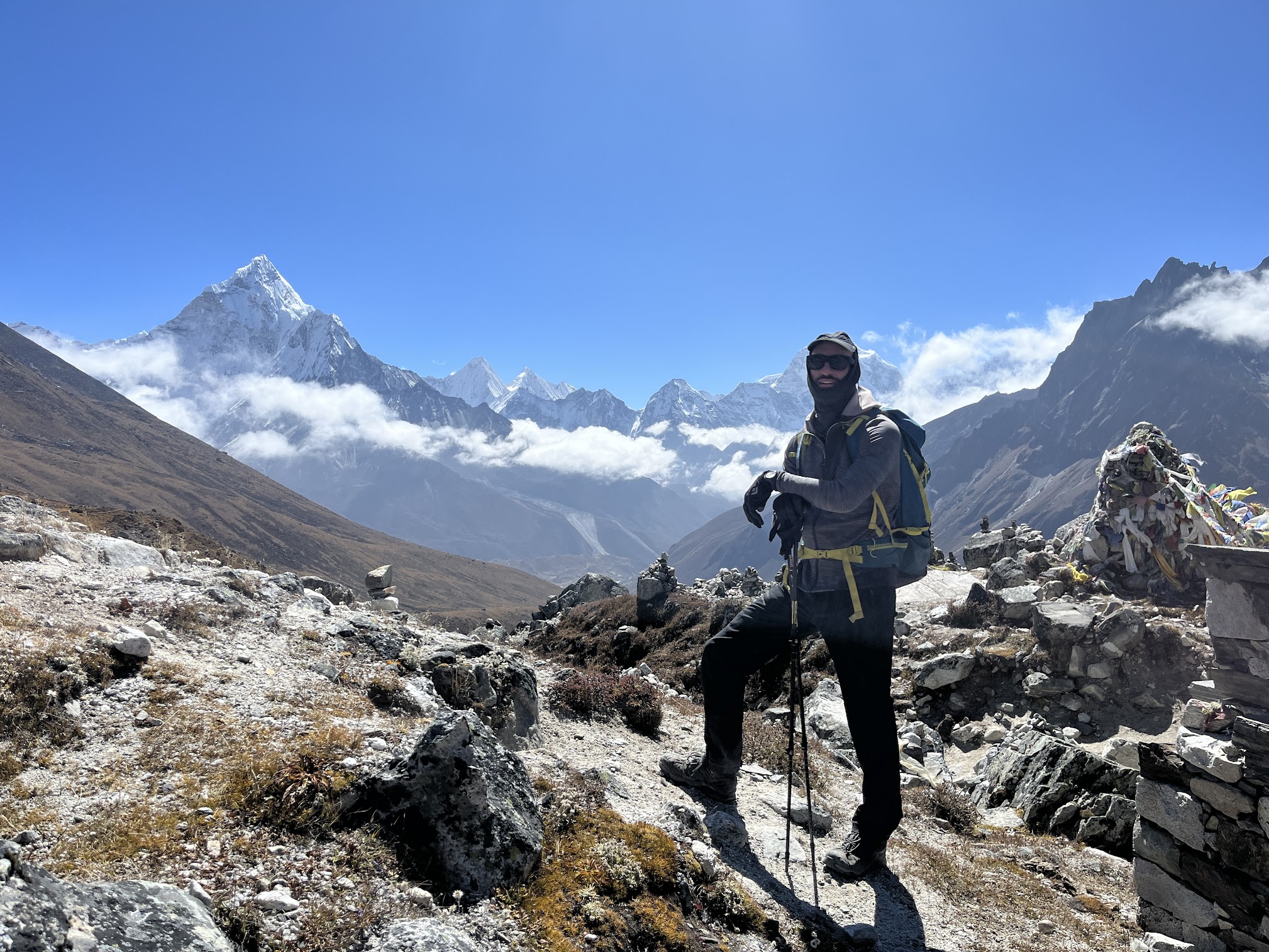
At 10:45 a.m., the big difficulty of the day is behind us. We arrive at theEverest Memorial. A striking place with many prayer flags, but above all, many memorial steles with plaques in memory of those who disappeared during their expeditions in the Himalayas.
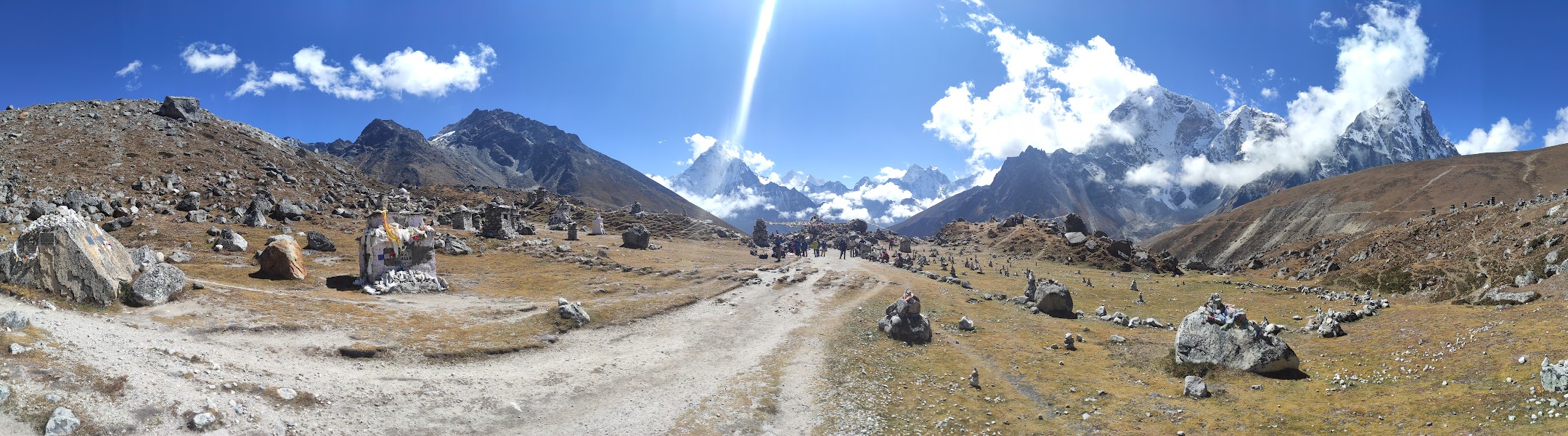
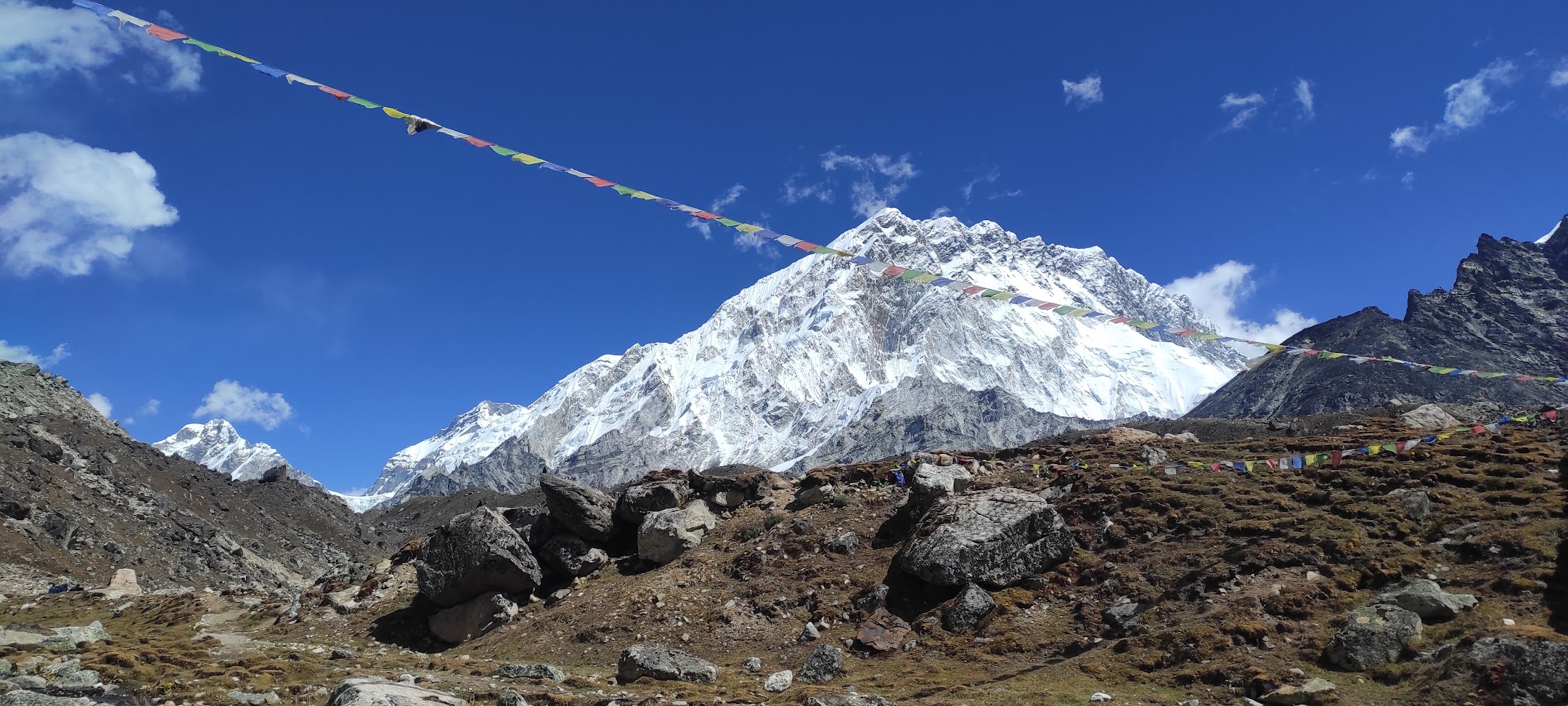
On top of being in a place steeped in history, the weather is beautiful, the sky is blue, and we have a spectacular view of many peaks.
The end of the trail is easy, and we have plenty of time to admire the 360° panorama.
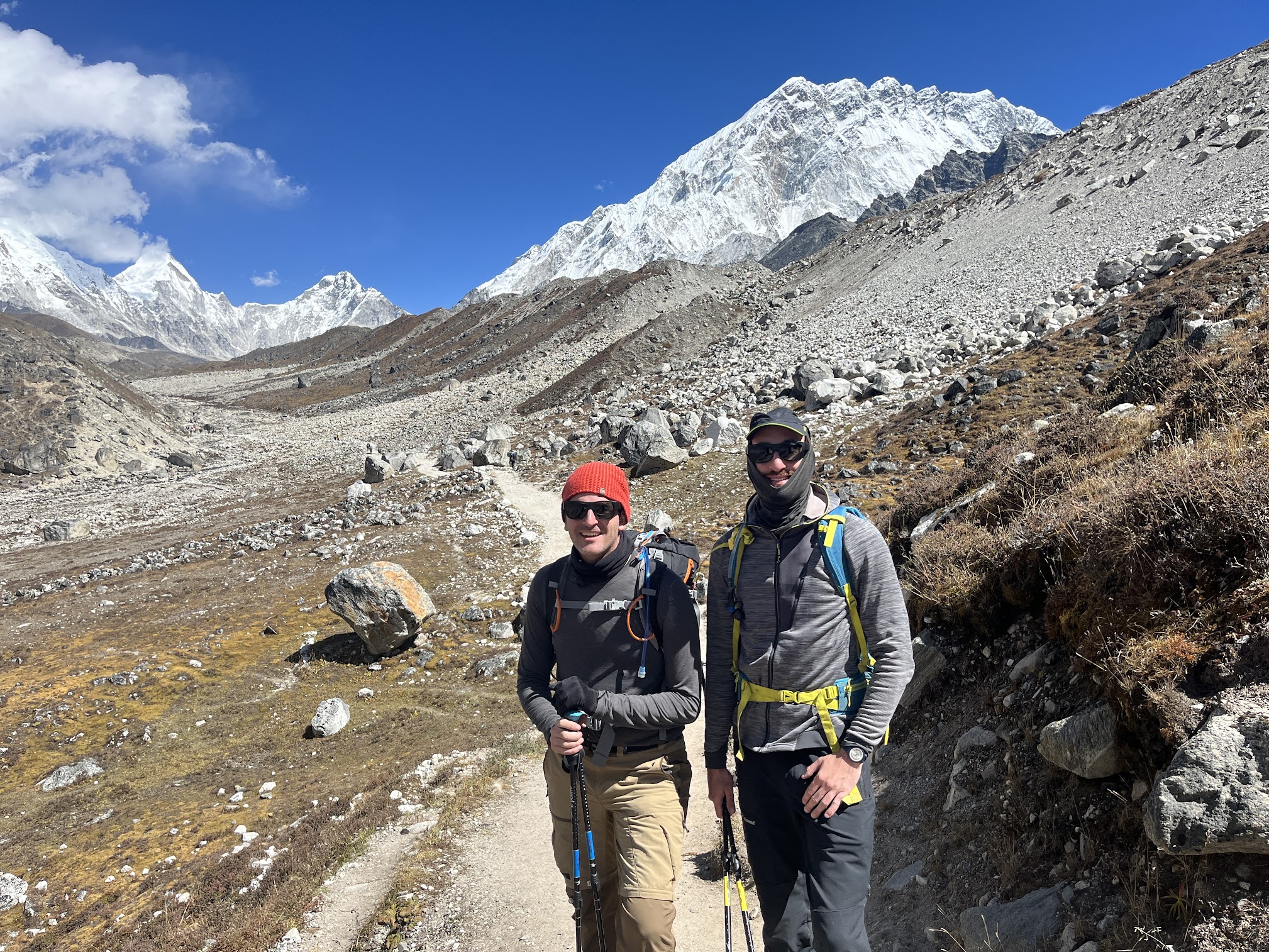
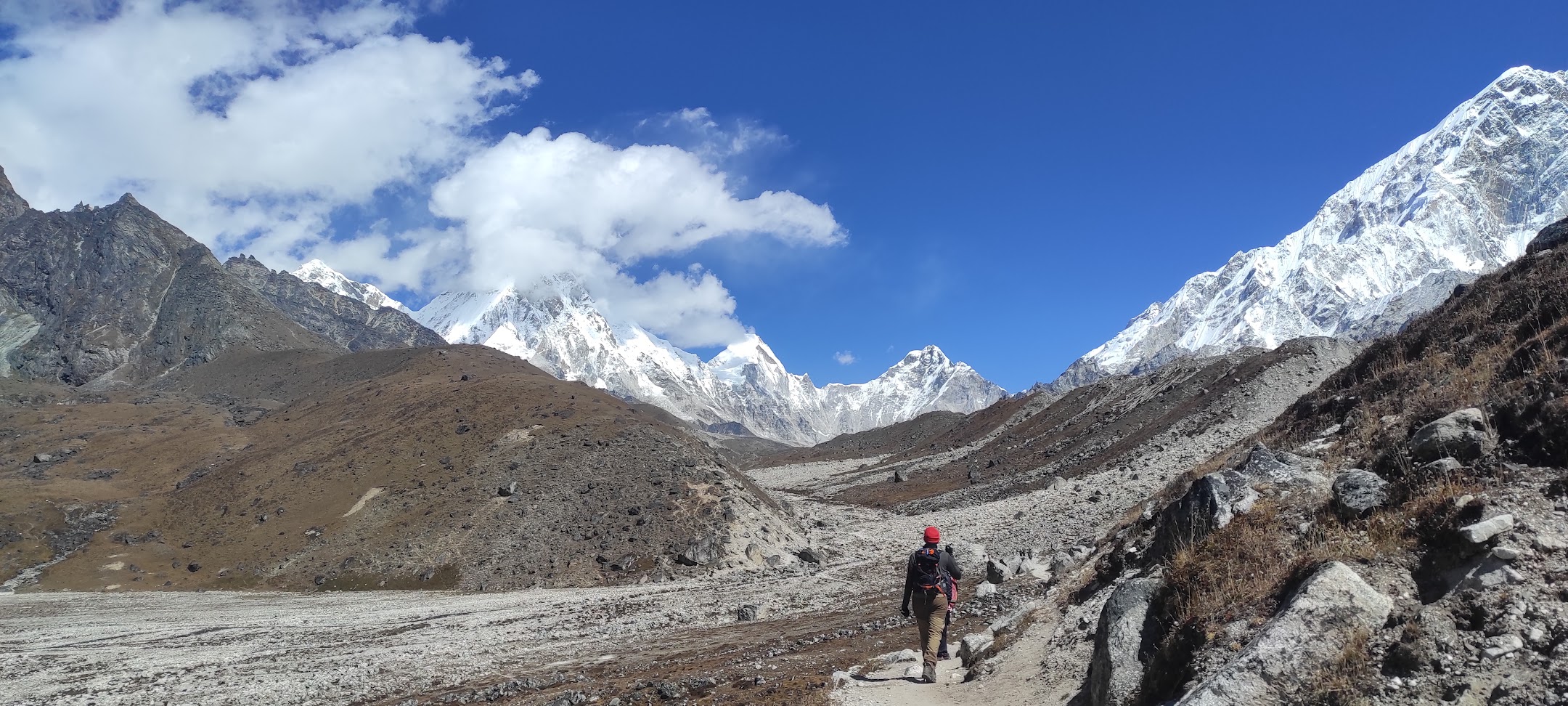
At 11:30 a.m., we arrive at Lobuche. At 4,900 meters above sea level according to our agency’s itinerary. At 5,030 meters according to the sign welcoming us. That same sign says Everest Base Camp is 6 km and 6 hours of walking away. We’ve never been this close.
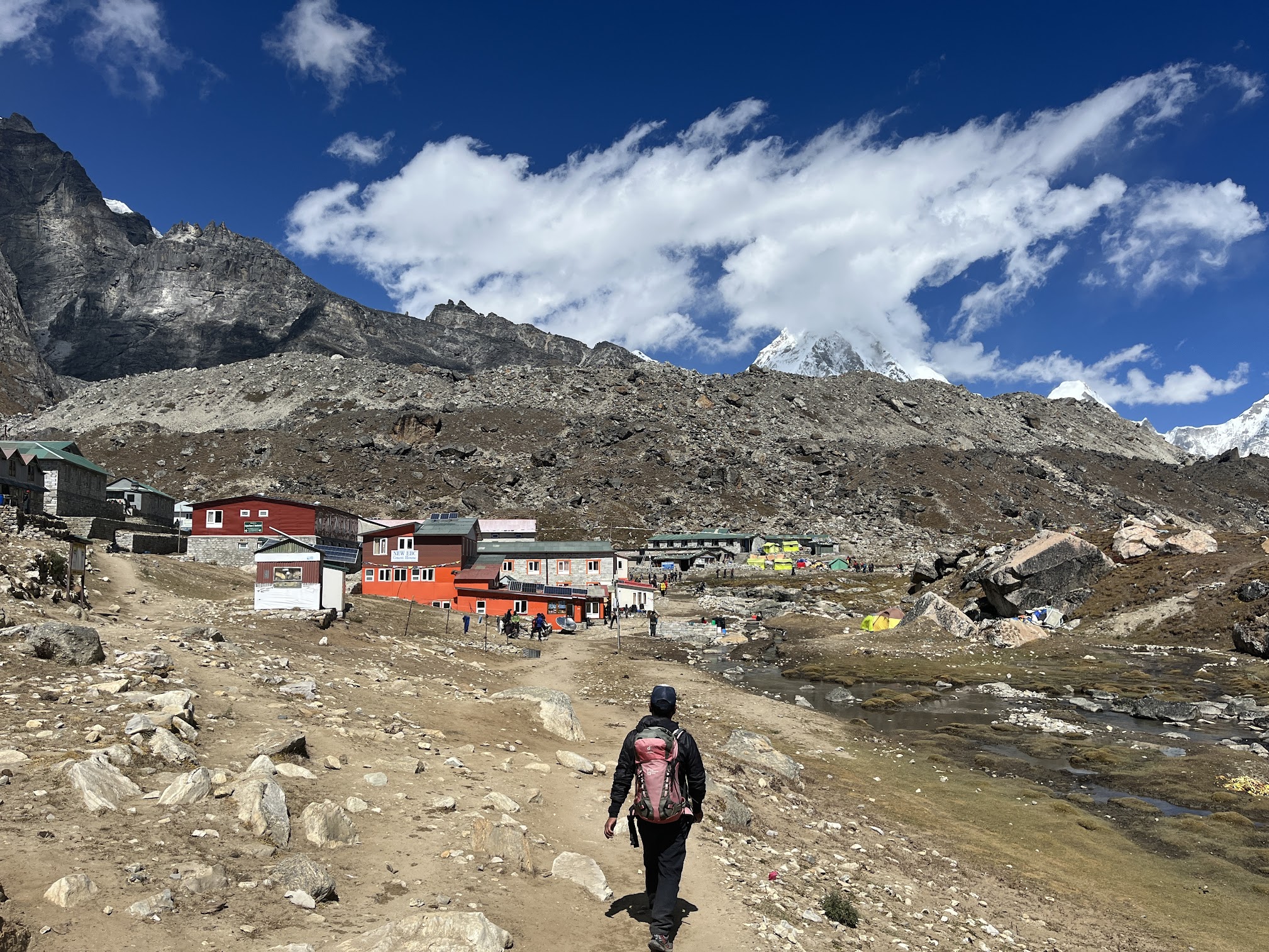
As we step into our tea house (New EBC Guest House) and the day turned out easier than feared, I’m hit with a headache and a mild sore throat. There was no way I’d be spared till the end!
I force myself to eat, even though I have no appetite, then head to our room, where I’ll spend a good chunk of the afternoon resting.
The sky clouds over and it’s freezing outside; Vincent even thinks he spotted a few snowflakes.
The two upcoming days are going to be both the longest, the most demanding, the most exciting, the most anticipated, and the ones we dread the most.
Tomorrow evening, we’ll be sleeping at the legendary Everest Base Camp!
Day 8 – Saturday, October 14, 2023: Night at Everest Base Camp!
While I had been sleeping well so far, last night was disastrous. Same for Vincent, who’s now on his fourth night of insomnia.
Even though I managed to sleep intermittently, every time I woke up, I’d find Vincent on his bed in a new position.
Vincent explains that every time he’s about to fall asleep, his subconscious makes him think he’s going to suffocate. He did some research, and it seems this is quite common during nights at high altitude.
On top of this difficult night, I’m starting to lose my appetite, another symptom of altitude sickness. We’re at 4,900 meters, not exactly usual!
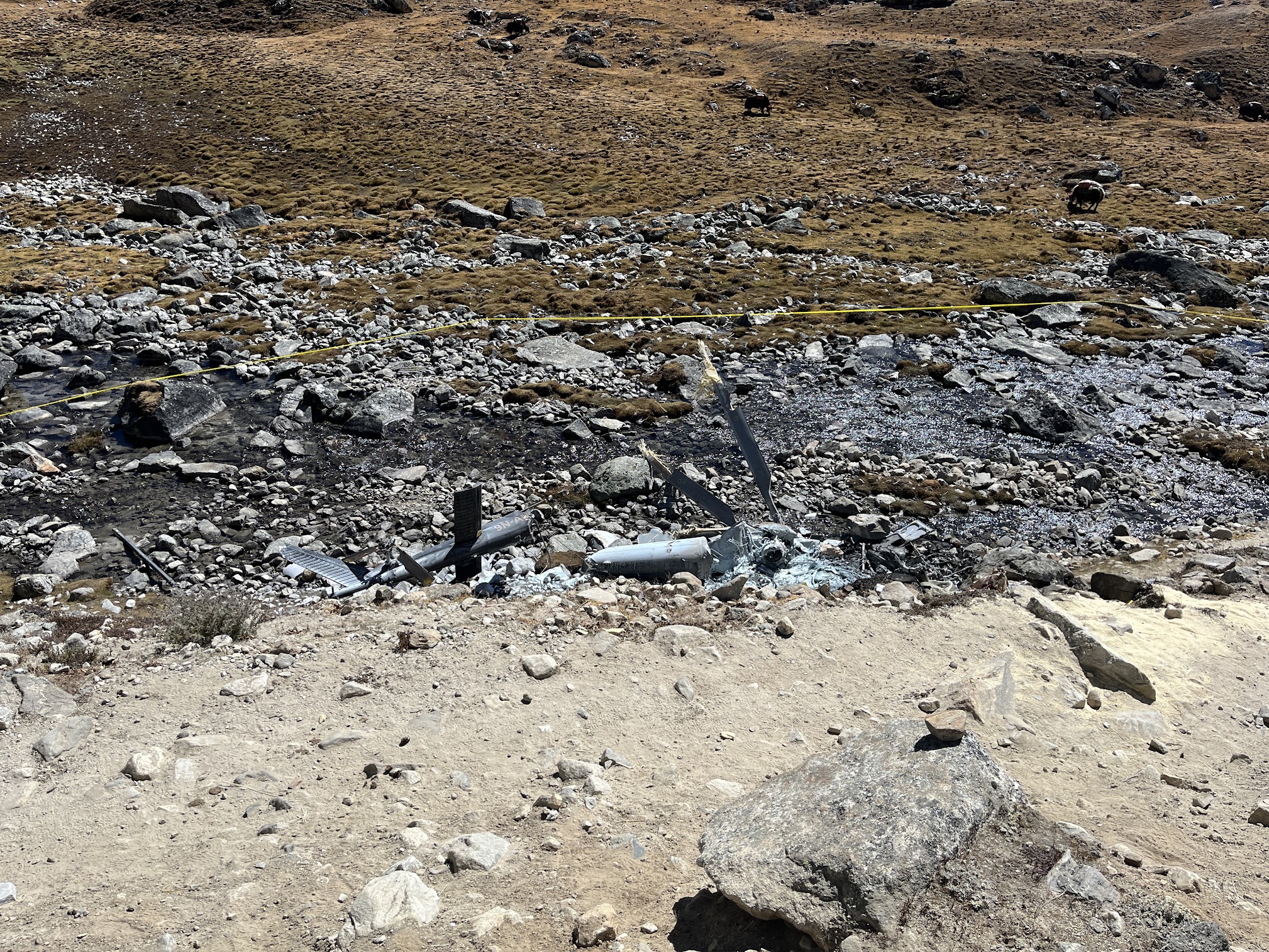
On the way, our guide tells us thata helicopter crashed near Lobuche, 45 minutes after we left. It wasn’t carrying passengers, but the pilot is seriously injured.
It was cold this morning, and I made the mistake of wearing tights under my pants. Soon, I’m too hot, and before a big climb, I decide to take them off.
At this altitude, taking off shoes, pants, tights. Putting pants and shoes back on. It’s exhausting, and I lose quite a bit of energy in the process.
On the way, we witness an avalanche on a mountain across from us. Fortunately, very far away.
At 10 a.m., while I’m struggling and about to ask for a small break, we spot Gorakshep (5,190 meters).
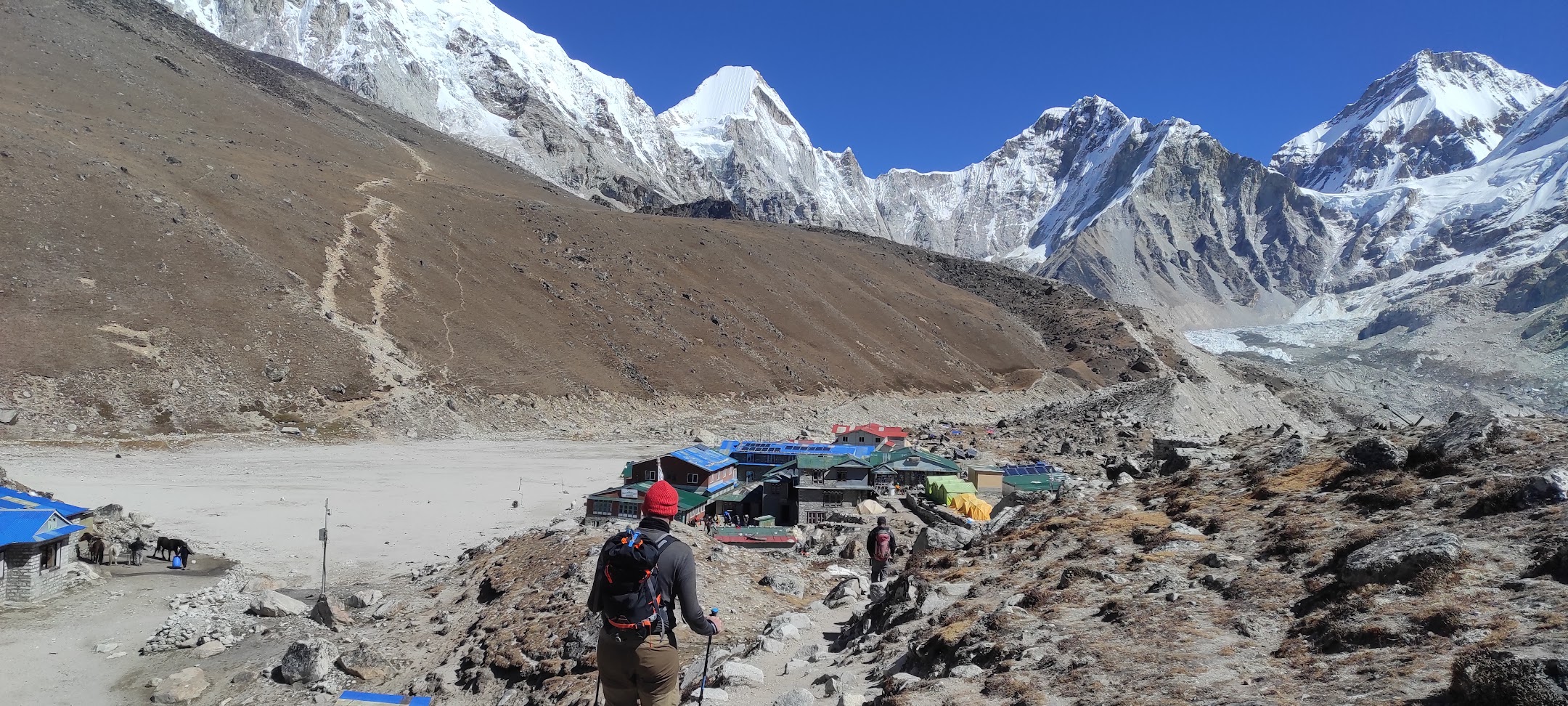
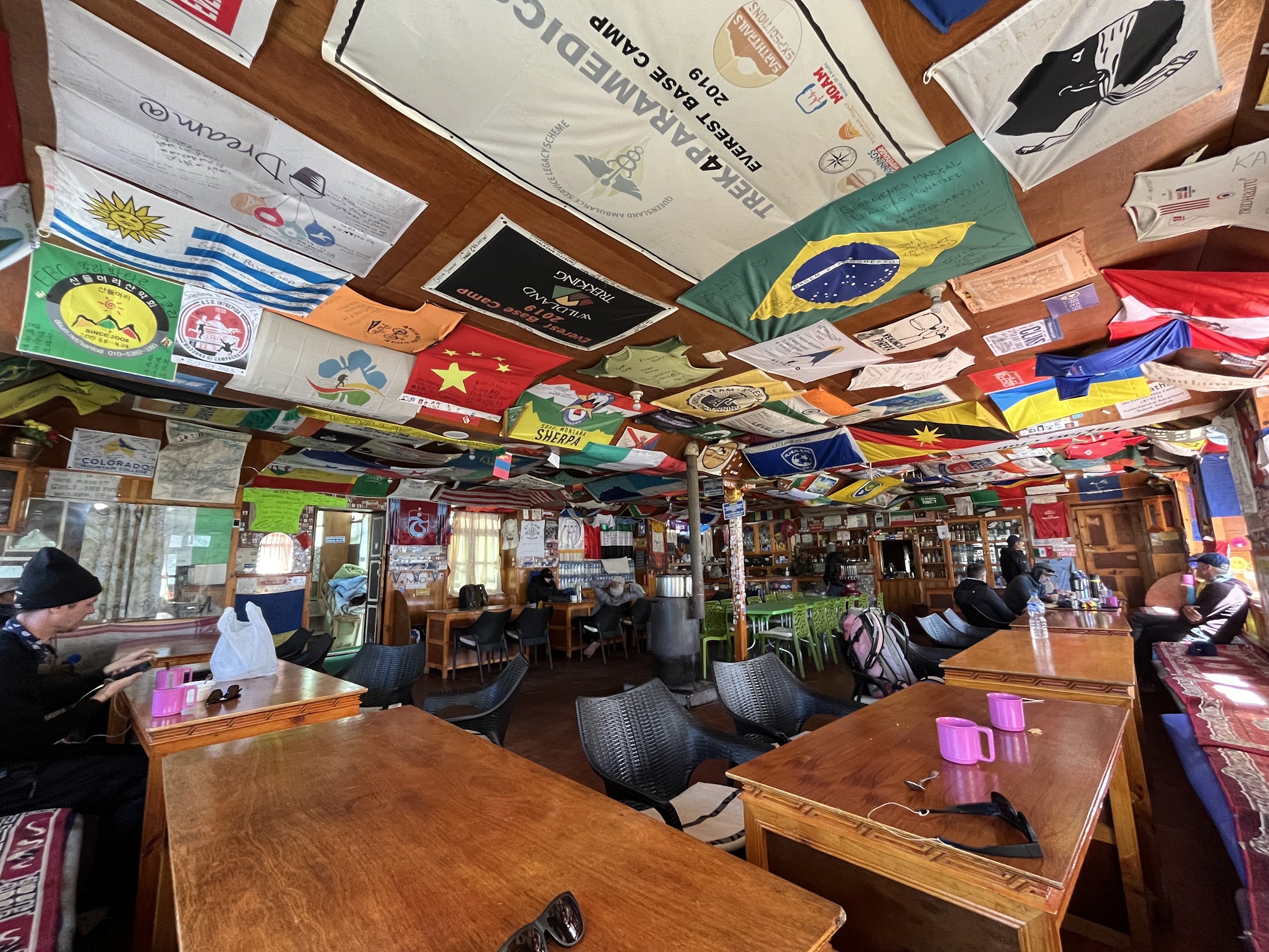
We settle in at the ” Buddha Lodge ” THE tea house for trekkers heading to or returning from Everest Base Camp.
The dining room bears witness to thousands of personal victories. The walls are covered with flags, ID photos, and bills. All signed with dates, home countries, …
The vast majority of people doing the base camp trek pass through Gorakshep, drop off their gear, walk to base camp (about 2 hours away), then come back to sleep in Gorakshep.
For us, it’s different since we’ll be sleeping on site. No need to rush; we’ll leave at 3 p.m.
That gives us time to have lunch, rest, and chat with a group of Indians who let us try their pulse oximeter. We’re at 76% and 77% oxygen, respectively.
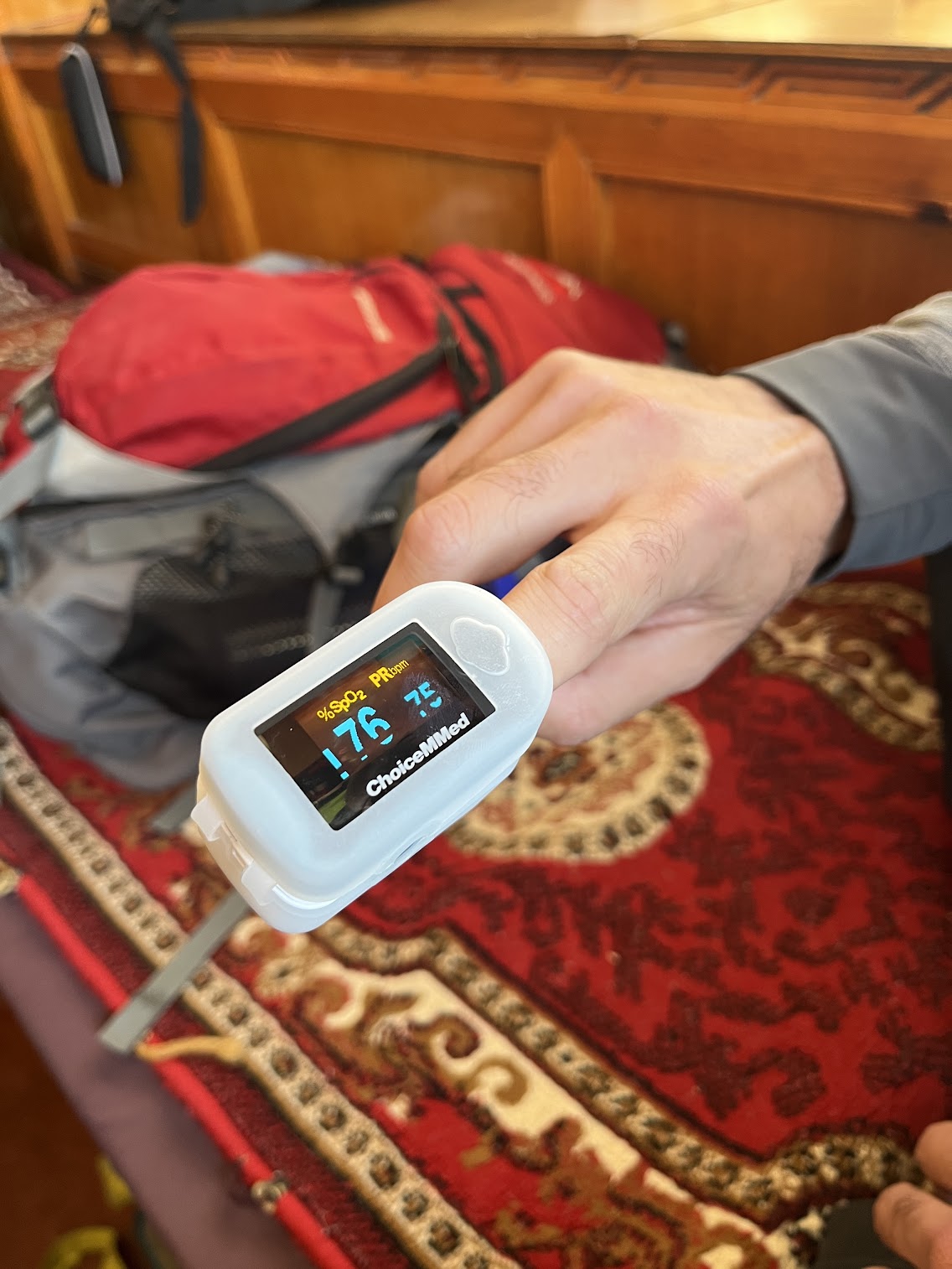
According to an article found on Doctissimo: “Below 90%, the situation is critical: it’s called desaturation.”
Meanwhile, Rinzi handles the logistics. He orders food and drinks. He rents the tent for the night (after making sure we didn’t mind all three of us in the same tent).
We’re surprised that our porter Boudha isn’t sleeping with us. There’s a logical answer: Boudha isn’t as acclimatized as we are, not having slept at the same altitudes and not having done our acclimatization days. He could get sick if he sleeps at base camp.
So Boudha will carry our bags and the tent up to base camp, then come back down to sleep elsewhere, and come back up tomorrow morning to pick up our stuff. Tough for a guy lacking acclimatization!
We leave around 3 p.m. The path is harder than I imagined (there’s less than 200 meters more elevation than Gorak Shep).
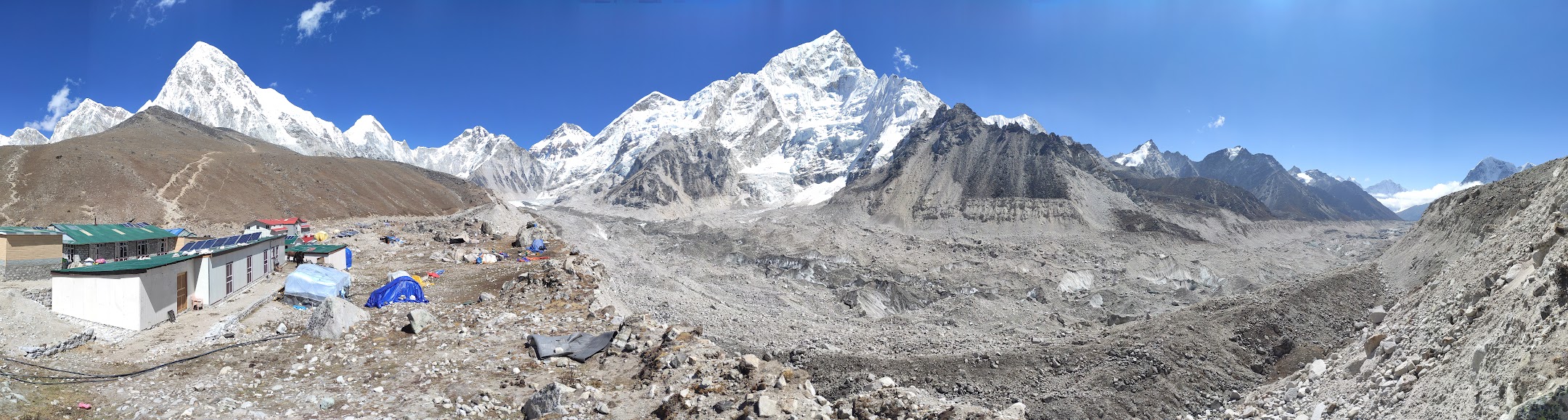
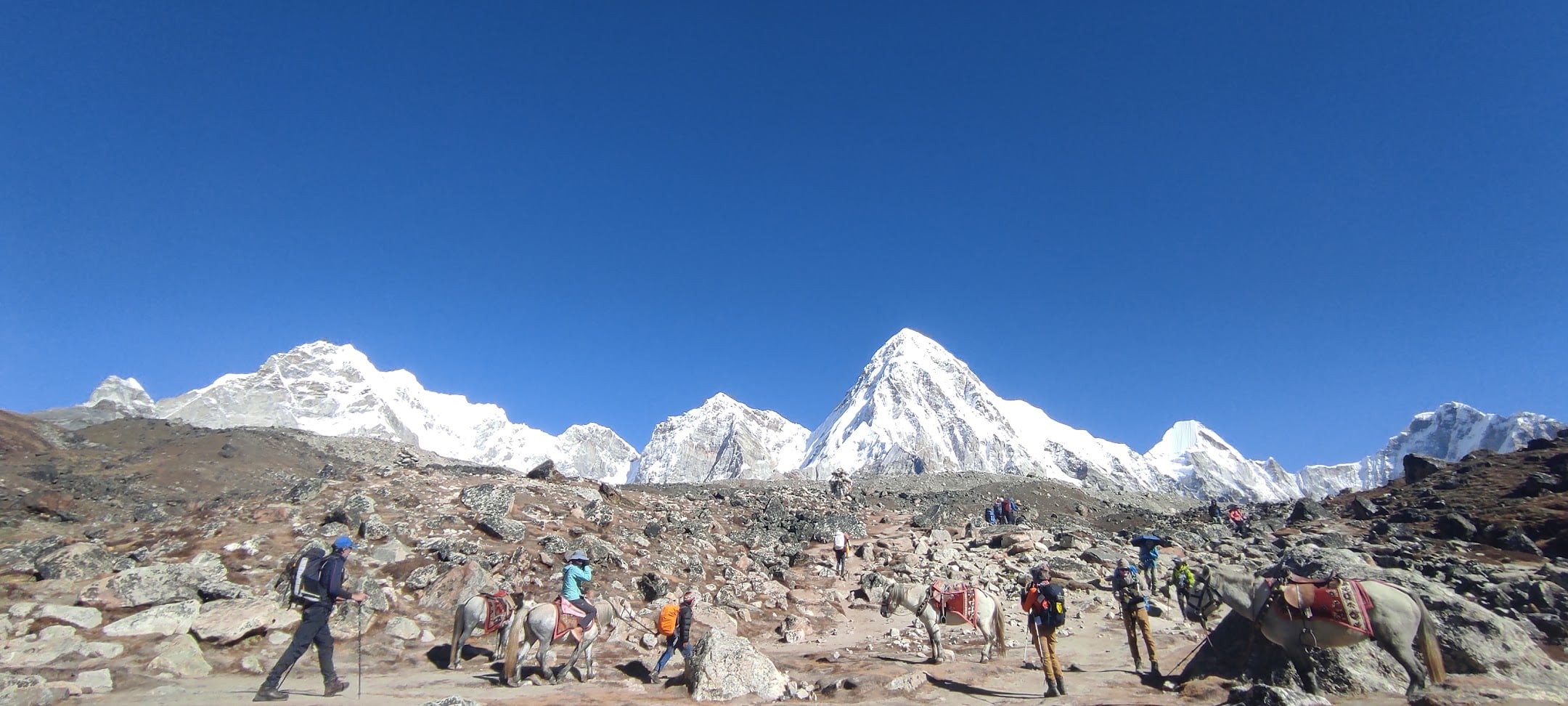
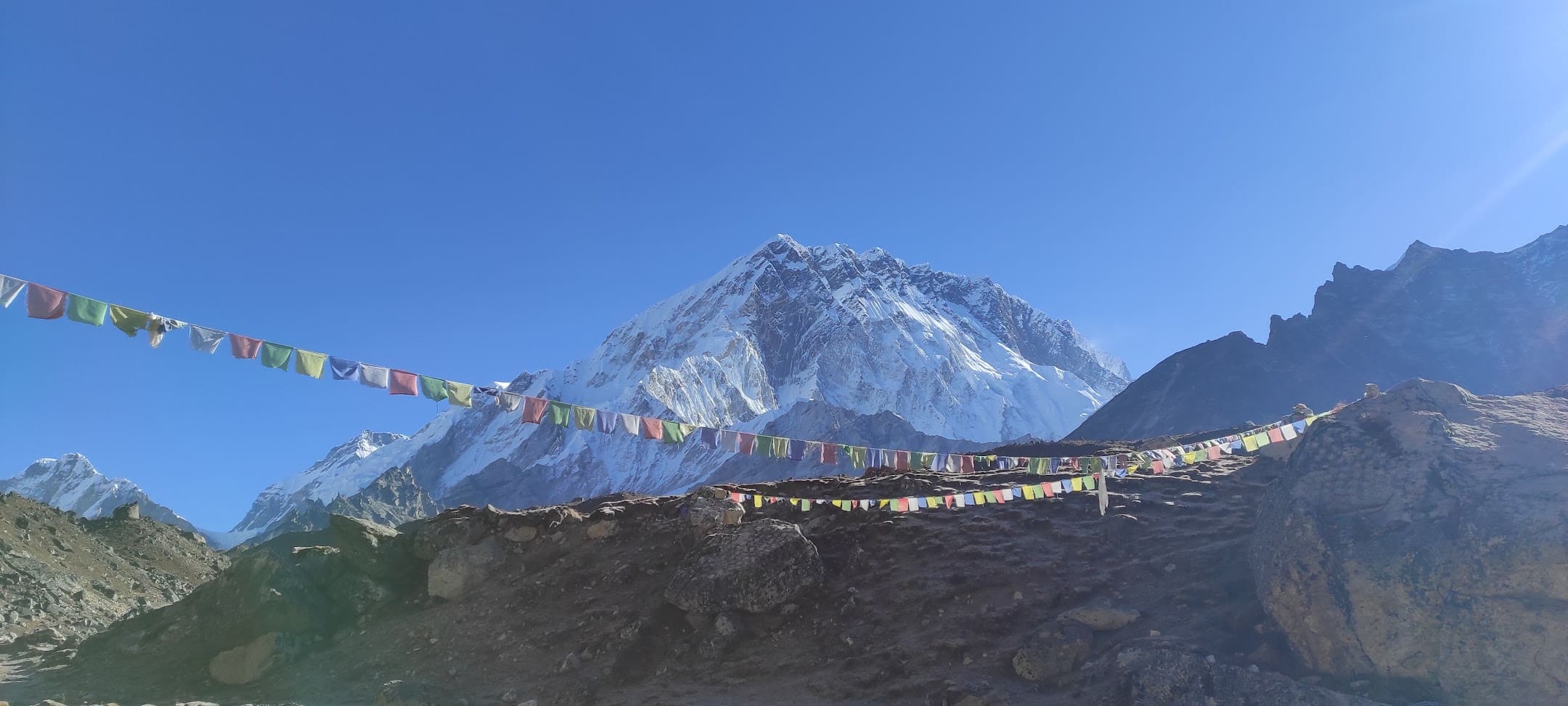
But after about an hour, we spot tourists below queuing in front of the famous rock marking base camp at 5,364 meters!
A few more minutes of effort and we’re there. We watch amused as enthusiastic tourists take turns posing for photos in front of that symbolic rock. Once again, we’re lucky with the weather; the sky is magnificent, cloudless!
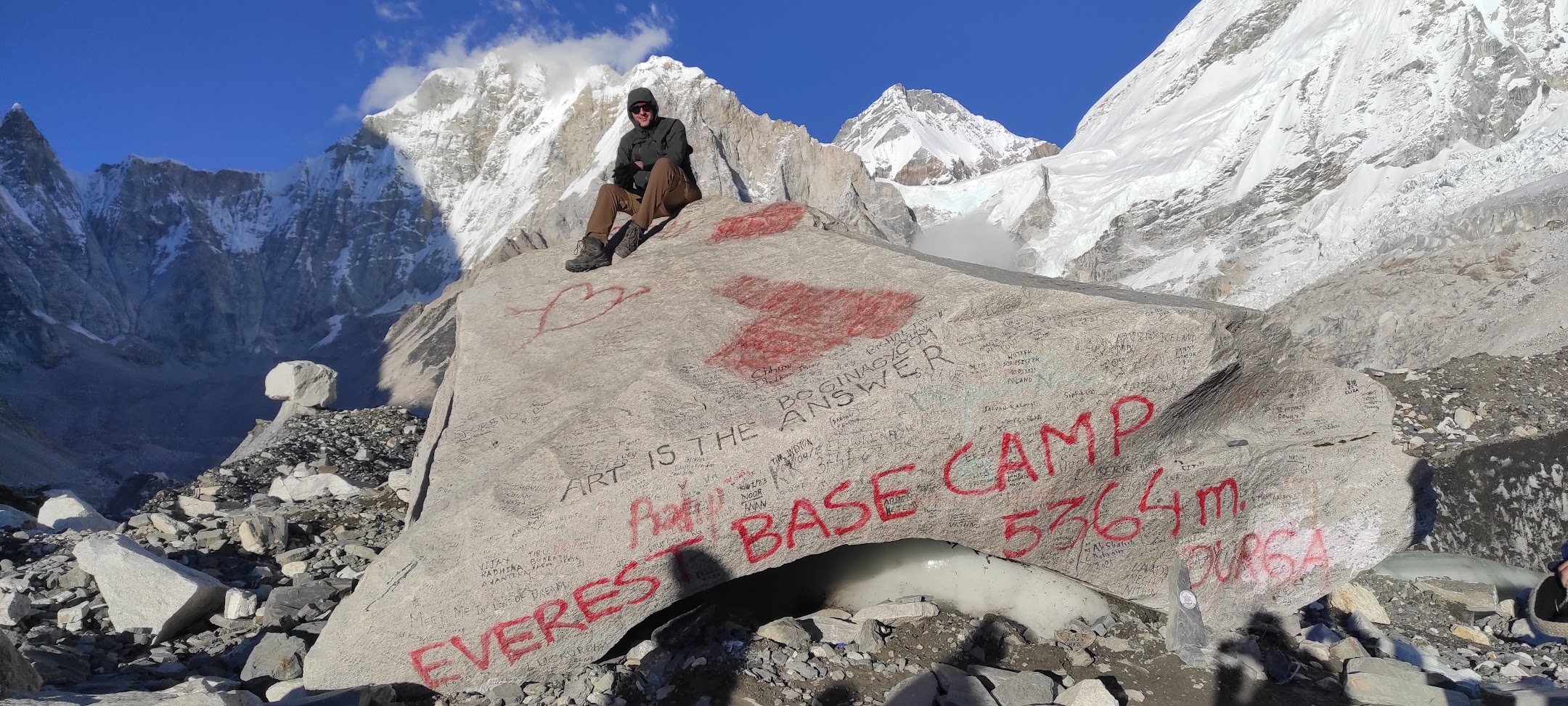
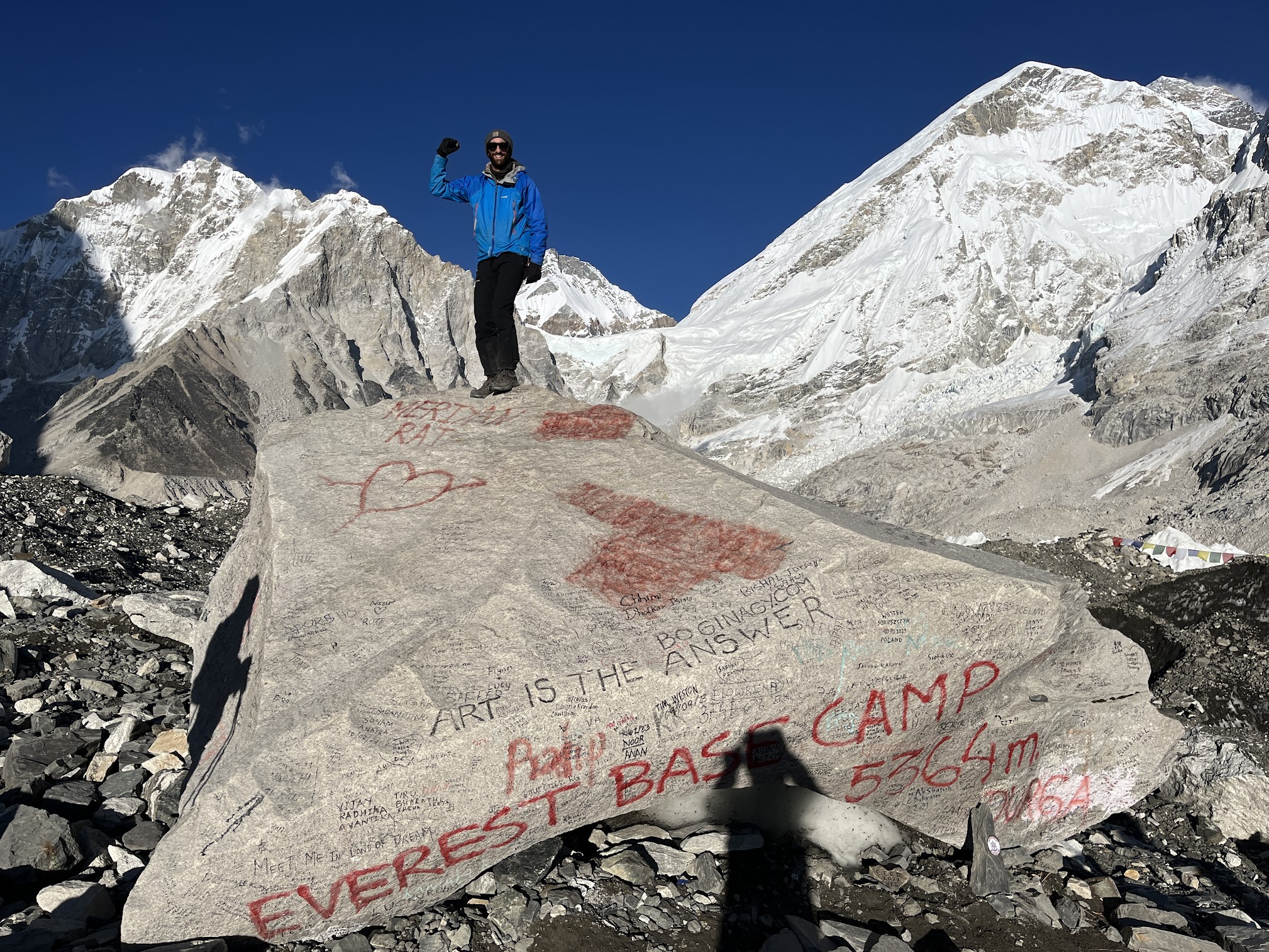
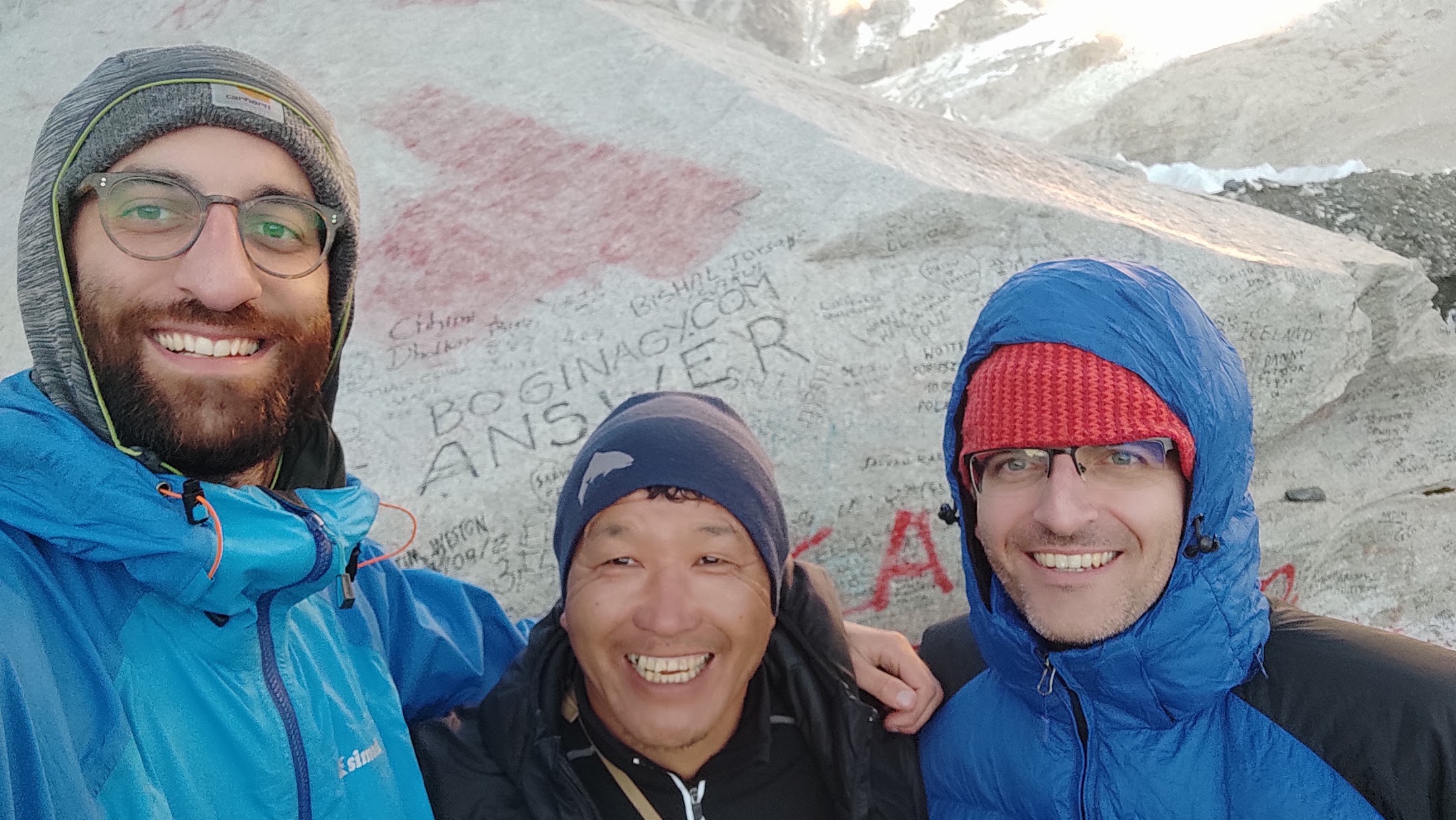
Meanwhile, Rinzi has set up our tent. It intrigues a group of Chinese tourists who don’t hesitate to snap away with their cameras, without caring that we’re right in the frame.
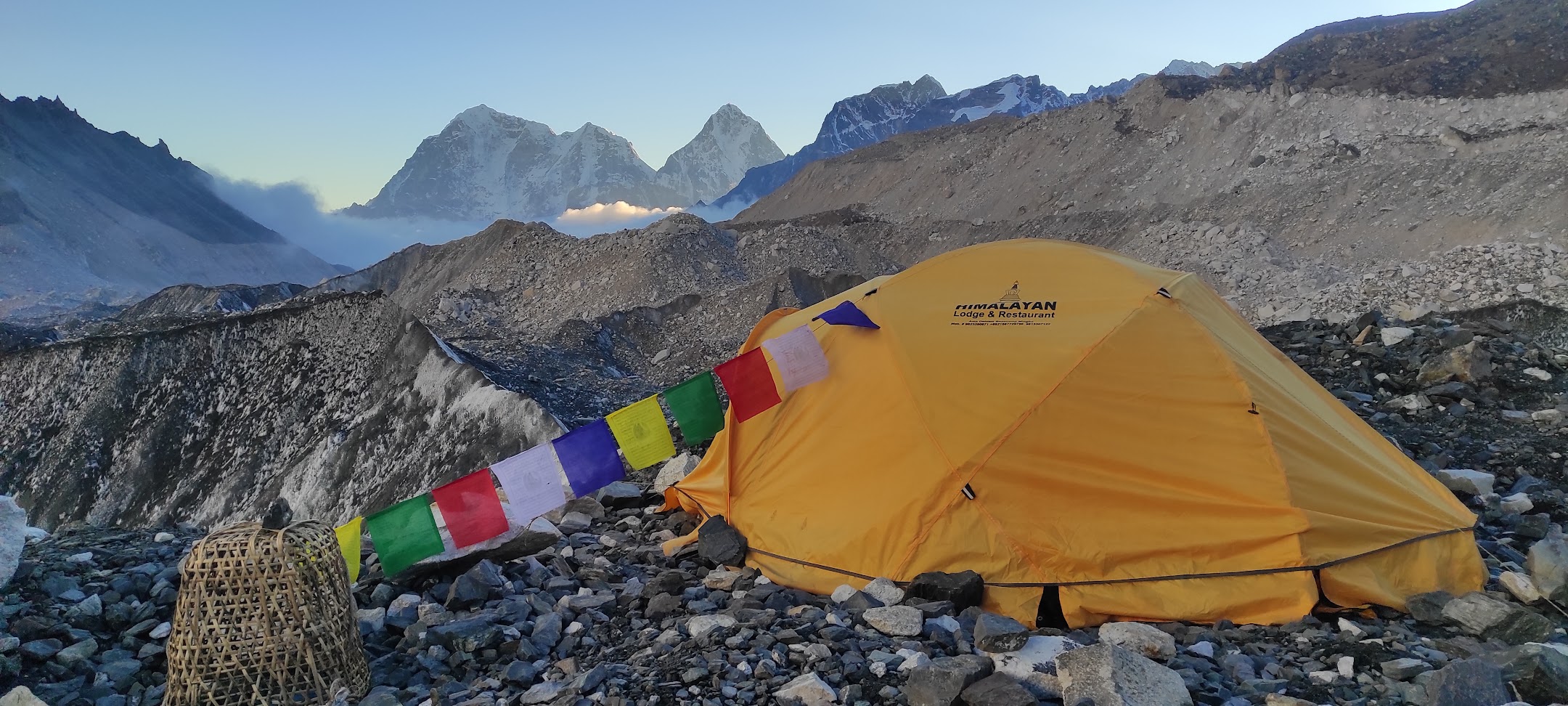
We let it go until one of the group nearly knocks over our thermos and another tries to get inside, …
A bit annoying, but never mind. Early evening approaches and everyone heads back to Gorak Shep. We find ourselves literally alone at base camp—it’s grand!
We enjoy the sunset as it gradually changes the light on the immense peaks surrounding us. The highest, Everest, is the last to be lit.
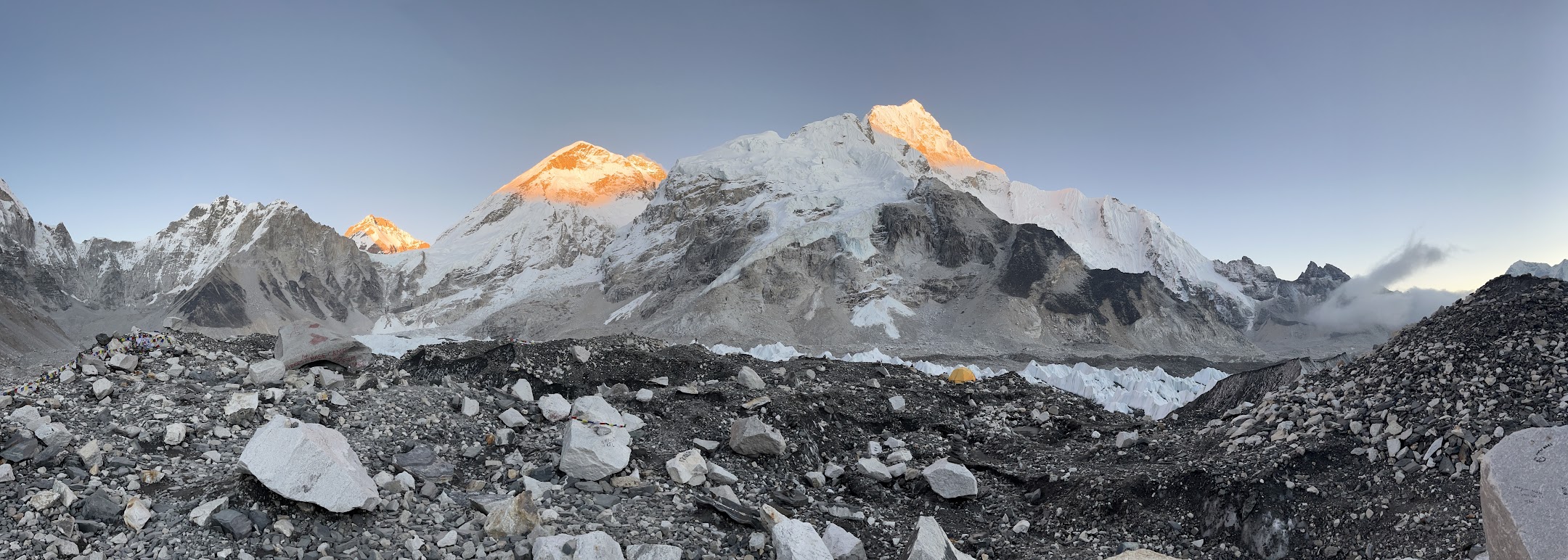
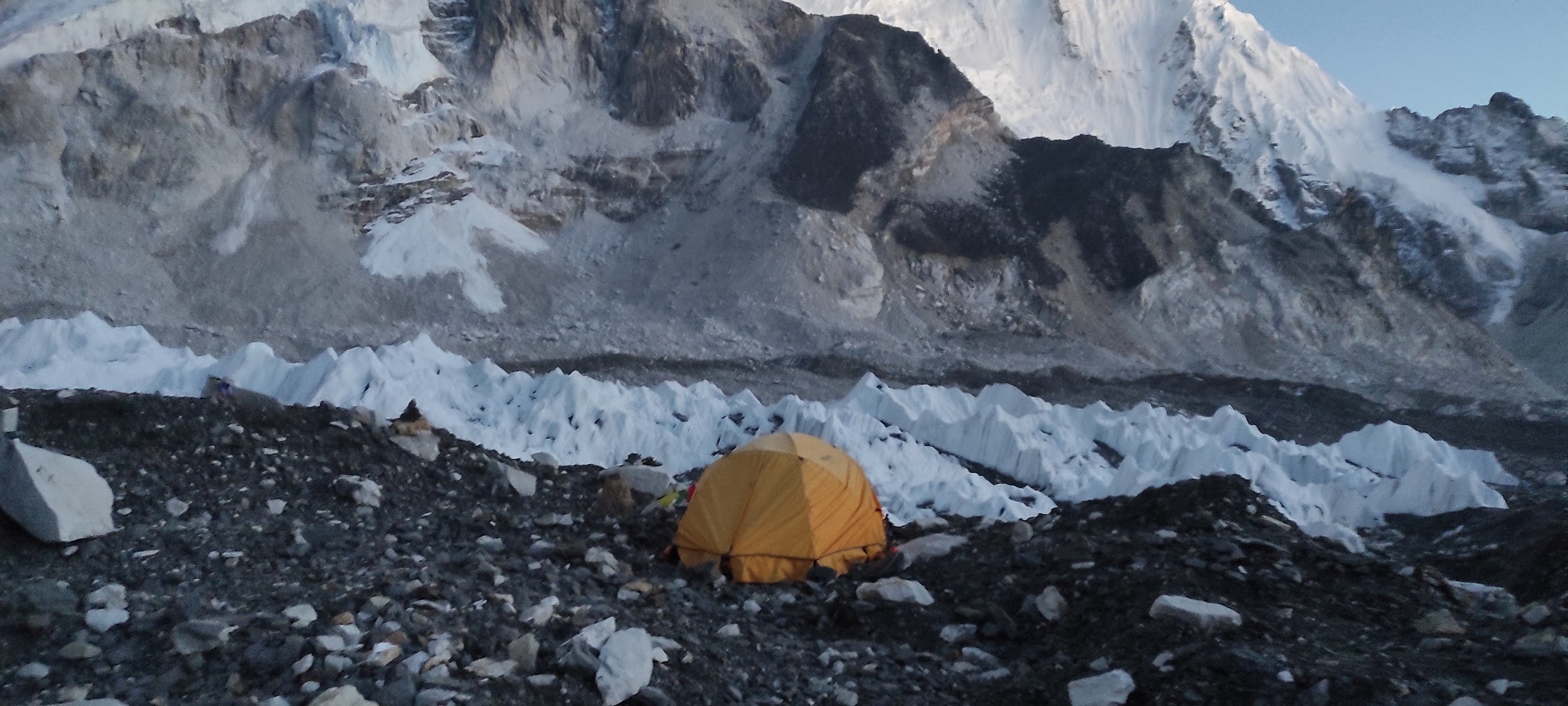
It’s getting really cold, and we appreciate the down jacket lent by the agency.
We can watch and especially hear the icefall constantly cracking.
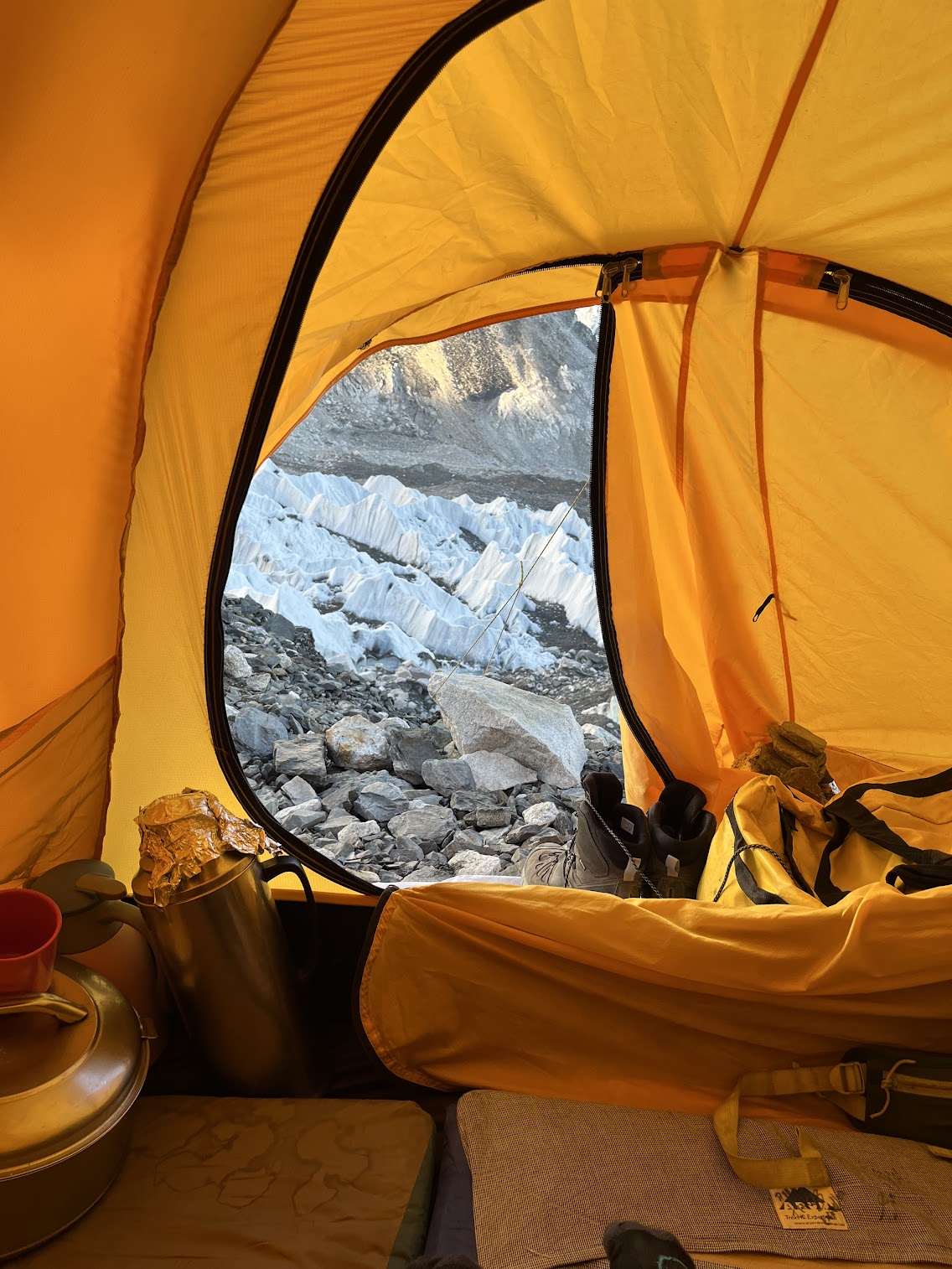
We take refuge in the tent for dinner.
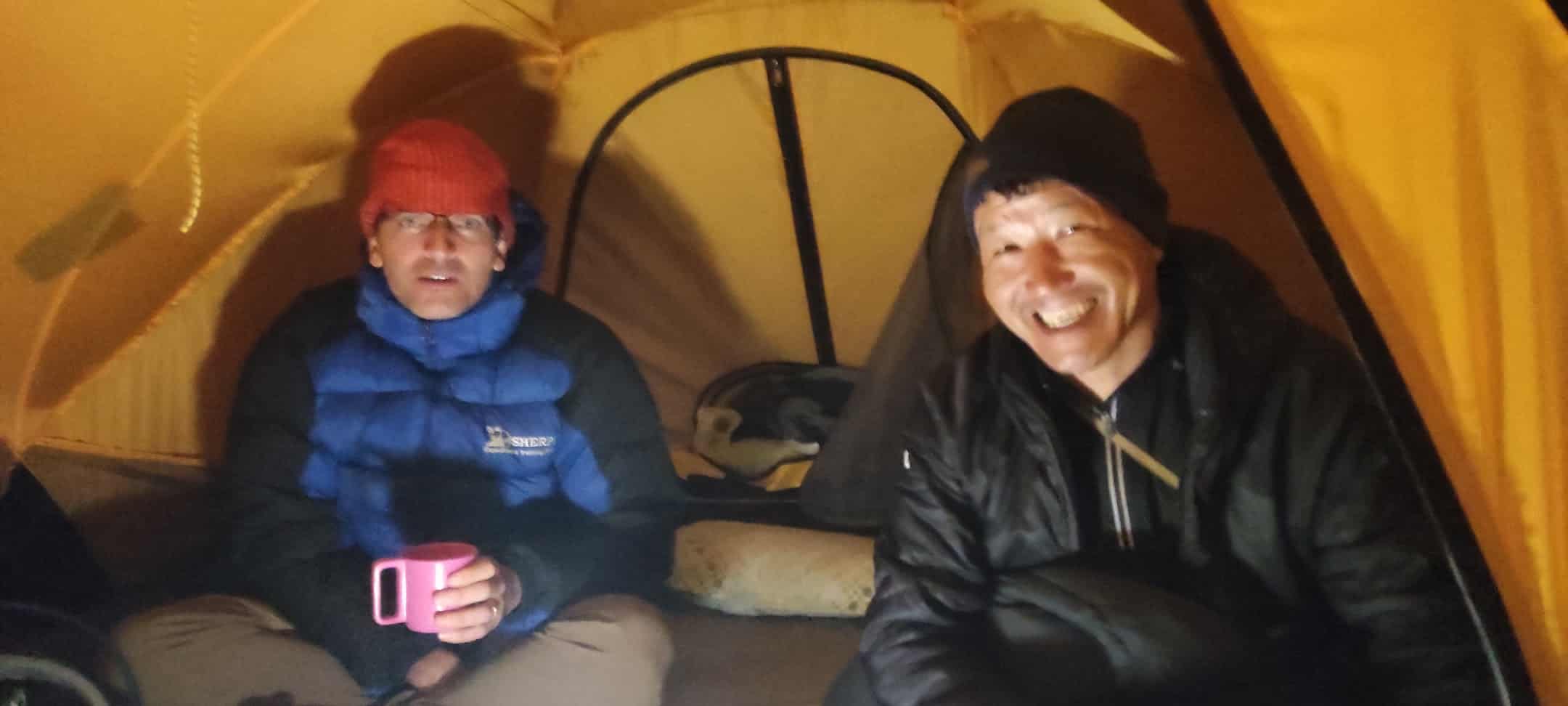
We step out to enjoy the sky. Not only is the sky cloudless, but it’s a moonless night. Vincent, who’s used to stargazing back in his hometown, has never seen such a clear Milky Way. The starry sky, the Milky Way, the summits, the lit tent… A skilled photographer would be in heaven and could snap postcard-worthy shots or computer wallpaper material!
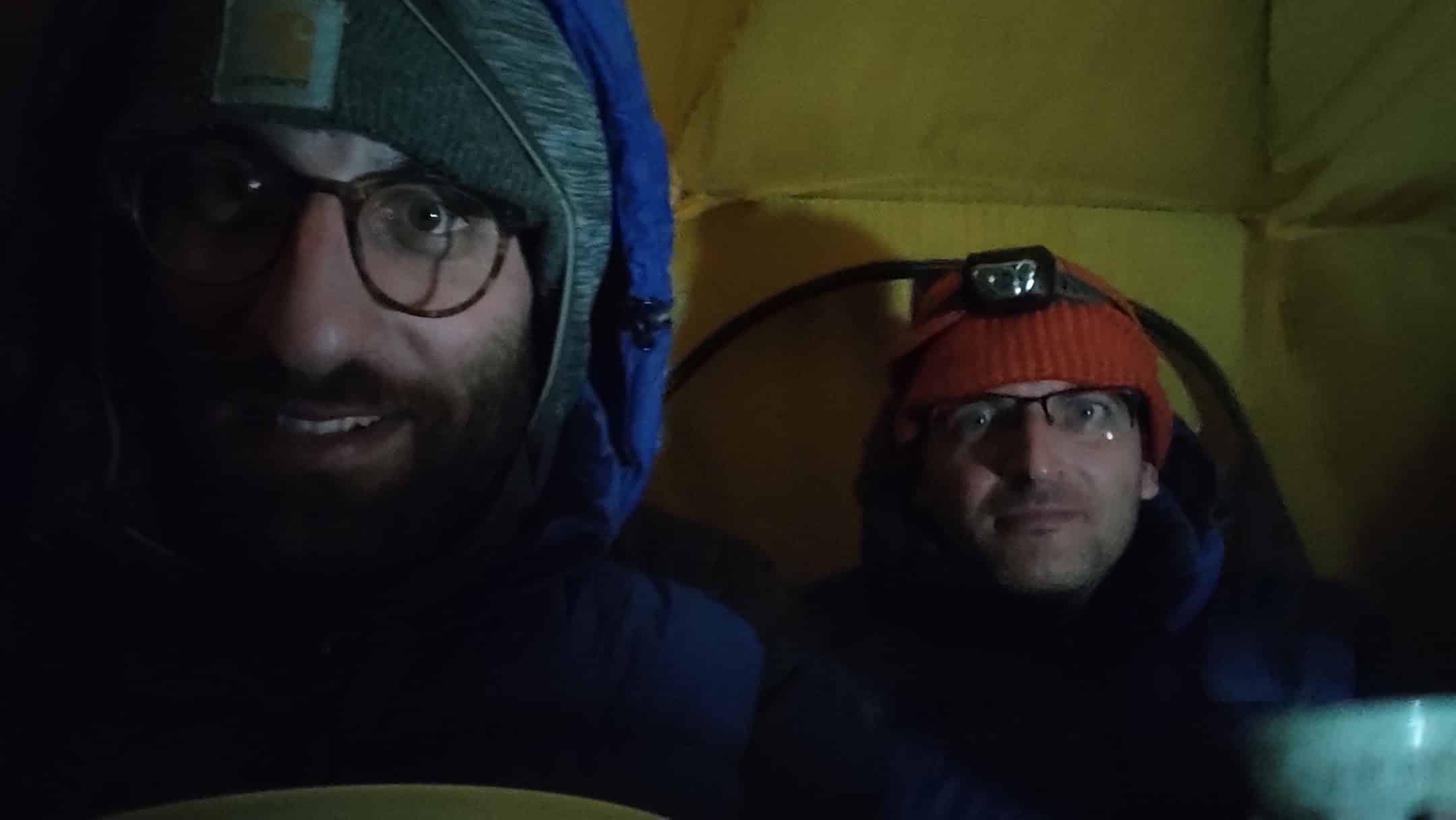
Around 8 PM, it’s already time for bed. It’s so cold that my earplugs are hard as stone; I have to warm them in my hand to soften them up.
Day 9 – Sunday, October 15, 2023: on the way down!
Before diving into Sunday’s events, let’s rewind to the previous evening.
It’s 8 PM, and we’ve just turned off the lantern in the tent.
And I realize with worry that:
- It’s only 8 PM
- I’m not tired
- My feet are cold
- I can barely move inside my ‘sarcophagus’ sleeping bag
- I’m squished between Vincent and Rinzi
- It’s already 0°C inside the tent and below freezing outside.
One question comes to mind, and it’ll remain unanswered: ‘what on earth am I going to do for the next 10 hours?’.
I quickly discover that Vincent is asking himself the same question.
And as we’re in a legendary place, here we go for one of the toughest nights of our lives.
Long story short, we didn’t get a wink of sleep, while Rinzi slept like a baby and would doze back off in 30 seconds whenever our fidgeting woke him.
It would be pointless to detail everything, but in a nutshell:
- 8:30 PM: I try to put on a second pair of socks (bear in mind that in the cramped tent, at high altitude, in the cold, … every move requires an insane amount of energy).
- 9 PM: I try to put on a third pair of socks
- 10 PM: “Vincent, going out for a pee? Wait, I’ll join you”
- 11 PM: I contort myself to grab my earphones. I just remembered I had podcasts downloaded on my phone, and that saved my life. Without that, I’d have gone crazy.
- 3:30 AM: “Vincent? Fancy a walk outside?”
I regret not taking a photo of Vincent, dazed, at 6 AM, squatting and throwing stones into a small frozen lake.
Anyway, we don’t regret it for a second; having the base camp all to ourselves for a whole night is a unique experience.
But not sure we’d do it a second time.
Boudha arrives and we break camp around 7 AM to head back to Gorak Shep.
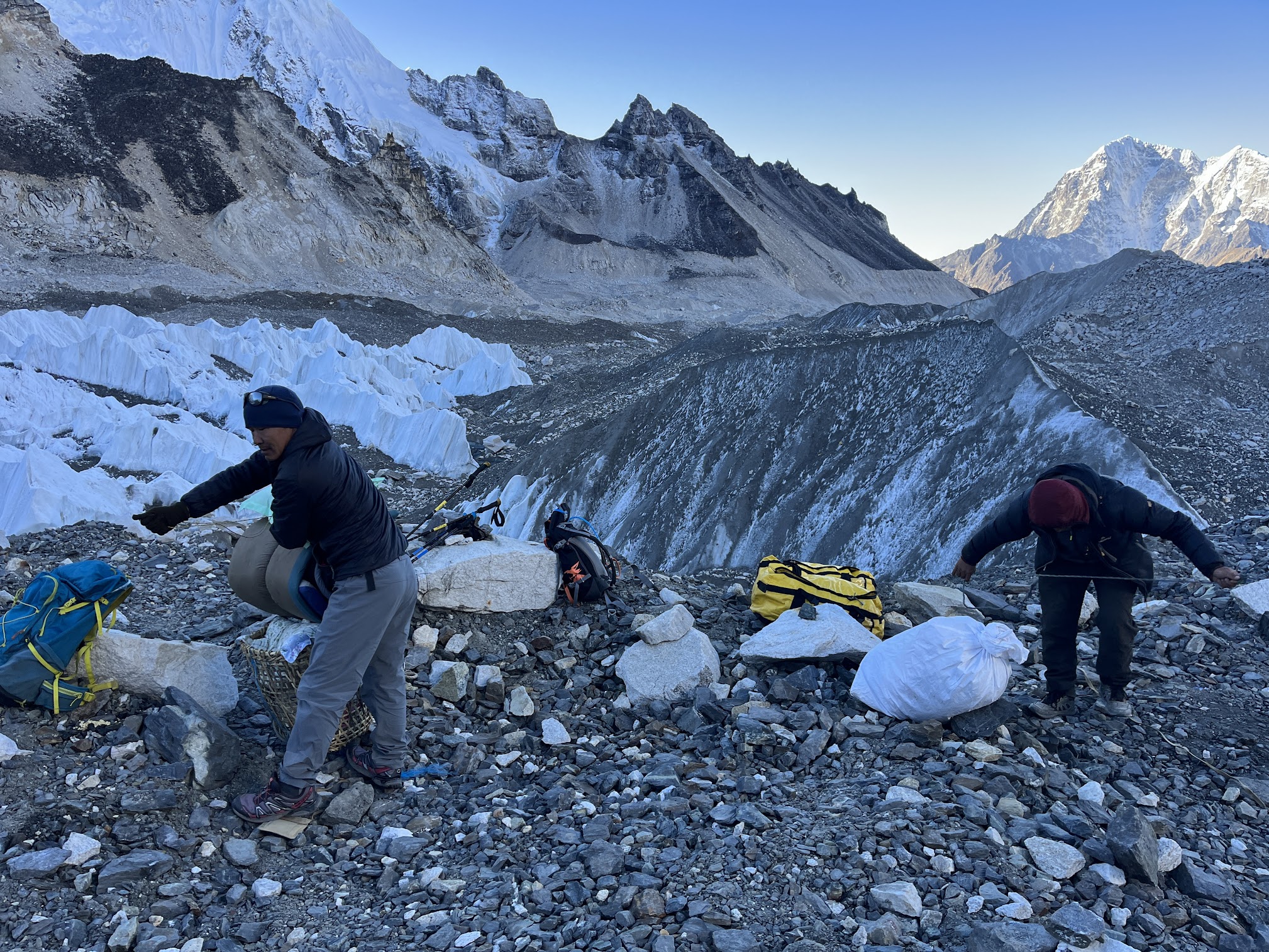
To add a bit of ‘fail’, I’d been careful not to drink too much the evening before, from early evening on, to avoid getting up 15 times during the night to pee (my specialty when it’s cold, but with real scientific backing).
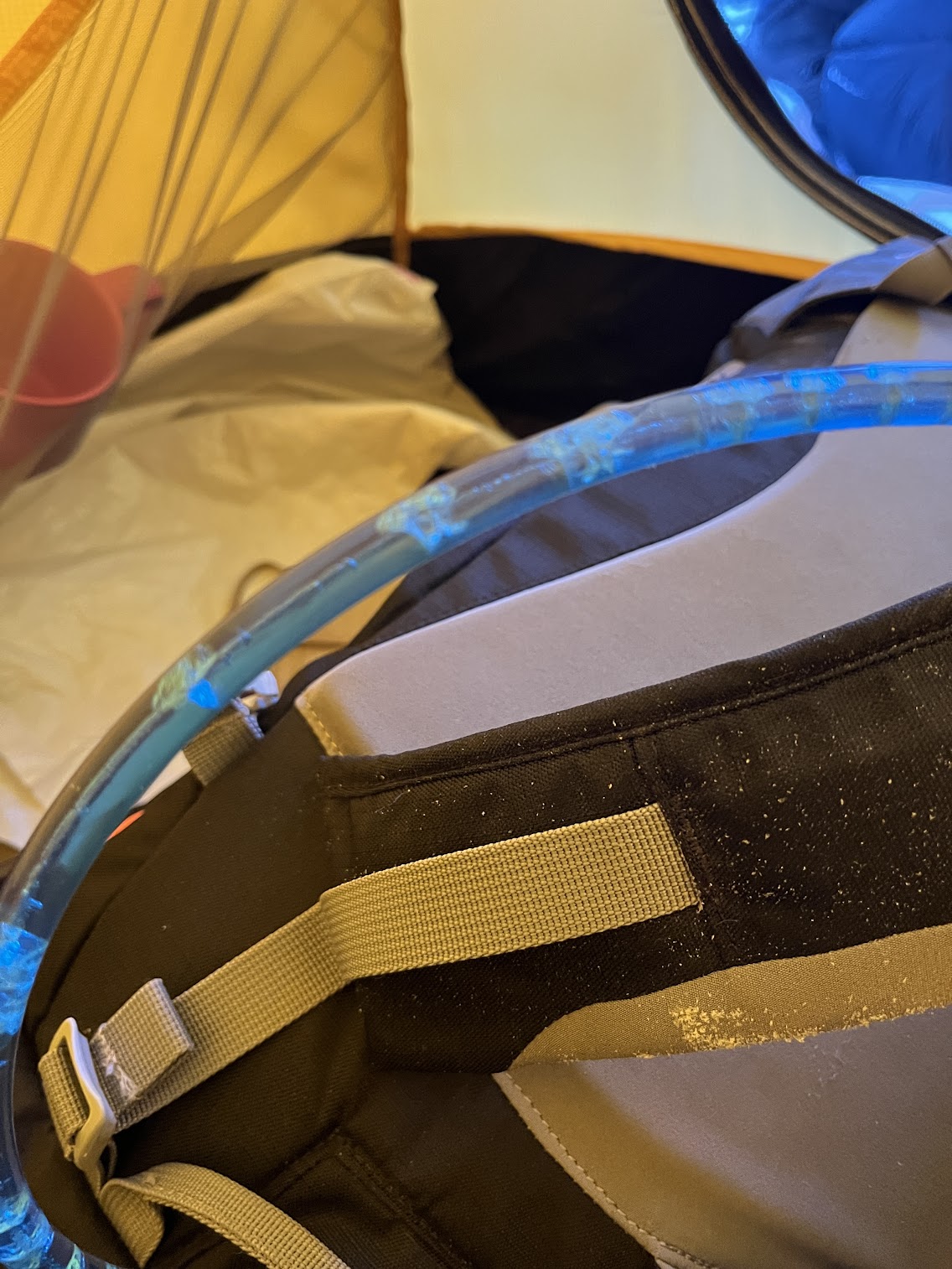
I planned to rehydrate on the way, but of course, the water in my CamelBak straw froze, #fail.
Even before this memorable night, Rinzi and I had agreed not to climb the summit of Kalapatthar to watch the sunrise. We’d have had to leave around 2 or 3 AM. We preferred to spend more time at base camp. And I can tell you, we had all the time in the world!
Back in Gorak Shep, it’s time for a day of descent. Rinzi gave us the choice between hiking back down to Pangboche (3,900 meters) or Pheriche (4,270 meters).
Even though it makes for an (even) longer day, we choose the first option. We really need to sleep, and sleep will surely be easier at a lower altitude.
The problem with the mountains is that even when you go down, you sometimes have to go up. And that’s the case at the very start of the trail, and I have no energy left!
Fortunately, we then begin a very long descent. I’m on autopilot, in automatic mode. I try to stay focused because I’m not far from falling asleep while walking.
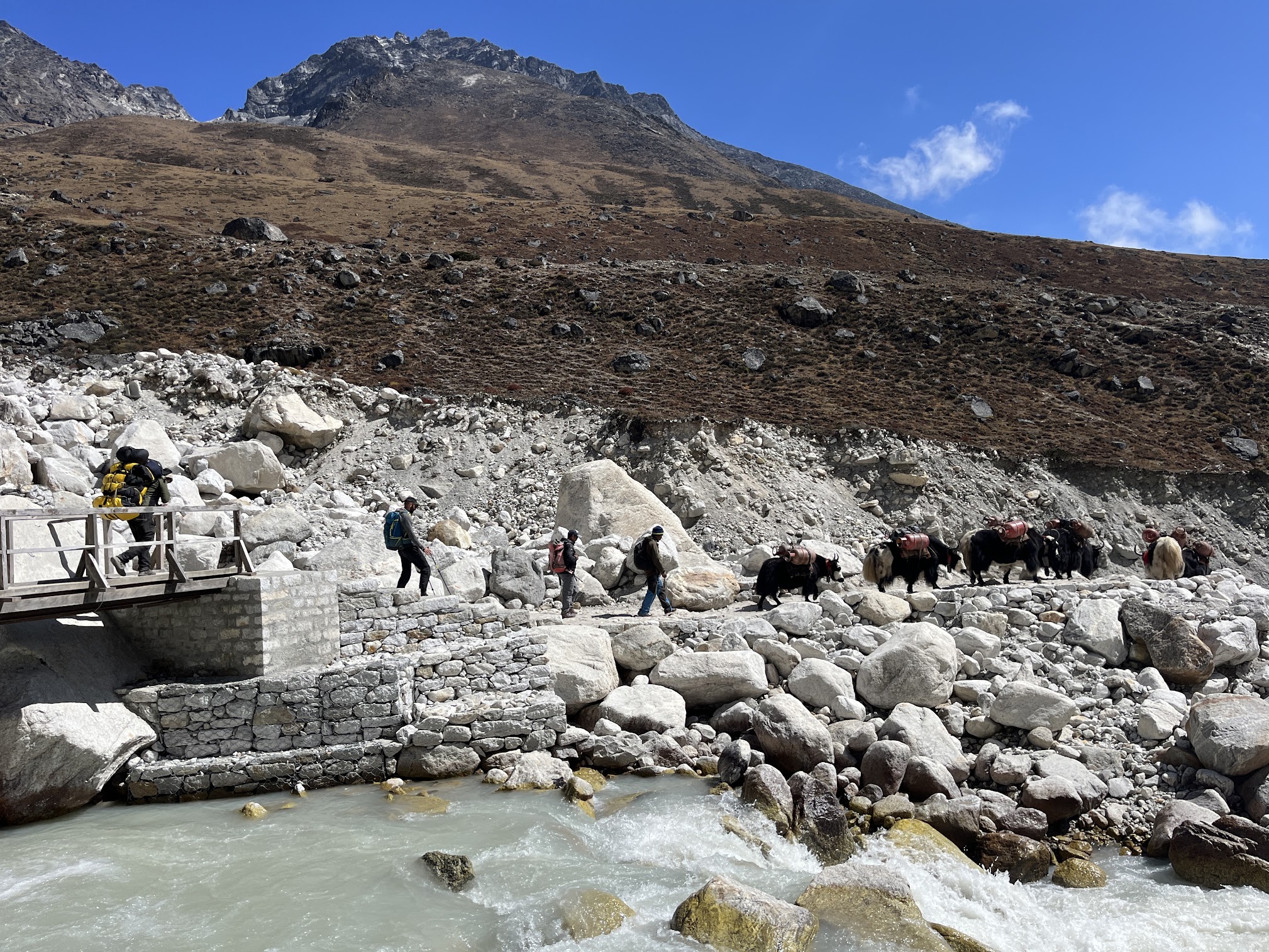
At 10:30 a.m., we are at Lobuche and pass by the site of yesterday’s helicopter crash. Given its condition, we’re glad we weren’t inside…
At 11 a.m., we pass by the memorial again. The view of the peaks is magnificent!
We then begin a long descent to Pheriche on a very pleasant trail. We have lunch there.
And at 3 p.m., we arrive at our tea house “View Point Lodge Pangboche“. It’s the height of luxury: we have a toilet in our room, a first! But no sink, let’s not get carried away!
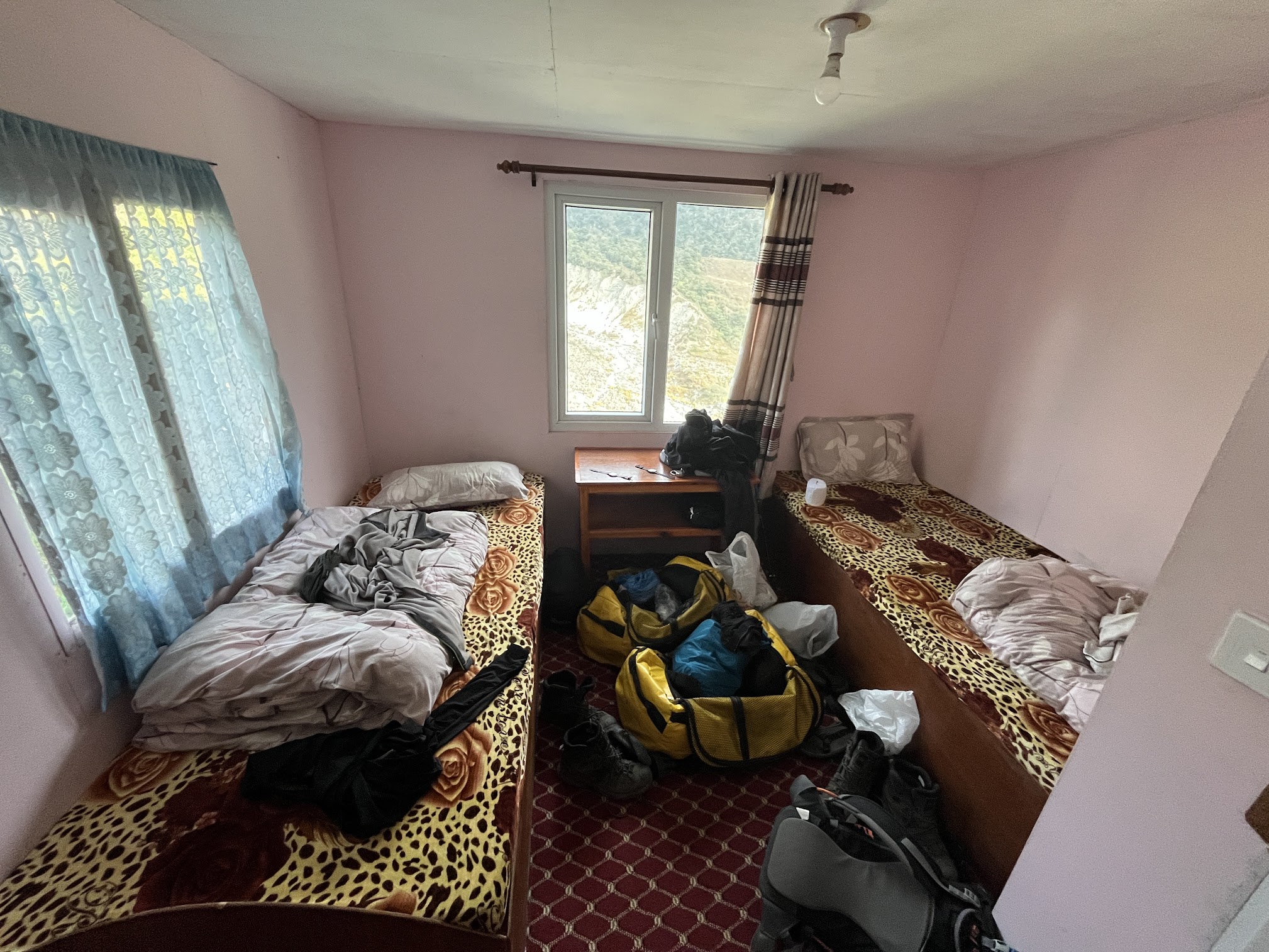
We treat ourselves to a hot shower. A quick nap confirms that we’ll sleep much better at 3,900 meters than at 5,300m.
I think we’re going to sleep particularly well tonight!
Tomorrow, we continue the descent (with some nice climbs, though) to Namche Bazaar.
Day 10 – Monday, October 16, 2023: second-to-last day of walking!
Wake up at 7:30 a.m.: after so much sleep deprivation, it feels good to sleep almost normally. Almost only, for some unknown reason, I woke up every two hours. But in total, I got enough sleep.
I’m having a bit of trouble getting motivated this morning; we only have two more days of walking to reach Lukla. Once the base camp goal was achieved, the return path has less charm.
We leave around 9 a.m. and begin a long descent. It’s now that I realize all the ground we’ve covered over the past 10 days, what a climb we’ve done!
A short climb and we pass by Tengboche around 10 a.m., where we had slept a few days ago.
It’s quite amusing to do the trail in reverse. What seemed like endless climbs are now descents, and vice versa.
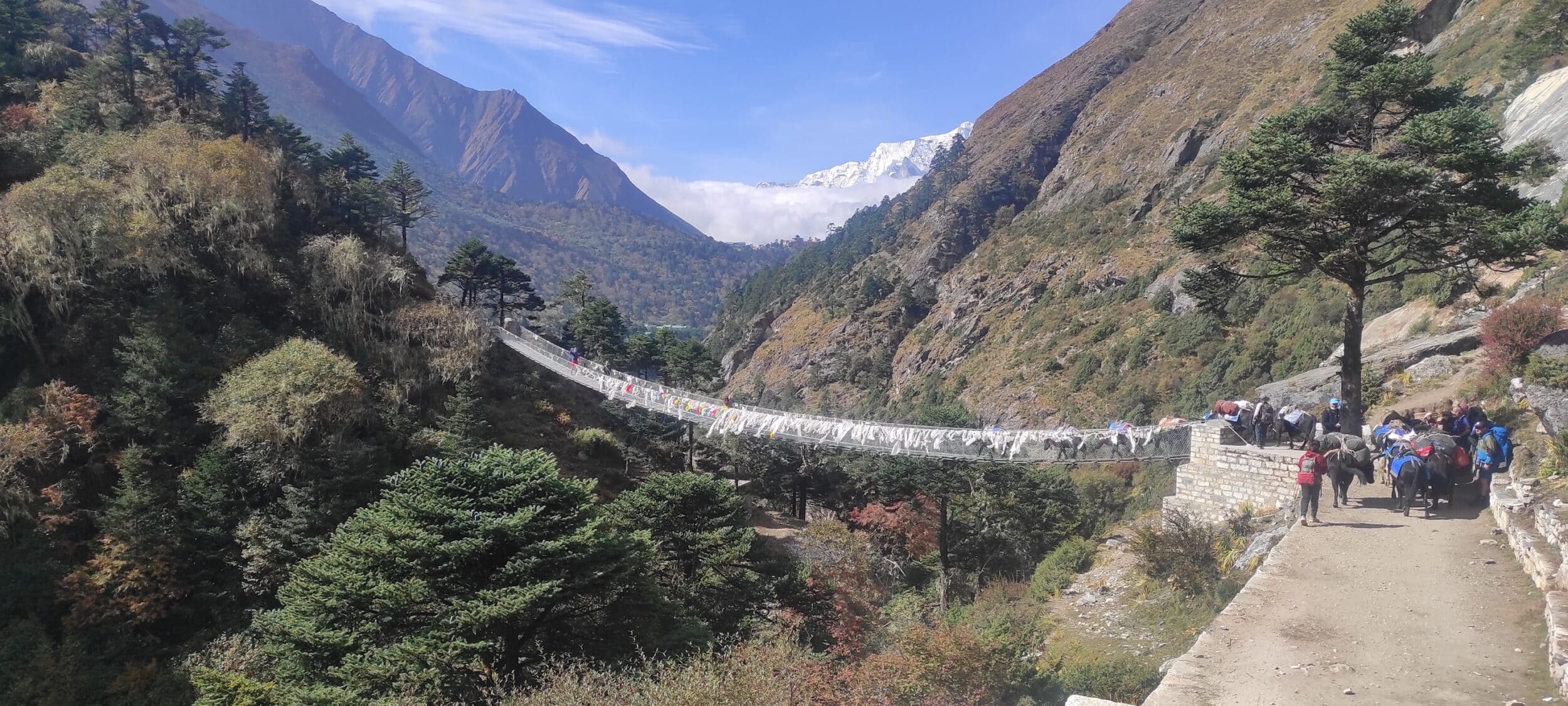
We cross many people. They must be on their third day of trekking. There has clearly been a shift due to the weather problems that grounded planes.
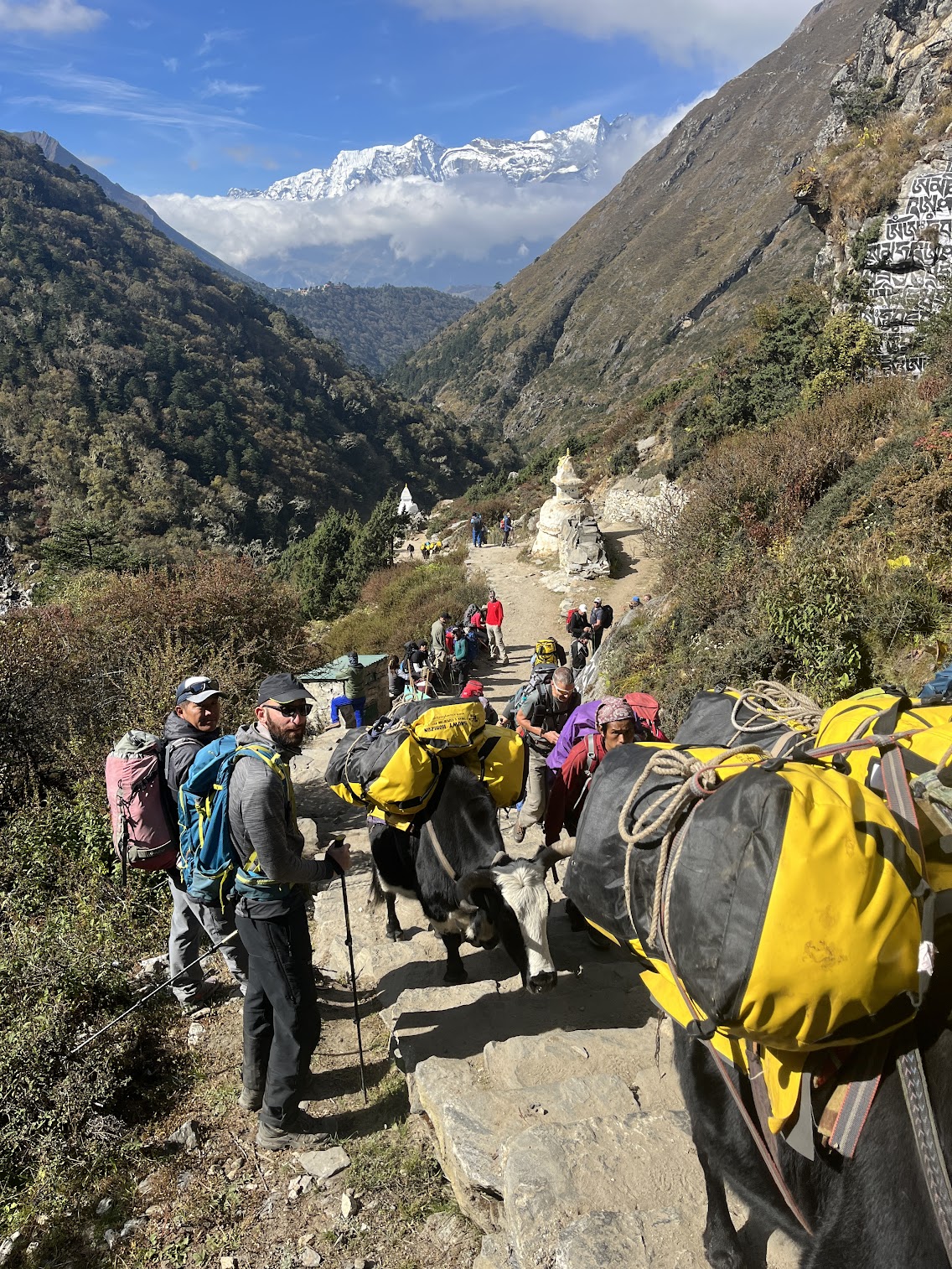
I observe the people I pass. Some are as fresh as daisies and probably don’t realize the difficulties ahead. Others are already worn out, and we wonder how they’ll make it to the end.
Even after 10 days, I still marvel at the porters we pass all day long, with loads more improbable than the last. True worker ants without whom nothing would be possible. We could think we were in the Middle Ages if we didn’t see most porters on their phones, playing with their smartphones, or listening to music through a Bluetooth speaker attached to their cargo.
We begin the descent that seemed infinitely long a few days ago. Today it’s become a climb, and I confirm it’s very long. But after days spent at higher altitudes, breathing is easier and the climb is almost easy.
At 1 p.m., we arrive at Namche.
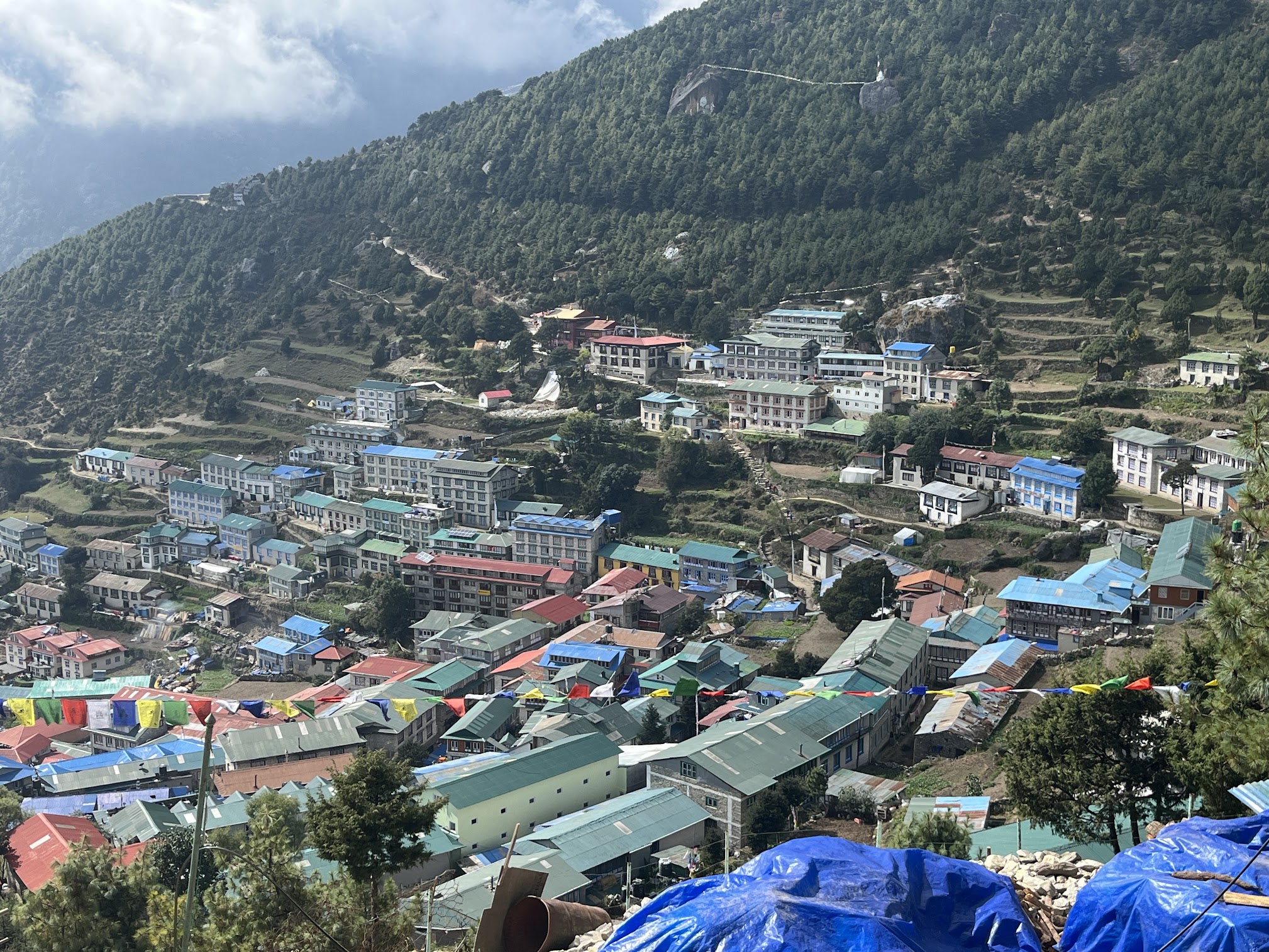
Tomorrow, the last (long) day of walking to Lukla!
Day 11 – Tuesday, October 17, 2023: return to Lukla and end of the trek!
Once again, I didn’t sleep very well; it was cold and damp in the room, and I’m starting to get fed up with our sleeping bag (a bit too small for us).
The road is long today: we have to reach Lukla from Namche in one day, a route we had done in two days on the way there.
At 8:15 a.m., we pass the Namche “checkpoint” and each pick up a small bag of one kilogram of plastic to recycle that we must carry to Lukla. 1kg corresponds to 20 plastic bottles, way more than we consumed during our trek since we filtered water.
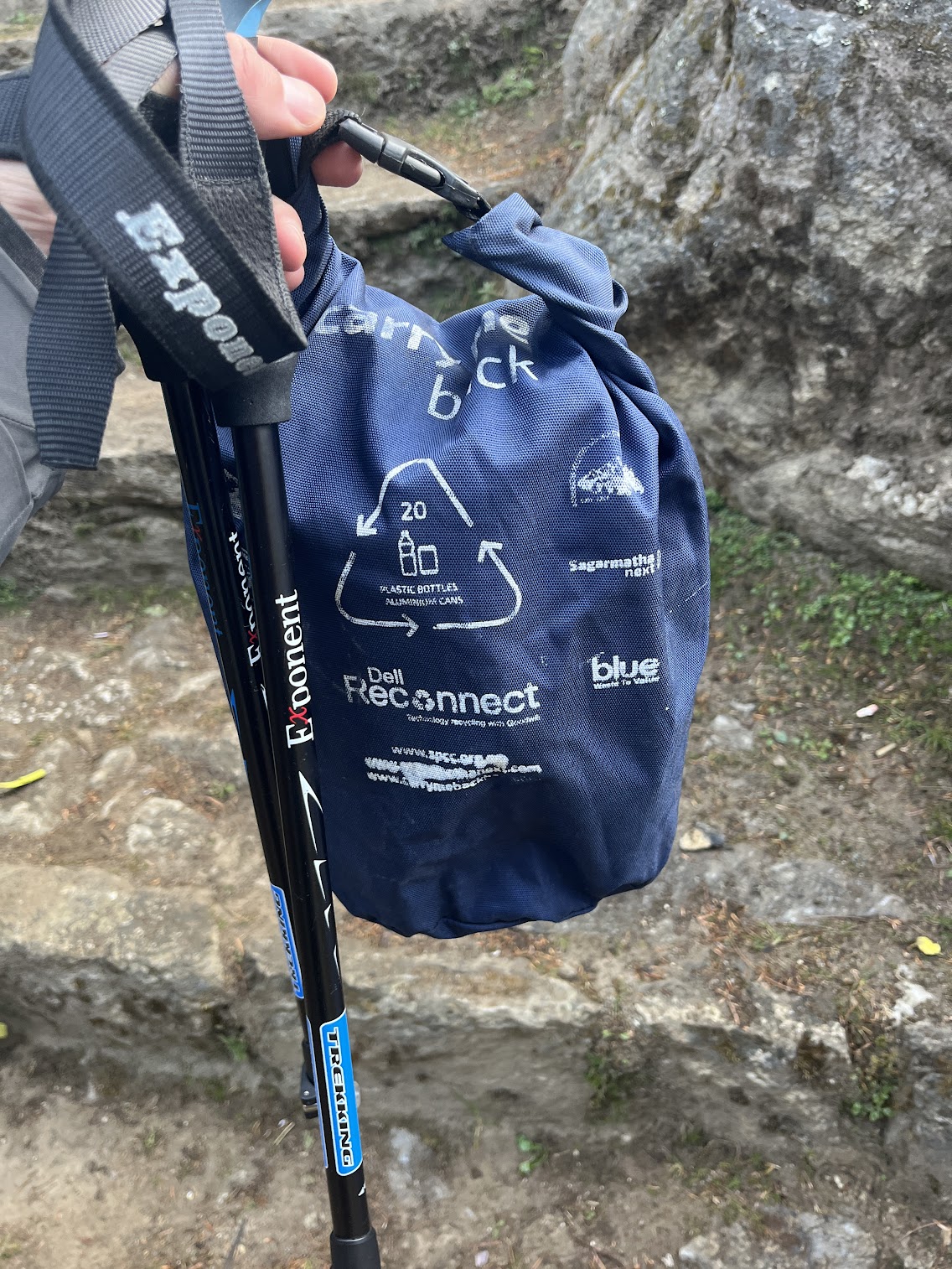
Off we go on a long descent on wet, uneven stone steps. I really don’t like it; I tend to hold back, it’s tiring and hard on the knees.
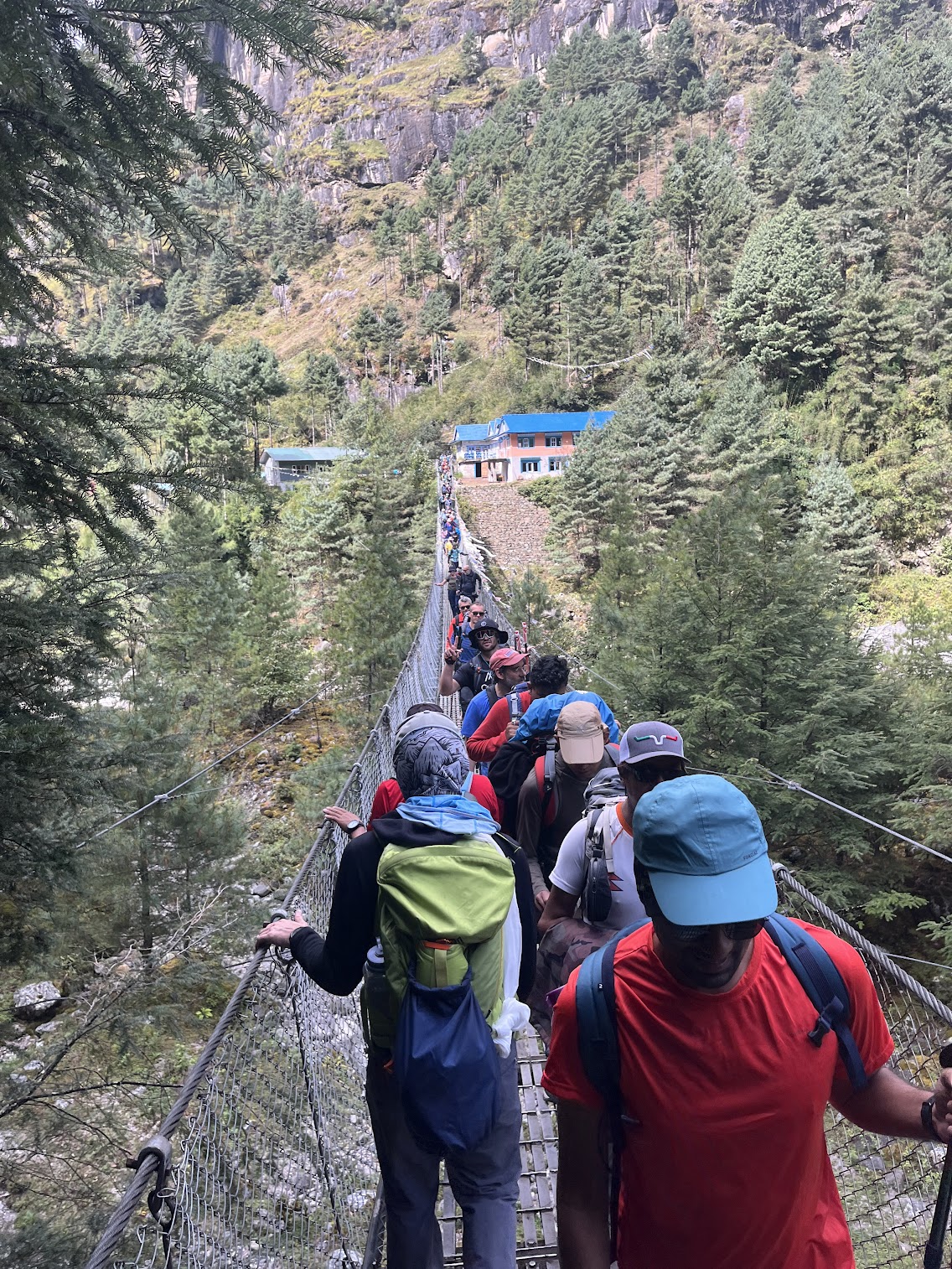
We are impressed by the number of people we pass, people on their first or second day of trekking. There are even groups that must number 30 people! These groups are made up of several guides who stay in contact via walkie-talkie… All these people give the place a Disneyland vibe that scares us a bit.
If we had planned to start our trek “out of sync” with the groups (who mostly arrive in Kathmandu on Saturday to start their trek on Monday or Tuesday), the weather setbacks are retrospectively a real blessing. In 2 hours today, we’ve seen many more people than since the beginning of our trek 10 days ago!
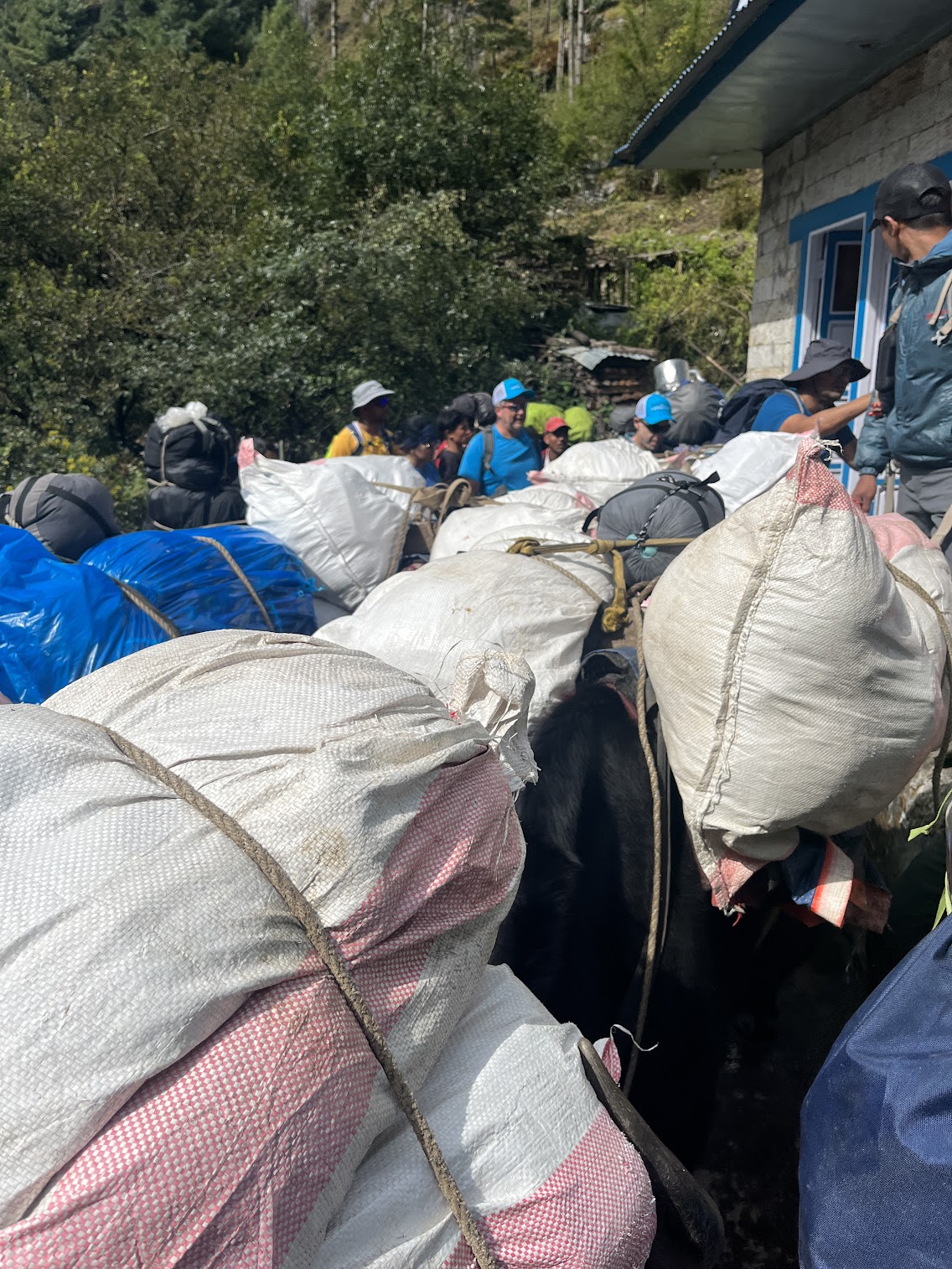
Surely a consequence of all these people, we also pass many herds of donkeys and dzos carrying bags of tourists and other goods. In places, it creates big traffic jams!
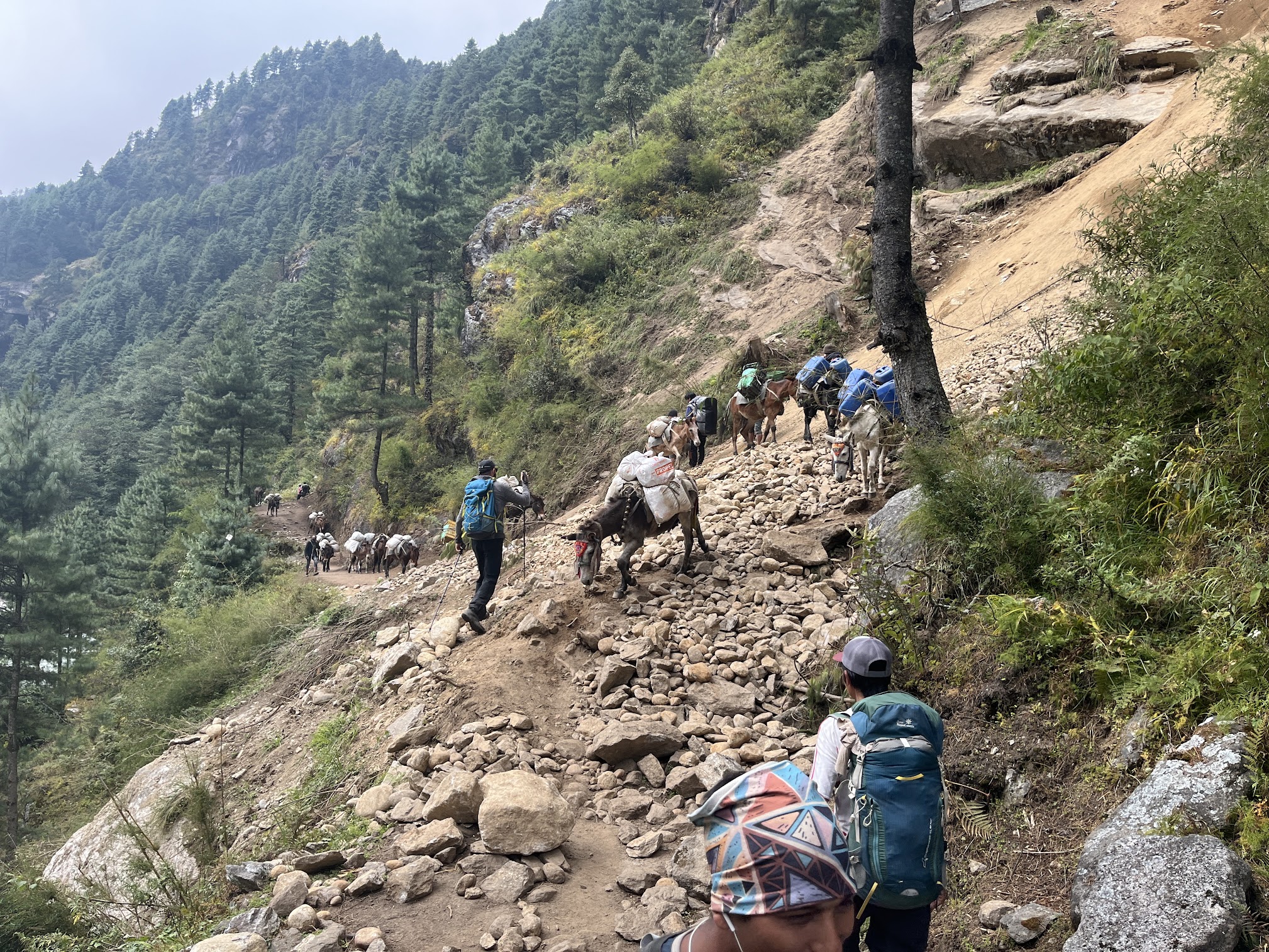
Along the way, one road is no longer passable (due to a landslide?), we have to take a “detour” along the river. This detour is not developed at all, and it becomes perilous when crossing herds of donkeys. It adds a bit of spice to a day that isn’t particularly exciting.
Just after 11 a.m., we arrive at Phakding (2,610 meters) where we stop for lunch. We realize that the lower the altitude of the restaurant, the wider the menu choices!
Back on the trail, and to finish with a bang, we’re about to tackle some serious climbs. Lukla is indeed 200 meters higher than Phakding.
I’ll admit, I’m starting to get fed up.
At 2:15 PM, we arrive in Lukla. We hand over our 2kg of plastic waste and head to our hotel.
You can believe it or not, but it’s at this exact moment that it starts to rain ! Throughout our entire trek, we only had to walk in the rain for the last 5 minutes.
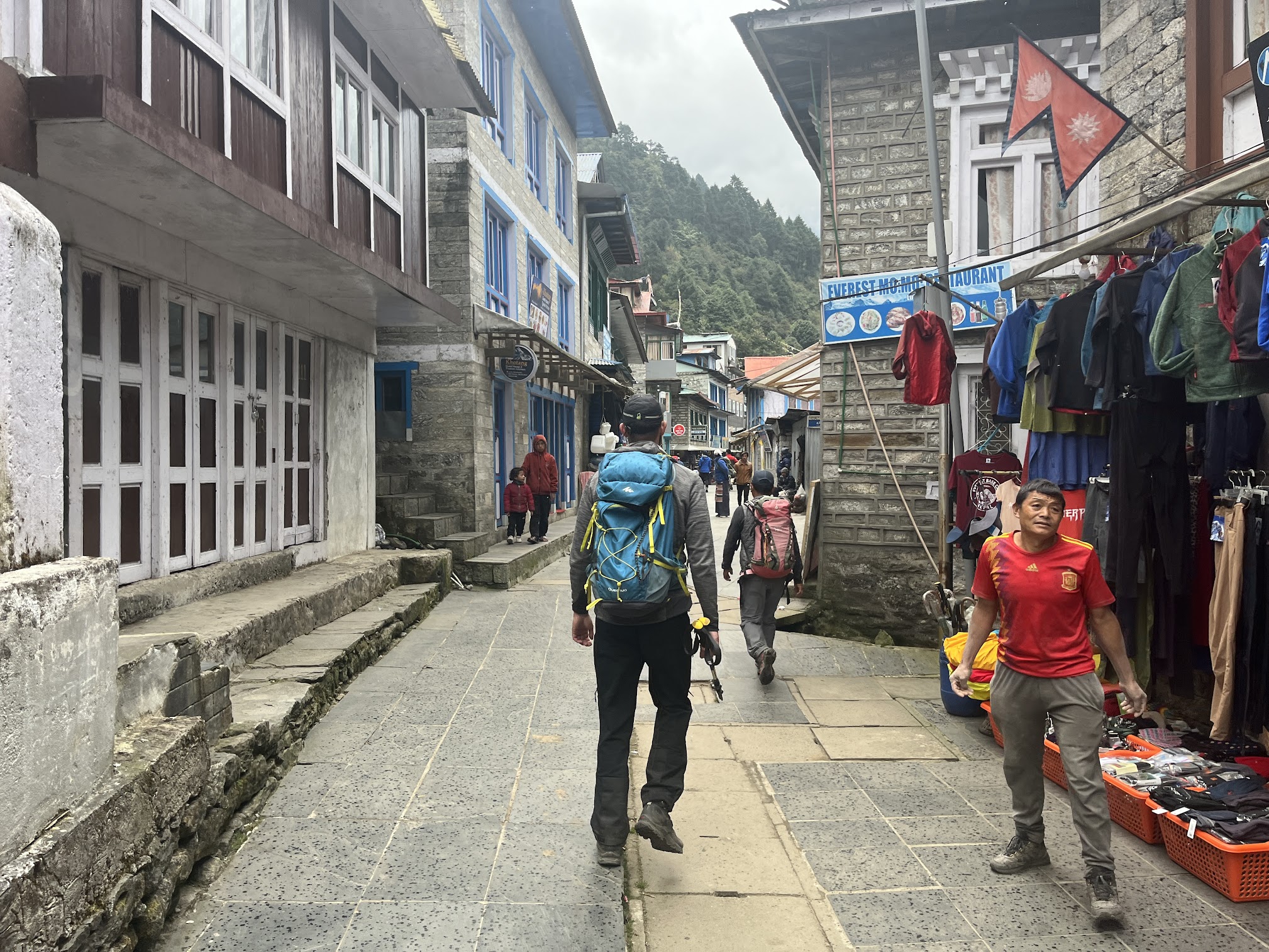
Our hotel (Buddha Lodge) is literally glued to Lukla airport, so much so that airport staff take their breaks at the hotel’s little bar. From our room window, we can even see a part of the runway.
This airport is, with a dose of storytelling, presented as the most dangerous in the world. Its very short runway indeed doesn’t leave much room for error.
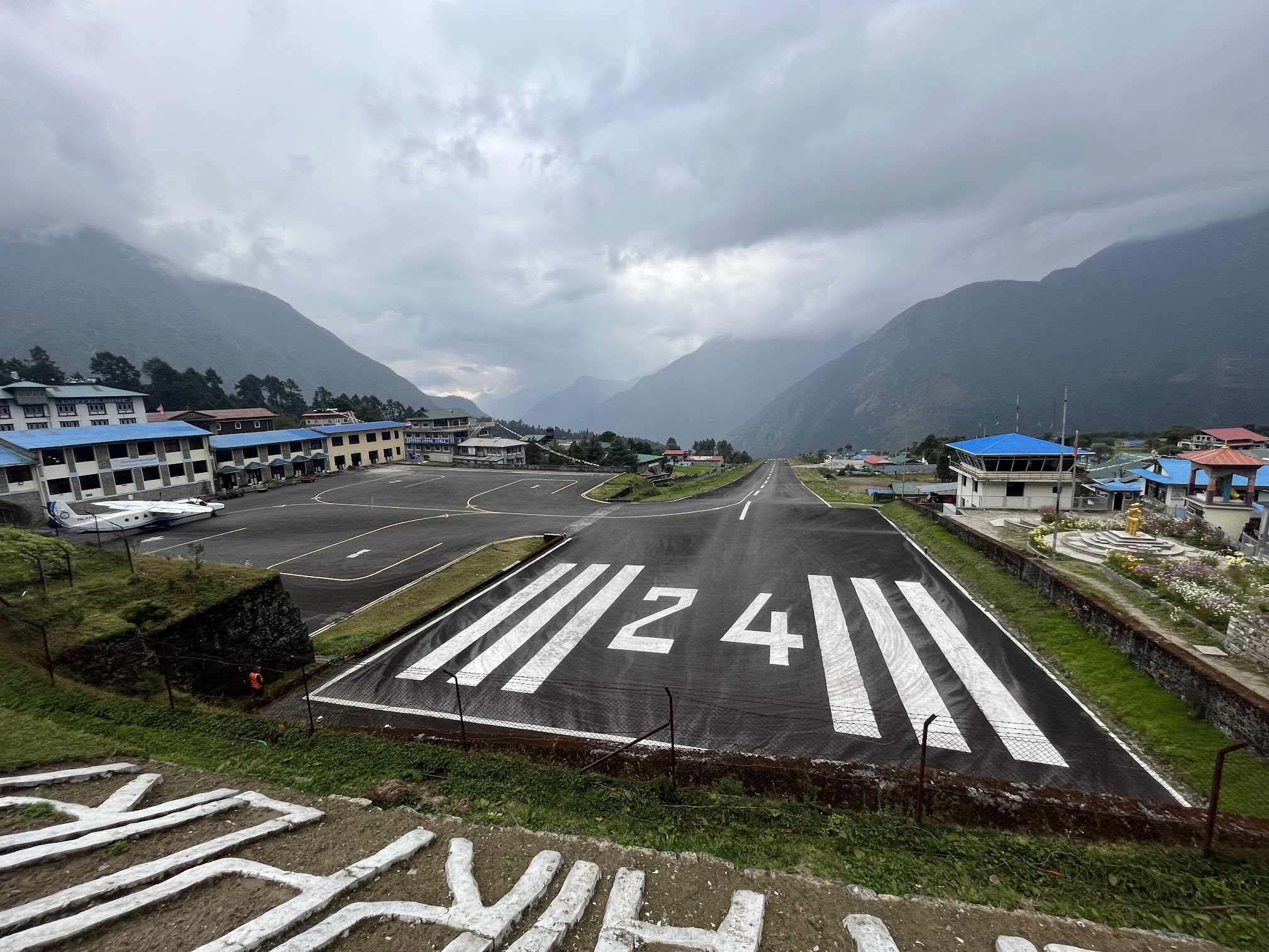
From the hotel rooftop, it’s possible to watch planes and helicopters take off and land.
Arriving at this hotel marks a return to a certain normalcy: we have a shower in our room (even if the water wasn’t quite hot due to the lack of sun today), we have an electrical outlet, and even free wifi (even if very, very slow).
We say our goodbyes to our porter Buddha, not without giving him his well-deserved tip. It’s always a slightly awkward moment—the tip is expected and part of the guide’s and porter’s salary. But it must be presented as a spontaneous gift.
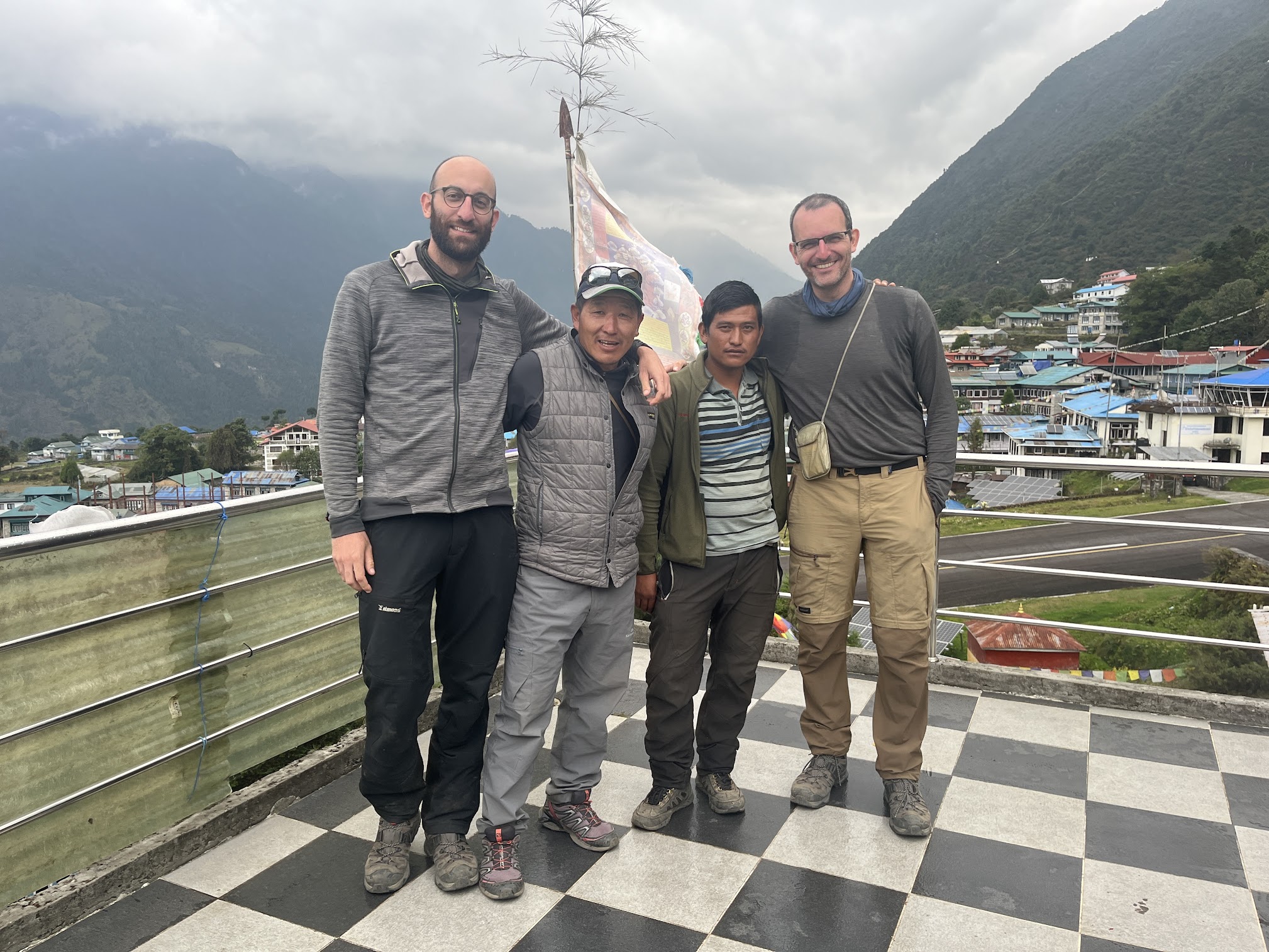
Goodbyes with Rinji will be for tomorrow; he’ll accompany us to the airport tomorrow morning, with the flight scheduled, weather permitting, at 7 AM.
On the agenda for tomorrow after returning to Kathmandu: drop all our stuff at the laundry service, stop by the agency to return borrowed gear and pick up our summit certificate, and treat ourselves to a massage!
Day 12 – Wednesday, October 18, 2023: back to Kathmandu
Just as we start dreaming of sleeping in, the wake-up call is early again. We need to be ready by 6:30 AM to head to the airport, located about twenty steps (literally) from our hotel.
Rinji accompanies us, and we quickly get our boarding passes.
Lukla is a tiny airport, and this is the first time my bags are manually searched, without going through an X-ray machine!
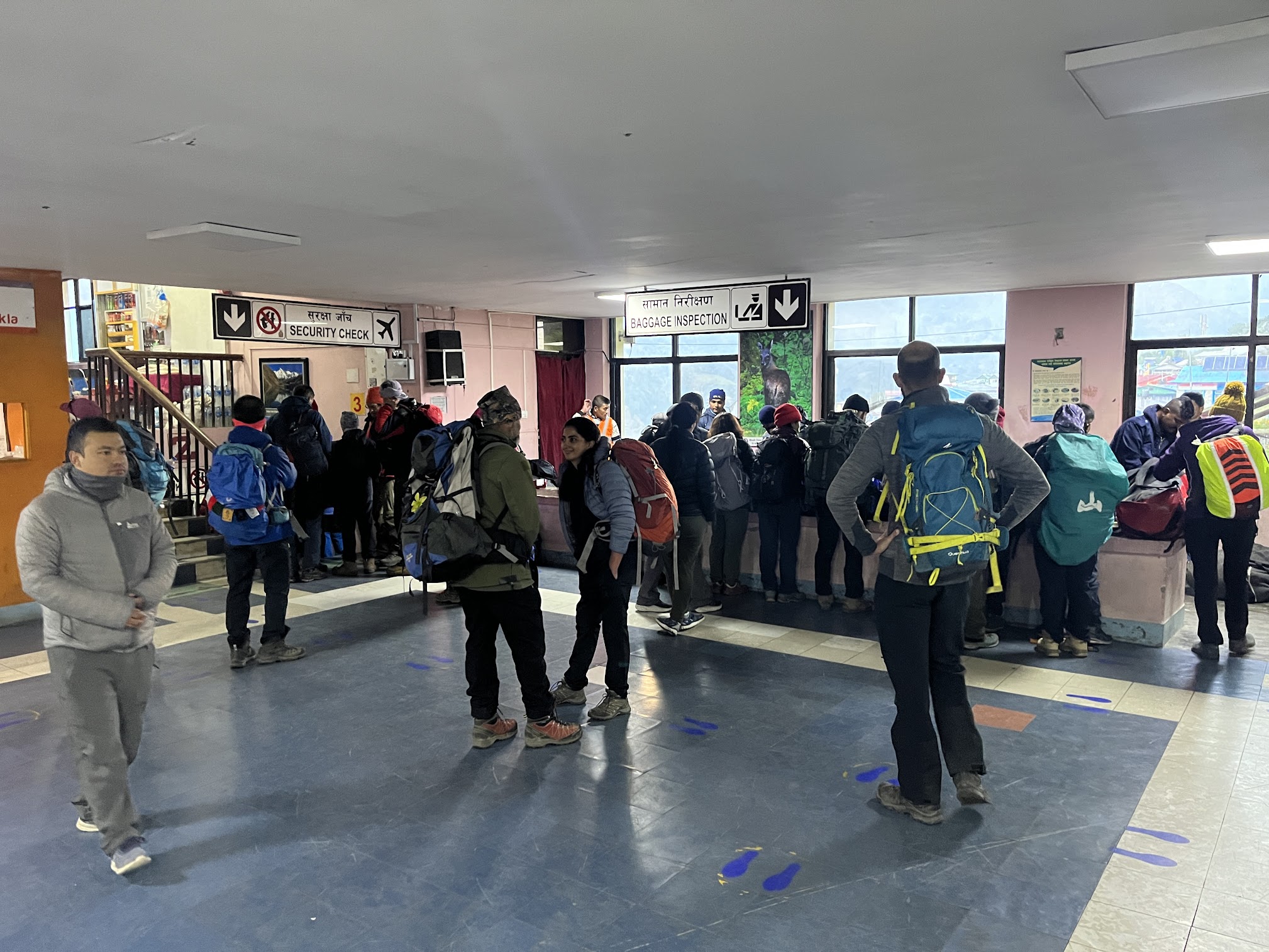
Just as we’ve said our goodbyes to Rinji and are heading to the boarding gate, we’re approached by an unknown guide who tells us we’ll need to wait for our driver near the café at the airport exit.
At that moment, we don’t really understand. It’s a few moments later, looking at our boarding pass, that we realize our destination isn’t Kathmandu, but Ramechap. Again, due to the weather.
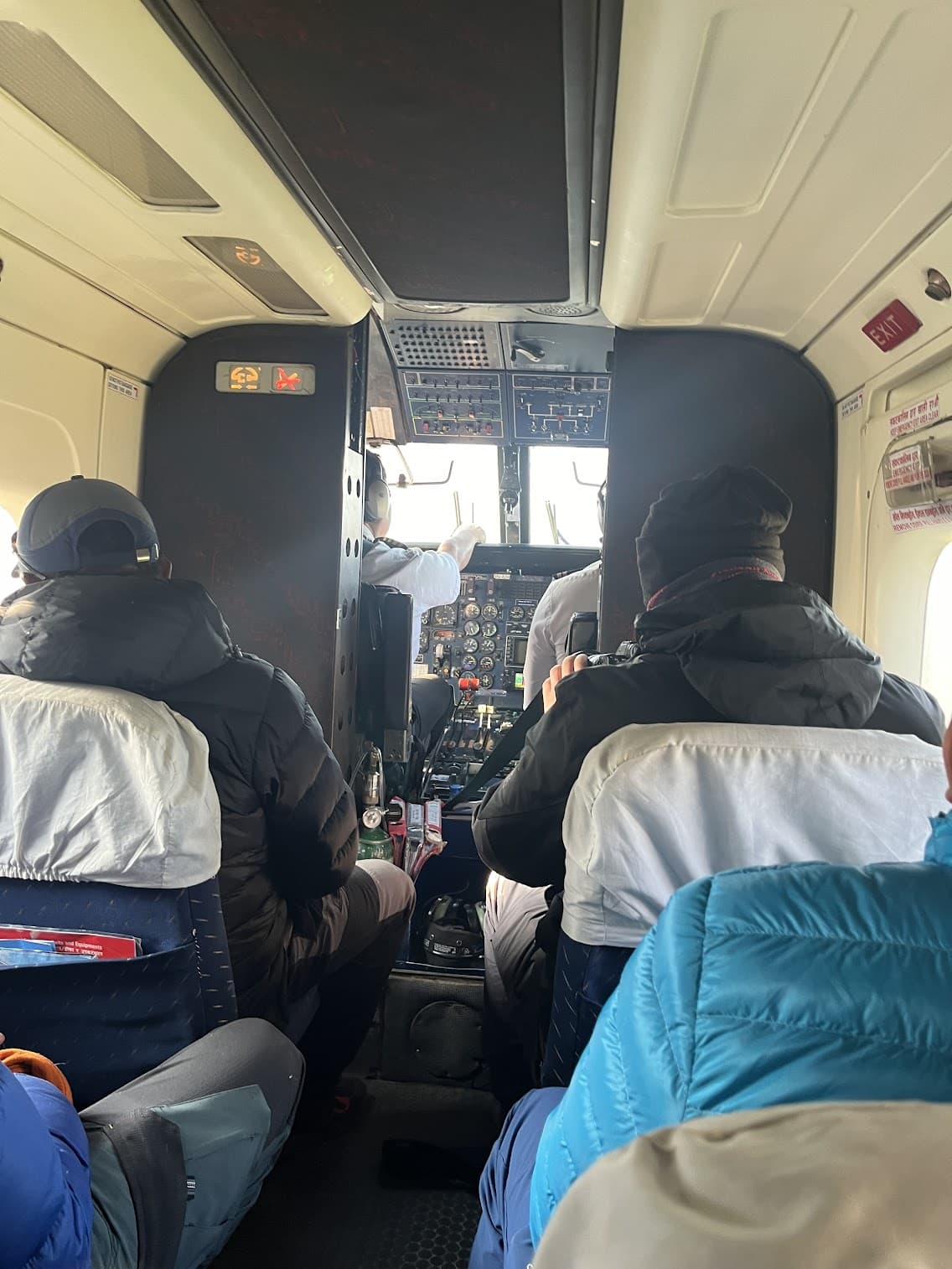
At 7 AM (the scheduled time!) a plane arrives, passengers disembark, their luggage too, and we immediately board—we almost feel like we’re getting on a subway car!
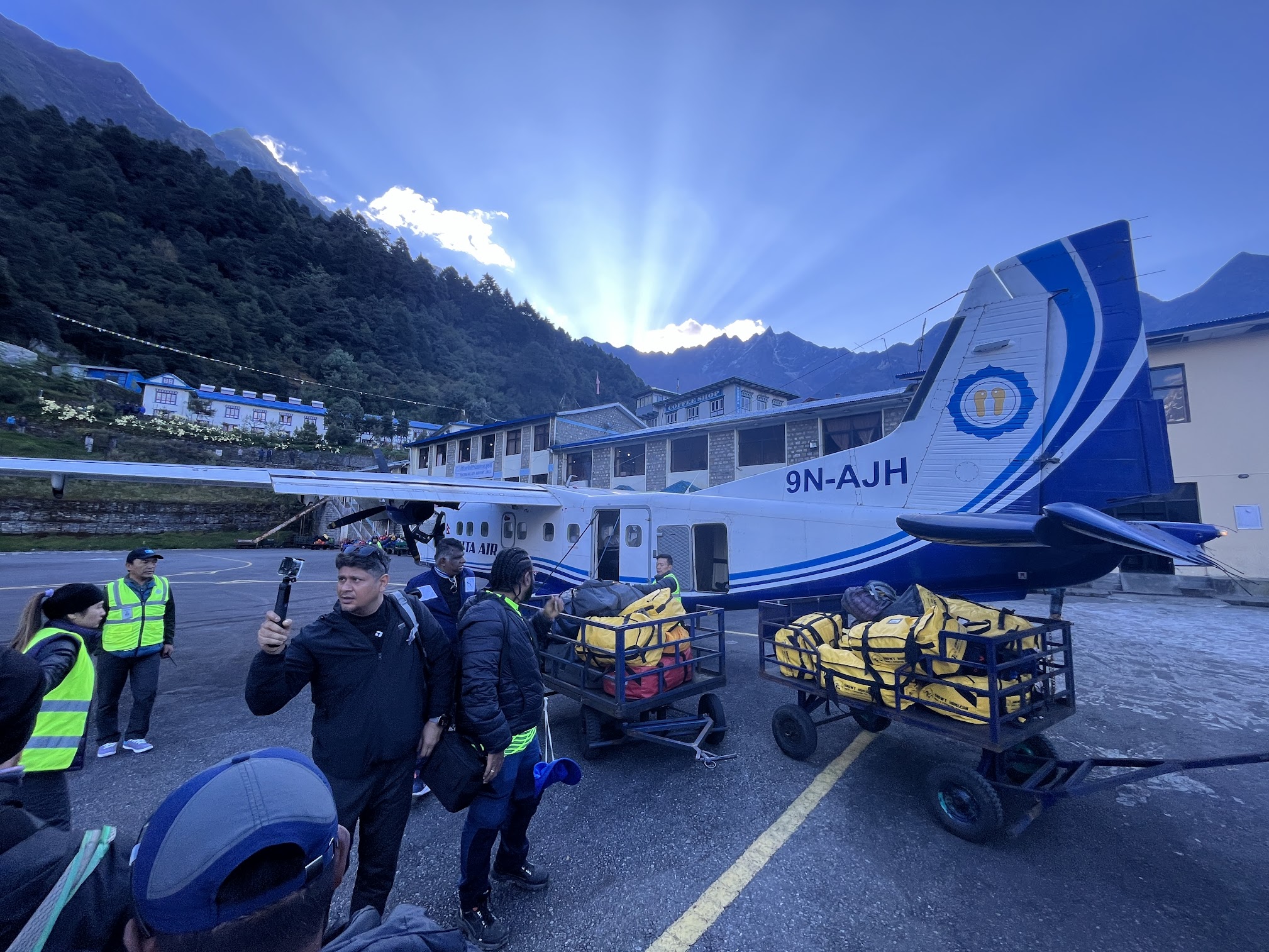
The plane has about twenty seats; we take off, and 30 minutes later, we’re in Ramechap.
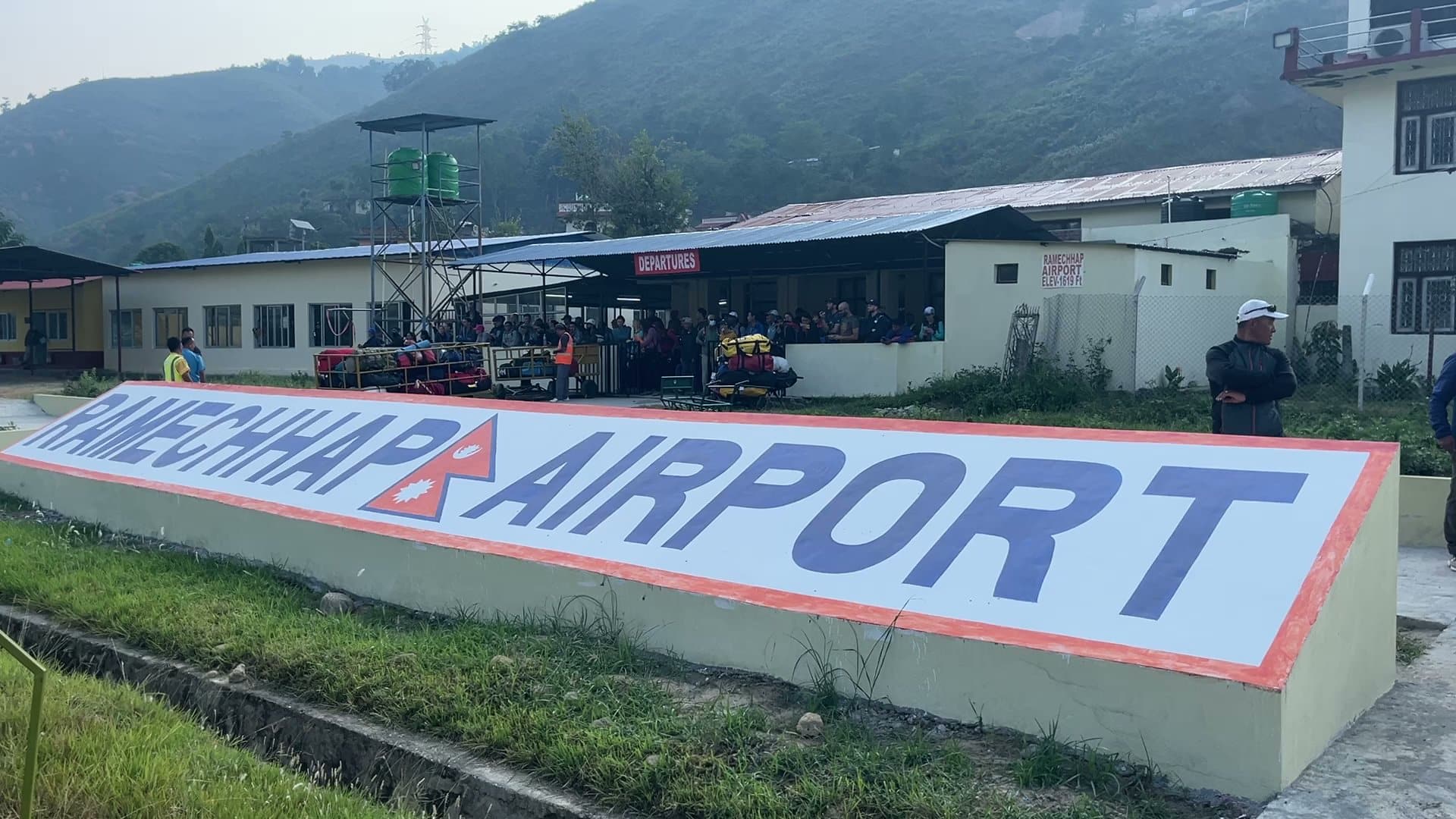
We head to the café and are approached by a Brazilian tourist from the same agency as us. He arrived on the previous flight; he was told he had to wait for two tourists (us!) and that a driver would take care of us.
The driver arrives, and off we go to Kathmandu.
The Brazilian tourist tells us he had the same difficulties as us getting to Lukla due to the weather. He had reached Ramechap (something we’d refused, sensing a sketchy plan) and had to sleep in a horrible hotel before also resigning himself to taking a helicopter.
The ride isn’t unpleasant despite the aggressive driving of the Nepalese. Our driver is no exception, and it’s better not to overthink during his overtakes on mountain curves with zero visibility.
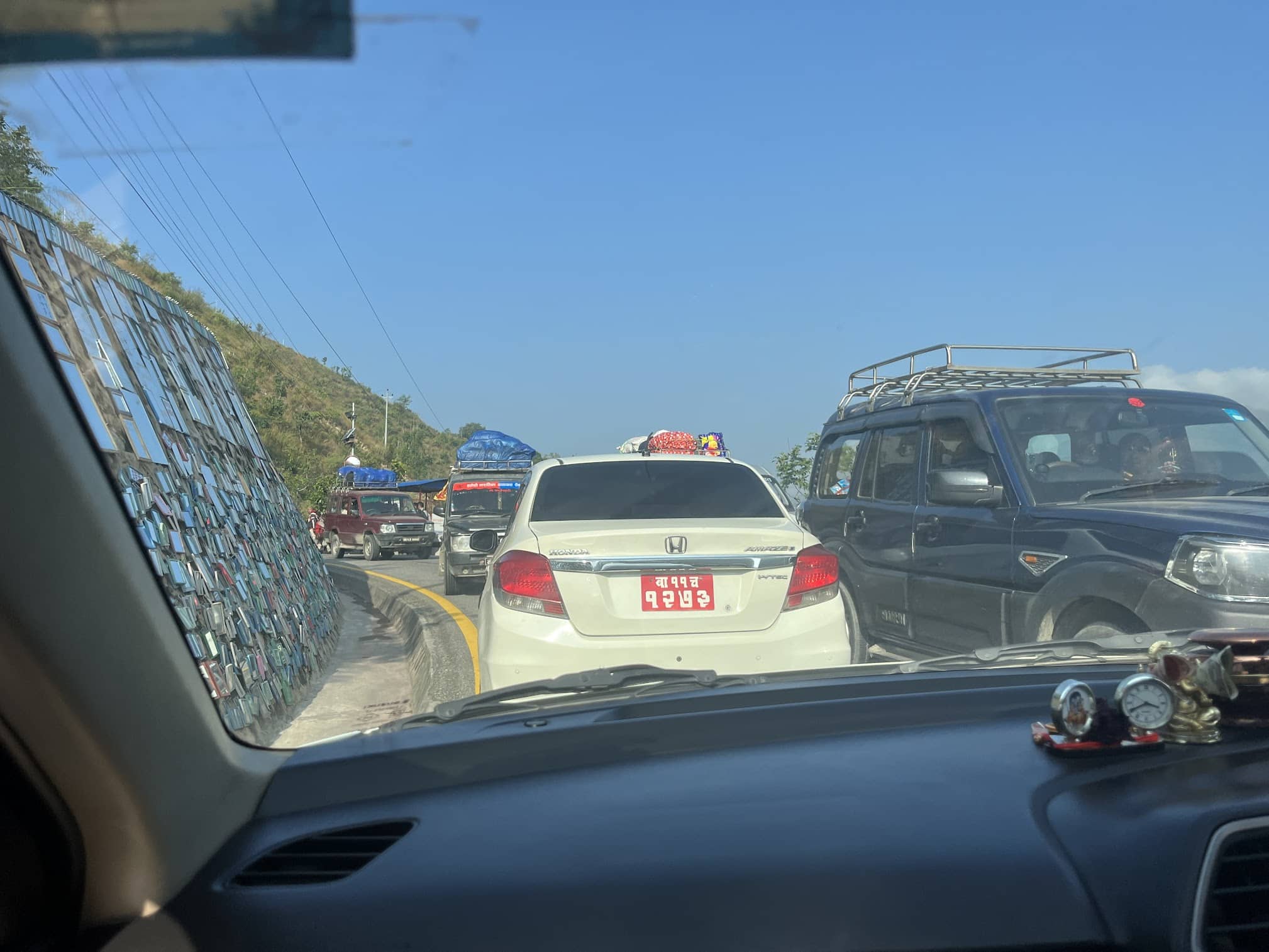
This trip allows us to see a bit of the country. Halfway, we take a short break where we enjoy delicious samosas.
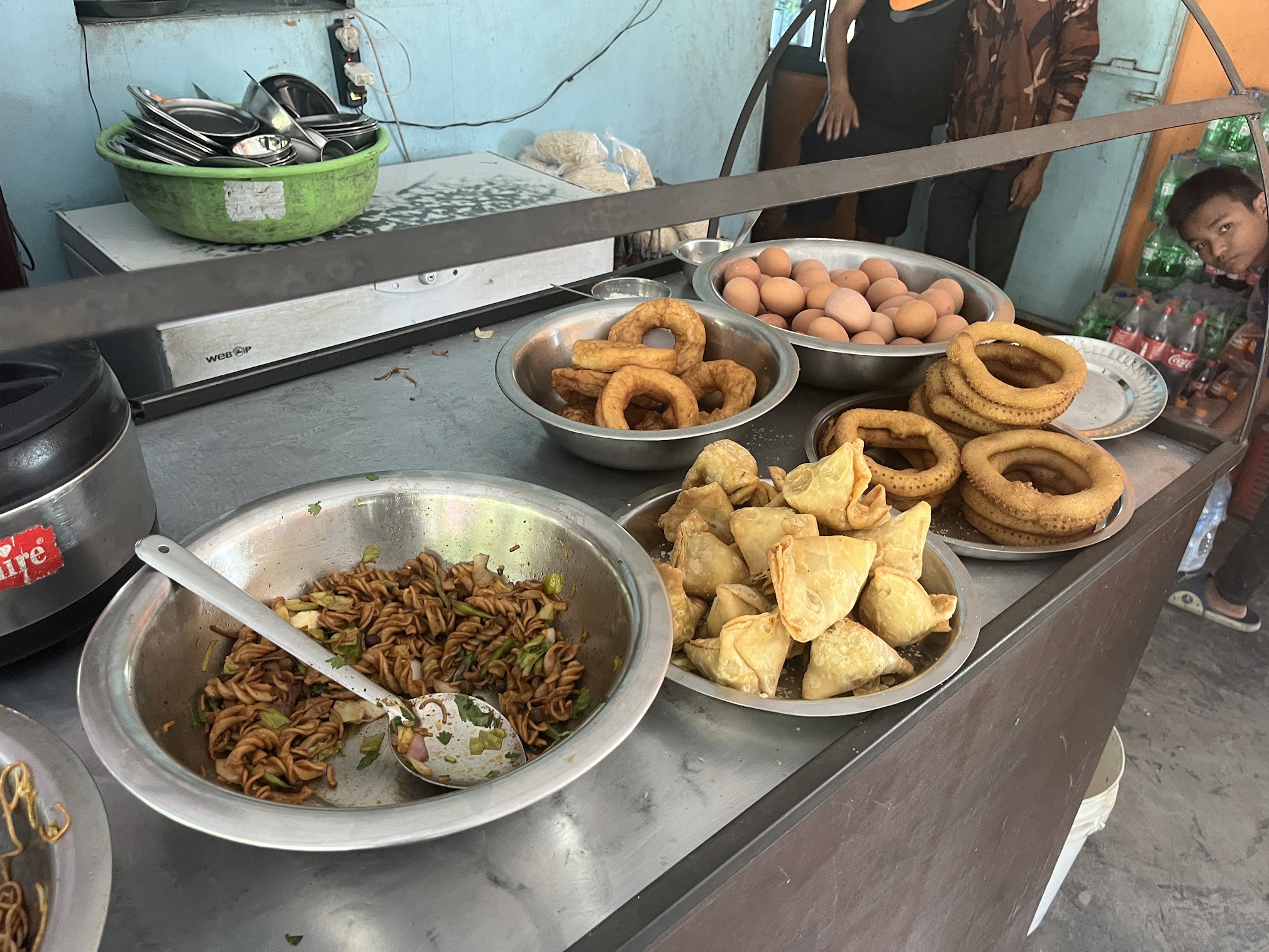
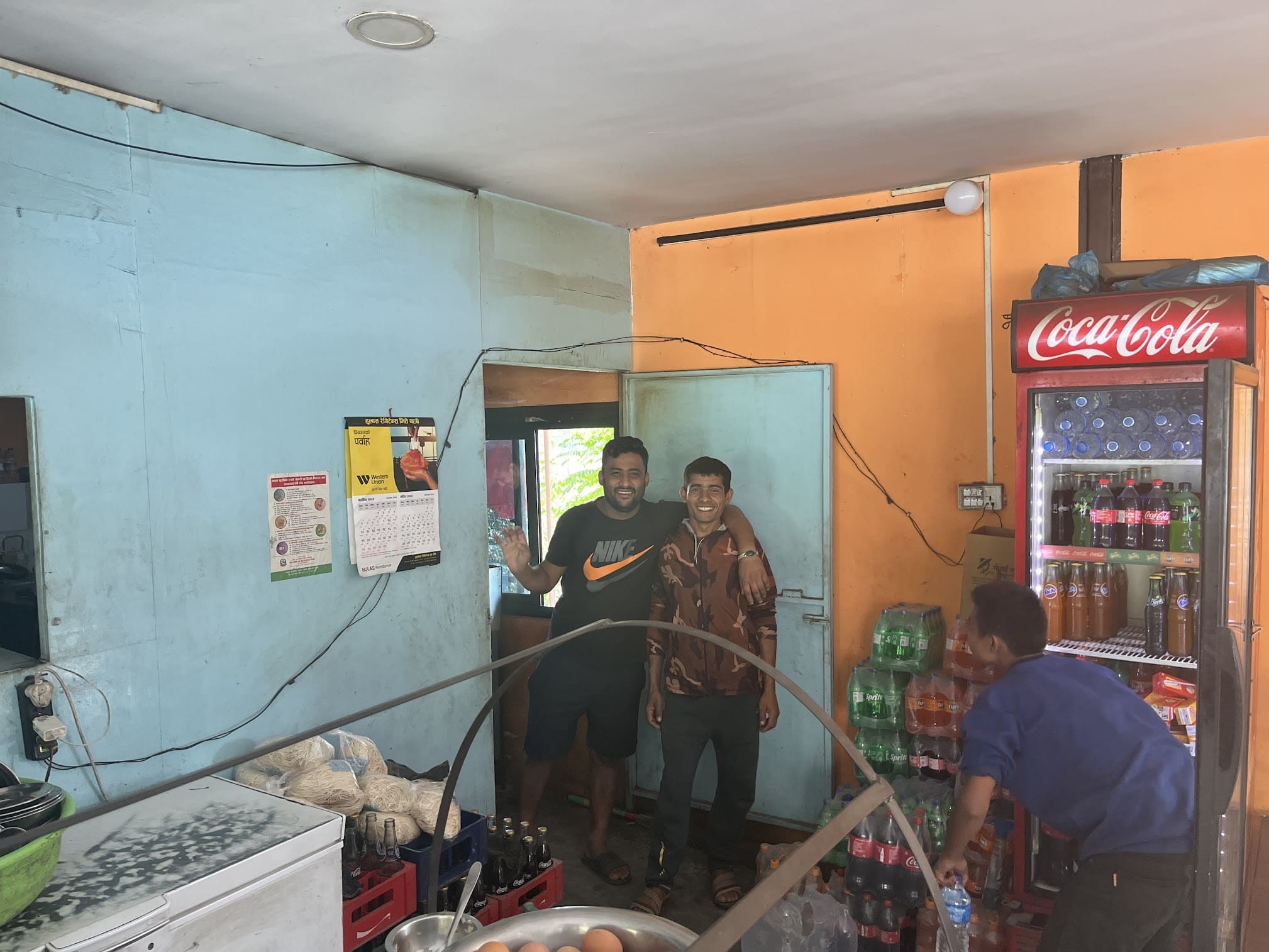
It’s ultimately the only ‘non-touristy’ spot in Nepal we’ll see. Thamel, the Kathmandu neighborhood where we’re staying, and the entire trek path are very touristy. We pass through several lively towns; for instance, we spotted what seemed to be a goat market.
After over 4 hours on the road (including a good hour in Kathmandu traffic), we arrive at our hotel.
First mission: take a nice hot shower with good pressure.
Second mission: drop off all our laundry at a place that can return everything the same day—we have nothing clean left!
Third mission: stop by the agency to return the gear they lent us.
Fourth mission: massage! I had promised Vincent I’d treat him to one if we reached base camp. On Google, I found a highly rated massage center near us (Seeing Hands Nepal). It was when we arrived that we realized it involved massages performed by blind people (as I already experienced in Cambodia). It’s even better! The massages were excellent and we might go back tomorrow.
Fifth mission: for me, going to get a shave at the barber’s.
Sixth mission: treating ourselves to a few cocktails at a bar (Blackbird). It’s not really my thing usually. But the place is very nice (plus we were the only ones at the bar), the cocktails are high quality, and the barmaid is kind. She gave us lots of freebies and well deserved her tip.
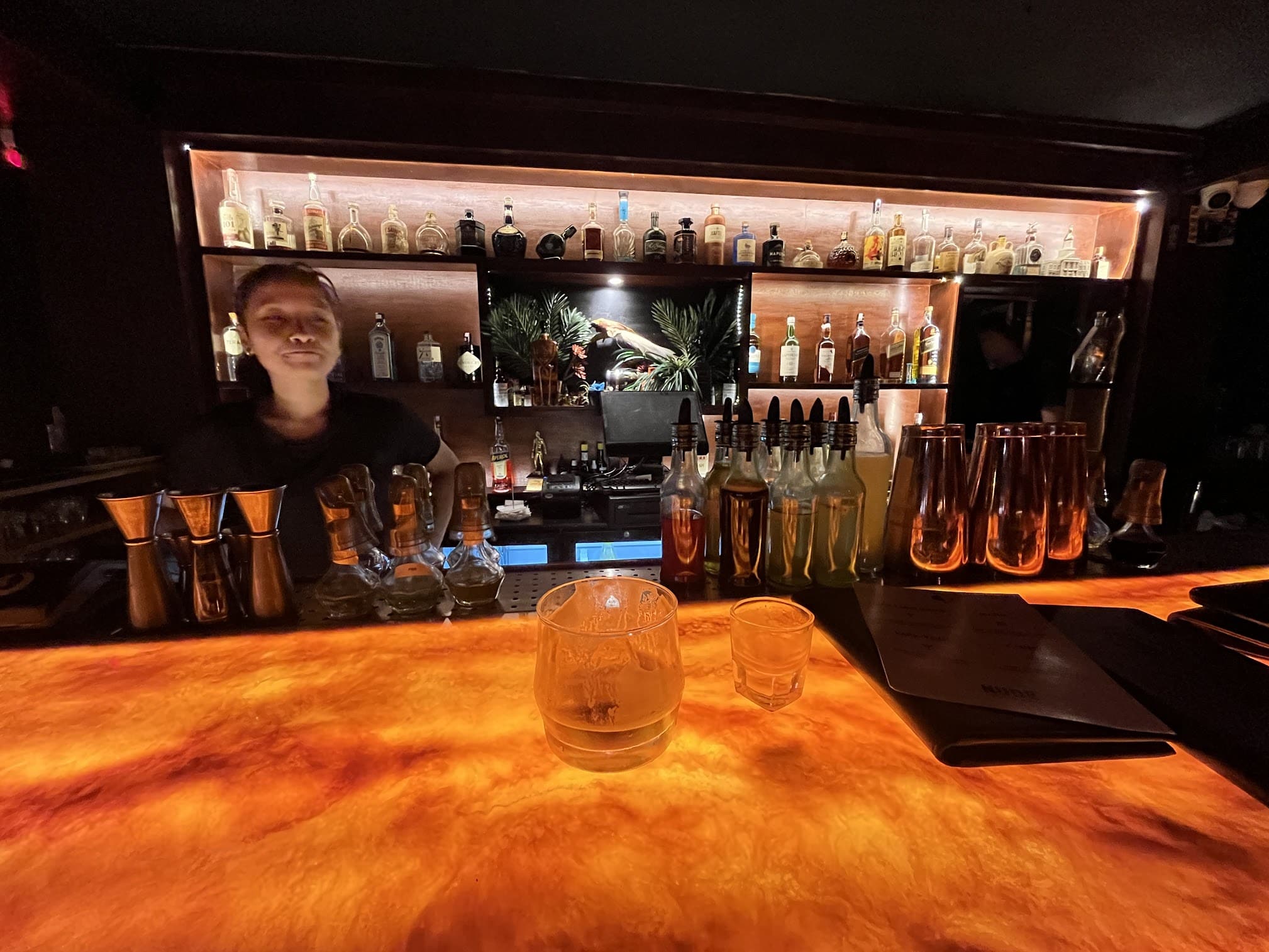
Seventh mission: being close to drunk, going to eat sushi at a Japanese restaurant.
It’s on this last busy day that our Everest Base Camp trek definitively ends. It’s time for me to join Anh in Barcelona for our transatlantic crossing.
See you soon for new adventures!

