My Current Favorites [December 2023]: William Morris’s Ideas
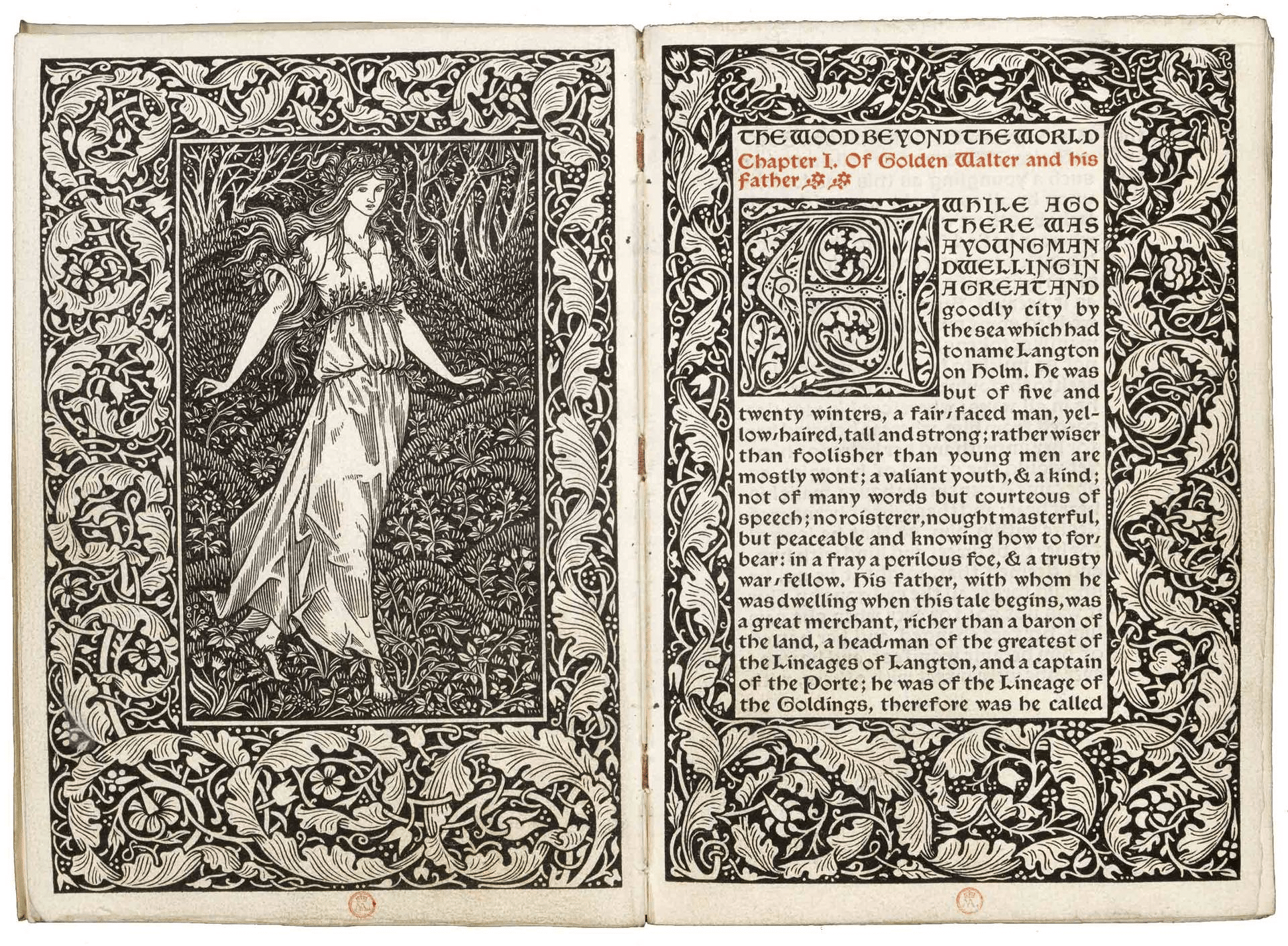
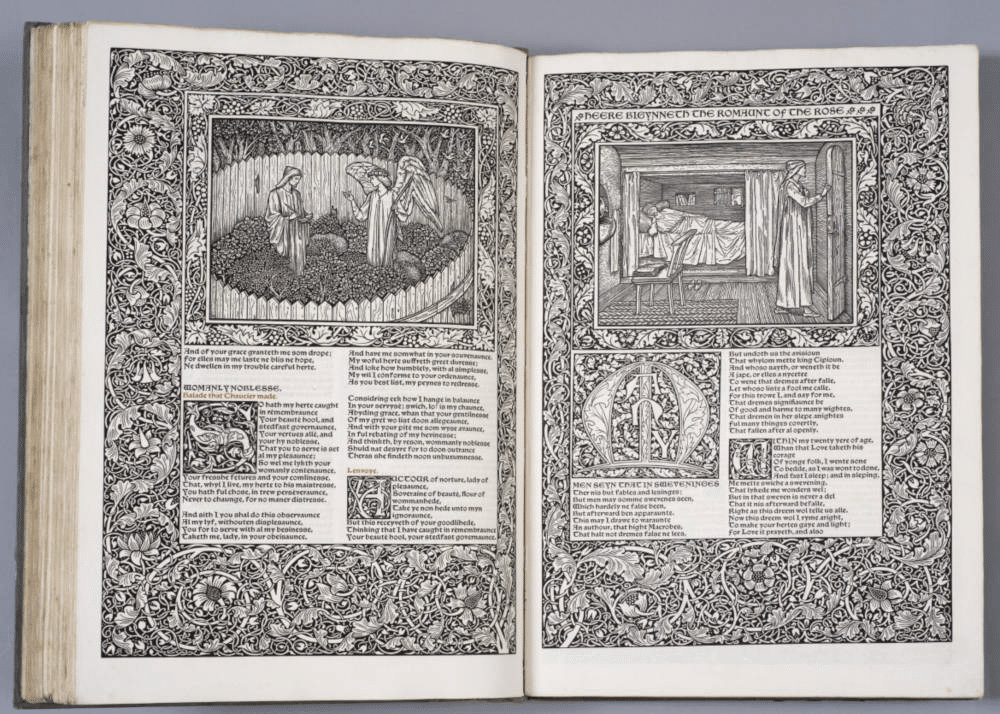
As I was getting interested fine books, I came across the book The Kelmscott Chaucer, considered the most beautiful book in the world, created by Kelmscott and William Morris. It was while getting interested in William Morris that I understood things about myself.
You know I’m very interested in crafts (jewelry, stained glass, paper flowers, sewing, bookbinding, leatherworking, linocut, etching, paper cutting) but I do it at a demanding level, meaning I train directly with artisans, use professional tools, the best materials, as if I were going to sell each piece. Moreover, unlike many, I’m interested in a wide range of different trades. For years, I struggled to understand my own interest, why others can be satisfied with one form of craft, and I have to do them all? Is it to escape the virtual side of my work? For each type of craft, I research thoroughly, and now at a glance, I can distinguish good work from mediocre work. And mediocrity annoys me so much that I can’t settle for average results; I wanted my pieces to rise to the level of art and be sellable in any shop window on Rue du Faubourg Saint-Honoré. I’m not there yet; my pieces are far from perfect, my teachers still criticize me on many details and poorly mastered techniques, but I hope to become better every day.
I’m angry at the mediocre handmade items sold by other amateurs, who don’t even take the time to do all the necessary steps to finish their pieces, nor to train properly (they think YouTube is enough). There’s a “bookbinder” who has been making barely passable books for 3 years, and starts putting out a tutorial book on bookbinding, knowing that her only source of info for 3 years has been YouTube (!!). She’s never even seen a real bookbinder in her life. We see this trend more and more among Instagrammers and TikTokers, indicating a lack of knowledge or even contempt for artisan trades (“it’s too easy, just follow this online tutorial“), an inability to recognize beauty, complacency in mediocrity, being so used to surrounding oneself with ugly, poorly executed, soulless objects. Yet, when beauty or art disappears from our daily lives, our lives become very sad.
I was relieved to find William Morris. Reading about him, I was able to better structure my ideas and motivations towards craftsmanship, because I resemble him a bit (just a bit). He worked in painting, poetry, drawing, calligraphy, embroidery, and a dozen artisan trades. His company manually produced wallpapers, furniture, books, carpets, and stained glass of high quality. The quality of his works was so high that it always served as a benchmark for certain arts. It was he who learned all these crafts, rediscovered lost techniques, and taught them to his employees.
It all started with his move to the Red House in 1860 with his wife: dissatisfied with what was commercially available, William and his wife Jane spent the next two years furnishing and decorating the interior with the help of members of their artistic circle. Monumental frescoes and hand-embroidered fabrics adorned the walls, creating the atmosphere of a historic home. Buoyed by the success of their efforts (and the experience of “joy in collective work”), Morris and his friends decided in 1861 to create their own interior design company: Morris, Marshall, Faulkner & Co. Everything had to be handcrafted, a principle that placed the company firmly against the grain of the general emphasis on industrialized “progress.” The company signed many contracts for stained glass production (for churches, cathedrals, and private clients). In 1875, Morris became the sole director of the renamed and restructured Morris & Company. Over the following decade, he continued designing at an impressive pace, adding at least 32 printed fabrics, 23 woven fabrics, and 21 wallpapers, as well as more patterns for carpets and tapestries, embroidery, and tapestry, to the company’s product range. All these items were sold in the shop Morris opened on Oxford Street in 1877, in a fashionable space offering a new retail experience “all under one roof.” In 1881, Morris had accumulated enough capital to acquire Merton Abbey Mills, a textile factory in south London. This allowed him to consolidate all the company’s workshops in one place and have tighter control over production. William Morris’s final pride was his publishing house Kelmscott. The books produced by Kelmscott Press, 66 in total over time, were printed and bound in a medieval style, with Morris designing their typefaces, initials, and borders. The most famous of these is an illustrated edition of Geoffrey Chaucer’s works, published in 1896, a few months before Morris’s death, considered the most beautiful book in the world. Source: V&A Museum
Here, I’ll summarize William Morris’s ideas, expressed in the book William Morris by Arthur Clutton-Brock.
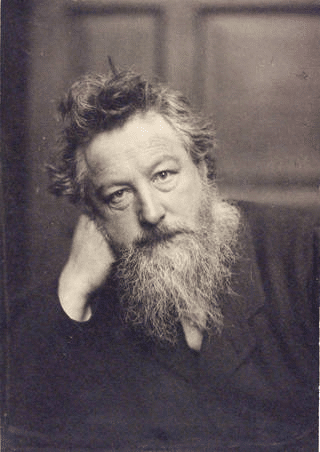
Photo: William Morris
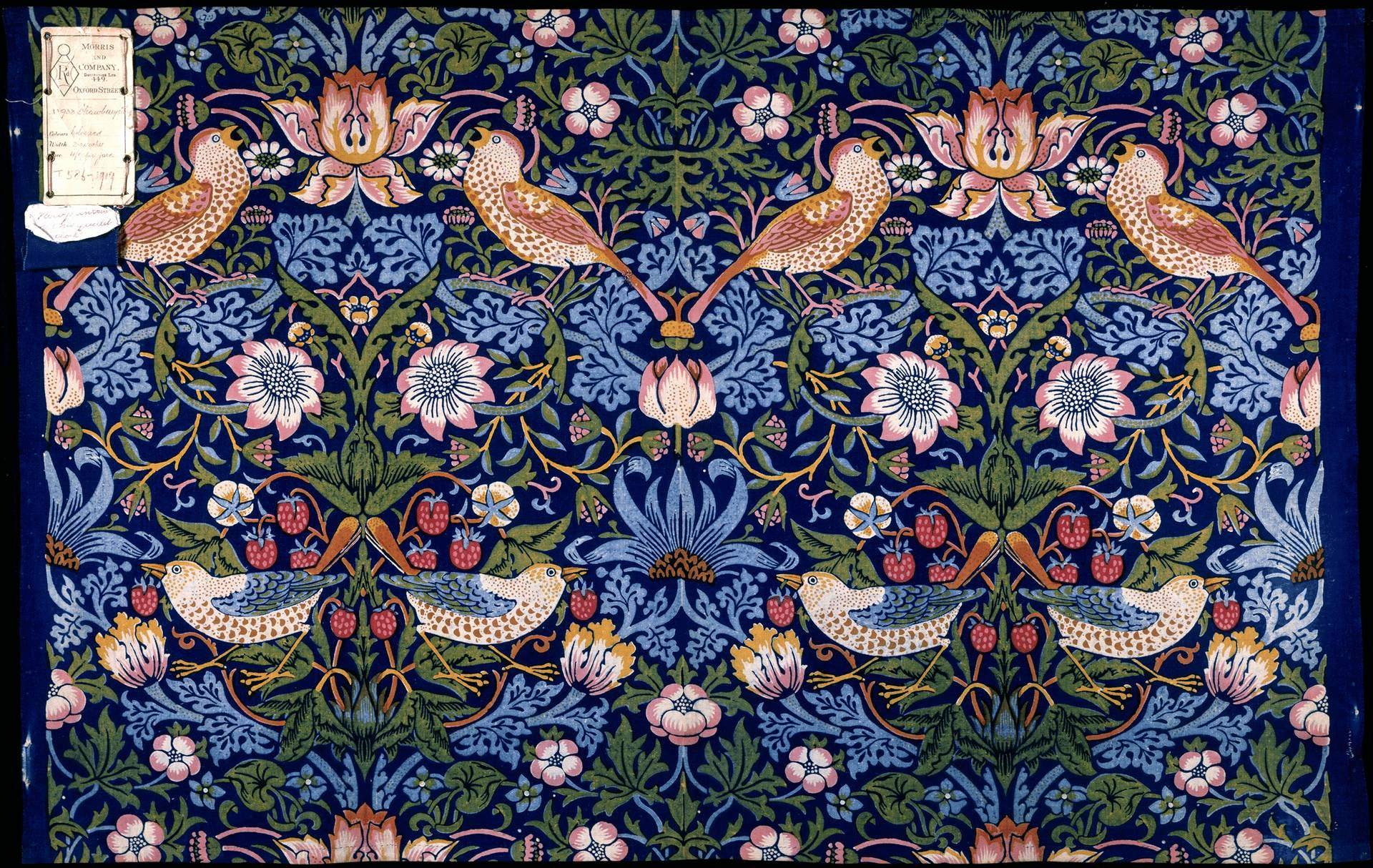
I see that many people appreciate and use the patterns created by William Morris, but as usual, they’ve fallen into mass consumption. If they buy these mass-produced items where the employees had no pleasure creating them, in the cheapest materials, that goes against what William Morris wanted for our society. So it’s worth explaining his ideas before you buy that patterned plate Strawberry Thief made under dubious conditions in China.
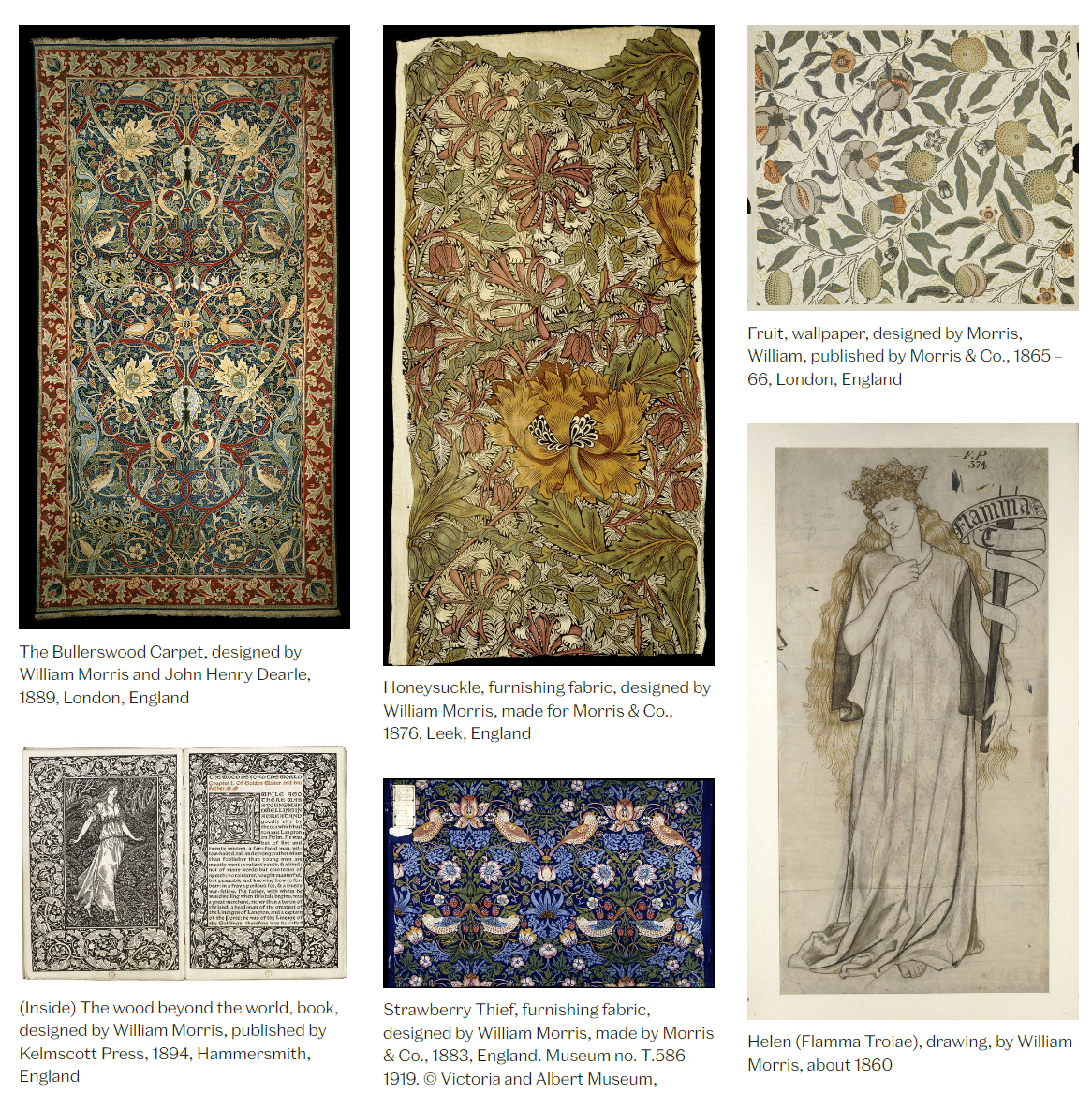
Photo: a large part of William Morris’s works are currently at the Victoria and Albert Museum.
William Morris, a fervent advocate of the intersection between art and society, insisted that art was the expression of the joy man finds in his work. According to him, the quality of well-made objects testifies to the happiness of those who create them. Morris observed with concern the decline of happiness in contemporary society, attributing it to the inability of individuals to find pleasure in their current work.
For Morris, society had deviated from its original purpose, to achieve an obsession with the pursuit of profit. The craftsman, once free, had become enslaved to the pursuit of profit, inevitably leading to the degradation of the quality of work. He deplored the use of machines in the service of capitalist profit rather than easing labor and contributing to the well-being of society. He denounced modern slavery imposed by commerce, symbolized by the “famine of art” that prevailed in his era. William Morris was not against machines, but according to him, they should be better used.
I would add that you just have to look at everyday objects. Before, even traffic lights had more details and charm than current traffic lights. A study found the decrease in the number of colors used in everyday objects. When shopping, it will be impossible for you to find your favorite color if it is not the “trend color of the season.” With minimalism, we tend towards gray. Minimalism does not declutter our homes; it introduces simplistic, soulless objects into them. We remember an article that laments the quality of Marie Kondo’s e-shop: she advises us to empty our homes, but does not take offense at filling them with useless items from her e-shop, namely a wooden stick for $12 or a flower bag for $42 (link).
Morris, an artist and craftsman himself, had started his activity with the ardent desire to be free, and the success of his company had proven that there was an audience for good work. He emphasized that social problems lay not only in the distribution of wealth, but especially in the flawed relationship between producers and consumers. Society had turned commerce into an end in itself, neglecting the true objective. Morris called for a change in attitude, encouraging everyone to find happiness in work well done rather than in the frantic pursuit of profit. Even the rich are not so happy either, surrounded by so much ugliness. The rich should learn to love art, more than wealth, the poor to hate their working conditions, more than poverty.
I would add that current luxury is not necessarily synonymous with work well done. Sure, it might be a bit better than factories in China, but when inspecting closely the items sold by luxury brands, and discussing with their artisans, the focus is always on profitability and not quality. Even the rich are not spared either because despite the money, they could not always buy quality items (which no longer exist). During our visit to Louis Vuitton’s workshop, it really amused us to see ultra-rich people spending monstrous sums on trunks that were certainly handmade but covered in plastic (yes, it’s not leather). While for the same price, from a craftsman without a logo, they could have had better quality and better materials. All that just to have a brand logo at home.
Morris criticized his contemporary society for its lack of soul in work, attributing this to the subordination of the craftsman and the extinction of his creativity. He advocated for the valuing of natural talents of each person, emphasizing that thinking without creating led to sadness and intellectual poverty.
In conclusion, William Morris called for a radical transformation of society, emphasizing the need to value well-done work, recognize everyone’s creativity, and restore the connection between art, morality, and reason.
On our own scale, what we can do is aim for quality, if possible objects handmade with love and soul. I’ve already told you at length about my favorite artisans or retailers:
- Beautiful Accident for jewelry
- Organic Vietnamese tea by Nuage Sauvage
- Leather goods by Amina
- Bookbinding by Fédora, best worker in France
- Fashion and home accessories: all in raffia and handmade at Raphia et Compagnie
- Gaala for clothing
- Custom-made clothing in Vietnam
- Organic argan oil at Melchior & Balthazar
- Black seed oil at Nigelle Pur
For those who aren’t interested in art or craftsmanship, we can pay more attention to “working conditions.” Are they currently suitable for you? How can you make work more creative? What can you learn to aim for a job with more favorable conditions? How can you make your life more beautiful, your soul richer?
If you’re handy, you can participate in workshops (one or three days). And if you have a permanent contract, don’t give me the budget argument. Did you know that it’s my CPF that paid for my bookbinding workshop? Yes, CPF pays for many creative courses, not just English or Spanish lessons. Manual creation boosts your creativity, teaches you to appreciate every object around you: how they’re made, what materials… I really enjoy going to artisans and asking them questions, and they’re always very happy to show me a hidden detail that took them a long time to master or design.
I read another book about William Morris, by V&A Museum. This book shows not only his most famous works, but also his early attempts. For example, for calligraphy, he practiced in his free time on weekends and it took him two years to understand how to create beautiful letters and use his knowledge to create fonts for his publishing house Kelmscott. In this book, we see more of the long work, the mistakes to master an art. Likewise, reading the drafts of Marcel Proust, I realized that his early drafts were bad, but each paragraph was immediately rewritten (5-6 times), until he was satisfied with the result. The time spent and the level of rigor were impressive. It’s often said that you need 10,000 hours to master a new craft/art, sure William Morris, being a genius, got there faster than others, but he spent rather 5,000 hours than the 200 hours of YouTube that some settle for.