

My Current Favorites [June 2023] Books to Get Rich and Achieve Financial Independence
When I wrote my article on how I saved money before traveling the world, I was very surprised to see that some people found it useful, even though the tips I gave were really simple, maybe too simple. I was even embarrassed to give such basic advice.
Then, I looked around me and realized that while everyone roughly knows how to earn more money each day, they don’t know how to become “rich” day by day, because no one taught them how. I read a few books on the subject to better organize my thoughts, and here are my findings.
The Richest Man in Babylon
It’s a beautiful book, based on fictional tales from Babylon, that changes your relationship with money. The story begins with two extremely talented artisans from Babylon who have nothing in their pockets. Not understanding why talent doesn’t rhyme with money, they decide to go see the richest man in Babylon to ask for advice. He, being very generous, shares his story and tips with them.
After reading, you retain the following lessons:
- Talent doesn’t necessarily rhyme with money. Just because you’re the most skilled artisan in the universe doesn’t mean you’ll be rolling in wealth. You need to follow some tips.
- The 5 Laws of Gold:
- Gold comes willingly, in ever-increasing quantities, to the man who saves at least one-tenth of his earnings to create wealth for his future and that of his family => You should always save at least 10% of what you earn
- Gold works diligently and profitably for its wise owner who finds profitable uses for it, multiplying like herds in the fields. => This savings must multiply on its own and make you money; we’ll talk about that below.
- Gold remains under the protection of the prudent owner, who invests it based on the advice of wise men.
- Gold escapes the man who invests it aimlessly in ventures he is unfamiliar with or that are not approved by those who know how to use gold.
- Gold flees the man who forces it to yield impossible gains or who follows the seductive advice of fraudsters and deceivers, or who relies on his own inexperience and romantic investment dreams.
- Many people behave like victims, attributing their lack of success to fate, but fate may have already extended a hand to you several times, but you didn’t seize or see the opportunity.
In short, it’s a short book, very easy to read and understand. I highly recommend giving it to your kids, your interns… or to anyone who doesn’t have a healthy relationship with money yet, who prefers to squander their fortune on luxury bags, for example 😀
Saver 3.0
For the world tour, since we needed to access our money without delay, we kept our savings in accounts accessible at any time: Livret A, LDD, etc. But when we switched to “retirement saving mode”, we changed our strategy. We took more risks, but in the long run, these savings will yield more. JB was heavily inspired by the two books written by Edouard Petit: Saver 3.0 (Amazon linkand Creating and Managing an ETF Portfolio (Amazon link). His only regret: not knowing about the method earlier.
I highly recommend reading them, but to make you want to read them, I’ll quickly summarize these two books:
- It’s great to put part of your income into savings accounts (emergency savings). However, they earn little.
- Inflation is higher than the interest rate on these savings accounts. So you lose purchasing power if your savings don’t keep up with at least inflation.
- Statistics show that world ETFs (trackers based on the performance of the world’s best companies) over a period of at least 20 years perform better than buying stocks in a few companies, and better than inflation.
- It’s with this method that your savings can multiply on their own and earn you money in the long run.
- If this method isn’t well known, it’s because
- it involves risks
- because you need to buy regularly (e.g., monthly) to smooth out risks, buying when it goes up and also when it goes down. And over the long term, on average, you can come out ahead.
- it’s a long-term investment
- we have little financial culture in France, and we believe the state will take care of our retirement.
- It’s recommended to buy European ETFs, US ETFs, and emerging market ETFs (or a World ETF for simplicity) to cover absolutely all the world’s economies, so if one continent isn’t doing well, another will compensate and in the end, you can come out ahead.
The book Epargnant 3.0 (Amazon link) is tiny and very easy to understand, and it’s not expensive. Plus, it’s available as an audiobook so there’s no excuse not to read it.
Investing your savings
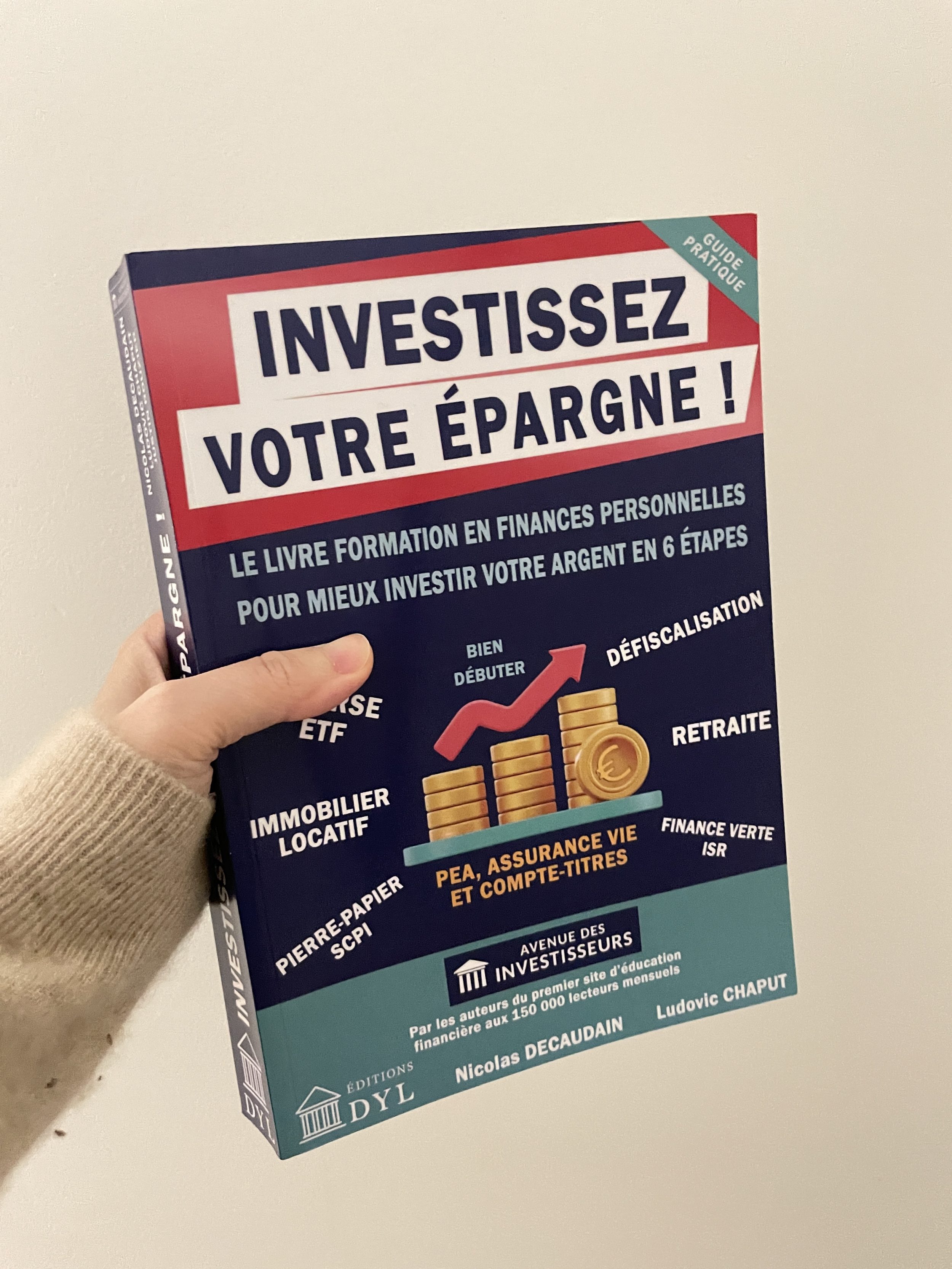
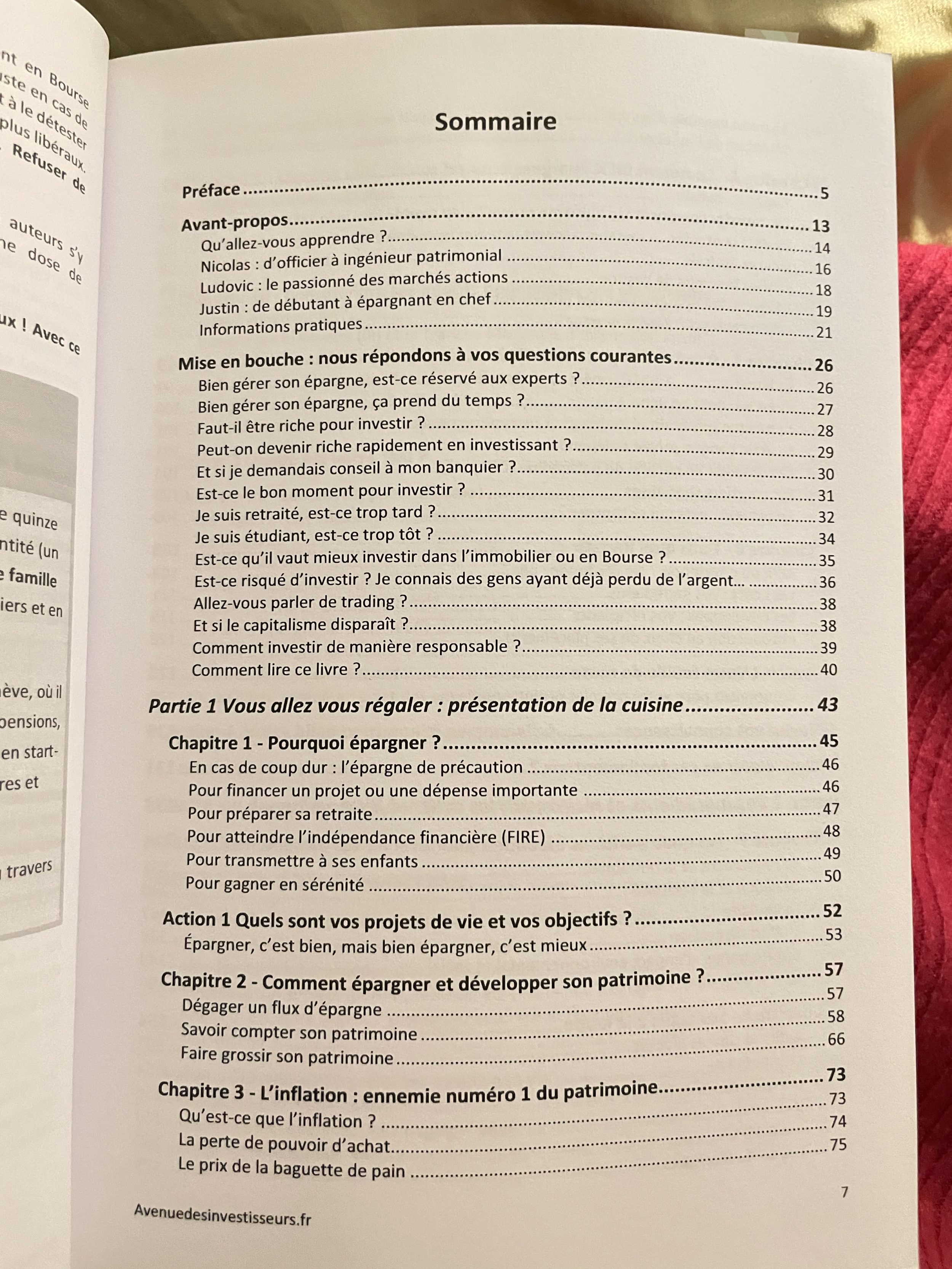
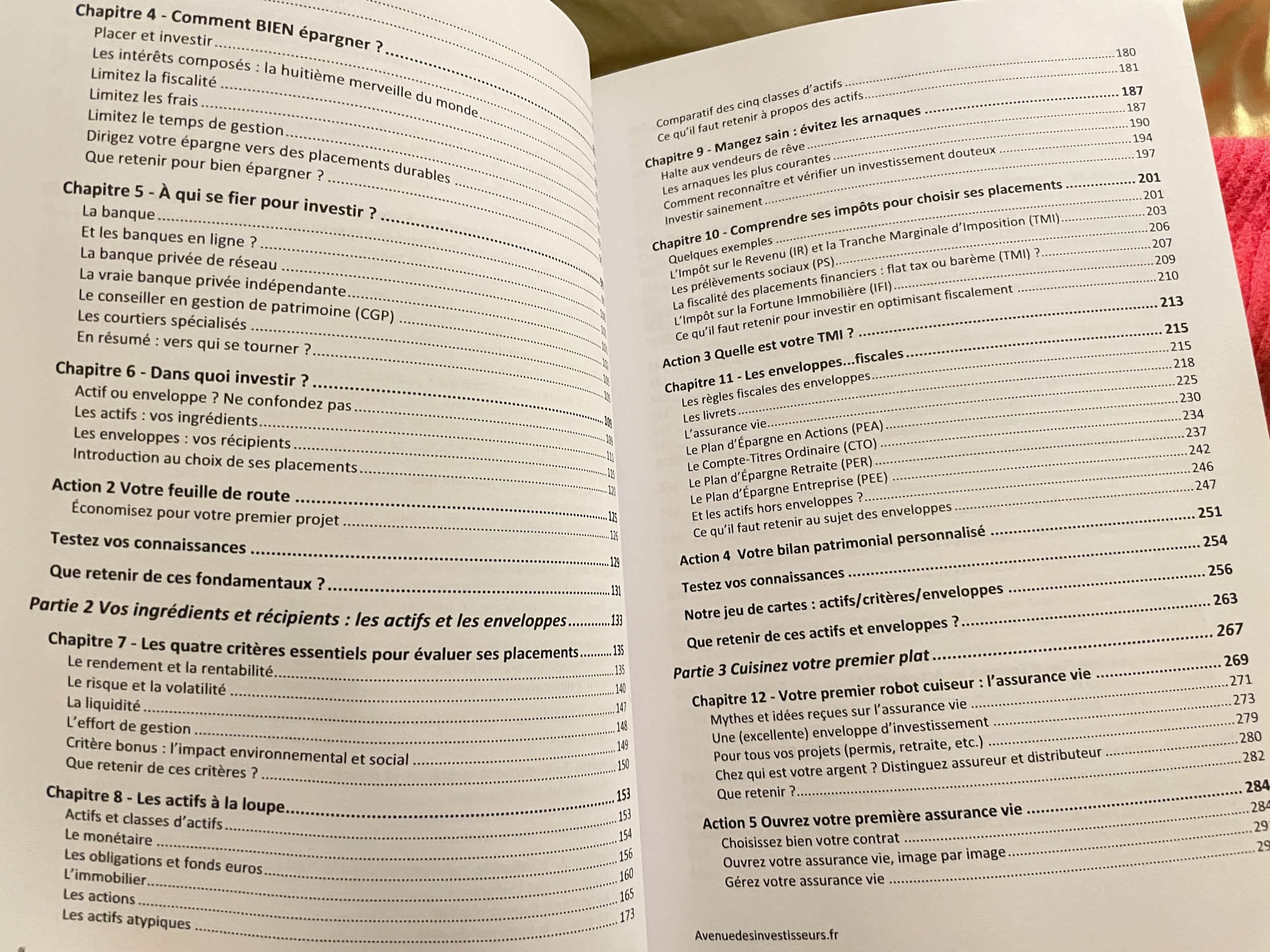
Don’t be fooled by the plain layout of this big book, the investment bible for the French (Amazon link). After reading “The Richest Man in Babylon,” if you’re wondering, “That’s cool, but where do I invest the 10% I save each month so my gold multiplies?” This book will answer that question. In France, we don’t have many investment options, but for a beginner, understanding the pros and cons of each type of investment and how to declare taxes for each one still requires a lot of research. This one will save you the effort, and the advantage is that since it came out recently, the info is still fresh and aligned with French laws (on tax percentages, regulations, etc.).
The difficulty level increases gradually. So if you ever find investing too hard, you can stop at the easier types of investments (like ETFs). In short, it’s a must-read because it’s all about concrete actions.
Secrets of the Millionaire Mind
According to Albert Einstein, “Insanity is doing the same thing over and over again and expecting different results.” If you’re not rich yet, even if you keep doing what you’re doing more intensely, the result won’t be fundamentally different. To achieve wealth, you need to change your mindset; you need to think like a rich person. And this book tells you how rich people think.
For me, reading this book (Amazon link) isn’t essential. All its content boils down to 17 points, and I’ll comment on some of them:
- Rich people believe “I create my life.” Poor people believe “Life happens to me.”
- Rich people play the money game to win. Poor people play the money game not to lose.
- Rich people are committed to being rich. Poor people want to be rich.
- Rich people think big. Poor people think small.
- Rich people focus on opportunities. Poor people focus on obstacles.
- Rich people admire other rich and successful people. Poor people resent the rich and the successful.
- Rich people associate with positive, successful people. Poor people associate with negative or unsuccessful people.
- Rich people are willing to promote themselves and their value. Poor people think negatively about selling and promoting.
- Rich people are bigger than their problems. Poor people are smaller than their problems.
- Rich people are excellent receivers. Poor people are poor receivers.
- Rich people choose to be paid based on results. Poor people choose to be paid based on time.
- Rich people live in a world of abundance. Poor people live in a world of limitations.
- Rich people focus on their net worth. Poor people focus on their working income.
- Rich people manage their money well. Poor people mismanage their money.
- Rich people have their money work hard for them. Poor people work hard for their money.
- Rich people act despite fear. Poor people let fear stop them.
- Rich people constantly learn and grow. Poor people think they already know it all.
I’ll comment on point #7: Rich people associate with positive, successful people. Poor people associate with negative or unsuccessful people.
Before the world tour, I wanted to host people at our place in Paris via Couchsurfing to see what it felt like and whether it might appeal to me when traveling. Couchsurfing allows travelers to stay one or two nights for free at locals’ homes. Unfortunately, people who need a free roof don’t do it for a cultural exchange, but to save money. I felt exploited and didn’t really like it. I decided to stop offering accommodation, but to offer my time instead. That’s how I met people who have already visited Paris, who don’t need free accommodation but genuinely want to meet locals and enjoy a good cultural exchange. We can do more activities together, instead of debating whether €15 is a fair price for the Louvre. So I’ve gained access to a different kind of people: “positive and successful,” not people who “haven’t made it” and have to rely on free beds to visit Paris.
During these meetups, I met a super, super rich guy, like in the movie “Crazy Rich Asians,” from Singapore. He told us about the origins of his family wealth (real estate) and how his father taught him to earn and manage money well while he was still a student. His father owns several houses spread between Singapore and Indonesia, and he doesn’t give his son money. He entrusts him with 2–3 houses to manage, and the son has to cover all his expenses (including his expensive studies in the USA) by managing those 2–3 houses. Obviously, he listed them on Airbnb, but the management isn’t easy since he handles it all from the US. We were invited to one of his houses in Indonesia and we were blown away by his organization. Plus, we were charmed by his intelligence: in two and a half months, he could communicate with us in French, conjugate verbs correctly, and made an effort to use difficult words. He’s the one who encouraged me to learn Spanish. for our first round-the-world trip.
There’s a passage in the book about the “Law of Attraction.” Basically, you make wishes in your head, sometimes unconsciously. As long as you haven’t changed your relationship with money (thinking it’s bad to be rich), you’re sending contradictory messages to the universe and you’ll never be rich. I’ll quote the passage for you:
The universe, another name for the “higher power,” is like a gigantic postal counter. It constantly delivers people, events, and things to you. You “order” what you get by sending energetic messages to the universe, based on your predominant beliefs. Here again, according to the Law of Attraction, the universe will do its best to fulfill your requests and support you. But if you have conflicting messages in your file, the universe won’t be able to understand what you want.
For a minute, the universe hears you say you want to be rich, so it starts sending you opportunities to get rich. Then, it hears you
say: “Rich people are stingy,” so the universe starts supporting your efforts to not have much money. But then you start thinking: “Having a lot of money makes life so much more enjoyable,” so the poor universe, all dizzy and confused, starts sending you opportunities to make more money again. The next day, you don’t feel inspired anymore, so you tell yourself: “Money isn’t that important.” Frustrated, the universe ends up yelling at you: “Will you just get it together! I’ll give you what you want, you just have to tell me what it is!”
The main reason most people don’t get what they want is that they don’t know what they want. The rich know
perfectly well that they want wealth. They don’t waver in their desires. They are fully committed to making a fortune. As long as it’s legal, moral, and ethical, they will do everything in their power to get rich. The rich don’t send conflicting messages to the universe. The poor, on the other hand, do.
I shared this passage on my Instagram account and someone wrote to me saying: “That’s exactly it! When filing my income tax return, I told myself I was paying too much tax. The universe heard it and suddenly I have fewer contracts. I need to rework my message to the universe.”
To receive, you must give
The books below talk about it very little (one line) but it’s an important rule. I’ve already explained here the power of giving through a club of Vietnamese entrepreneurs.
Many billionaires lost their fortunes miserably before finding success. Those who aren’t used to it will get discouraged at the first failure. That’s why a club of Vietnamese entrepreneurs wants to teach their members about loss from the beginning. As soon as they reach their first billion Vietnamese Dong (about €40,000, enough to buy a small studio in Vietnam), members are required to give it all to any charity. Those who don’t wish to give are asked to leave the club. This way, they learn the true entrepreneurial mindset.
They learn to accept loss, to start over from scratch. A person who has lost everything and can rebuild from zero will be able to invest monstrous sums and also win monstrous sums; they won’t be afraid of losing because they know they can start over at any time. You can imagine that you can’t make billions by investing €10. You have to break your old mindset to aim for a different result.
Values, Prosperity, and the Talmud: Business Lessons from the Ancient Rabbis
I don’t know anything about the Talmud, I’m not Jewish. But I know it’s a collection of millennia-old oral teachings. Saying someone studies the Talmud is like saying someone studies the I Ching, it commands admiration. The Talmud has about thirty volumes and it takes about 7 years to read the entire collection, and then the person starts reading it again from the beginning.
This book in English (Amazon link) summarizes the business and prosperity lessons learned from the Talmud (Amazon link). It states that if Jews aim for prosperity, it’s not to buy Louis Vuitton bags and keep them in a locked closet; it’s to (1) free up more time to learn and grow spiritually (2) help the community (by creating jobs, helping the less fortunate, etc.).
There aren’t any really innovative ideas, because you learn that many ideas that were innovative for their time ended up being adopted by current law. For example, having at least one day of meals per week. Having a sabbatical year every 7 years, etc.
After 300 pages, the book concludes that the secret behind success is reputation. By having an ethical approach, you will eventually succeed, sooner or later. It’s truly a profound and spiritual message.
I hope you enjoyed this article and it gave you some food for thought. Remember, being rich is not a sin. As Yuval Noah Harari pointed out in “Homo Deus” (Amazon link), in the past, for a merchant to become rich, he had to make another merchant poor. But thanks to the invention of the banking system, there is now enough abundance in this world for everyone to enjoy it.

