

My made-to-measure leather trunk bag / little suitcase
I’ve always had an obsession with small suitcases. When we lived in Paris, all my DIY tools were carefully kept in cardboard suitcases. I even sewed a suitcase (with a lot of difficulty, mind you) out of cotton. Since then, I’ve had huge respect for fabric suitcase makers.

Last year, JB signed us up for the Journées Particulières at Vuitton , and and Moynat and we got to see how trunks and suitcases are made. It’s a tricky craft (and a dying one), still largely done by hand. While trunks don’t appeal to me, I fell for this little suitcase at Moynat. It’s tiny and looks completely useless (it holds very little), but it’s just too cute! Moynat, like Louis Vuitton, started out making travel trunks (the equivalent of today’s suitcases). These mini trunks – suitcase bags – are a nod to the brand’s past.
At Goyard, they have a slightly larger model.
Step into 2022 the Goyard way: introducing the Grand-Hôtel trunk-bag#goyard#sogoyard#timelessstyle#timelesscratsmanship#grandhoteltrunkbagbygoyard pic.twitter.com/NQuX90p8Vf
— GoyardOfficial (@Goyard) January 8, 2022
Unfortunately, no model totally appeals to me. I’m not a fan of this plastic-coated canvas I think it’s too cheap for a fully handmade product. The inside of the Moynat suitcase is very pretty and luxurious (the feel is divine) but too dark. The handle at Goyard doesn’t appeal to me at all, and the strap pulls too much on the top of the bag; I would have liked the weight to be distributed on both sides of the bag.
I was just looking into how to make one myself and where to find hardware when I learned that little suitcases have become super trendy in Vietnam. The luxury leather goods maker Quyn (Vietnamese) is making a few (in Himalaya crocodile), and his wife, who sells accessories at 3Q Leather, is importing lots of hardware. I really like how she organizes the inside of the bag, but I honestly think her version is bigger than what I’m aiming for.


Do I want to learn the trade of a trunk maker? Knowing that Glamourunique offers a 2-week course to do this:
After much thought, I decide to first order a suitcase bag from a leather craftsman, and I’ll make one myself later (to store my jewelry). Designing the suitcase took me 1 month. I had to watch all the videos I could find on YouTube and all the articles about trunk making to understand the technical challenges and make decisions (whether to use hinges, cover the corners, etc.). In the end, I go for an exterior similar to the Moynat suitcase, with an adjustable strap (to lighten the whole) and an interior identical to my Himalaya crocodile bag.
So I contact a leather craftsman I don’t know at all (Chung Hoang https://www.facebook.com/chungdodathucong), who already made a suitcase a few months ago. Honestly, I could have chosen a craftsman in Hanoi, which would have made my life easier, but I wanted to trust him even though he’s 100km from Hanoi. We communicate only via Messenger, and after a few questions, I realized he was as difficult/meticulous as I am. Frankly, both of us have blind trust in this project because (1) I’ve never seen his creations except in photos (2) he’s never met me. One click is all it takes for us to block each other on Messenger, and for one of us to scam the other.
Now that I have experience (after designing my novonappa bag and my Himalaya crocodile bag), I was able to give an ultra-precise brief. He advised me on the choice of leather (epsom, more durable), but I chose the color and designed the interior. I let him decide on the details like the size of the inside pocket, the handle, and the thread/edge colors. My leather craftsman seems very enthusiastic about the project; he likes the colors, finds the project super interesting, and different from the first suitcase he made.
That said, he must have had a hard time gathering all the hardware:
- ordering a custom wooden box from a cabinetmaker in Da Nang
- ordering the leather and hardware from several suppliers in Hanoi
Given that the suppliers made mistakes in ordering/shipping, it took him 2 months to gather everything, and to let Têt pass (when no one was working)! But no worries, since I started 5 months in advance 😀 I asked my leather craftsman to send me photos regularly so I could learn the techniques from his photos, and we could refine the details together.
One of the difficulties encountered was the absence of hinges under the small suitcase. You can see that compared to the valisette made by Quyn, I wanted to lighten it up and use as few metal accessories as possible.
However, when visiting the Louis Vuitton workshops, I learned that you can glue the two pieces of wood together using linen (photo taken from Deedee’s blog).

By getting rid of the hinges, the whole thing is airier, more minimalist, but the piece of linen hidden under the layer of leather still guarantees the object’s solidity. It’s a trick only pros know about. My leather craftsman was humble enough to follow my suggestion (before, he used hinges). Even better, he was able to improve the technique in his own way. To avoid damaging the piece of linen (by opening the bag regularly), we agreed on a 45-degree opening. My craftsman takes out his laser cutting machine to test different paper templates.
For the outside, the most important element is the handle. It’s the most visible and luxurious element, not to be missed. My craftsman made it entirely by hand, sculpting each layer of leather. The handle alone took him a whole day. And it’s absolutely incredible because you can see that the symmetry is better with this technique than using some sort of ready-made industrial foam.


Each piece of wood is then fully covered in leather. Where two pieces of leather overlap, since the leather is thicker than the canvas used by the luxury brands mentioned above, an extra step is needed, i.e., thinning the leather so the whole thing stays smooth. This is also very difficult and must be done by hand.

The small suitcase already looks like something. The handmade handle is on another level, you can see!! The inside now needs to be done, and then the nails will be placed everywhere to secure the leather.

Even though I chose the leather colors myself, I’m surprised at how well they go together. The gold hardware goes perfectly with the gold Epsom leather. The whole thing is very, very pretty and luxurious.
The inside is lined with Alran Sully goat leather. It’s leather I particularly like for linings and I already use it in quite a few of my projects. You might tell me that off-white gets dirty, but this leather cleans very well, as does off-white Epsom. I find leather easier to clean than the fabric linings you currently have.
As usual, the tag with my name on it can be easily removed. It’s a reflex for me now. Since my items will last for generations, I’d like to be able to pass them on to someone else (my niece, for example) and I’d like her to be able to remove my tag and put hers on easily. The tag is in gold Epsom because we thought it would be more visible than on white Epsom.

Since there are very few stitches on the outside, I want the handmade stitches to be a bit more visible on the inside, to showcase the craftsman’s talent. That’s why the thread contrasts with the leather.
I can’t stand unlined leather (it gets dirt under my nails) so everything was lined, including the small pocket. And I made that very clear to the craftsman. He tells me many of his clients accept unlined leather projects to pay less. But it kills him not to line his leathers 😀
And here is the final product. I think the craftsman and I can both be proud of our teamwork. After this project, I’m going to attempt to make a small suitcase myself, surely not as good and simpler.


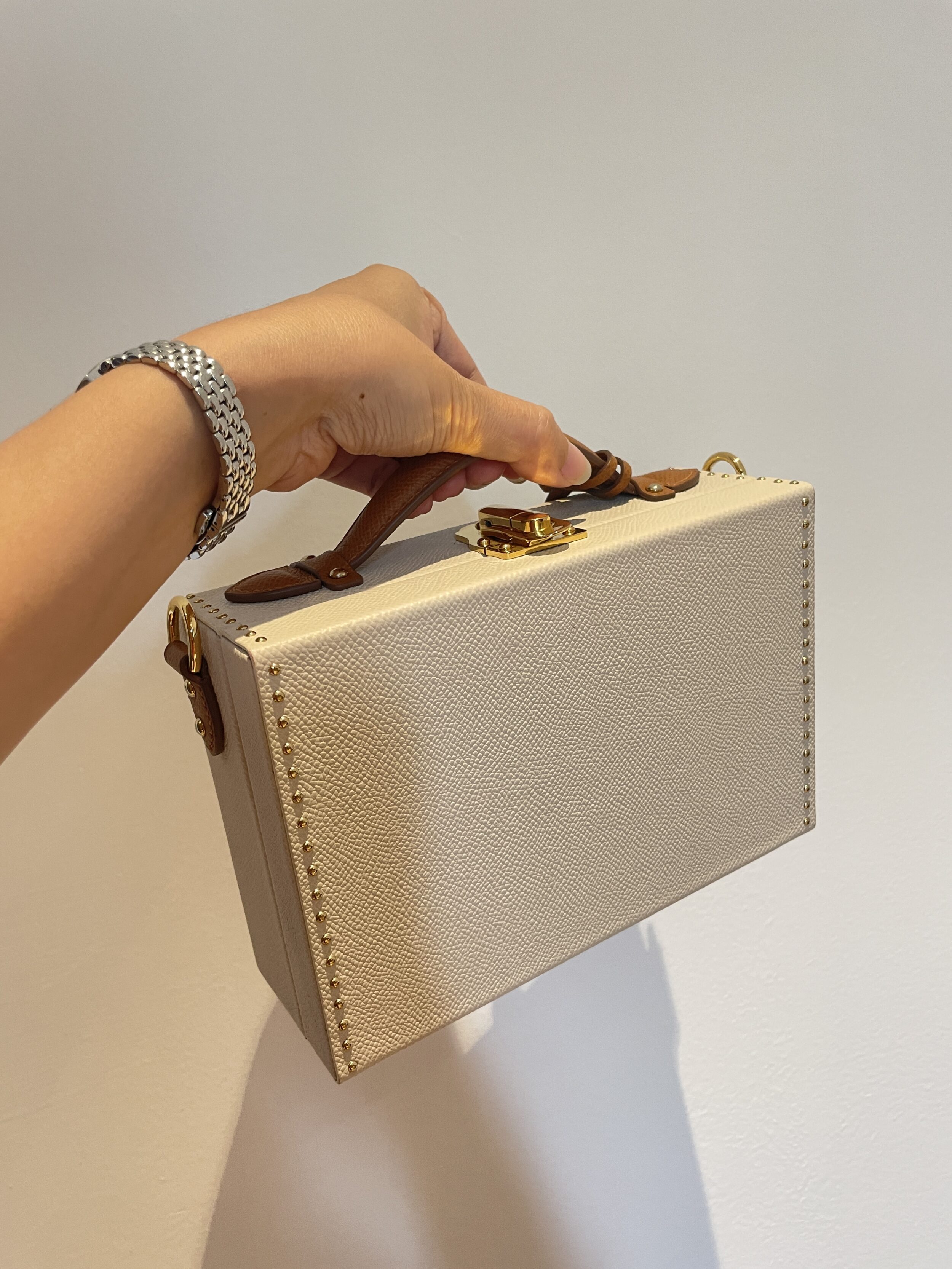


In terms of cost, I paid 30% as a deposit so the craftsman could buy the accessories. 40% when the project was finished on his end. And the remaining 30% upon delivery (he had to drive 100km to bring the bag to Hanoi). Such a project shouldn’t be shipped by mail because the craftsman deserves to see the joy on his client’s face, I think.
The project cost me 20,000,000 VND or €730 all included. The luggage tag was generously gifted by the craftsman.
A nod to trunks
For the little story, trunks were the suitcases of yesteryear and hotels gave stickers to guests to paste on their trunks. It was a way to personalize them but also to keep memories of the cities and hotels visited.

I could have had my craftsman make leather “stickers” but I know I change my mind often, so I preferred to use charms instead, to remember my favorite places. I’ll make them myself later. Plus, I wanted to add a luggage tag as a nod to travels of the past.

