

[Reflection] #37: The Roots of Jealousy
Recently, I attended an online philosophy class led by a Vietnamese philosopher. At the end of each session, students can submit their questions. Some have been following him for years, and he knows them well. One of them speaks up to describe his situation: he considers himself competent. Too much, even. To the point where his less capable colleagues are putting obstacles in his way, sabotaging his projects, and pinning their own mistakes on him.
The philosopher’s answer surprises everyone: your energy level isn’t high enough. Firstly, you’re not rising sufficiently above your colleagues to escape their jealousy. Secondly, you’re not radiating enough positive energy to attract well-being into your life. Thirdly: you’re not seen as indispensable in the company because you think too much about your own interests instead of the group’s.
I’ll expand on the professor’s idea here in my own words. If we take an energy scale from 1 to 1000, for example, 1000 being the highest. 200 is the energy level of a standard human. 400 is Einstein’s energy level, and beyond 700 that of spiritual masters, with 1000 being the energy of the creative Universe. This scale was established by David R. Hawkins, the author of Power vs. Force (Amazon link) which I told you about here , and and there. This scale is logarithmic.
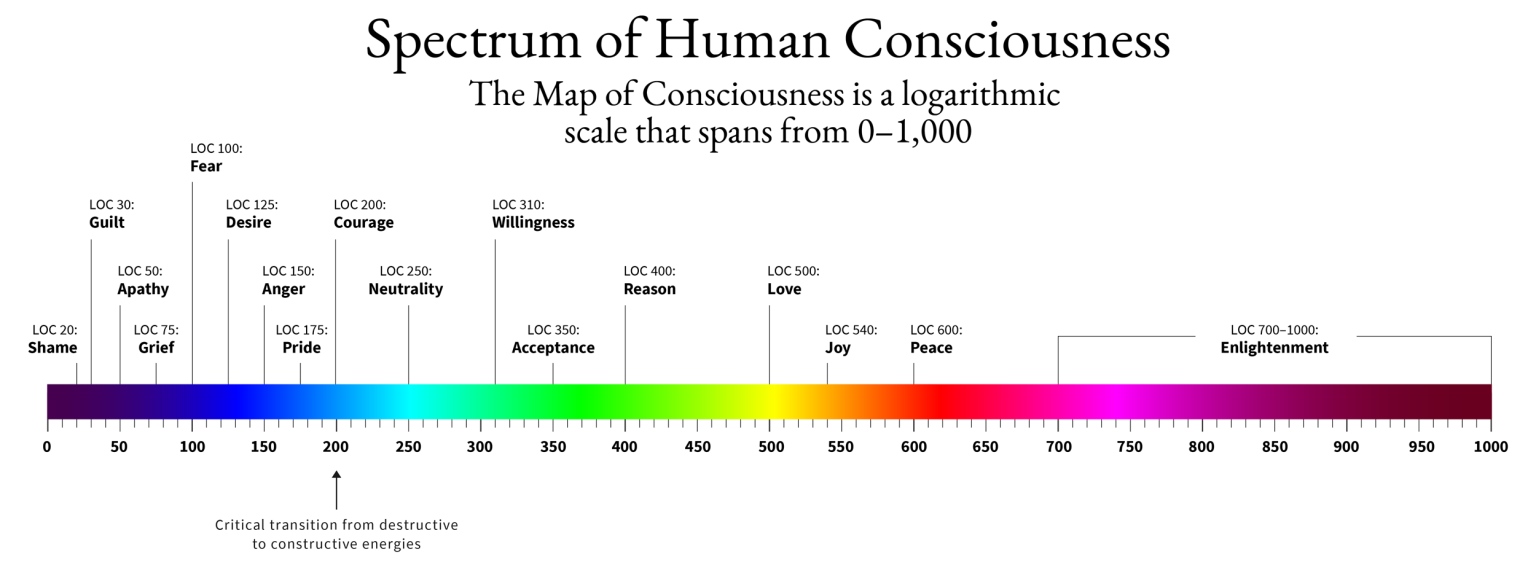
Suppose his colleagues are at a level of 250 on this scale. By being hardworking, intelligent, and unafraid to take action… he might be at a level of 255, for instance—just barely higher, but enough for him to consider himself competent. He’ll get attacked by colleagues at level 250. Why?
Because any behavior that slightly exceeds the norm acts as an uncomfortable mirror. It says nothing, but it reveals to others their own limitations and the fragility of their justifications. Why can he do it and not me? Because I’m lazy? No one wants to admit that. It’s so much easier to tell yourself: he’s just lucky, a teacher’s pet, his parents are rich… Going from 250 to 255 is still within the realm of possibility with a little effort, and that’s precisely the problem. As long as the gap is attainable, it stands as a silent accusation: proof that their mediocrity was indeed a choice.
Paradoxically, if the gap becomes immense—say, 350 and beyond—jealousy dissolves on its own. No one envies Mother Teresa, because no one compares themselves to Mother Teresa. At that level, you cross into another category: that of the off-the-charts anomaly, the exception you no longer measure yourself against. You end up respecting it, precisely because it seems unattainable. Collective mediocrity forgives absolute genius far more easily than ordinary progress.
So, just slightly above his colleagues, he’ll turn them into haters. Much higher up, he’ll turn them into followers.
. In the meantime, wisdom lies in not exposing yourself head-on. Stay humble. In reality, when you feel superior to others while they’re slowly sinking, you’re not as elevated as you think. Why? Because a truly elevated being simply doesn’t think in those terms. Comparison wouldn’t be their first instinct. They wouldn’t talk about it, wouldn’t even think about it. No one feels the need to shoutlook at me, I’m smarter than a 2-year-old because an adult’s intelligence is obviously at a stratospheric level compared to a toddler’s. Whenever you feel arrogance, that need to feel superior, it’s precisely the signal that you’re not all that superior.
Rather than highlighting your differences, it’s better to try to understand your colleagues and quietly send them lots of loving energy. In doing so, your own level will naturally rise, and you’ll start attracting peaceful situations… where before, you only reaped confrontations.
I’ll leave you with a quote from Marianne Williamson during an interview with Oprah (link). She’s the author of A Return to Love,(Amazon link), a digestible summary ofA Course in Miracles (which I really like). Here she talks about people who, afraid of being rejected by family and friends, don’t dare to rise. We all have an interest in calibrating ourselves to the highest possible energy level, because if the level is too low, too attainable, we create resentment, but if we truly rise high enough, we create genuine impact around us.

We are more afraid of our light than our darkness didn’t come from me. That’s from A Course in Miracles, and that’s what I was talking about.
That we are, we have more fear of how powerful and light we are. And part of that is this fear that we might offend somebody else, that somehow if I have, that you have less. Rather than realizing that if I’m living in the light of my own true being, it actually subconsciously liberates you to live from the light of your true being.
[…] What’s true in the material world is the exact opposite of what’s true in the spiritual world. So in the material world, there are only so many pieces of the pie. If I have a piece of the pie, you have less. But in the spiritual world, the more I’m able to actualize, which, and that’s what enlightenment is, it’s self-actualization. Actualizing the love that is in our hearts. The more I self-actualize, I mean, look at what, I mean, to look at your career as such an example, as you actualize the resonance that it’s a field of possibility for others.
And that is true for every person.
Translation: “We are more afraid of our light than we are of our darkness. That didn’t come from me. It’s from A Course in Miracles, and that’s what I was talking about. As human beings, we are more afraid of our power and our light. And part of that fear is the dread of offending someone else, as if, because I have something, you have less. Instead of realizing that if I live in the light of my true being, it unconsciously frees you to live in the light of your true being too. […]
What is true in the material world is exactly the opposite of what is true in the spiritual world. In the material world, there are only a certain number of slices of the pie. If I take a slice, you have less. But in the spiritual world, the more I am able to flourish; and that’s what enlightenment is, it’s self-fulfillment. Letting the love in our hearts shine. The more I flourish, look, take your career (editor’s note: Oprah’s) as an example: by fully fulfilling yourself, you create a field of possibilities for others. And that is true for every person.”

