
My Current Favorites [February 2023]: Yi King, The Book of Changes
There are books that come into my life late but exceptionally. As a Vietnamese person, I am strongly exposed to Chinese culture, but it was only after a special Saturn transit in my birth chart (the kind of event that happens only 2, at most 3 times in a lifetime) that this book was placed in my path. It absorbs all my thoughts because its philosophical depth has a “boom” effect in my head.
How did this book come to me?
I’m going through a complicated period right now, and to distract myself, I watch shows that don’t require too many brain cells. It all started with the show “Mind Your Manners” about etiquette and good manners by Sara Jane Ho (on Netflix). But since she is Chinese, she slipped into this show many elements from ancient Chinese culture, including the feng shui. Anyone interested in feng shui has certainly heard of the I Ching. Indeed, according to the Chinese, the success of a project depends on three elements:
- The man: his abilities, his skills, his qualities
- The right time
- The right place, the right environment
For example, when JB released a free software more than 10 years ago, it changed his life. Where did this success come from? He succeeded because
(1) he was good
(2) the software was released at the right time. It was the first on the market to be free and open source. If he had released it in 2022, no one would have paid attention to his software because the market has become too competitive
(3) we had moved a few months earlier: he had his own office in a huge living room, so he could find his time and especially the comfort to spend hours coding at his desk. Whereas in our first apartment, we barely had room to sit, he wouldn’t have been able to work on his project.
Do you see how with the same JB, the same skills and abilities, he would have completely botched the project if he had undertaken it in the wrong place and at the wrong time?
So, how to put all the chances on your side? To influence the environment and find the right place, feng shui is there for that. We are not going to talk about it today. You already have the excellent book The Way of Feng Shui (Amazon link, Fnac link) which talks about it in detail.
On the other hand, to find the right time, there are two ways:
- turn to astrology: this method is very difficult, and after several years of learning, I still struggle. Moreover, even professional astrologers cannot predict with precision. The main reason is that (1) many precious documents have been lost or burned (2) current Western astrology is no longer sidereal astrology. If the Chinese Bazi astrology is more precise, it is extremely difficult to learn because there are too many Chinese words to remember 😀 and too many rules. Professionals say it takes 5 to 6 years to master it.
- turn to the Yi King: the method is too simple. Basically, you ask a question to the book, you toss 3 coins 6 times to form the 6 elements that make up a hexagram. You find the answer among the 64 proposed hexagrams and by reading the answer, you will feel the answer to your question deep inside you.
Yi King, what is it?
The Yi King (or Yi Jing, or I Ching) is an ancient book that started as a divination practice and became a reflection of Chinese cosmological culture. It was written between the 8th and 3rd century BC but was completed over the millennia and became a classic under the Han. Westerners discovered it in the 20th century thanks to Richard Wilhelm’s translation, whose preface was written by Carl Jung. Since then, the Yi King has been known worldwide.
It all begins with YIN (represented by two broken lines _ _) and YANG (represented by a single solid line _). By combining these two signs, we first get 4 combinations. Then by combining these 4, we get 8 elements. And by superimposing these 8 elements on each other, we get 8×8 = 64 hexagrams. We could have continued 64×64, but that’s enough.
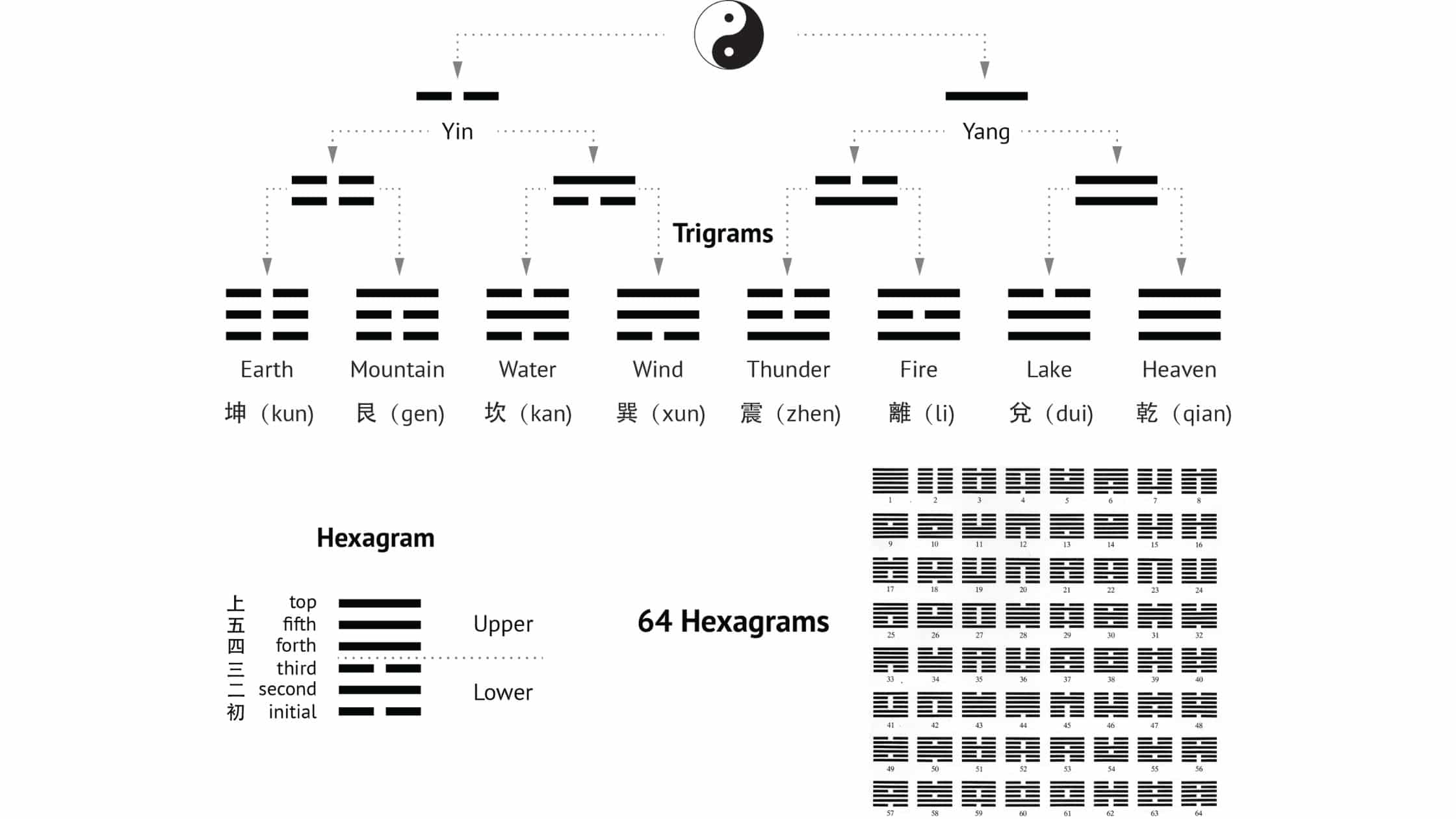
Each hexagram has a Chinese name and it is considered that the entire universe can be explained by these 64 hexagrams. All situations in the world can be explained by 64 hexagrams. Your work is at a standstill? Hexagram number 5 will perhaps tell you to “wait for the flood to end before crossing the river”, you need to prepare yourself more before taking action. These 64 hexagrams each contain 6 lines, so as much information and possible evolutions for your situation.
However, the value of the Yi King goes beyond its divinatory use. It contains all the ancient Chinese philosophy. It was propagated as a divination book to be better distributed and accessible to the people. If it were simply a philosophical book, it would have been quickly forgotten and shelved because it was not understood. This divinatory scope even saved it from the fires of Emperor Qin, who, to unify his country, burned all books… except those with a practical purpose. Divination being a trade like any other, the Yi King escaped destruction.
The whole system is based on just two elements: yin and yang. It’s a concept that is so scientific and so spiritual at the same time. Scientific because the mathematician Leibniz created the binary system: 0 and 1. Computing is based simply on that: 0s and 1s!! Spiritual because yin and yang, for the Chinese, are both 2 and 1; they seem to oppose but actually complement each other. According to them, one creates two, then two creates three, three creates the whole. The universe is three (yin and yang and the relationship between yin and yang); we find the number three everywhere, in religion, astrology, but also in atoms: protons, neutrons, electrons. Yin and yang have such an important impact on Chinese culture that it explains why the smallest unit of society is the FAMILY, whereas in the West, the smallest unit is the INDIVIDUAL.
Yang is not preferable to Yin. Both coexist, are created at the same time, and are important. If there is too much Yang, Yin will grow to reach balance; if there is too much Yin, Yang will grow to reach balance, so changes occur endlessly. Desiring only YANG means wanting only the day without the night, good weather and never rain, yet Yin and Yang must coexist for life to happen. Thus, one cannot be miserable forever, nor happy forever. When in a rough patch, one must know better days are coming, and when one thinks nothing can get better, one must stay cautious and attentive. Learning the Yi Jing will help see through dualism monism. Going from 2 to 1. Understanding the 1, understanding that everything is one, no longer distinguishing between self and other.
There are so many levels of interpretation of this text that I don’t know if one day we can list them all. In any case, the philosophical scope of this text is immense : just discovering it exists is already a stroke of luck, and being able to understand even a tiny part of the text is another.
Since this book was written thousands of years ago, it is not easy to understand its content. I asked my Chinese friend for advice, and he said to choose the edition carefully. Thousands of versions exist to interpret and reinterpret the text. It is important to choose the right edition according to your intentions.
If your intention is to decode its philosophical message (with a bit of divination), you can buy this edition with the red cover (Amazon link, Fnac link). This book explains very well how to cast too.
The one with the yellow cover corresponds to Richard Wilhelm’s translation (Amazon link, Fnac link), whose philosophical scope is still praised even in the East. There are some translation errors, but its interpretations are still very accurate. Learning the Yi Jing requires reading different sources, so for serious study, buy both the yellow and red editions. If you must buy only one, prefer the yellow edition despite its errors and cryptic sentences.

Carl Jung’s preface is not there, but you can read at the end of this little book (Amazon link, Fnac link)
To read the Yi Jing, start by reading absolutely all 64 hexagrams. The information is very dense, so it is advisable to read only 2 hexagrams per day (read them in order, as they are not classified randomly). Once you finish, start again, and you will better understand the philosophical scope of the book. Only then can you use it as a divination book. Or even better, after two readings, you won’t even need divination anymore, because the philosophical message inside will teach you that the answer is already within you, that every coin has two sides, that yin will turn into yang, that everything moves constantly, and seeking to know the future is not important. The human being is a microcosm. By studying the macrocosm, we understand the microcosm. By studying the microcosm, we understand the macrocosm. What is below is like what is above, and what is above is like what is below.
A more common use in China is associating a person’s birth time and date with a hexagram. There are computing tools to calculate it. And through this hexagram, one will know everything about that person and the evolution of their life. It is a bit like modern astrology, but more concise. The red edition can be used for this type of interpretation. In the West, the use is mainly focused on divination because it was promoted here for that very reason. If your intention is only to use it as a divination book, this little book is more practical (Amazon link). It explains very well how to cast. Beware, it does not contain the original text! But just the divination part, rewritten to be practical and immediately understandable for you. It can be an introduction to the Yi Jing and make you want to read the full text later.
What have I learned from the Yi Jing?
For now, I have only asked one question to the Yi Jing – to understand how to use it for divination – and the answer was accurate, concise, and the timing was right. The hexagram I got, as well as the transitional hexagram, answered my question perfectly. This is not a coincidence because among the 64, many have absolutely nothing to do with my question. I used a somewhat complex Chinese method to determine the timing and, to my astonishment, the given date was correct.
Divination is not my main use because I prefer to rely on sidereal astrology to determine favorable moments. Astrology, for me, is like a clock with 10 hands, so difficult to read, but effective for indicating the cycles of life and the universe. Astrology is also used to understand the message “all is one,” “man is a microcosm.” Reducing the I Ching simply to the art of divination is to misunderstand its cosmological scope.
Other than that, it is impossible for me to summarize the information of the I Ching. There are things that cannot be expressed through words. And I think that’s why there are thousands of interpretations, because each person is able to see, as in a mirror, their true identity. Each sentence can be interpreted in a thousand ways, but how it resonates with you is what matters most. That’s why it’s advised to use the I Ching yourself, and not consult an I Ching expert because their interpretation can be biased.
If you already have it in your hands and don’t find it as extraordinary as all that, it’s okay. Read it again later. Every project requires (1) the person (2) the right time (3) the right place. Maybe with the right time and place, and an older version of yourself, you’ll have a better reading of the book, who knows?
Other resources
- Read my article on fortune cycles
- My book review I Ching the Oracle
- Read my article on momentum & timing
There is a Taiwanese master who explains very well the origin and influences of the I Ching in Chinese culture and Chinese management: Zeng Shiqiang. I found some videos of his course subtitled in English. Unfortunately, it’s not complete (the full course has about a hundred videos), but it’s better than nothing. Here is the playlist with 7 videos:
