
Astrology for Beginners: Predictions, Transits & Planet Returns (2/2)
Following my very first beginner’s article on astrology, I received some very enthusiastic comments. It made me really happy, and I waited until I was a bit more informed before writing this second article on astrological predictions.
Initially, I wanted to use astrology as a way to get to know myself, but when Covid hit, I needed to calculate my travel dates (departure/arrival in a country) to avoid yet another lockdown or getting stuck in a foreign country. I knew the Chinese had a sort of auspicious calendar, but it was tailored specifically for Asia (and also aligned with Beijing time), so I didn’t want to overcomplicate things and chose Western astrology instead. Thanks to my little calculations (even though I was a total newbie back then), we managed to keep our non-stop round-the-world trip going from June 2020 until now (2023) without ever catching Covid, getting stuck, or being locked down. Every time, we slipped right between two lockdowns and were free. Let me explain my method below.
Tropical vs. Sidereal Astrology
If my article is only coming out now, it’s because I wanted to test, compare, and follow professionals’ predictions over a long period before giving my opinion. Having learned both tropical astrology and Hindu astrology since 2020, I still consider myself a beginner, but at least I’ve seen what works for me.
When it comes to predictions, I noticed that tropical astrology couldn’t make accurate predictions. The sky used in tropical astrology is shifted by about 25 degrees from the real constellations—that’s almost an entire sign. So, when you think Jupiter is exalted, it probably isn’t, because its actual position, according tosidereal astrology, is in the next sign over. I observed, listened, and noted professional astrologers’ predictions, and I concluded that there was something off with that system.
Sidereal astrology (which aligns with the real sky) is already a bit better, but there’s a glaring lack of books on this system, and the best ones you’ll find are about Hindu/Indian astrology—which is a different method altogether.
However, both astrologies rely on very subjective notions dating back thousands of years, based on beliefs from one or two people who injected their own methods or systems that suited them for religious reasons, such as the decans, exaltations, and rulers… So, we won’t be using those here either.
Time is Cyclical
To me, astrology is a giant clock with 10 hands whose instruction manual we’ve lost.
When you look at your watch and it says 1 PM, the information is neutral. The time itself is neutral.
But for you, 1 PM might hold special meaning: it’s lunchtime, time to pick up the kids, time to finish your meal and head back to work, etc. The information “it’s 1 PM” might trigger panic in someone who’s running late, but joy in someone whose work ends at 1 PM—or absolutely no emotion at all.
It’s the same with astrology: by looking at the astrological clock with its 10 hands, you can tell what “time” it is— where you stand in the cycle of time.
Time is cyclical. We repeat the same things over and over. Roughly every 10 years, there’s an economic crisis. Every 11 years, even the sun’s magnetic field flips. The Chinese use 10-year astrological cycles, Indians have cycles called Dasas that vary widely (7 years, 10 years, 19 years, etc.), and numerology is based on 9-year cycles. The menstrual cycle aligns with the 28-29-day lunar cycle. The idea is that every xx years or xx months, the same things come back to us (opportunities, challenges, luck, misfortune, or nothing at all…), just like summer returns every year—it’s cyclical.
But these cycles are so hard to keep track of on your own (I already struggle to wake up at 9 AM every day myself) or they’re just too long (like the 30-year Saturn cycle), so you risk missing the start of a cycle, opportunities, or warnings…. because you’ve forgotten how to read the astrological clock.
So knowing how to read the astrological “time” is like telling yourself, “It’s 1 PM—either I do nothing with that info, or I know I need to head out for lunch now.” It’s as simple as that.
“As above, so below; as below, so above,” says the Emerald Tablet. By looking at the planets’ cycles, you’re looking at your own cycle.
In terms of predictions, with a very simple method, you can see:
- when a period of opportunity arrives and when it ends (roughly)
- when a challenging period arrives and when it ends (roughly)
Know that situations are neutral. Your free will is always more important. You have the power of decision, it’s you who decides, always.
It’s like when you look at the weather forecast and know it’s going to rain tomorrow. You’re not going to stay home because of the rain, you just need to plan an umbrella.
The methodology
So, I settled for a super basic method, which is in all astrology books, works for both astrologies, whether tropical or sidereal, because we’re not talking about zodiac signs here: the TRANSITS , and PLANET RETURNS.
- Work transits, it’s the zodiac passage of a celestial body at a given time over a sensitive point of the natal chart (planet, house): i.e., when it crosses one of your houses, or forms an angle with one of your astral chart bodies
- Planet returns: it’s when a celestial body returns exactly to the same position as in your natal chart
Since the Moon goes around the zodiac in 28-29 days, the transits and returns of the Moon aren’t that important. On the other hand, outer planets that take a very long time to traverse the zodiac will have more significant impacts on our lives:
- Pluto, Neptune, and Uranus: these are the most important transits, their influence concerns entire countries, the whole planet
- Saturn and Jupiter: important transits, these are the ones I look at the most
- Mars, Sun, Venus, and Mercury: secondary transits
Here are the angles that interest me the most:


Here’s a quick reminder of the meaning for each planet/house. It’s a quick translation of the tables from the book Llewellyn’s Complete Book of Astrology (Fnac link, Amazon link, Bookdepository link).
| Planets | Glyphs | Keywords (planet) | Degrees of influence of the transit | House | Keywords (house) |
|---|---|---|---|---|---|
| Sun |  | ego, individuality, confidence | 5° | 1 | Self, Personality |
| Moon |  | emotions, habits | 5° | 2 | Personal Finance, Possessions |
| Mercury |  | communication, thoughts | 5° | 3 | Communication, Learning |
| Venus |  | love, money, power of attraction | 5° | 4 | Family, Home |
| Mars |  | energy, initiative, anger | 5° | 5 | Children, Creativity, Leisure |
| Jupiter |  | expansion, luck | 1° | 6 | Work, Work Environment, Health |
| Saturn |  | restriction, responsibility, life lessons | 1° | 7 | Relationships, Love, Partnership |
| Uranus |  | independence, eccentricity | 1° | 8 | Shared resources, other people’s money |
| Neptune |  | vision, creativity, illusion | 1° | 9 | Higher education, Travel |
| Pluto |  | transformation, change | 1° | 10 | Career, status |
| 11 | Friends, Groups, Associations | ||||
| 12 | Subconscious, Spirituality |
Example
For example, looking at the “Transit Chart” for this fictional person born on April 10, 2008 at 6:57 AM in Paris (I use the sidereal system from the Time Nomad app).
On April 9, 2023, Jupiter transits their first house, and is in square aspect to their natal Jupiter (which is in the 10th house). The degree of influence of a Jupiter transit is 1°, but this transit is 0.2°, so the transit is already in effect.
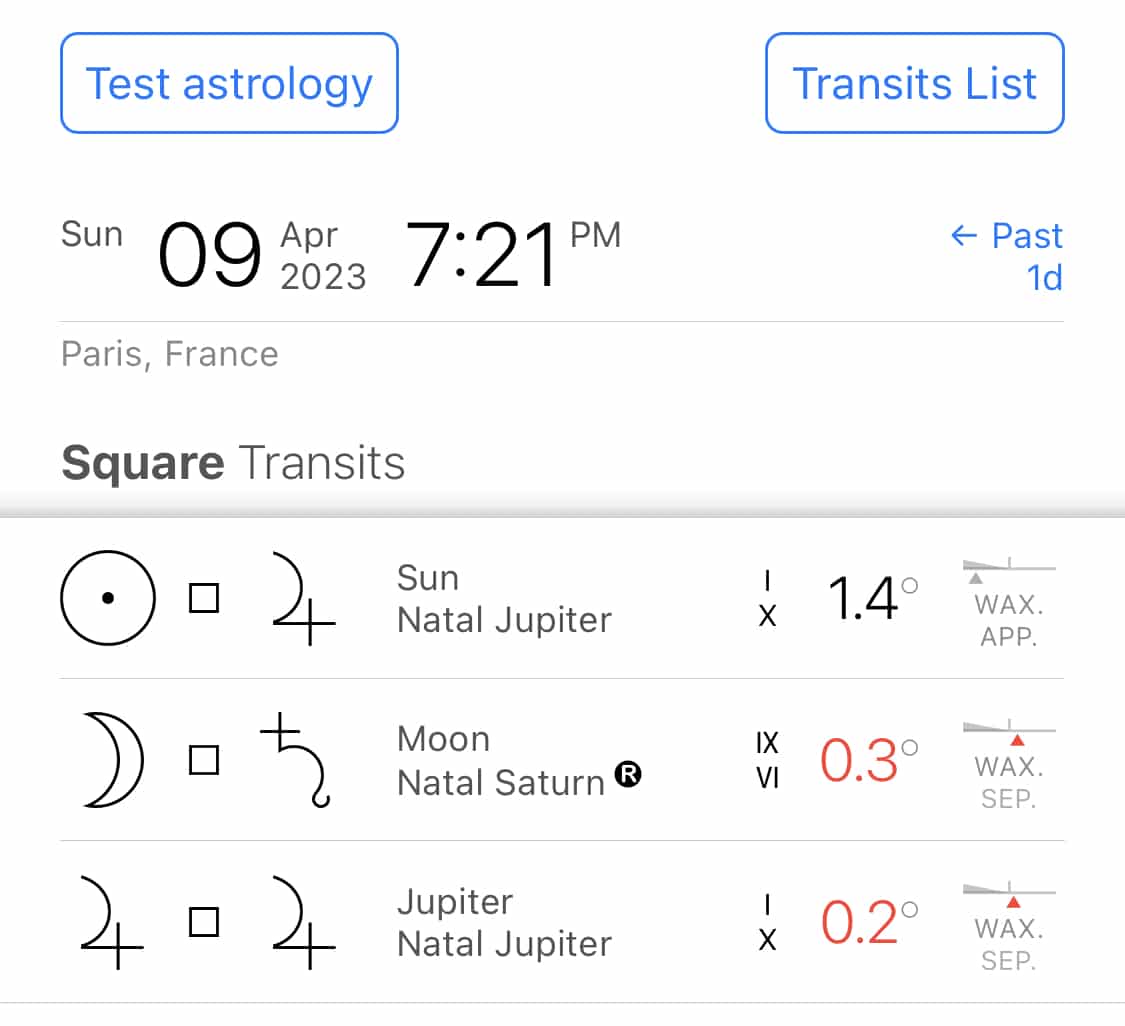
This is a dissonant (square) transit
For more detailed explanations, check my list of keywords and search further on the Internet:
- “Jupiter transit 1st house”, which gives: expansion, luck (Jupiter) in Self, Personality (1st house)
- Square transit: keywords action, conflict, requires attention
- “Jupiter square Jupiter transit”, a search on the Internet gives: Your expansion is limited right now. You need to reassess your goals or wait until the end of the period to relaunch things, in “Career, status” (10th house)
Summary: expansion is limited in terms of Career, and it’s better to use this period to work on yourself
Quick side notes on Saturn and Jupiter, I systematically look at which houses they are in relative to my birth chart.
- Saturn is a malefic planet and its passage can bring a lot of challenges to the houses/planets it transits – with which it forms an aspect.
- Jupiter is a benefic planet and can bring luck and lots of joy to the houses/planets it transits—with which it forms an aspect.
For these two planets, I also look at where they are relative to my ASCENDANT, and my MC.
Among these transits, the conjunctions or planet returns: a planet’s return to its natal position, especially for Jupiter and Saturn are very significant events.
If for Saturn, that happens about once every 30 years (among other things, it’s responsible for the quarter-life crisis), for Jupiter, it happens about every 12 years! That means it doesn’t happen very often in a lifetime, and you’ll need to be ready to welcome them. Otherwise, you’ll have to wait another 12 or 30 years!
We therefore have personal cycles of 12 and 30 years because of these planets, and this is also seen in other astrologies (Chinese and Indian).
A very challenging transit is when Saturn forms a square to natal Saturn. This happens about every 15 years, and I’ve clearly seen its challenging impact. But I’m always very happy about each Saturn transit because I come out of it more mature and grown each time, my life changes completely, and it’s always cool to progress.
Time is Cyclical, even if there are very tough periods, success and opportunity will eventually come too. You can’t be a winner forever, nor a loser forever. No worries!
I hope I’ve been able to explain my method clearly. And I hope this gives you a little idea of the opportunities and challenges ahead and when they might arrive. Remember that free will remains the MOST IMPORTANT. No celestial body should dictate your life.

