
Astrology for Beginners – Basics & Keywords (1/2)
I never thought I’d write this article one day. Well, I never thought, not even for a second, that I’d ever take an interest in Astrology. Simply because I studied Maths Sup Maths Spé, and how shall I put it… astrology wasn’t exactly on the curriculum for science students 😉 … until a few weeks ago.
I came across a post written by a Vietnamese guy doing an internship in Israel. I’d been wanting to visit Israel for a long time, so the post showed up on my Facebook feed. He was talking about meeting an elderly bookseller in downtown Tel Aviv. Impressed by the Vietnamese student’s intelligence (this student was competing in international math competitions), the bookseller opened up his secret library full of rare books and showed him a book to read, on the condition that he didn’t take notes or photos. Just read and retain as much as he could. It was a book on astrology. And since this student had a phenomenal memory, after a day of reading, he managed to retain the entire content. The bookseller, convinced by the student’s abilities, decided to pass on his knowledge of prediction (financial, personal, and even the weather). Apparently he had a sort of clock that could calculate what was going to happen to a person (morning/afternoon/evening) based on their date & time of birth plus the mother’s date of birth. The author mentioned that astrology was mainly used in Israel for career guidance : choosing the right studies and the job where the individual feels most fulfilled, gifted, and useful. According to the celestial destiny that was meant for them. For instance, someone naturally gifted with numbers will think everyone is like them, because it seems too easy. So knowing your strengths, which you’re unaware of, will help you use & develop them better.
P/s: sure, you can get there with psychological tests and skills assessments, but we’re talking astrology here.
The story stopped there, but it was enough to spark my curiosity.
Since I like to do things properly, before diving into Hebrew astrology, I’m going to look at the astrology used all over the West first because there’s more info & accessible books. In this article, I’ll walk you through the ABCs of astrology.
Basic concepts
Before learning to predict the future, you need to learn the basics: know yourself.
And the natal chart helps you know yourself, before learning techniques to “see yourself” in the future and predict your own future.
- Before you start, you need to find your exact date of birth & time of birth, down to the minute. That exact time is listed on your birth certificate.
- Then, go to astro.com to get a natal chart (birth chart) for free, it’s like a snapshot of your astrological sky at the moment of your birth. Note that I said “astrological sky” and not “astronomical sky” because the sky in astrology doesn’t really match the current sky anymore, at least in so-called “tropical” astrology (vs. sidereal). There’s almost a one-sign shift—for example, someone with the sun in “Virgo” in the tropical system might be “Leo” in sidereal astrology.
- If you want to use sidereal (astronomical) astrology, which I highly RECOMMEND, you can, but you’ll need to use the app Time Nomad and select “sidereal” in the settings. Because most online tools use tropical astrology. I wrote an article for those with an iPad/iPhone here
- It’s possible to draw up your own natal chart, but it takes time. Then you need to check the ephemeris (astronomical tables) to see who’s retrograde, who’s not, where a planet sits in relation to another. Why bother when the internet provides them for free?
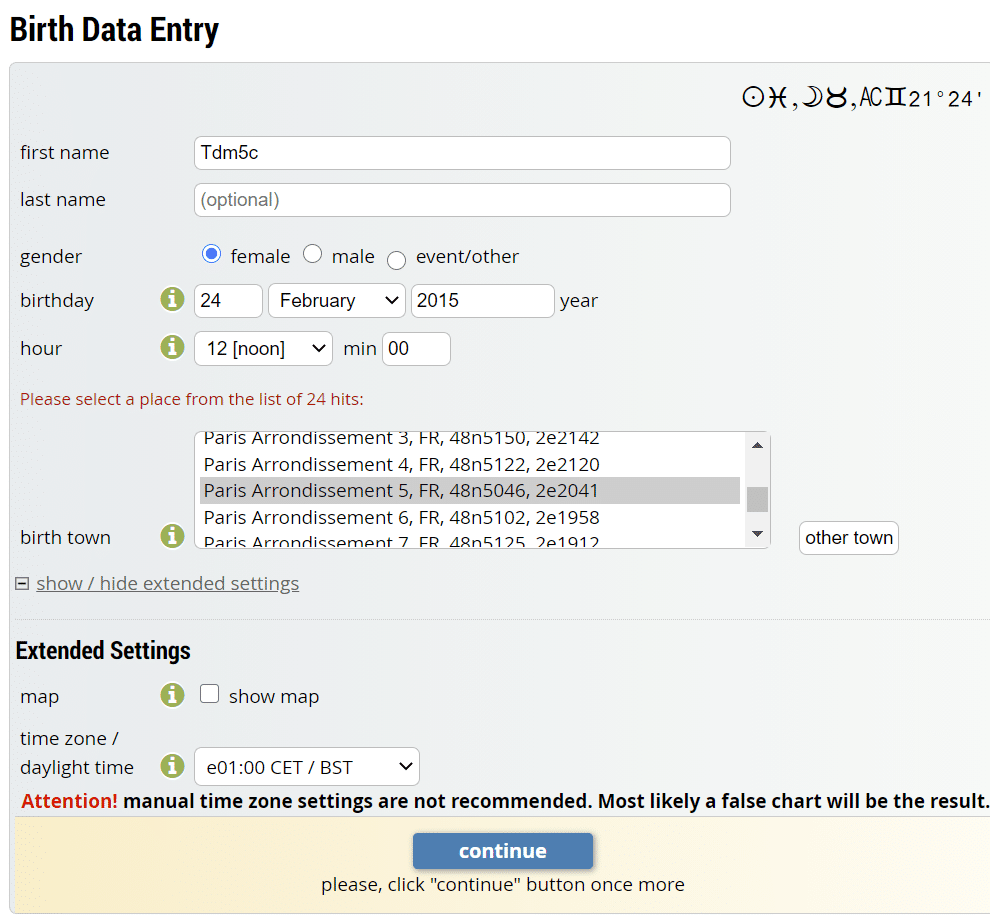
- On astro.com, it’s crucial to choose the right time zone (especially if there’s daylight saving time) because off by an hour or two, the sun, moon, and ascendant shift, and it’s no longer the right chart. Here, we have a fictional person born at noon on 24/01/2015 in the 5th arrondissement (normally you can’t look at astrology for a child, but this is just an example). This is the tropical system being used here.
- learn the glyphs of the planets & the 12 zodiac signs by heart, because natal charts use glyphs.

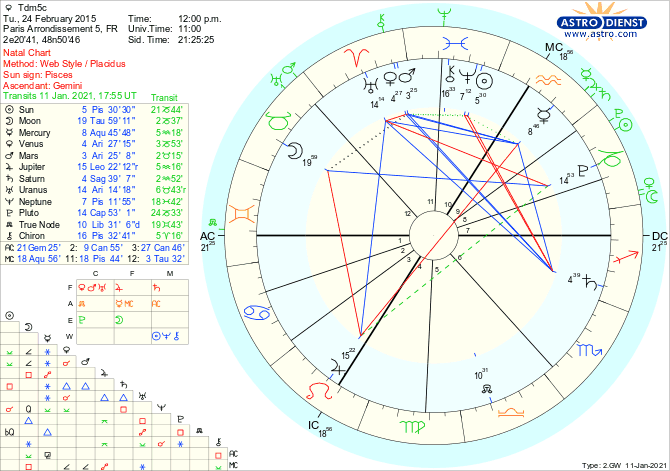
This is what will give you that (choose “with transits”, even if we don’t look at them in this article, it’s always good to have a complete birth chart from the start).
Look at the sign at the level of AC is your rising sign. It’s important. In this fictional birth chart, this person’s rising sign is Gemini.
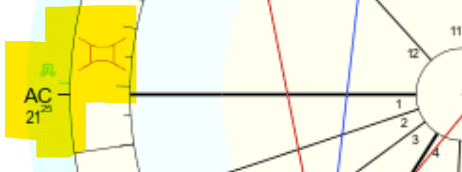
The rising sign is part of the major triangle along with the Sun and the Moon.
- Sun = your ego (your Sun sign, which is the sign you usually read about in horoscopes, e.g., Aries = March 21 to April 20 in tropical astrology). It’s the sign corresponding to your birth date. If this sign doesn’t quite resonate with you, try sidereal astrology – which is almost a sign shifted compared to tropical astrology, and it might speak to you better.
- Moon = the soul behind that ego, it’s your psyche (you need to look at your birth chart to see which sign it’s in)
- Ascendant = the mask you wear and show others (you need to look at your birth chart to see which sign it’s in). This ascendant changes based on the time of birth, changing signs every 2 hours. Thus, someone without their birth time will have a hard time getting an accurate birth chart.
I’m not going to elaborate on the meaning of each zodiac sign here; you’ll find that everywhere on the Internet.
Your astrology books will also dedicate a long description to each sign. I found the interpretations in the book The Only Astrology Book You’ll Ever Need (Fnac link, Amazon link, Bookdepository link) remarkably accurate.
Now, note that the 10 planets (the Moon and Sun are considered “planets”) are scattered all over (ignore the glyphs you don’t understand, that’s for advanced level). Also look for any retrograde planets. They’ll be marked with the symbol ℞ next to that planet.
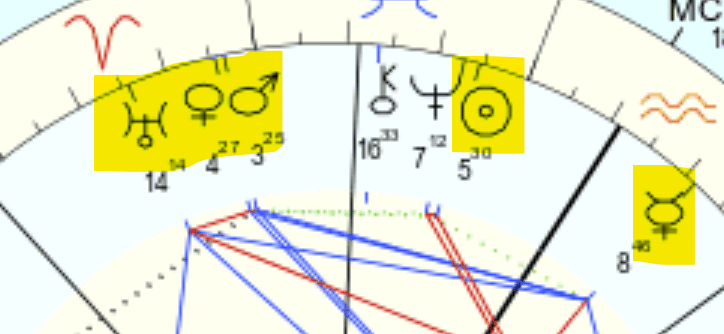
Work The 12 zodiac signs share the “pie” equally equal in a counterclockwise direction. There are 30 degrees for each sign.
But there are 12 “houses” (numbered 1 to 12) that share the “pie” unequally in a counterclockwise direction (Placidus system. The site astro.com offers this system, which is also used in most books. Beware if a site specifies “whole signs,” you need to change it). Each house can have more or less than 30 degrees, and it varies from one birth chart to another.
Each planet is in a zodiac sign (Cancer, Leo, Virgo…) within a house (1, 2, 3, 4…). That’s what you need to pay attention to.
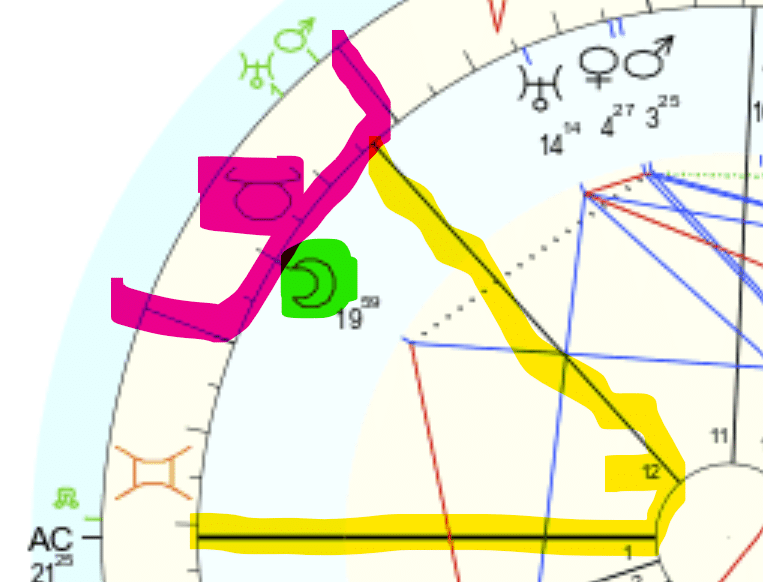
Exercise: What sign is the Moon in on this chart?
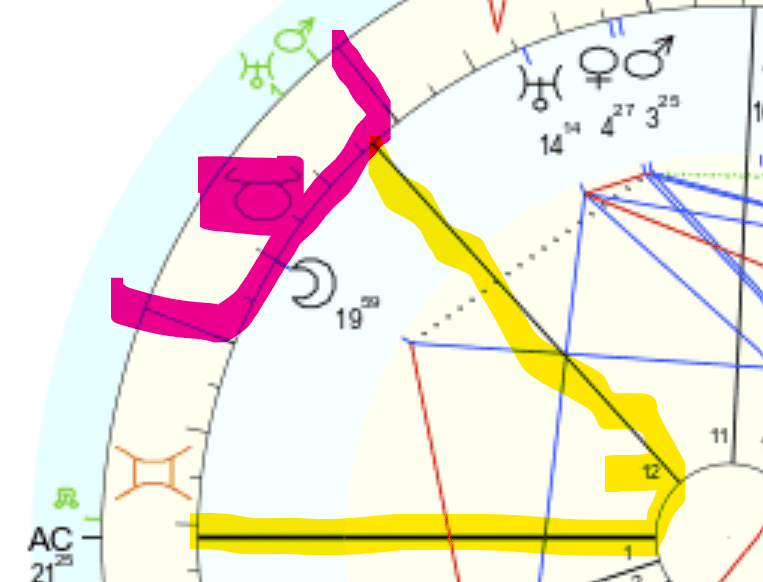
If you have doubts, the table next to it clearly says the Moon is in TAU (Taurus) at 19 degrees 59 minutes and 11 seconds (1 degree = 60 minutes = 3600 seconds)

In the example above, the Moon is in Taurus in the 12th house (identify the boundaries of the “piece of the pie” of house 12)
Work Planets answer the question WHAT?
Work Signs answer the question HOW AND WHY?
Work Houses answer the question IN WHAT AREA?
To have a sort of mnemonic device, there are keywords for each planet/sign/house. This is a quick translation of the book’s tables. Llewellyn’s Complete Book of Astrology (Fnac link, Amazon link, Bookdepository link)
| Planets | Glyphs | Keywords (planet) | Zodiac Signs | Glyphs | Keywords (zodiac sign) | House | Keywords (house) |
|---|---|---|---|---|---|---|---|
| Sun |  | ego, individuality, confidence | Aries |  | courageous, initiative, impatient, impulse | 1 | Self, Personality |
| Moon |  | emotions, habits | Taurus |  | stable, stubborn, determined, lazy, chatty, devoted | 2 | Personal Finance, Possessions |
| Mercury |  | communication, thoughts | Gemini |  | sociable, seductive, hyperactive, adaptable, attentive | 3 | Communication, Learning |
| Venus |  | love, money, power of attraction | Cancer |  | emotional, domestic, protective, encouraging | 4 | Family, Home |
| Mars |  | energy, initiative, anger | Leo |  | confident, loyal, stubborn, generous, selfish | 5 | Children, Creativity, Leisure |
| Jupiter |  | expansion, luck | Virgo |  | practical, critical, reserved, discriminating | 6 | Work, Work Environment, Health |
| Saturn |  | restriction, responsibility, life lessons | Libra |  | sociable, cooperative, impatient, fair | 7 | Relationships, Love, Partnership |
| Uranus |  | independence, eccentricity | Scorpio |  | stubborn, relentless, emotional | 8 | Shared resources, other people’s money |
| Neptune |  | vision, creativity, illusion | Sagittarius |  | freedom-loving, optimistic, honest | 9 | Higher education, Travel |
| Pluto |  | transformation, change | Capricorn |  | ambitious, conservative, responsible | 10 | Career, status |
| Aquarius |  | independent, rebellious, distant | 11 | Friends, Groups, Associations | |||
| Pisces |  | compassionate, sensitive, impressionable | 12 | Subconscious, Spirituality |
Back to the example Moon in Taurus in House 12, you’ll look for the corresponding keywords:
WHAT: Moon: emotions, habits
HOW OR WHY: Taurus: Stable, Stubborn, Determined, Lazy, Chatty, Devoted
WHAT AREA? House 12: Subconscious, Spirituality
This can give: Need for emotional security, dislikes unpredictable situations
Now let’s look at Mars in Aries in House 11
WHAT: Mars: energy, initiative, anger
HOW OR WHY? Aries: Courage, Initiative, Impatient, Impulse
WHAT AREA? Friends, Groups, Associations
This can give: strong energy invested in the collective
To develop these ideas further, you’ll need to check in your books the meanings of:
- Mars in Aries
- Aries in House 11
- Mars in the 11th House
and synthesize.
No book will give the precise meaning of Mars in Aries in House 11 because theoretically you’d need to provide explanations for: 10 planets x 12 signs x 12 houses = 1440 combinations (luckily, some planets don’t move too fast, the outer planets, which considerably reduces the number of combinations actually encountered). But hey, who wants to read 10,000 pages on astrology?
There are generational planets (Uranus, Neptune, Pluto) because they orbit the Sun slowly, so an entire generation experiences their placement in a specific sign. For example, with Pluto in Capricorn for 20 years, a whole generation born in the last 20 years is influenced by this energy. But the placement of Pluto in your chart varies, as it can be in the 1st, 2nd, or 12th house… and that’s what makes your chart unique.
Astrology doesn’t end there; I haven’t mentioned the 4 elements, 3 qualities, dualities, polarities. You also need to account for retrograde phenomena, the rulers, the aspects (planet at 0°/60°/90°/120°/180° to another planet), decans or decanates, those on the cusp (cusp), the nodes, other meteoroids, etc., the aspects, to analyze for advanced levels. And most importantly, you should look at the birth chart more holistically, but I imagine it takes a lot more experience to have that global vision.
Once you understand yourself, you can move to the next level: predicting the future (for yourself), predicting the future for a country (mundane astrology), predicting economic trends (financial astrology). But is it really necessary?
Recommended Books
In order of preference. Sorry, but I’ve read more books in English than in French so far.
- Practical Treatise on Astrology by André Barbault: it’s a classic. The author is a highly respected figure in the field. Unfortunately, he passed away in 2019, and he was able to warn us well in advance (in the 1970s) of the risks of a pandemic in 2019-2020 (Fnac link, Amazon link)
- Llewellyn’s Complete Book of Astrology (Fnac link, Amazon link, Bookdepository link): the author uses the keyword system I detailed in the article, which greatly facilitates autonomy. The author loves tables, which is great because they summarize so much. I love the analyses of celebrities’ birth charts at the end of each section, so you can practice. She skips some concepts (well, she mentions them without explaining their usefulness).
- The Only Astrology Book You’ll Ever Need (Fnac link, Amazon link, Bookdepository link): extremely comprehensive; there’s even a section on how to create your own simplified birth chart. Read this after the previous book for additional info. I find the interpretations in this book more relevant.
For predictions, you can read the rest of my article here

