

[review] The Dream of the Red Chamber – Bibliothèque de la Pléiade
Today, I’d like to introduce you to the ‘Bibliothèque de la Pléiade’ edition of the novel The Dream of the Red Chamber. Many people don’t have the opportunity to browse these books freely in bookstores, so I took some photos to give you a glimpse of this edition. I’m lucky enough to borrow it from my local library; if that’s not the case for you, know that you can sometimes find second-hand copies online, especially on Amazon or at Fnac.
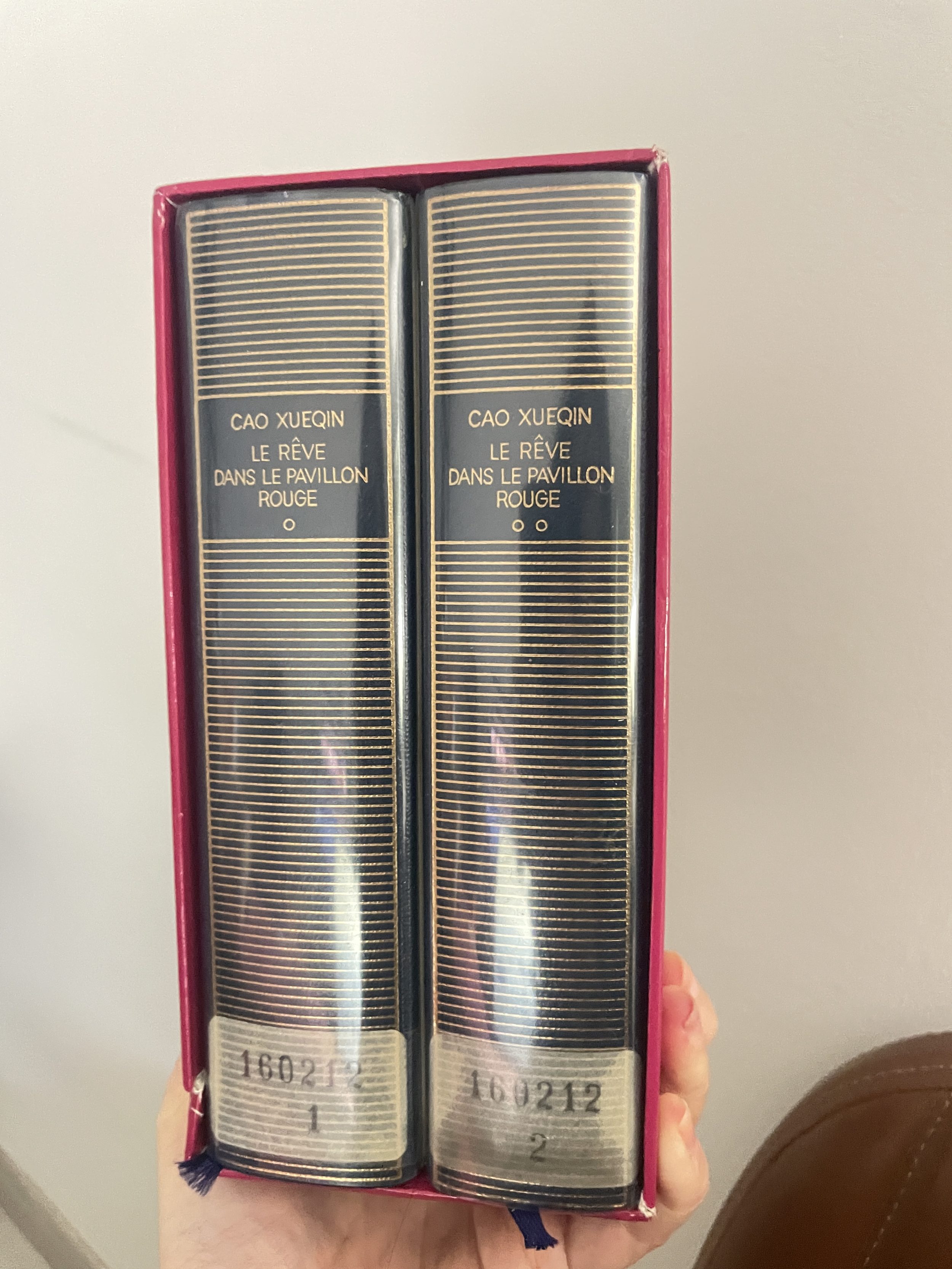
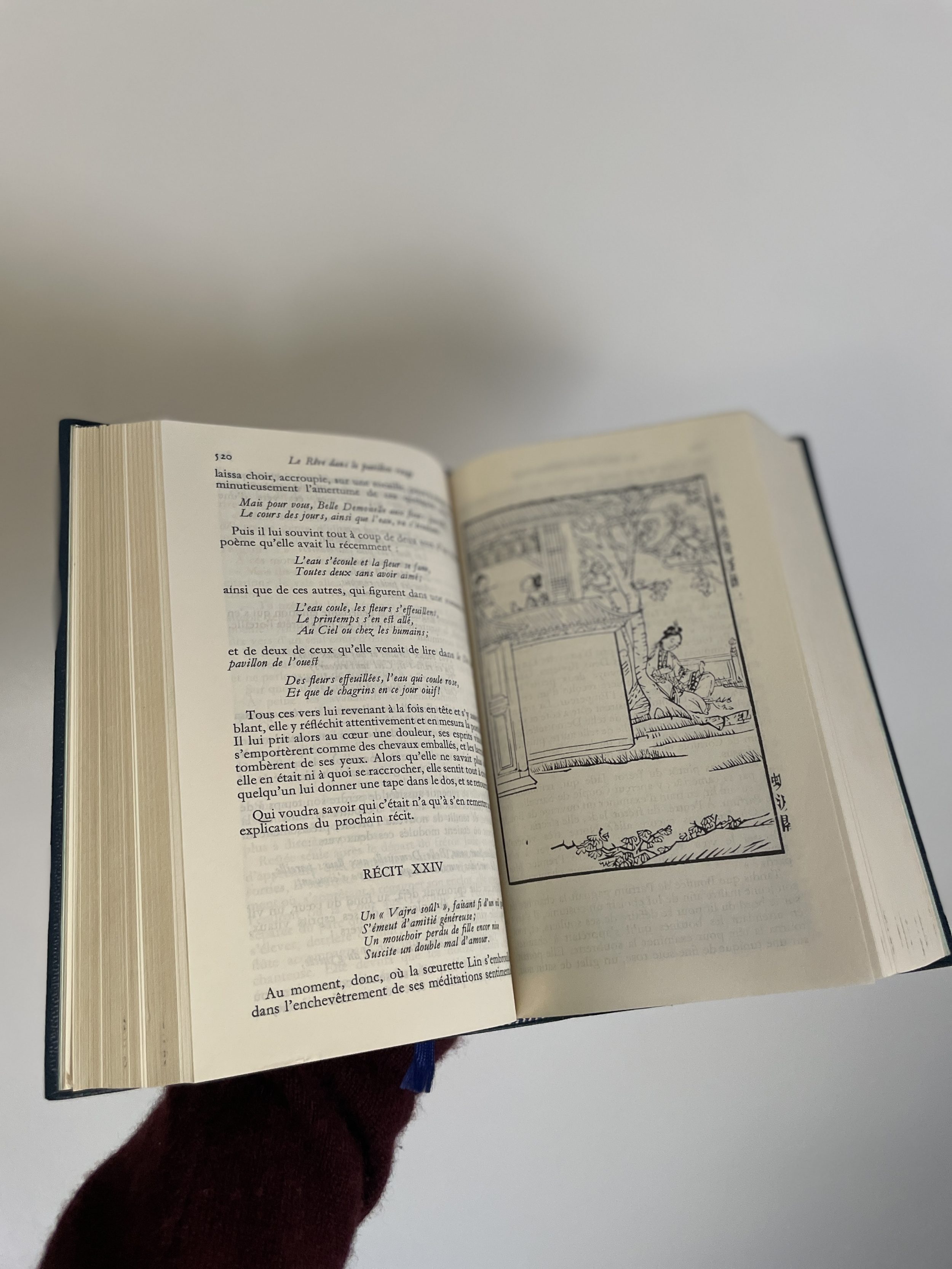
This masterpiece of Chinese literature comes in two volumes, almost 3000 pages printed on bible paper. I was pleasantly surprised to discover black-and-white illustrations, a real plus. The Dream of the Red Chamber is one of the four great classic Chinese novels. The first 80 chapters are by Cao Xueqin, while the last 40 were written by Gao E. The story tells of the rise and decline of four wealthy families during 18th-century China. Those interested in Buddhism, Taoism, Confucianism, or the I Ching will find plenty to enjoy.
It is one of the most complex novels to read and translate among these classics, due to the large number of characters (often with similar names) and the poetic richness full of subtle wordplay. But the Pléiade translation is remarkable, the result of 27 years of work by three specialists, two of whom are renowned (Li Tche-houa, Jacqueline Alézaïs, and revised by André d’Hormon).
This is the first time I’ve bought a translated work in this collection. Unlike my books dedicated to Proust or Voltaire, the annotations here are more succinct as they don’t include sketches. Primarily, they serve to compare two versions of the original text or to clarify wordplay, historical and cultural references, or character names.
The annotations don’t explain certain concepts considered fundamental, such as yin, yang, the fear of losing face, the dependence of families on one or more powerful protectors, or traditional Chinese medicine (knowledge generally acquired by Asians but which might confuse a French reader). By leaving some ‘basic’ notions undeveloped, it’s an approach that respects the well-read audience while being a bit demanding for the reader unfamiliar with these traditions.
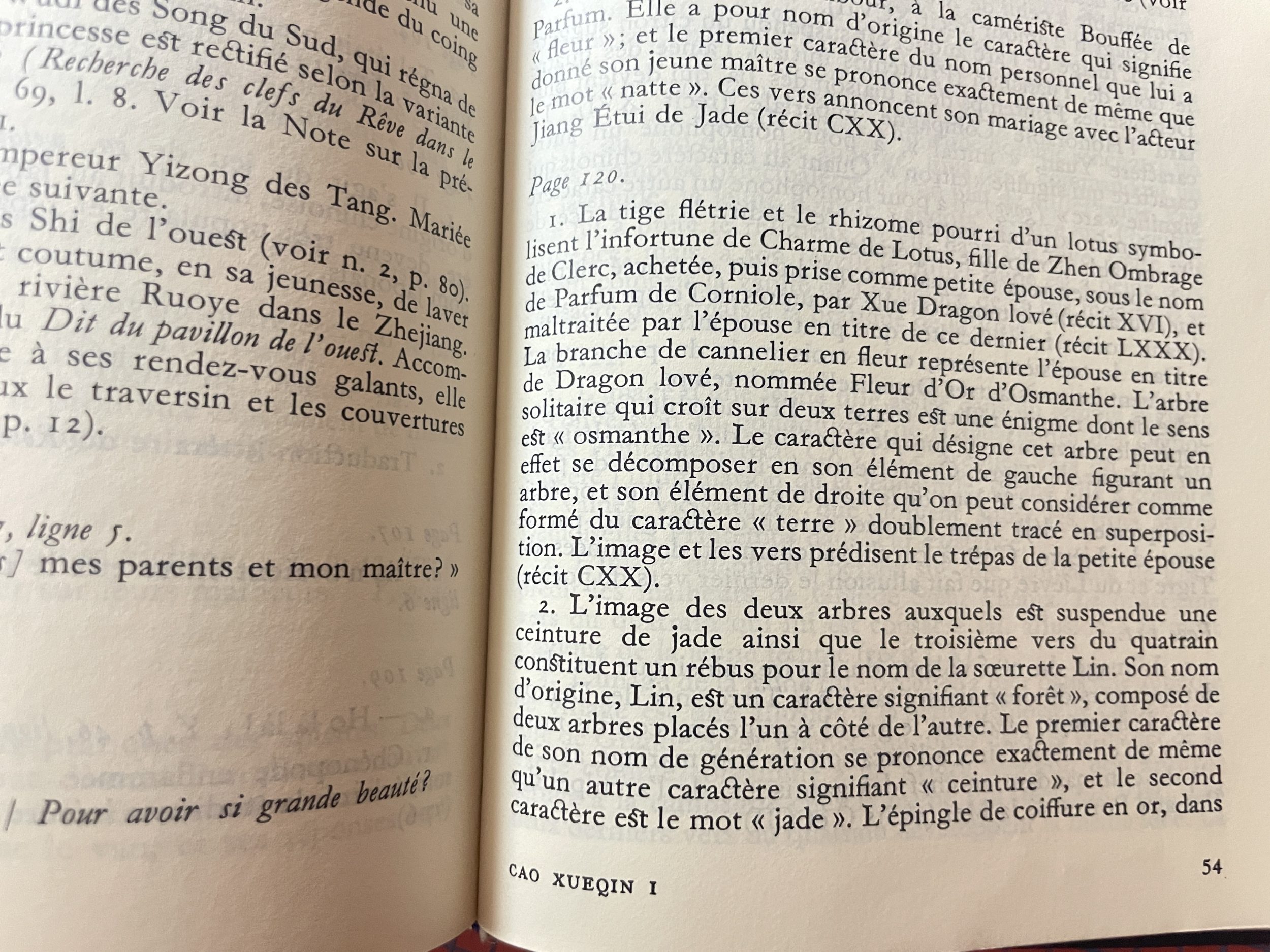
I particularly appreciated the introduction, which is very enriching. This translation is based on in-depth research in Redology, offering a fluid reading and relevant annotations. The character names, often carrying hidden meanings or wordplay, are unfortunately translated literally. The semantic translation of first names greatly facilitates their identification, especially since there are more than 450 characters (including over 50 named Jia!). A detail raised in the introduction concerns the 30 lost chapters by Cao Xueqin, whose plots are supposed to differ from those written by Gao E, but the translator doesn’t really go into the detail of this distinction (or it escaped me).
I haven’t delved into this point, but I strongly recommend, to go further on this translation, this excellent thesis by Wang Yuhan, defended in 2021. Update in June 2026: I’ve long wondered why this thesis criticizes the French translation to such an extent, so I had another Chinese edition of the novel (脂砚斋重评石头记) translated (by AI), and indeed, compared to Chinese editions, the French translation lacks annotations severely. But for that, it would have required 400 additional pages of annotations.
As for the book, it’s like all books from the Pléiade collection, you either love it or you don’t: the font, the bible paper, the small size, the price… I like it, but if it’s too small for you, I understand you might not appreciate it. I’m glad I waited a long time to read it; I probably wouldn’t have grasped its deep reflections if I’d discovered it at a younger age.
Let me show you a few pages of this edition:
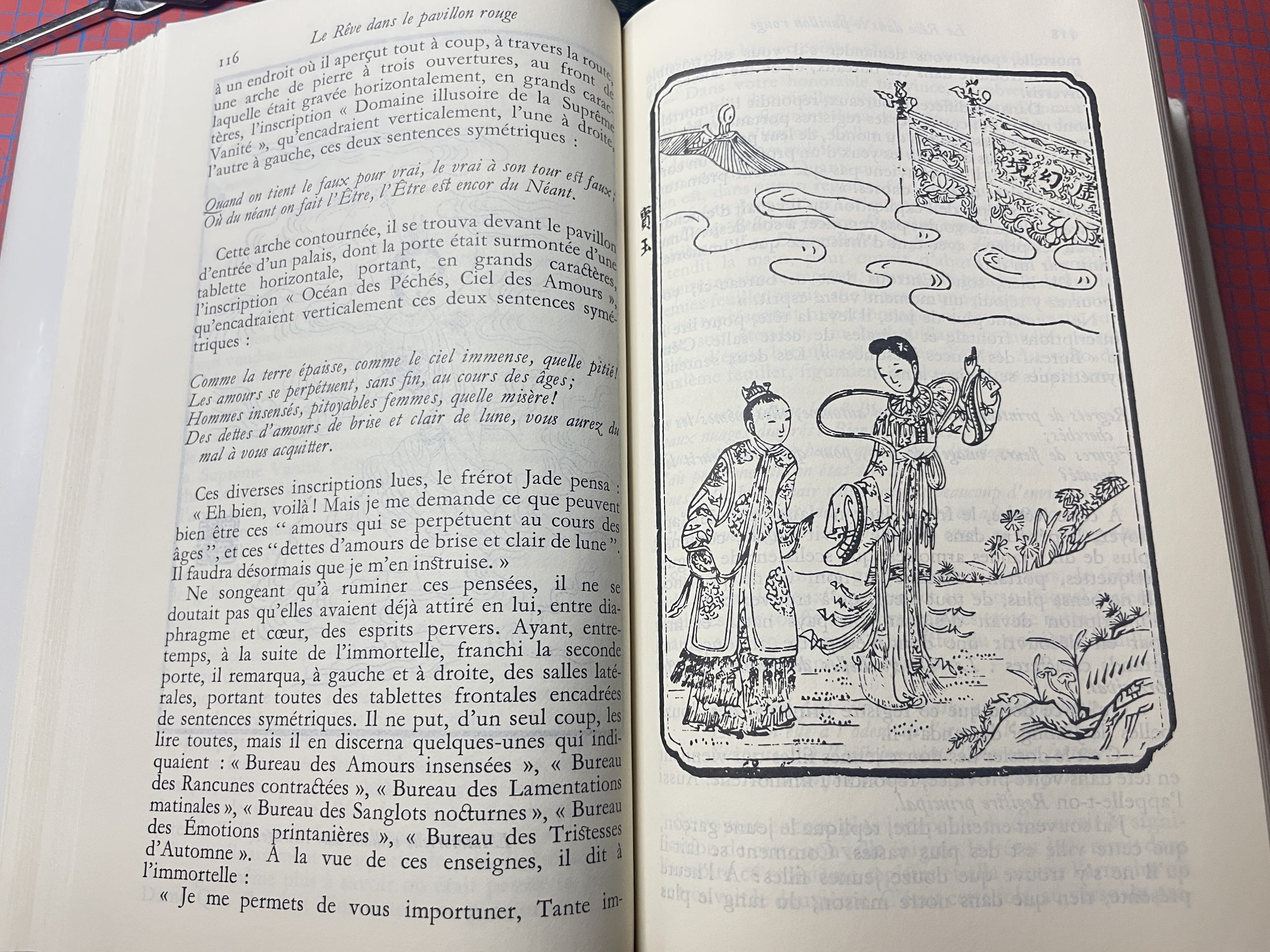
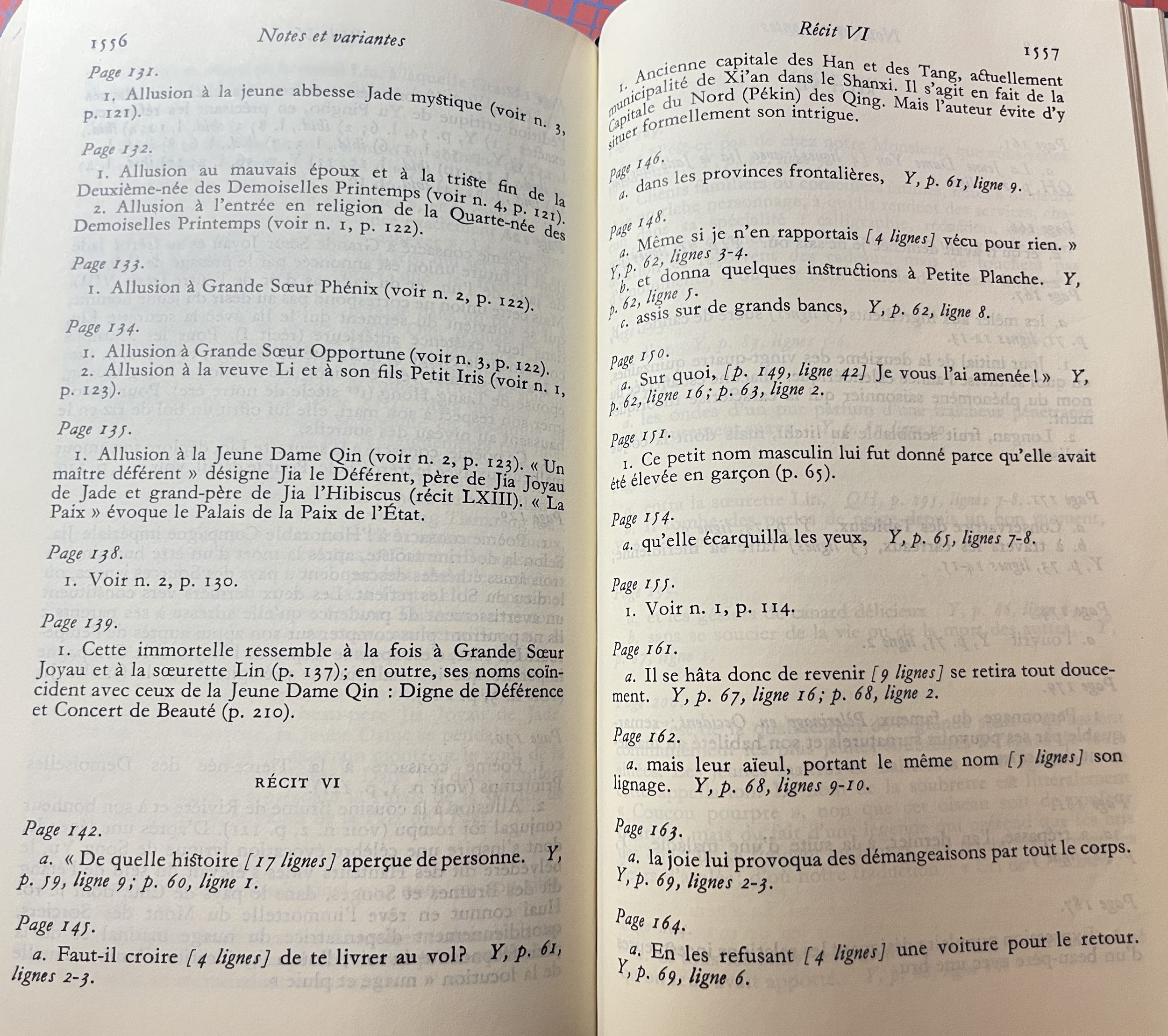
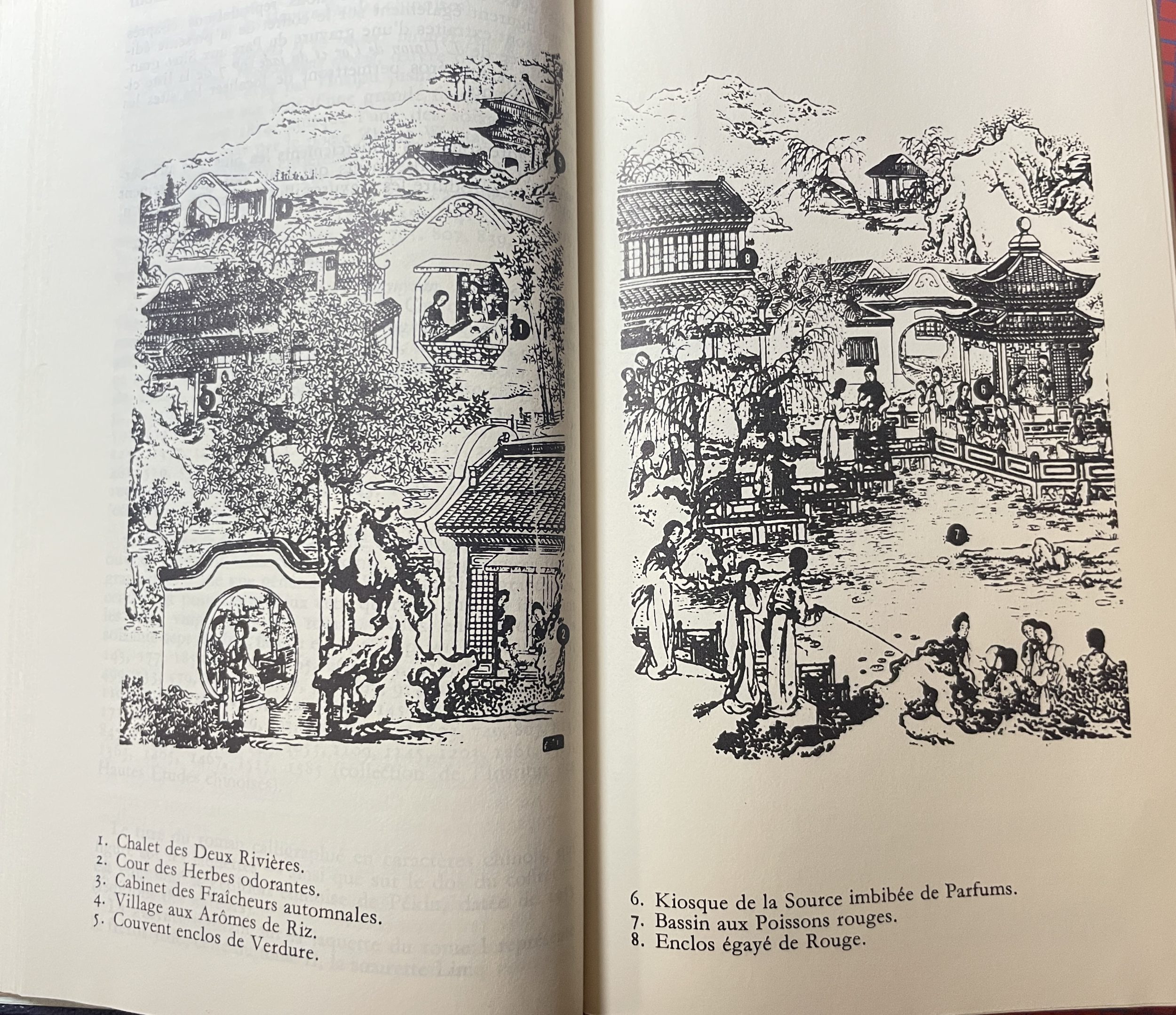
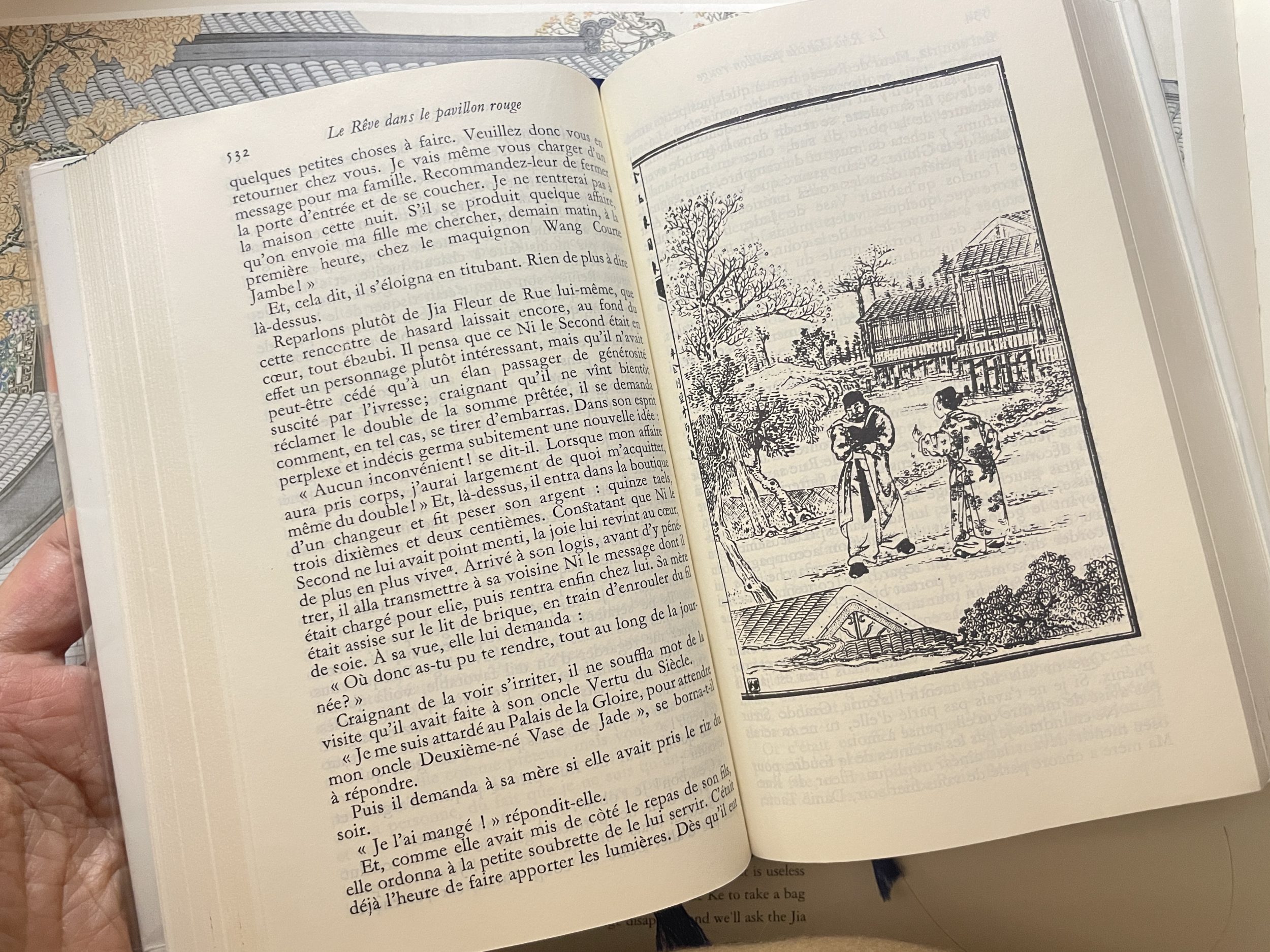
Personally, I read the novel in Vietnamese (I don’t speak Chinese), and when I don’t understand certain passages, I have to refer to the French version.
My analysis
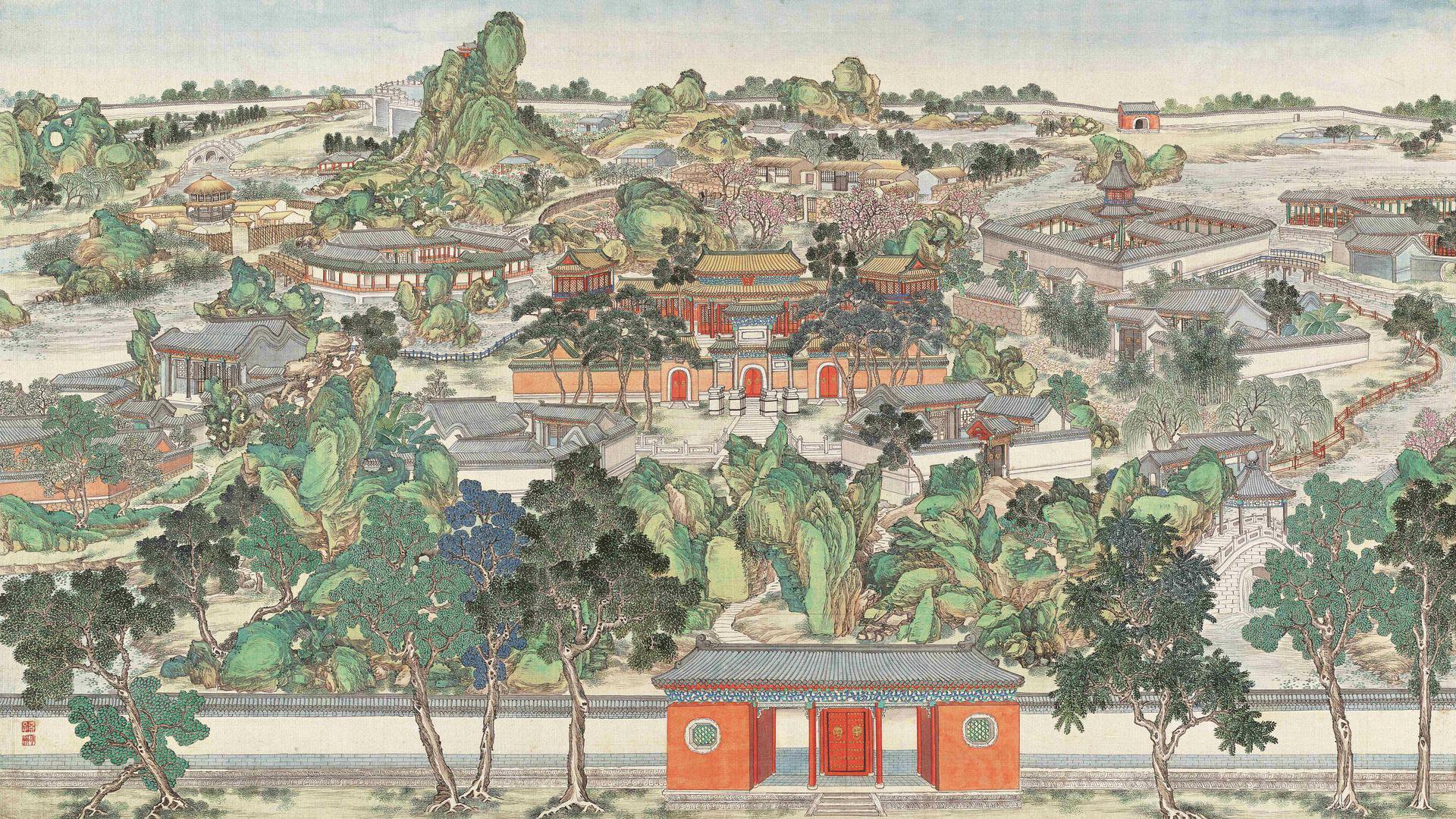
To analyze this novel, I wish to focus on a few essential themes.
The first concerns the perpetual cycle of life. Readers familiar with the I Ching will immediately recognize this fundamental concept. These cycles evoke both the stages of human existence—childhood, adolescence, adulthood, old age—and the evolution of family dynasties or empires. The I Ching particularly emphasizes a principle: when one reaches the peak, decline becomes inevitable. That’s precisely why, despite warnings (the novel’s prophetic dreams), no one can prevent the collapse of this once all-powerful family.
The second theme explores how seemingly minor elements can lead to major consequences. This idea runs through numerous hexagrams of the I Ching. When a group tolerates a harmful element, it inevitably ends up contaminating the whole. When Jia Zheng strikes his son, claiming he will end up “killing his father or his king,” this may seem excessive to those unfamiliar with the I Ching. Yet it is a direct reference to this ancient text, which teaches (essentially) that if a son kills his father, or a minister his sovereign, it is never a sudden act, but the culmination of a gradual deterioration that was allowed to set in. I observe the same mechanism in countless companies: a toxic employee is placed in a strategic position, blind eyes are turned to their deviant behavior on the pretext of their “good results,” then gradually talent leaves the organization, the employee recruits their accomplices, until the final collapse—whereas a lucid look would have identified and eliminated this bad seed from the start.
Finally, the character of Black Jade is strikingly realistic. Each of her appearances in the novel gives me real anxiety. Her unpredictability is total: will she sulk, burst into tears, or throw a fit? I believe anyone who has dealt with an unpredictable, touchy, borderline bipolar person, who weaponizes their physical fragility (their illness) to terrorize those around them and impose their mood on the whole family, can only applaud Cao Xueqin’s talent. I know many analyses present Black Jade as the ideal woman for Jade, as the embodiment of freedom. Yet she represents a very heavy mental burden and isn’t built to function normally. If they marry each other, they’ll become poets but homeless, even faster than the family’s fall. My best friend told me he had a date with a beautiful woman, but one suffering from a chronic illness. He admitted, not without some embarrassment, that he didn’t feel ready to take on that burden and care for a sick person, so he preferred not to pursue the relationship. And I completely understand his decision! People with chronic illnesses—I know this may sound harsh—lack vital energy ( qi), which affects their emotions and ends up gradually draining those close to them (caregiver burnout syndrome). As the doctor who examined Black Jade explained, her bad temper stems solely from her illness:
“From the ailment your Lady suffers, there must frequently follow dizziness, loss of appetite, and many dreams. The patient surely never passes a single night until the fifth watch without waking several times, because she cannot fail to be moved or irritated by everything she has heard during the day, even if it does not concern her in any way; not to mention that she harbors, at every turn, all sorts of unjustified suspicions and vain fears. So much so that those who do not know her very well take her for a young person of bizarre and extravagant nature, when in truth all these anomalies stem from a deficiency in her liver fluid, a weakening of her heart energy, that is to say, in short, the nasty tricks her illness plays on her. Let us now know whether all this is accurate or not.”
Granted, one doesn’t choose to have a chronic illness, or to be an orphan like Black Jade, but those around her aren’t responsible for that suffering either. Yet Black Jade weaponizes both her physical fragility and her heartaches to place a constant burden on those around her, to the point that even her own grandmother ends up no longer tolerating her emotional outbursts.

