

My Current Favorites – [October 2025]: Illumination, Cashmere Throw, Dream of the Red Chamber
The weather is getting colder, and this month I’m enjoying activities that warm both body and soul.
Cashmere Throw
Last winter, facing the cold, I had an ambitious idea: making a cashmere throw myself from fabric sold by the meter. I didn’t know where to buy it, how to choose. That’s why I went to see lots of suppliers in Paris, ordered lots of samples online, and it was only in October 2025 that I decided to take the plunge: deciding which cashmere to buy, what color, what weight, what size…
243€ Later, a double-faced cashmere 400g/m leaves Turin and arrives at my place. After 4 hours of sewing (by hand), here is my cashmere throw with scalloped edges. I explain here how you can do the same as me, or delegate the sewing part. Honestly, it’s one of my best purchases of the year!


While sewing the throw, I had it on me in bed, and I was too warm. So I think this winter, I’ll be less cold and need less heating.
Plus, I treated myself to a recycled cashmere pajama pant from Etam. Found new for €40 on Vinted. The detail I love: the two pockets! JB doesn’t understand why I dress from head to toe in cashmere, pashmina, or silk in winter. In reality, I feel the cold easily and I hate static electricity. These materials have low static electricity buildup. Moreover, these materials have a very high vibration and are compatible together (unlike linen and wool, for example, which should not be worn together).


I took the opportunity to declutter my closets and get rid of what I no longer use, to free up stagnant energy. I’m thrilled to see that things sell quickly on Vinted.
Facsimiles
Last month, I gave myself a huge gift, a William Morris facsimile. And then, thanks to the money earned on Vinted, I was able to free up budget to get two other facsimiles:
- a much more affordable William Morris facsimile: a small book titled The Rubaiyat of Omar Khayyam whose original is kept at the British Museum. The Rubaiyat was a very popular poem in Victorian England. William Morris recopied this poem in four illuminated versions, and I believe only one is held by private individuals (sold at auction recently for a nice sum of money), the others all ended up in museums.
- on Vinted, I came across by chance the facsimile of the Ashmole Bestiary 1511, held at the Bodleian Library in Oxford, at an unbeatable price. The book comes with its French translation. Bestiaries were manuscript books fairly common in medieval times. They simply listed all the animals that exist in the Bible and in nature. The problem is that at that time, they didn’t have cameras, so some animals were never seen by these illustrators, and the drawings didn’t match the described animals at all. The text tells some really funny beliefs, e.g., a pregnant woman should not look at ugly animals or her baby will be ugly too 😀 hahaha
Having facsimiles allows me to realize the tiny size of the drawings and to see the use of gold leaf in these drawings. Before being creative, you must master the technique, and you get there by copying the masters. That’s why for me, if I want to do illumination well, I need physical facsimiles at home.


Illumination
Because between my first illumination workshop and now, I’ve developed a passion for illumination. I do it almost every day (you can see my videos here). During the workshop, several people talked about their “obsession” with illumination. It’s very surprising that they use that word. Usually, for creative hobbies, you’d use the word “addiction” or “passion,” but “obsession” is another level entirely. When people say things that are out of the ordinary, my memory records everything and tries to understand later. So by doing illumination diligently, I tried to uncover the secret of this obsession. By chance, I came across a video by a traditional master illuminator who explained that illuminators were necessarily enlightened beings.
It’s by exploring various materials (paper, parchment, gold leaf, metallic ink) and paints (natural vs. chemical) that I discovered meditative states. I can remain in a state of relaxation for hours, even days after practicing illumination, depending on the materials used. As that master illuminator said, naturally made paints have their own vibrations. When you use colors from the earth, roots, it’s a different energy than those from leaves, insects… One participant in the workshop told me: even if parchment is a byproduct of the food industry, the origin of the parchment determines its energy. The parchment maker who makes it himself from the skins of animals that lived happily in the mountains will sell parchment of much better quality than the big industrial tanneries…
The sum of all these vibrations elevates us, pulls us upward, brings us closer to the divine. I never speak of the divine as an external force, but of the divine that is already within us. The higher self if you prefer. So the more you practice illumination, the more you enter a state of deep meditation and the closer you get to your higher self and develop your intuition. It is for this reason that monks devoted themselves to illumination and Tibetan monks to mandalas. It was a technique for rising above. The part I am particularly passionate about is gilding on parchment. Nothing can rival the brilliance of gold leaf. Nothing can replace that satisfaction of seeing the gold shine before my eyes.
Medieval illumination uses less gold than Turkish illumination. I remember now that my passion for illumination did not begin with The Très Riches Heures du Duc de Berry but with the calligraphy I discovered at the Topkapı Palace in Istanbul. They kept the most beautiful manuscripts of the Quran and masterpieces of tezhip (Turkish illumination; “tezhip” comes from Arabic and means “to adorn with gold” or “to cover with gold”). I am particularly interested in Tezhip because the technique is closer to the mandala; you have to use your compass and have knowledge of geometry.


If the subject interests you as well, here are some books to learn classical illumination, and two books with very detailed tutorials on tezhip :
- Islamic Biomorphic Patterns: Creating Motifs Inspired by the Natural World (Amazon link)
- Islamic Art of Illumination: Classical Tazhib from Ottoman to Contemporary Times (Amazon link)


Tezhip requires somewhat different tools; I found a vintage calligraphy and compass set on Vinted. It includes “ruling pens” or tire-lignes, which allow you to draw straight lines or curves with ink. Historically, these ruling pens were used for technical drawings in engineering and cartography, accompanied by rulers, but today they are more commonly used by artists and calligraphers. If the subject interests you, search for “sacred art geometry”.


Novel: Dream of the Red Chamber
As a child in Vietnam, I remember those long TV evenings where series based on the four great classical Chinese novels kept running: “Water Margin,” “Romance of the Three Kingdoms,” “Journey to the West,” and especially “Dream of the Red Chamber.” I had the opportunity to read the first two, but the other two remained on my “to-read” list for a long time. I did try to dip into “Dream of the Red Chamber” last year, but knowing the tragic ending, I only ventured through a few excerpts, just to protect myself.
“Dream of the Red Chamber” takes us into the life of a mandarin family in 18th-century China. Over 120 chapters and more than 400 characters, we dive into their deepest intimacy, share their dreams and flaws, participate in the splendor… before inevitably witnessing the fall of this once all-powerful lineage. This novel illustrates and simultaneously critiques the fundamental ideas of Taoism, Buddhism, and Confucianism. It showcases the art of Chinese conversation, a subtle art often fraught with pitfalls such as false modesty and innuendo. Through internal focalization, the author manages to unveil the hidden mechanisms of this delicate art, demystifying its complex codes.
Recently, I discovered the existence of an absolutely splendid illustrated version:
“This exquisite edition of Dream of the Red Chamber presents a rare set of Qing dynasty paintings by Sun Wen. This collector’s edition includes all 230 of Sun Wen’s paintings, reproduced in magnificent colors and printed on fine quality paper. The refined pictorial style combines narrative, symbolism, and chromatic richness.
The condensed text of the original novel accompanies each painting and offers a fascinating glimpse as well as a brief summary of the 120 chapters.
This rare edition will make a precious heritage for many generations and will be perfect as a gift or for any presentation. The original paintings are currently housed at the Lvshun Museum in Dalian, China
The illustrated edition offers an abridged version of the original novel, perfect for those who are daunted by the scope of the original text. It’s an excellent gateway: you can start by absorbing the images and the main outlines before diving into the complete version. That’s actually the method I had already adopted for tackling “In Search of Lost Time” (the comic book first, then the seven volumes). What’s funny is that “Dream of the Red Chamber” is the Chinese version of “In Search of Lost Time”: it’s a saga with a fine analysis of human psychology, but with more action, shorter sentences, and less complexity.
The abridged illustrated version exists in four editions: the first two are in Chinese, and bilingual (Chinese – English).
Then, there are two translated versions: the English version is cheaper (Amazon link, Fnac link) but the text & image are condensed onto one page. The Chinese names are left as is.


The French version is more expensive (Amazon link, Fnac link) but the layout is more pleasant, with text on the left side and image on the right. The Chinese names are translated to make it easier to recognize the characters (because with 30 Jia, you risk not knowing who is who).
These are large formats, heavy, so you have to read them at a table.


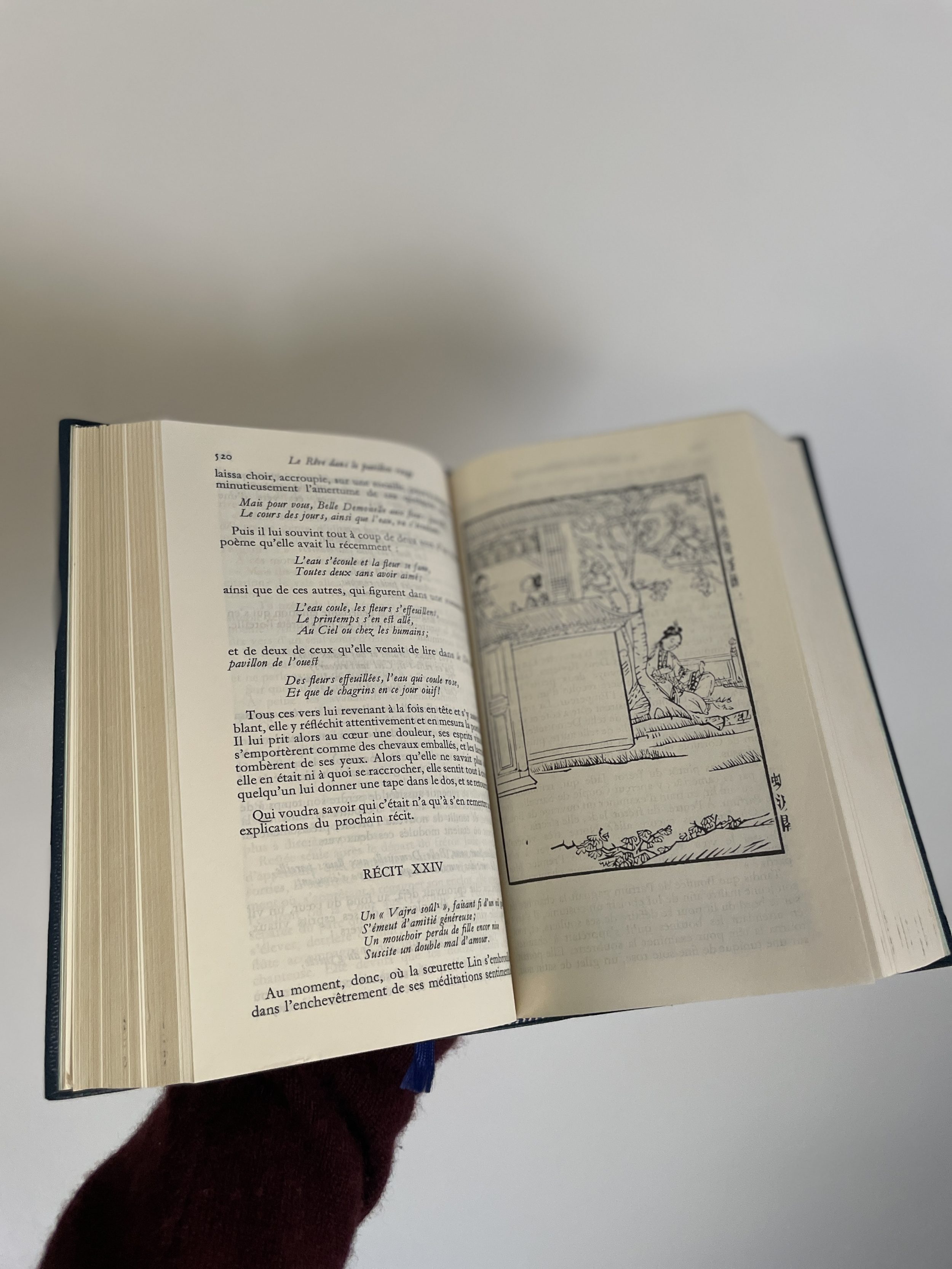
But the best version is still the two-volume Pléiade edition. I was able to borrow it from the library. Not only is the translation well done, the character names are translated, the annotations are not “too much” like other books in the collection, but there are also plenty of illustrations (in B&W). I highly recommend them (Amazon link, Fnac link).

Other
For over a month now, I’ve been receiving a basket of fruit and a basket of vegetables every week, all prepared to my specifications by my local greengrocer. I talked about it here. Other customers noticed my baskets and have followed suit. It allows me to eat well while reducing mental load as much as possible.
And finally, after 10 months in Lille, I finally signed up for the city library. The catalog is not as extensive as in Paris, but we have access to the catalogs of 9 libraries in the region and can request transfers of books to the library near home. I have a soft spot for books from the Pléiade collection for their critical apparatus, and being able to borrow them is a great pleasure for me. Before, I hated touching library books (because some readers have the annoying habit of leaving their DNA behind when turning pages). But since I got these finger protectors, I can turn pages without fear, ahahah 😀


