
[review] Charbonnel washable inks for linocut
After a bookbinding-linocut class (I mentioned here), I followed my teacher’s recommendations and went to the Charbonnel store to buy inks for my home linocut studio. The shop is in the 5th arrondissement, on the Seine quay, almost facing Notre-Dame de Paris. I ring, someone opens the door and welcomes me.
I went to this store twice. The first time, I chatted with a woman working on the Lefranc Bourgeois paint ink range, and the second time, I spoke with a man in charge of printing inks.
Note: this article is not NOT sponsored, I paid for everything out of my own pocket

As a beginner, I took the opportunity to ask lots of questions about how to use inks, what to choose, and I got good advice.
For printing, they have two ranges:
- an aquawash range, water-washable inks. As the name suggests, these inks wash off with water, plain and simple. Sometimes I don’t even need soap. Cleaning is made easy, but once these inks are dry, they stay. On clothes, but also on the flip-flops we wear at the beach!
- a standard range, which you remove with white spirit, but according to the manager, it cleans very quickly with a bit of sunflower oil
I’m really asking beginner questions and no one seems offended. I ask why prices vary by color. Why can’t you create Solferino Violet (the most expensive) simply by using primary colors, how can you achieve the three shades of blue like on the color charts, etc.

I’m told that prices depend on the pigments used. Some pigments are more expensive, not necessarily because they’re rarer to extract from a mine at the end of the world, but it depends on several factors.
Theoretically, you can create all colors from primary colors, but in reality, it’s not possible. I imagine it’s a matter of chemistry. The solferino violet will always cost €35, that’s just how it is. I saw it demonstrated at my teacher’s place, and it’s true that this color is really, really beautiful.
Sometimes regulations change, or an ingredient is no longer available, and they have to find a new formula to replace an existing color. It has to remain exactly the same color, so that artists using Charbonnel inks can recreate, with the same colors, the same intensity, 20 years later. So before he saw me, this man was testing a new formula, his freshly washed hands have no trace of ink. And he’s very proud to achieve inks that are so easily washable/cleanable. Gone are the days when artists have to be covered in rainbow colors 😀 He confides that production is still very manual, hence high quality, and that Charbonnel sells the best inks in the world.

I left with 2 colors to test. Of the 4 colors I have: 2 from Charbonnel, 1 from Cranfield, and 1 from a horrible cheap brand, the two Charbonnel inks give me the most satisfaction. Cranfield is supposed to be washable, but that’s not what I’ve found. There are traces of my Cranfield ink all over the kitchen, which is not the case with Charbonnel inks.
My teacher is particularly fond of Ultramarine blue , and I agree. My studio is clean, there’s no trace of ink. I can even wear white while printing, and you can see, the ink comes off easily with water. A real joy.

Now that I’ve seen how effective the Aquawash range is, I’m going to buy more colors. I’m encouraged by the cleaning instructions given by the manager at Charbonnel to try the standard range and have access to gold.
Where to buy linocut tools?


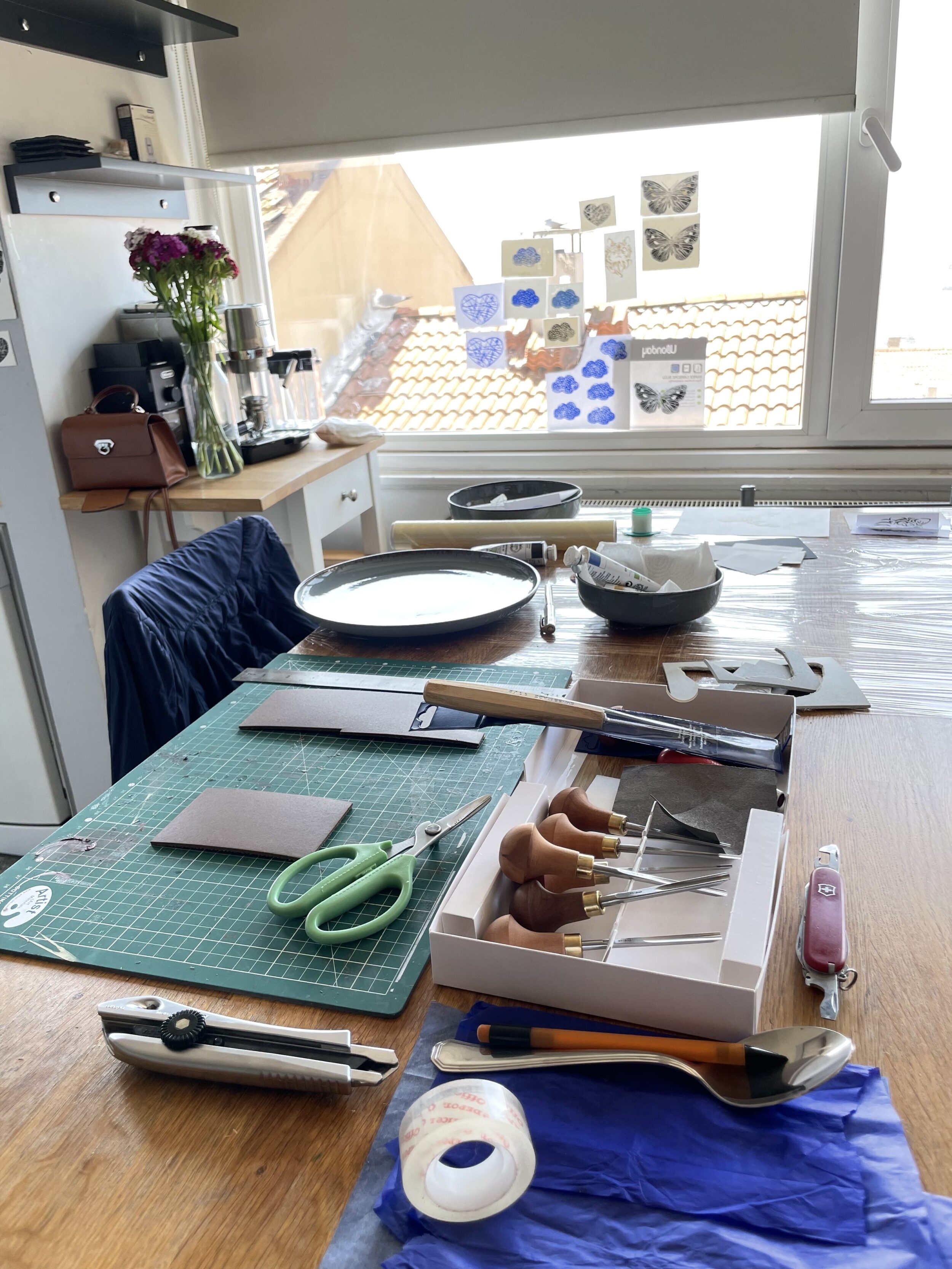
The Charbonnel store also sells linocut accessories: I left with a set of Pfeil gouges, printing sheets, a printing roller, and lino plates. You can buy at the store like me, or online.
Address: 13, Quai Montebello 75005 Paris
Website: https://www.charbonnelshop.fr/
You have everything you need to start a linocut studio at home.
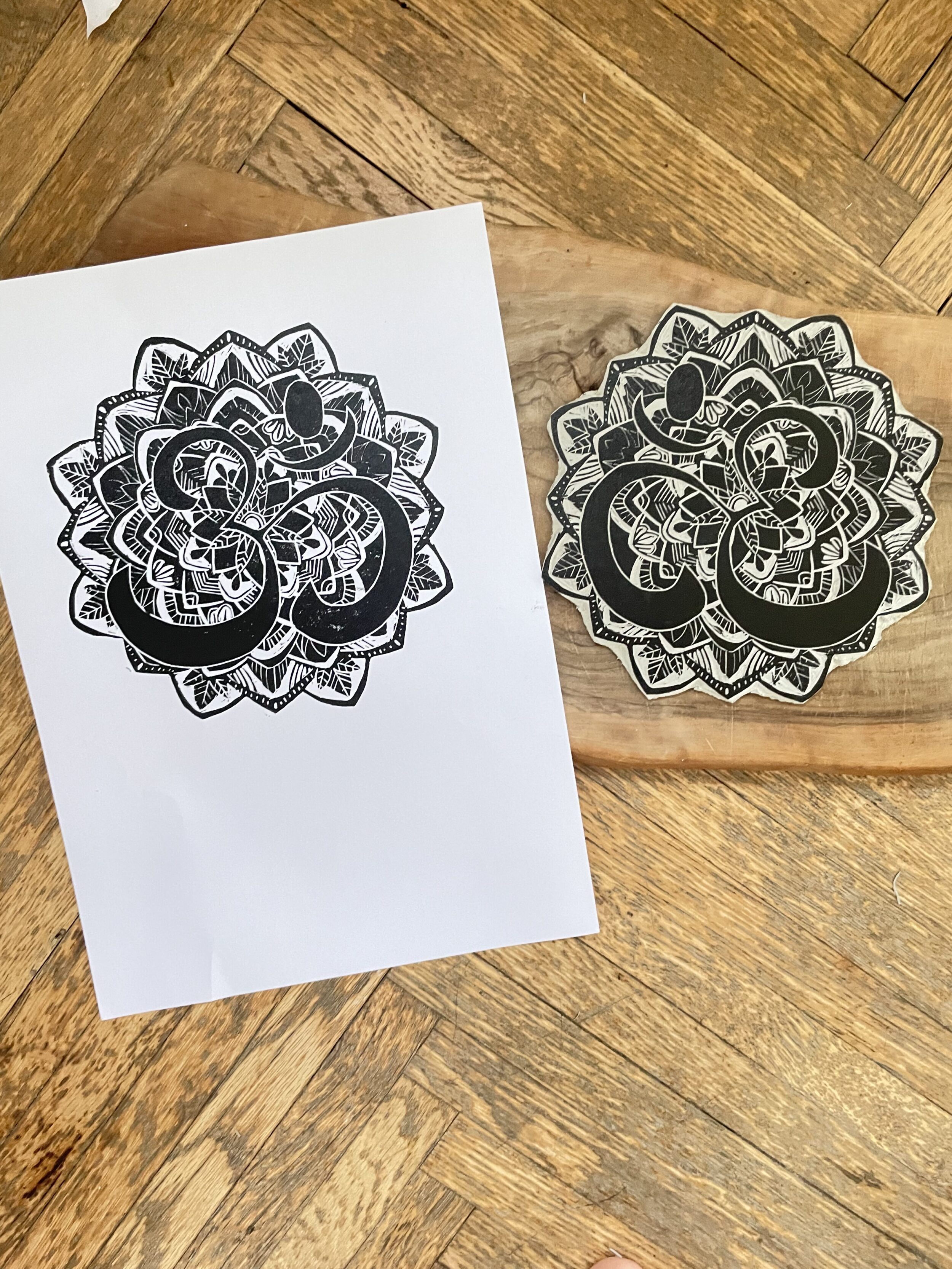
I show you my home studio and my print with the aquawash ink Carbon black from Charbonnel: