
Geoffrey B. Small, the man who makes the best clothes in the world
As you know, I’m in the middle of refreshing my winter wardrobe. I haven’t set foot in a store in years. When I finally go shopping again this year, I realize that everything is plastic (polyester, acrylic, viscose…), and it’s impossible to find a decent piece of clothing even if I’m willing to pay the price. Why has the fashion industry sunk so low? I did my research, I read books… until I stumbled upon Geoffrey B. Small, an American designer based in Italy, in Veneto, the Hollywood of luxury brands. He’s the only one who can truly claim to make the best clothes in the world. Listening to his interviews, I learned a ton of things and I’m eager to share them with you, especially if you’re not a native English speaker.
FYI, my sources come from:
- this podcast done with Style Zeitgeist (which you can find on Apple Podcast with automatic transcription) and an article written by Style Zeitgeist
- this article written by GQ
- the two interviews of Geoffrey B. Small conducted by Bliss Foster on his Patreon (access will cost you about 9 euros)
- you can read the descriptions of each garment on Mr. Small’s website, you’ll learn all about his suppliers, the choice of fabric, buttons, fibers—it’s fascinating! His clothes are expensive (starting at 3000 euros), but compared to other luxury brands, it’s the same price but with superior quality.
Mr. Small has over 40 years of experience in fashion. Unlike other designers, he knows how to sew well and is a master tailor. He’s also knowledgeable about fabrics and fabric treatments. However, he also has management skills, having earned an MBA. His goal is to make the best clothes in the world, made by humans, for humans. He always opts for the best materials, the best accessories (from zippers to buttons, including silk composition labels). I’ll quote Mr. Small in italics, then add my own comments.
I’m in the middle of the Veneto. The Veneto is the center of fashion for the global luxury market. Everything is made here. Everything.
All the French luxury houses, everything related to LVMH, is now managed here. (…)
(…) I decided there was room for a very targeted company that would focus on the absolute top end, both in design and in manufacturing here. We’re going to lead the market through research. We’re going to be the Ferrari of the industry. And I felt I could do it. I had the skills, I had the training. No one else does. There are very, very few CEOs or head designers who can actually make a bespoke suit. And that’s essential if you want to build a great research company. You need to have an engineer, so to speak, who is both CEO and head designer. (…)
I watch all these haute couture operations complain about their financial losses. They have to sell 15, 20 million euros worth of perfume a month to support their couture operation. I see the tailors of Savile Row complaining they can’t make money anymore. And you know what? I look at them and I don’t get it. Why? If you make high-quality handmade clothes and you focus on that, and you know what you’re doing, it’s like great chefs. You can be profitable. You can operate. So what’s the problem? The problem is that no one knows how to do it anymore.
And that’s our story. It’s a kind of reflection: what is fashion? My point of view is that not enough people focus on the practical, real experience of clothing. That’s why many people don’t understand what we do. “Oh, he makes conservative stuff. It’s handmade, high quality.” They don’t see it as an art form, but I do. Excuse me.
Look at Leonardo da Vinci. Da Vinci was 99% technical. He was the first to use the oil that came from the North.
He used oil instead of water. That allowed him to achieve a completely different level of painting in Renaissance Italy. He was technically driven.

In the article The Murky Business of Fashion’s Cash Cow: The Logoed T-Shirt from High Snobiety, it says: “According to Lorio (author of Made in Italy?), manufacturing is outsourced by big brands to suppliers who bid for the work and handle the entire process, from prototyping to delivery of finished products. These companies have offices in Italy, but they often outsource production to factories in developing countries, ranging from Moldova to Bangladesh, some of which also produce items for fast-fashion giants like H&M and Zara.” In the same article, a t-shirt with a luxury brand’s logo costs $3.5 to produce and is sold for $390. Prototyping is a very important step because that’s where design flaws are spotted. But when it’s outsourced or done in factories on the other side of the world, it will be hard to fix those flaws.
A garment is the result of many different trades: designer, pattern maker, tailor, fabric makers… and when a brand like GBS manages to master almost all of these trades at once, it results in incredible clothing. GBS was a bespoke tailor, he dressed real people. Since most people aren’t models, making clothes for them is very different from making standard sizes 36-38-40, etc. Apparently, anyone who has touched or worn GBS clothing immediately understands why it costs so much.
If you have a choice, as a business manager or shareholder, between making a T-shirt or making one of our handmade jackets, there’s no doubt about which one you’d rather try to do. If you can get away with a T-shirt, you’ll find any possible way to sell it at some margin, that’s the solution, the other option is a nightmare. (…)
I came out of the School of Disciples of Milton Friedman. From 1981 to ’84, that was the time when the free market concept was emerging from the University of Chicago, and all top business schools were training in that direction. I mean, we were literally indoctrinated with that way of thinking. And I can’t tell you how many times in class we were told to eliminate the human being as much as possible. The worst thing a manager can do is hire more people. You have to get rid of them.
If there’s a machine you can buy to get rid of an employee, you buy it. If there’s a poor country where you can outsource the work instead of employing an American, or an Italian, and you can have that person work for a dollar an hour instead of 15, you do it. And you do it systematically in every corner of the company to reduce every human skillbecause that exposes you to more risk.
That’s how we run businesses. And these guys I studied with, it’s important to note that many of them now run major Italian luxury companies. I won’t name names, but some of the big names you’re reading about in the headlines these days studied with me in Boston, okay? And they have the same disciple talk.
So what we have is nothing sudden. I studied in the ’80s, that was three or four decades ago. It’s something that has continued and continued and seeped into the entire corporate world. And now we’ve reached a point where it has worked. Everyone has been deskilled. There are no more jobs.
My comment: Before, clothes were made by tailors, custom-made. They were small family businesses, and each tailor had their own style. Now with ready-to-wear, it’s become a consumer product, brands have gone public, and the artistic side is pushed aside to generate more $$$$$. We often forget that before, people could spend a month’s salary on a garment that would last a lifetime. Now, even if you pay the price, it’s not certain clothes will last as long. This creates a vicious cycle where people spend less, quality decreases, and artisans also gradually disappear.
And that means that if you want to make a living from your work as an independent, you have to be expensive compared to what exists. That means that the moment you accept this reality, you have to sell to the rich. That’s a fact. It’s a brutal fact, and I’m going to say it. I know I risk a lot of criticism, but to be able to do what we do, we have to design products that the rich will buy, and they have to buy enough of them to keep us alive. We have competition, because that’s also what LVMH and Kering are aiming for. They try to sell to the rich. But there are things happening in the world, including among the rich, even if they are a minority, even if they represent 1%, 2%, or 3%, you have to understand that 1% of the world’s population is not a small number of people. There are quite a few. And what we’ve discovered over the years is that they are not all the same, not at all. They are not all identical in terms of wealth. Some are wealthier than others by factors of 150 to 1. Some are smarter, so to speak. They are more in tune. They are more educated. They are more cultural than others. Some have had their wealth for longer, maybe within their family, what’s called old money. Others are new, nouveau riche. They have the money, but they don’t have much else. They have to learn. Some try to be rich or appear rich. And so, as you begin to understand that you are going to have to be a luxury, quote unquote, and I hate that word, I hate it, but that’s what we are. I am a luxury market designer.
Alright, so as a designer, I have to do my job.
What do we do? And where do we position ourselves?
Now, we don’t need to sell to all the rich people in the world. We don’t need to sell to 50% or 60% of them. LVMH does that.
And that’s their problem, because that’s a large number of people. So, what we thought is that we can target a minority of these rich people. Let’s go for the smart ones. Let’s go for those who are serious about the real issues of the planet. And let’s go for those who are not aspirational. They get it. And if they get it and they like what we do, they buy a lot and they stay loyal to us. These are people I can count on.
I can provide employment for an entire town if I do my job. So what do I have to do? I have to do everything a very rich person would demand. And that’s complex. These people are not easy to please. They aren’t. Anyone says, oh, I have the luxury of selling to the rich. Listen to me. Try selling to the rich. It’s not easy. Why? First of all, they can buy anything.
So the first question is: “What do you do for me to put five thousand euros into one of your blazers?” So we have to give them certain things to merit that purchase.
First and foremost, like everything else, they must not look like an idiot wearing what we do. We have to make them look elegant. And we also have to make them look right ina certain way, that matches what they do in their lives, whether socially or professionally. So our aesthetic codes must follow these kinds of guidelines. I’m not talking about pieces we might present at a fashion show in Paris or special projects. I’m talking about the core work we do to answer your question. And so, you know, we have to make a good suit.
We have to make a good jacket. And it has to be something a man can wear to the bank. He might even own the bank, and many of our clients own banks. So we have to make a jacket that suits a man who owns a bank. While some things my honorable colleagues do, no. That’s not an easy thing to achieve. So the aesthetic has to be right, and it has to follow certain codes. And it has to be different from what everyone else is doing. We can’t do what Zenya does. We can’t do what Brioni does. We can’t do what Loro Piana does, because these rich clients are very powerful and very successful. And the other difficulty they present for a designer in our field is thatthey don’t want to look like everyone else. They are all special. They are all different. So we have to incorporate an enormous amount of exclusivity and differentiation into every piece we make. Now, nobody really sees it, except the people who wear and own these pieces. It’s worth the money they ask, because that, you can’t find anywhere else, and that’s something that really makes me feel good. And that’s the big part of GBS design. It goes down to the smallest detail. So yes, the silk linings from Como. Our silk linings from Como, we pay 30, 40, 50 euros per meter for them. Most companies use linings where they pay two to three euros. We use silk. When we started, we went to see them, and they said: “What do you want to do? Beautiful dresses, haute couture? What do you want to do with our fabric?” And I said: “Actually, I’m trying to find something to line some of my jackets with.”

My comment: this is a remarkable passage that everyone should take note of. There are many artisans who make exceptional products but fail to reach the ultra-wealthy. I know an artisan who does manage to access this clientele, but indeed the ultra-wealthy are hard to please.
The basis of marketing is knowing your targets. You need to know your ideal target’s typical day by heart. Where they go, at what time, who they see… that way you’ll know how to target them, where to target them. If Omega watches have several pages on “why golf swings don’t affect our mechanism,” it’s because their primary targets play golf. They’ll pay famous golfers to become their brand ambassadors. They’ll sponsor golf competitions, it’s simple. If their targets play ping pong instead, rest assured they’ll talk about ping pong too. As soon as an entrepreneur struggles to answer my simple question “who is your primary target?”, I know it’s off to a bad start. When the entrepreneur, on top of that, can’t give me their competitive advantages, it’s doomed. They’re targeting the entire planet, and it will be very difficult to get out of that.
If you’re an employee, this comment applies to you too. What’s your competitive advantage? In the job market, there will be 10,000 people like you. Why should they keep you at the company or offer you a promotion? Cultivate your differentiation, find yourself a niche. It could be a dual skill set, or a tool that no one at the company masters but that is very useful…
The problem is that if you’re LV with $40 billion, you need to reach $50 billion in 10 years. How are you going to do that? So they constantly have to expand the luxury market. An increasingly broad base. That prevents them from doing what we do in a meaningful way. (…) I have one or two guys who can make the best fabric in the world, and the companies that used to buy from them have now shifted to making cheaper things to reach a broader luxury market.
The luxury trade (…) is based on human technical skill. (…) I have a lot of people asking me why it’s so expensive? It’s so expensive becauseonly a few people know how to do it. And until we rebuild the knowledge base of human beings with these skills, it will stay that way. So one of the other things I try to do, and will continue to do until I die, is train and develop new generations of designers, but designers who are also tailors. Designers capable of making, who have a visceral knowledge of creating exceptional garments. I think over time, we’ll reach a critical mass where this level of skill becomes more widespread. We have the most advanced manual handling and fabric treatment operation in the world. And we do this to offer our clients total exclusivity. They can’t have the same fabrics as Brioni or other major luxury brands that also buy from Piacenza. If they buy from us, it has to be completely different. We use fabrics like vicuña, and for a year and a half now, we’ve been buying vicuña from Piacenza. This fabric costs 2,000 euros per meter. And these are coats sold for between 60,000 and 70,000 euros. It’s incredible. Every coat we’ve made has been sold (…) Just the cutting and sewing of the fabric is incredible. Truly incredible.
My comment: Vicuña is the most expensive fiber in the world. I tried to get my hands on this material, but prices are controlled internationally. Even in the land of vicuña Peru, I couldn’t find an acceptable price.
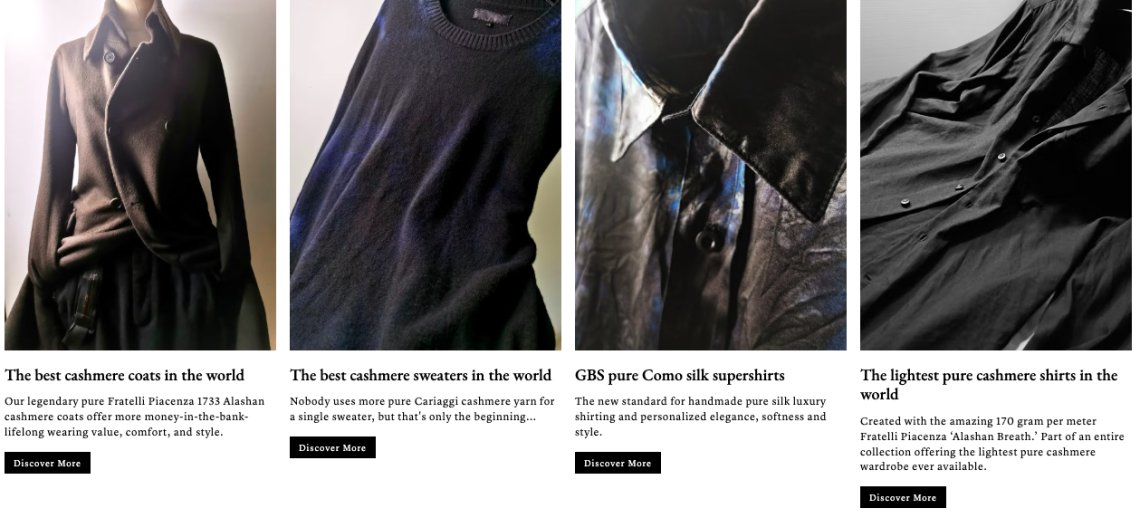
What Geoffrey B. Small offers his clients are the “best clothes in the world”. But he doesn’t just buy the best fabric in the world; once purchased, he puts the fabric through additional treatment to achieve the feel or texture he wants. He has a real R&D team that transforms fabrics, dipping them in temperature-variable baths, dyeing them, brushing them in a certain way… and that results in cashmeres with textures never seen elsewhere, or silk prints never observed anywhere else. There’s real innovation, and for cost reasons, you’ve seen that big brands no longer do this. When you buy a standard garment from him, all buttonholes are hand-sewn, there’s a hand-written label numbering the garment. And a long text explaining where the fiber comes from, where it was woven, where the buttons come from, what material they’re made of… you have a precise list telling you why it was designed and made with love by humans. GBS creates clothes for humans, which is why he adds extra fabric to the waist of his trousers so they can be let out. He uses the best natural materials he can find, not only because they’re luxurious, but also because they’re good for your body. “When you have plastic in your clothes,” he says, “your body feels it.” I saw a video on Instagram explaining why you absolutely had to use a cotton/polyester blend for such and such a design. That’s wrong! Because with the innovative method at GBS, you can make any design with natural fabrics. Using polyester is just laziness, that’s all!

When I started, first you study design. Then you quickly realize that to truly control your design and do something different, you need to know production. Because you can’t design what you don’t know how to make. You also need the respect of the factories and the ability to convince them you know what you’re talking about. So I studied production. Then I realized thatI also needed to study business, because you can’t produce if you can’t pay. And then, I understood thatI also needed to know the law, because you can’t play the game without knowing the rules.
My comment: Many brands fall into the hands of giants at some point because they lack cash flow despite selling out every collection. The selling price is basic math, but many entrepreneurs calculate it very poorly.
In a society where everyone is a specialist, the jack-of-all-trades will come out on top. An entrepreneur with no interest in marketing will spend their time creating a beautiful product, but no one will know about it. Let’s not forget that GBS masters his craft, but he also has an MBA!
The big plus for JB and me is that not only do we have our niche (we specialize in high-traffic websites), but we also know all the trades related to ours well; we have a global vision. We don’t build websites ourselves, but we know exactly how to do it and what tools to use. When there’s a drop in e-commerce revenue, even if it’s not my job, I’m also Analytics certified, and I can point my client to the exact cause of the drop (most of the time, it’s tracking or the payment module). G. B. Small doesn’t have a factory to make fabrics, but he knows exactly the limits of his fabric suppliers and what they’re capable of.
No one, absolutely NO ONE, will ask you to look beyond your scope, but if you do, you’ll be more competent, and that’s the secret of successful people.
I often explain to slightly naive and lost entrepreneurs that the entrepreneur is the most competent person in the whole company, they have the global vision, and must know a bit about all trades, even if they’re not a specialist. They must be visionary. When we started our small company, JB had to upskill and had to read legal texts, get back into accounting, he had to acquire the vocabulary and know the limits of everyone working with us. Over the years, it even happened that his accountant asked him questions to advise his own clients LOL.
I hope you’ve learned something. As for me, after searching everywhere without finding what I want, I’m going to get back into sewing. I was well trained (I told you about it here), and since I can make patterns myself, I’ll be able to do anything.


