
Sequoia & Kings Canyon National Parks – Road trip in the American West #10
Our hotel is 30 minutes from Sequoia & Kings Canyon National Parks, and after a good night’s sleep, we’re ready to brave the cold and wind to explore. Visiting Sequoia National Park means taking a big detour before heading to Yosemite, but we have plenty of time, so we might as well take advantage. And we’re glad we did, because in the end, we preferred Sequoia National Park to Yosemite.
This article is part of our series of articles on the American West road trip. If you haven’t read the previous travel diaries, here they are: #1, #2, #3, #4, #5, #6, #7, #8, #9
Part 1: Travel Journal
Part 2: Practical Tips
Part 1: Travel Journal
Day 16 of the road trip:
The road to Sequoia National Park is very pleasant, even though there are lots of curves and very few places to stop for photos. Or rather, stops with unsatisfying views. We’re constantly climbing, surrounded by trees, but they’re not the park’s giant trees. We won’t see any until we enter the park. Access is with our America the Beautiful pass, as usual. We paid $80 for a year, and we’ve definitely gotten our money’s worth, visiting 6 national parks with it.
We were smart to stop at the Visitor Center because I have no idea what to see here. I only know there are lots of black bears living in this park. A very nice man showed us the points of interest and reassured us about the bears: they are indeed numerous, but it’s pretty rare to spot one. He also warned us about bear cubs: if you see one and don’t see the mom, it’s best to turn back. Cubs stay with their mom for a year, and we’re arriving in the season (November) when the mom kicks them out. Apparently, black bears aren’t dangerous, unlike grizzlies. However, you must do everything to discourage them from being interested in our food. At the Visitor Center, they can rent containers to keep our food safe from the bears’ very sensitive noses. It’s not just a safety issue for us, but for them! If they aren’t afraid of us and get too close to gorge on our picnics, they risk being killed by rangers.
Before arriving at this park, I made sure to get rid of all our beef jerky packets and any food that might attract one 😀
For this park, the Visitor Center gentleman recommended:
- Tunnel Log, accessible by car
- Crescent Meadow
- General Sherman, the largest tree in the world
- General Grant Tree, the 3rd largest tree in the world
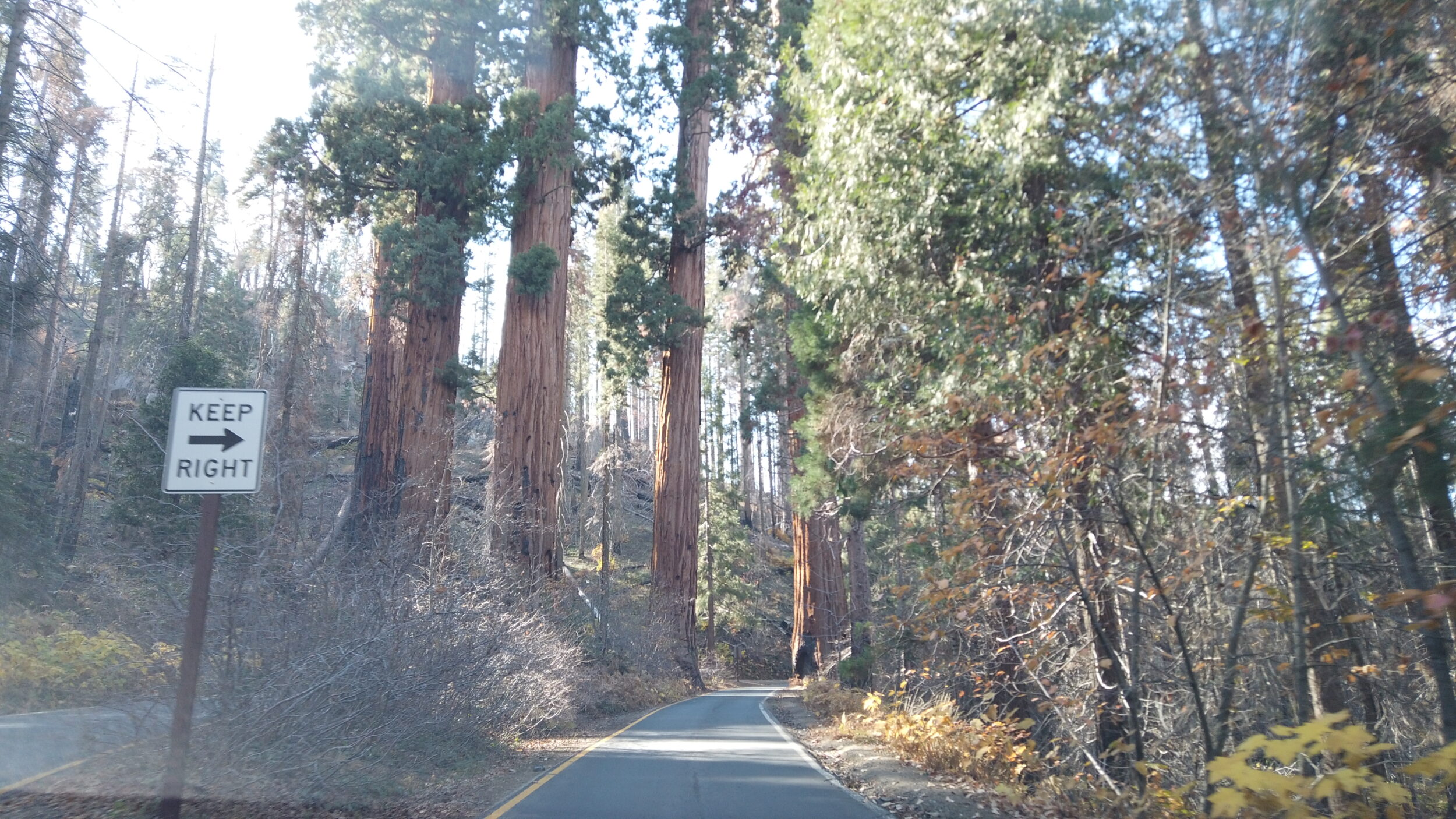
But on the way, we’ll see plenty of beautiful unnamed trees that deserve our attention. Not all beautiful trees have names, poor things.
We first stop at the museum that explains why sequoias live so long (some are 3000 years old). Their bark is very dry, and they don’t burn easily. And even when part of the trunk is burned, it can self-heal. The roots of this tree are huge and can reach deep water. Additionally, it can secrete chemical substances to ward off insect attacks. It also grows faster than other trees.
You can see several very impressive trees right in front of the museum, and there’s a sign indicating they’re “young” trees that are barely 1000 years old 😀 haha
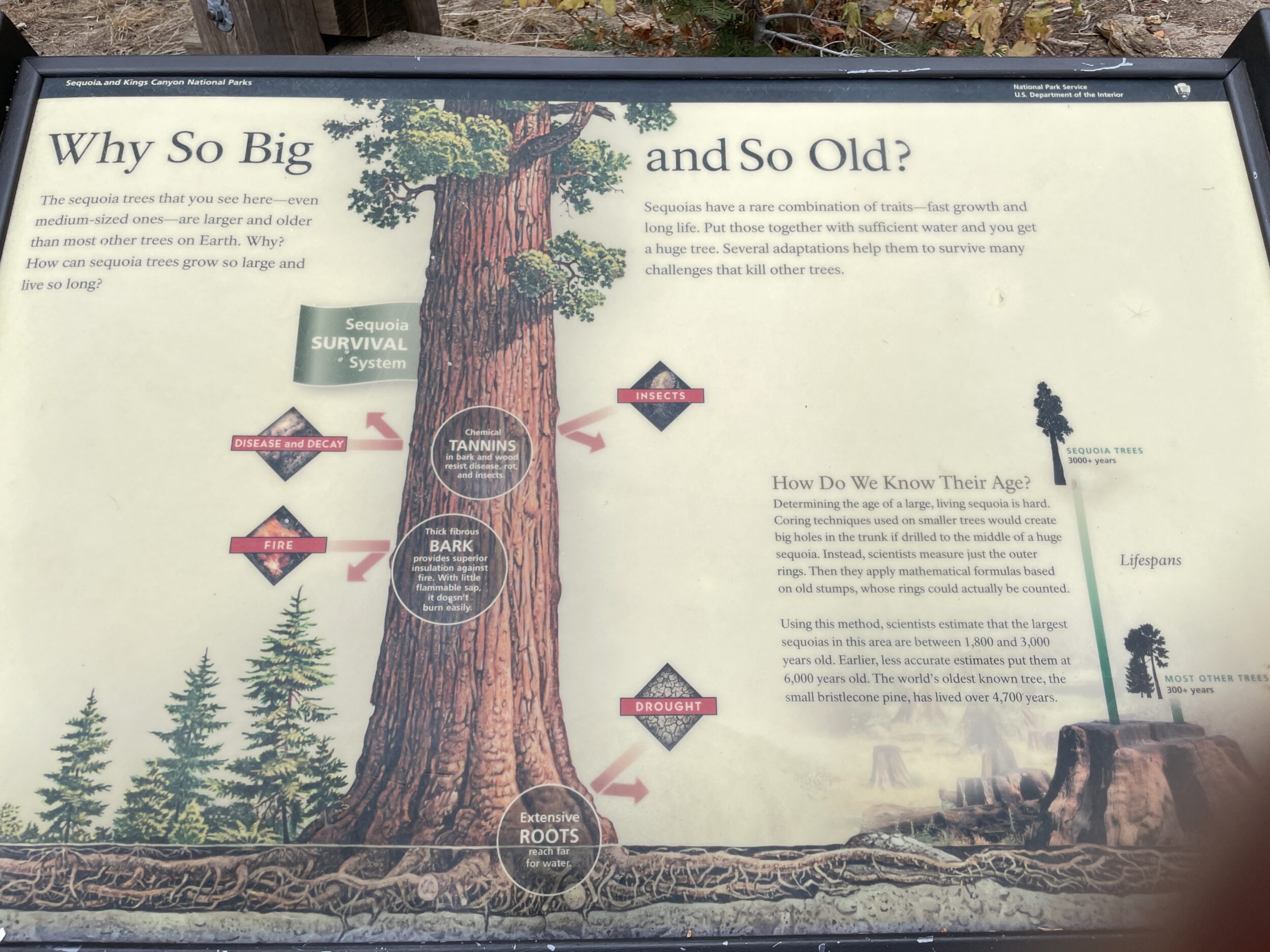
Here’s the explanatory text from the official park website:
Giant sequoias have survived varying climates over the past two to three millennia. For many years, it was believed that giant sequoias died by falling over or sustaining extensive crown scorch from fire. Standing death due to disease or insects (independent of crown scorch) has rarely been observed by scientists and managers who have worked for decades in the Sierra Nevada. A more significant drought occurred from 2012 to 2016. Higher temperatures intensified the effects of low precipitation, resulting in greater water loss and low moisture availability for the trees. In 2014, scientists observed significant giant sequoia foliage dieback. During and after this drought, they documented 33 giant sequoias that died standing, associated with native bark beetle activity and fire damage around the base of the tree. Scientists and managers are collecting information to better understand giant sequoia responses to drought and to characterize landscape-scale patterns of vulnerability to hotter drought.
Fire plays a crucial role in the ecosystem of giant sequoias. At the end of summer, when forest conditions become favorable for fires due to the dry season, lightning storms are not uncommon in the mountains. Fire scars in tree rings dating back 2,000 years show that widespread fires occurred naturally at intervals ranging from 6 to 35 years in these forests. Giant sequoias are adapted to periodic fire. The bark of the sequoia typically protects the trees from significant damage. With a thickness of up to 18 inches (46 cm) and extremely fibrous, sequoia bark not only resists burning but also insulates the tree from the heat of the fire. If fire penetrates the bark and scars the living tissue, new growth can heal the scar. However, giant sequoias endure many fires throughout their long lives and may fail to keep up with the healing process over decades to centuries of fire scars. Thus, you will see blackened areas extending from 1 to several feet up the trunks of older sequoias, where fires have marked the tree numerous times. Fire also prepares the bare, mineral soil needed for sequoia seeds to germinate. It removes competing vegetation and trees that seek to capture the abundant light young sequoias need. The reproductive success of giant sequoias requires only that each tree produce one mature offspring over its lifespan of several thousand years.
Sequoia cones hold their seeds—unlike other trees in their forest environment—in closed cones for perhaps 20 years. When a fire sweeps through the forest, the hot air dries out older cones. They open and, within one to two weeks, begin releasing their seed loads onto the bare, fire-swept ground. The life history of the giant sequoia begins with a very small seed, the size of an oat flake grain—91,000 sequoia seeds weigh just one pound (453 grams)! To germinate and survive, sequoia seeds must fall on mineral soil left bare by fire—without this, the seeds cannot successfully develop into new sequoia plants. Douglas squirrels and cone-boring beetles can also release seeds, but if they don’t fall on bare soil cleared by fire, they cannot germinate.
For a century, there have been no fires, so no new sequoias are forming. In fact, sequoias benefit from fires: since they don’t burn, fires burning neighboring trees give them more space and resources. The soil, cleared of branches and leaves, is more conducive to young trees. Thus, to help new sequoias grow, rangers must conduct controlled fires to burn the dead branches and leaves littering the ground.
The 2020 disaster (Castle Fire) is still remembered: those California fires that lasted months caused the loss of between 7,500 and 10,600 ancient sequoias, and the Windy Fire in 2021 killed between 931 and 1,257 ancient sequoias. So, between 2020 and 2021, we lost between 13 and 19% of the world’s largest sequoias. As we saw above and as indicated in the excellent book “The Hidden Life of Trees”, a tree produces only one descendant. With the loss of these sequoias, it will take thousands of years to replace them.
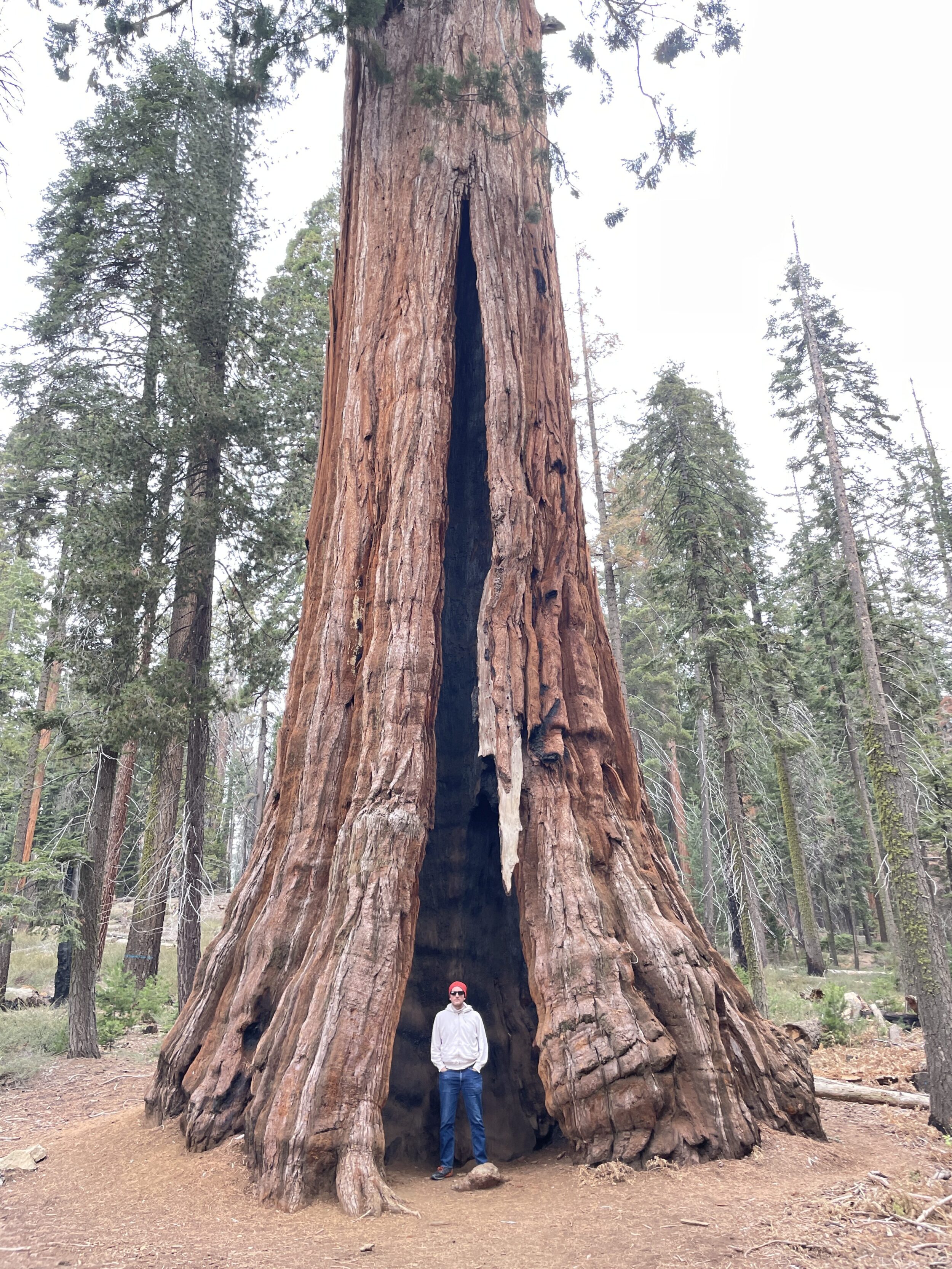
On the way to Tunnel Log, we see this tree, badly damaged at the base but still standing. These trees, partly damaged by the fire, risk falling one day. As they are immense and very heavy, one day the trunk will no longer be able to support its own weight due to this asymmetry caused by the fire. And they will fall, roots torn out.
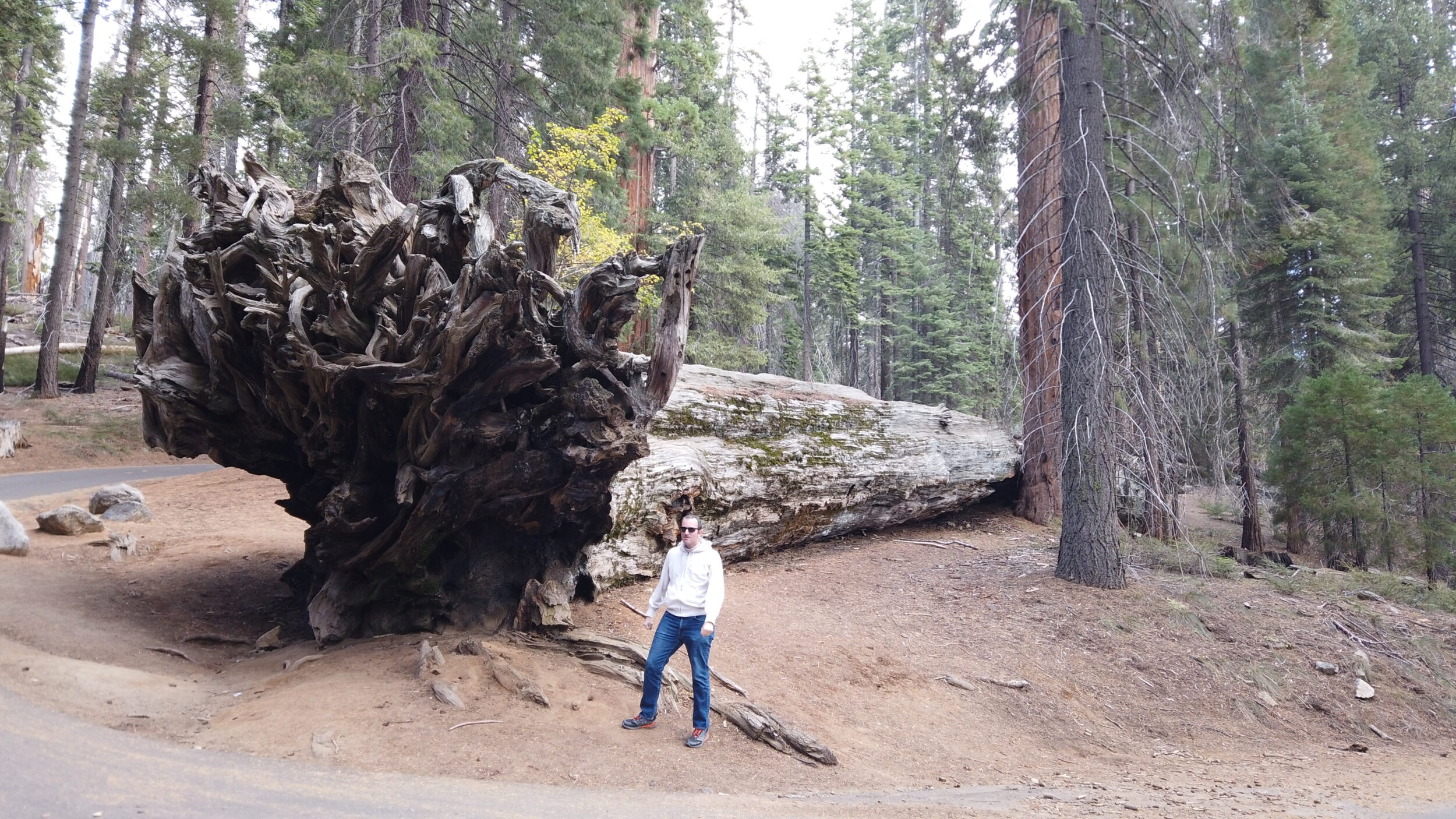
By the way, we’ll see some trees with clearly visible roots, and even the roots are several meters in diameter.
There are many beautiful sequoias along the path; feel free to stop regularly.
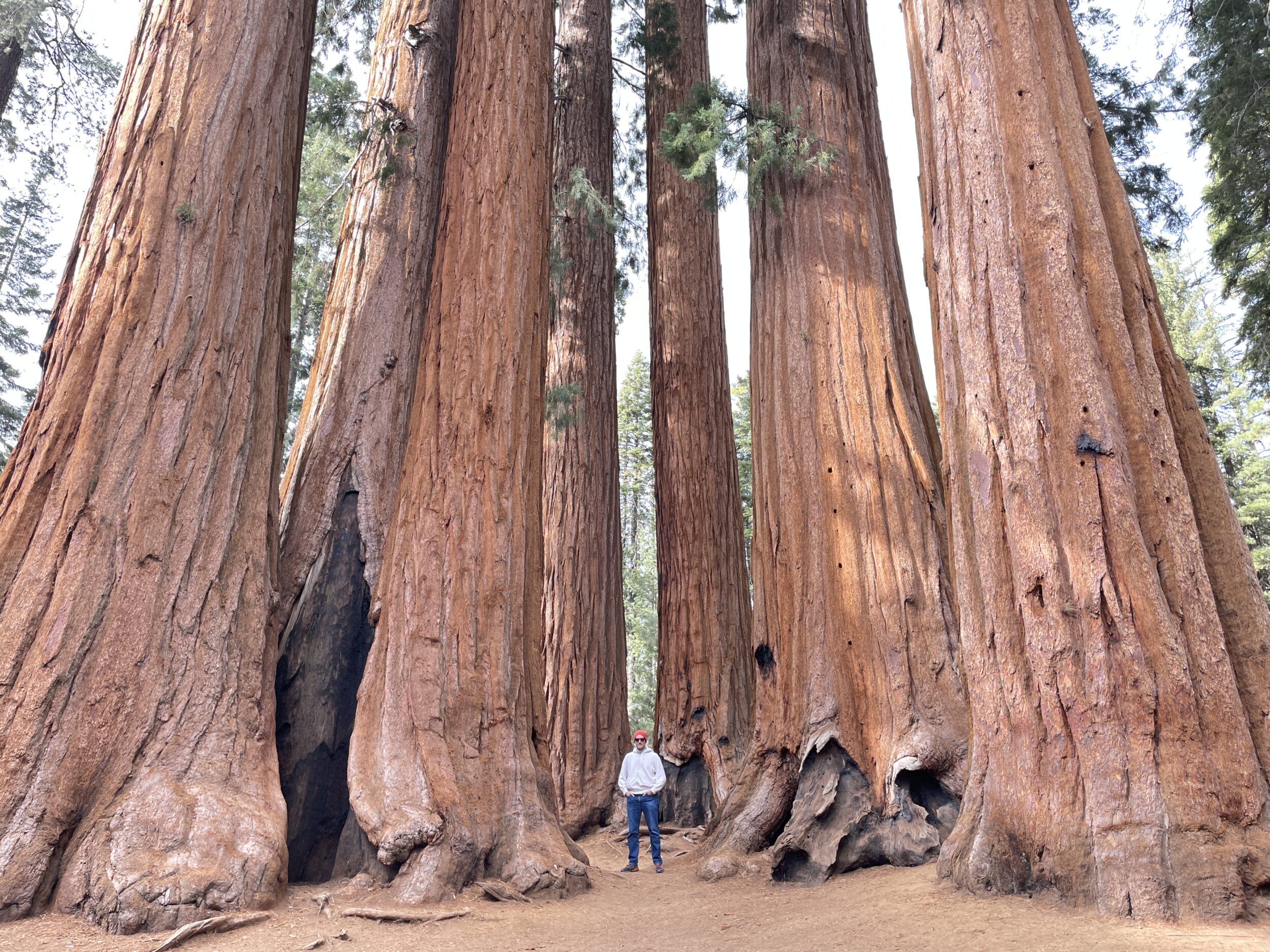
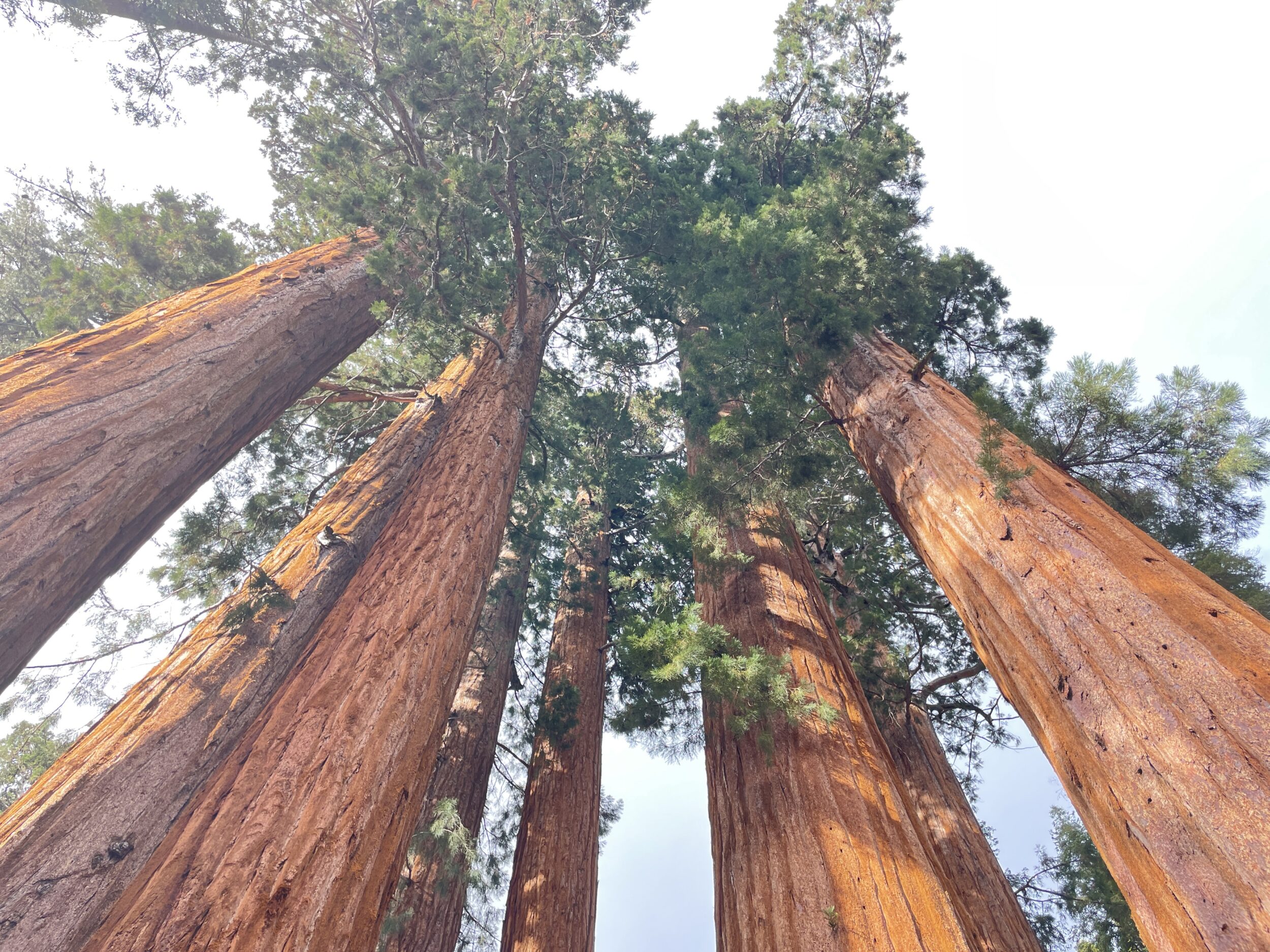
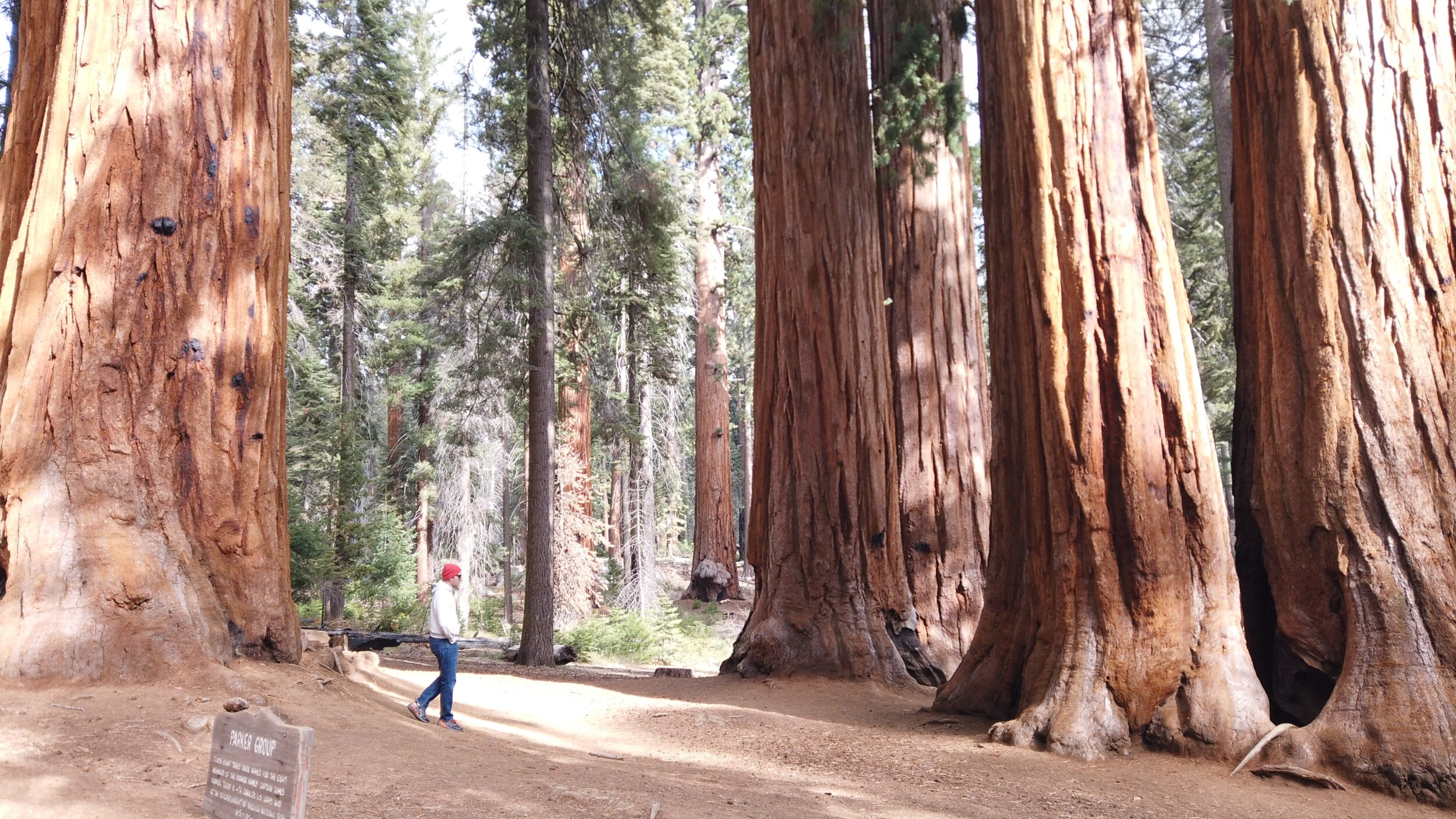
Parker Group
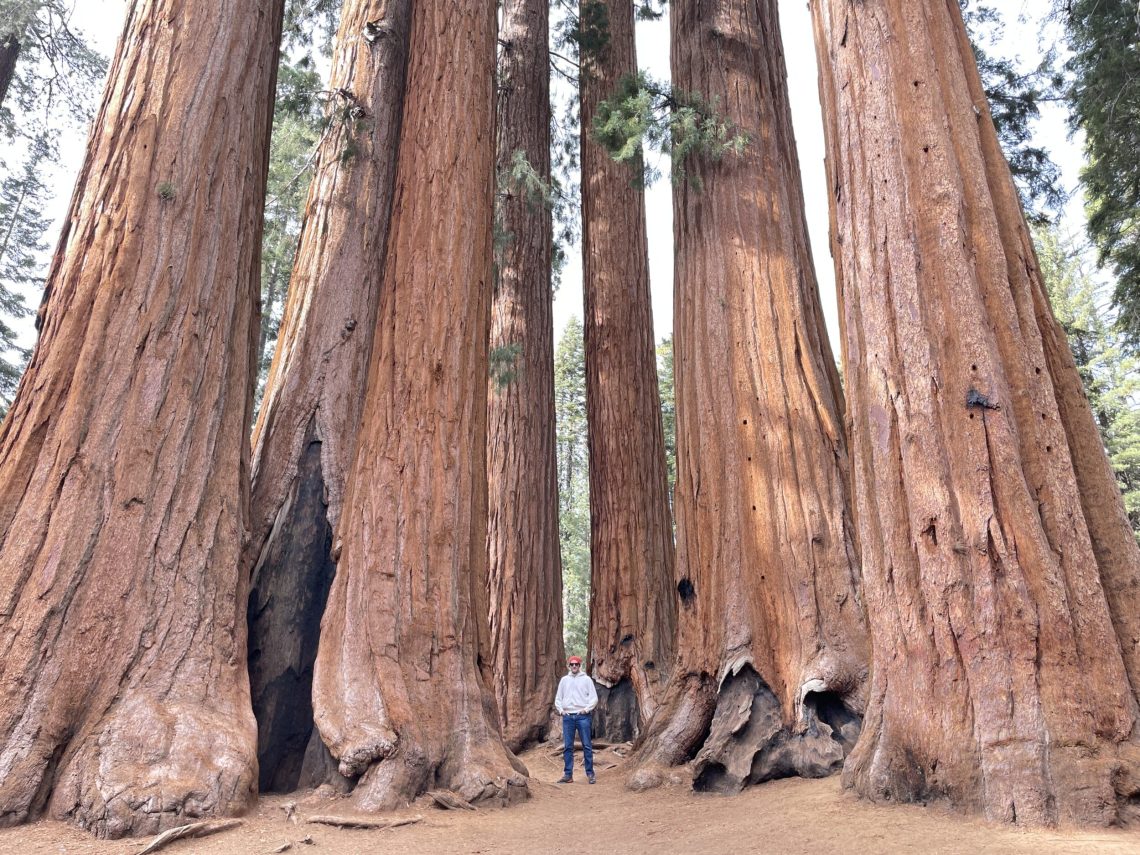
Before going to Tunnel Log, we come face to face with this group of 8 immense sequoias. You can touch them, but touching them isn’t really pleasant because the bark is very dry, and the more you touch it, the more you damage it (they’ll be less protected against fires), so if possible, it’s better to just look. JB, who is tall, isn’t used to appearing so small 😀
Tunnel Log
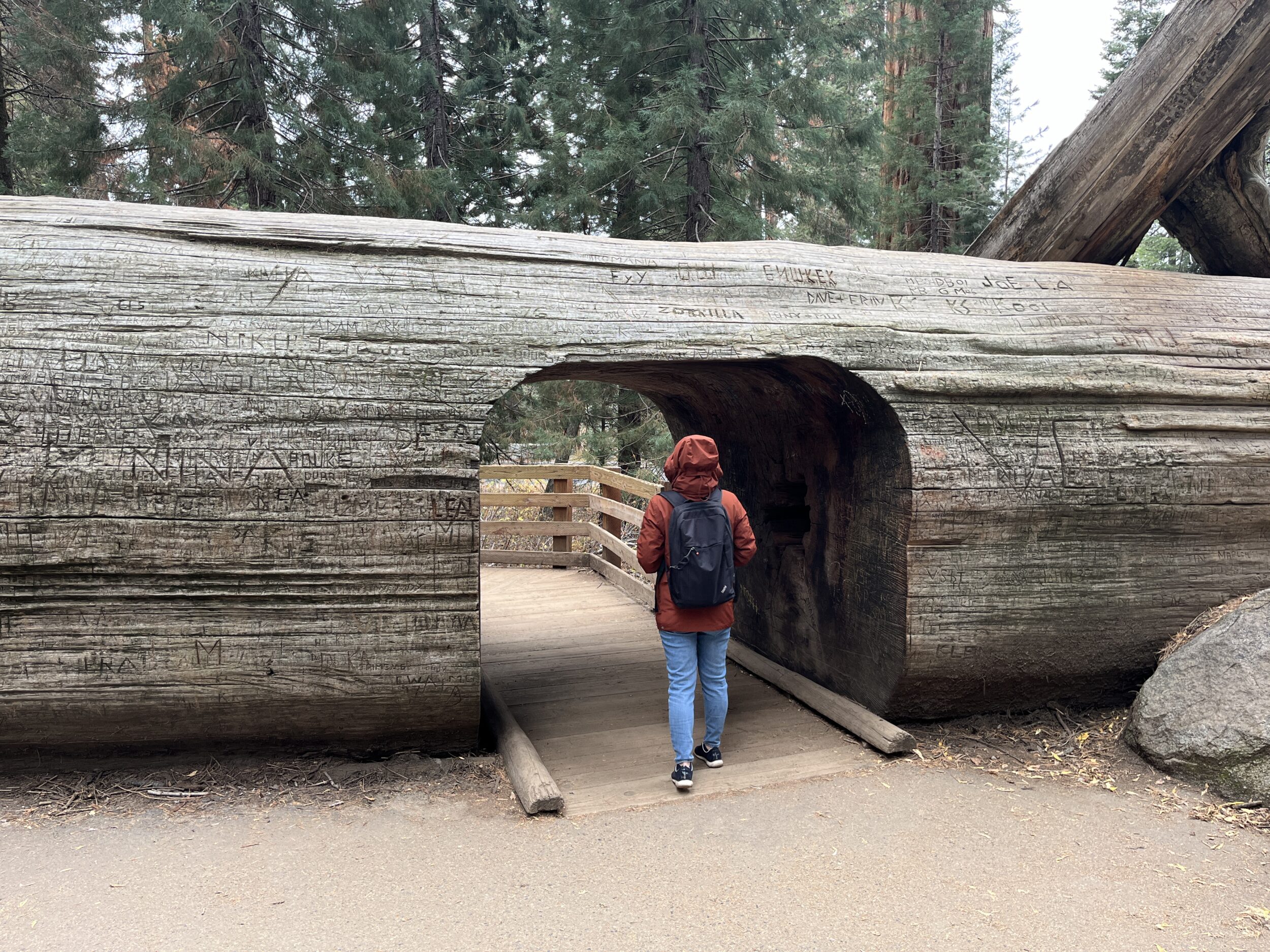
With our small car, we drive under this tunnel formed by a fallen sequoia, without any problem. A camper van will try to do the same but won’t make it, of course (there’s a detour for vehicles that don’t fit). As always, I put JB next to it so you can get an idea of the trunk’s size, knowing JB is 1.85m tall.
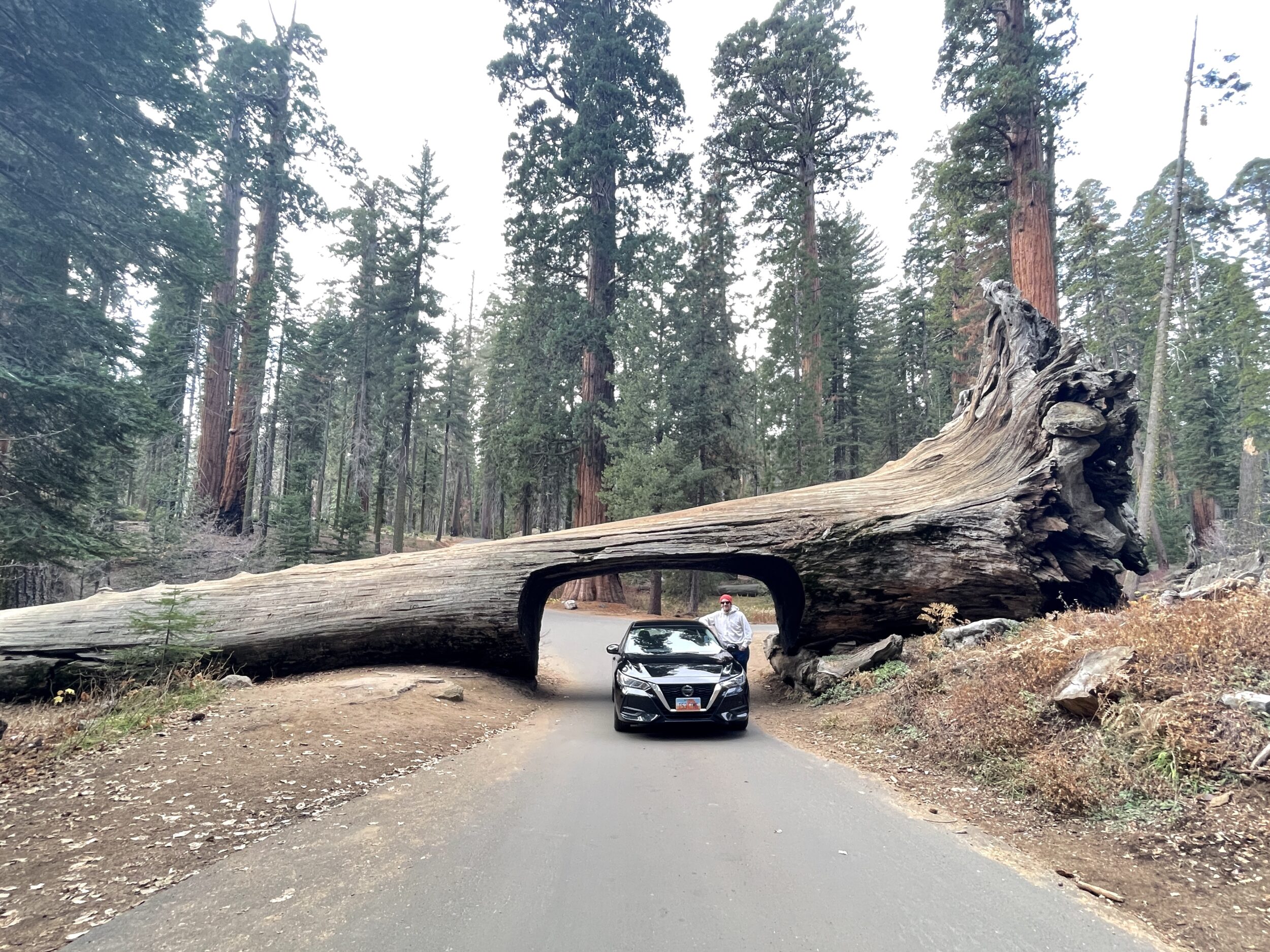
We then take the car to go to Crescent Meadow, but since we’re not hiking, there’s nothing interesting to see by car. I know you can follow the trails within the Giant Forest Grove, I saw several parking lots on the road, but it’s not for us. Also, if you wish, book a tour to explore the Crystal Cave.
General Sherman
For General Sherman, there are two parking lots: the closest one, for disabled visitors (200 meters from General Sherman), and a farther, larger one for everyone else. In winter, we could have parked in the closest lot but didn’t know that, so we took a long detour to the other one and walked about 1.6 km. It wasn’t a big deal; the fresh mountain air did us a lot of good, even though it was freezing cold. On the way to General Sherman, there are other giant trees, but not as beautiful as the ones we saw on the way to Tunnel Log.
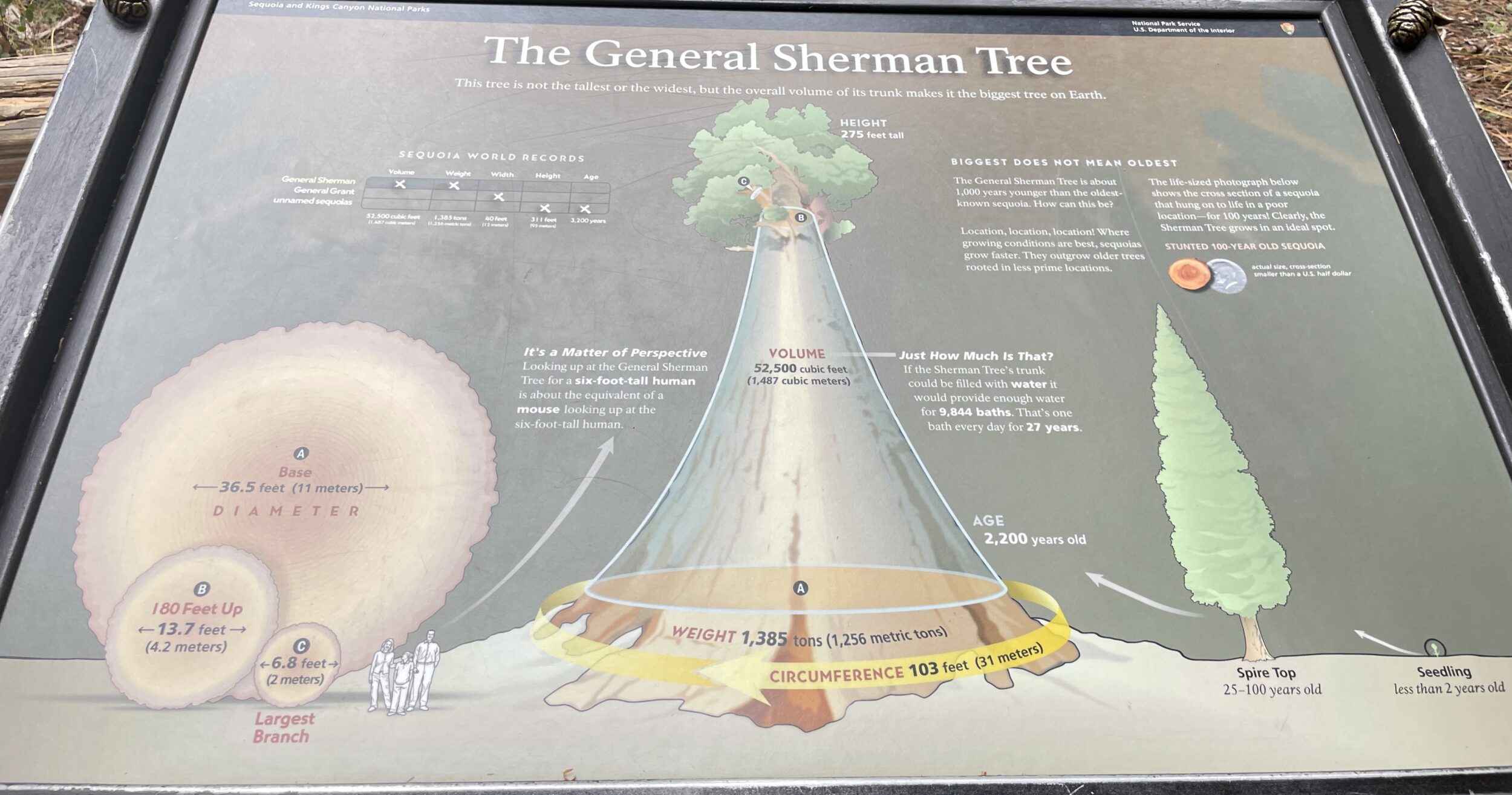
And here is the General Sherman. Poor thing doesn’t have many leaves left. It won’t grow any taller, but its trunk will continue to thicken. Everyone knows that each ring on the trunk represents a year, and rings can be wider or narrower depending on how much water there was that year. By counting the rings, you can determine the age of a dead tree, but for a living tree, you have to measure the circumference of the trunk and make an estimate; unfortunately, you can’t be very precise.
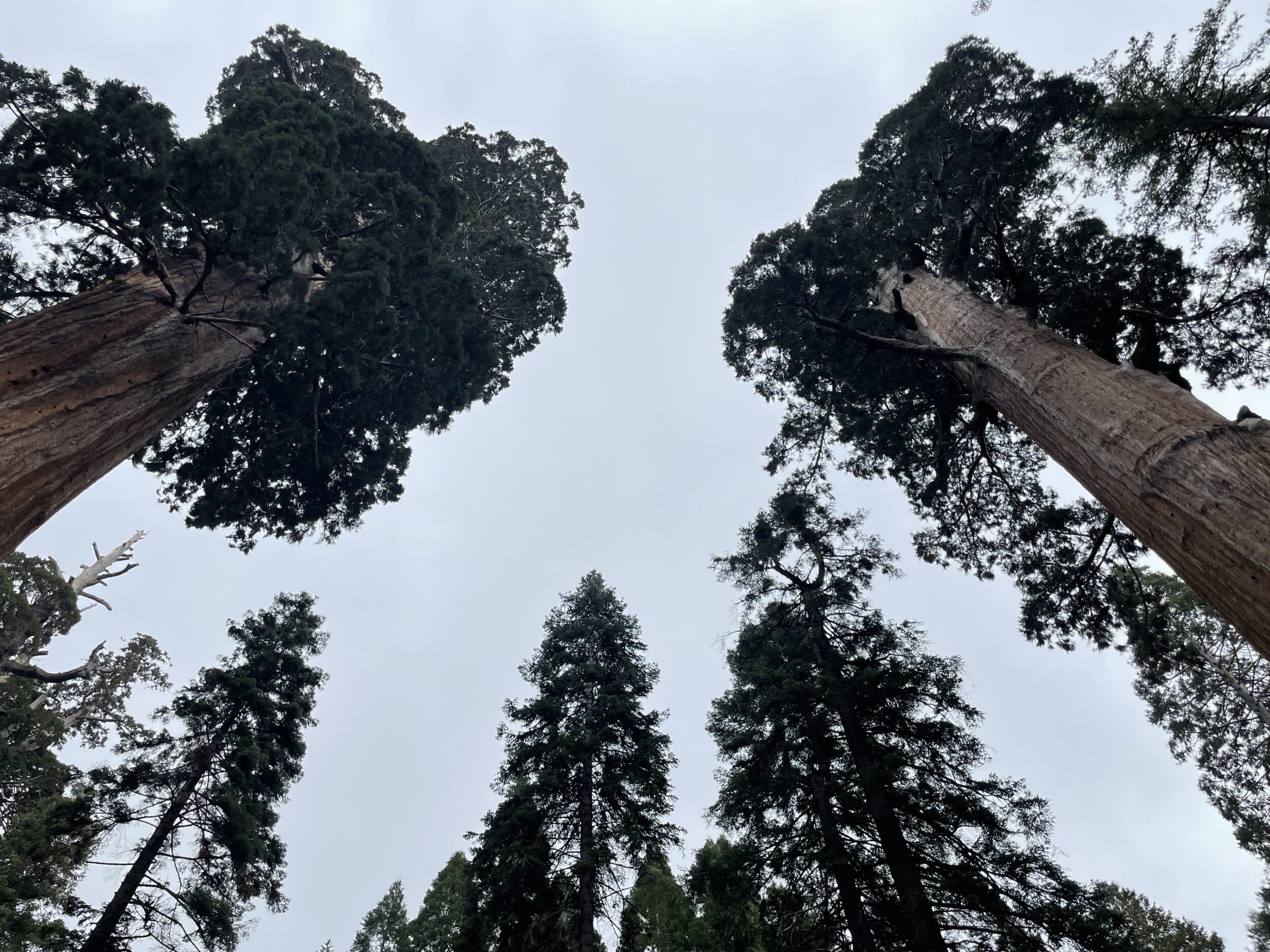
A human compared to this tree is like a mouse compared to a human.
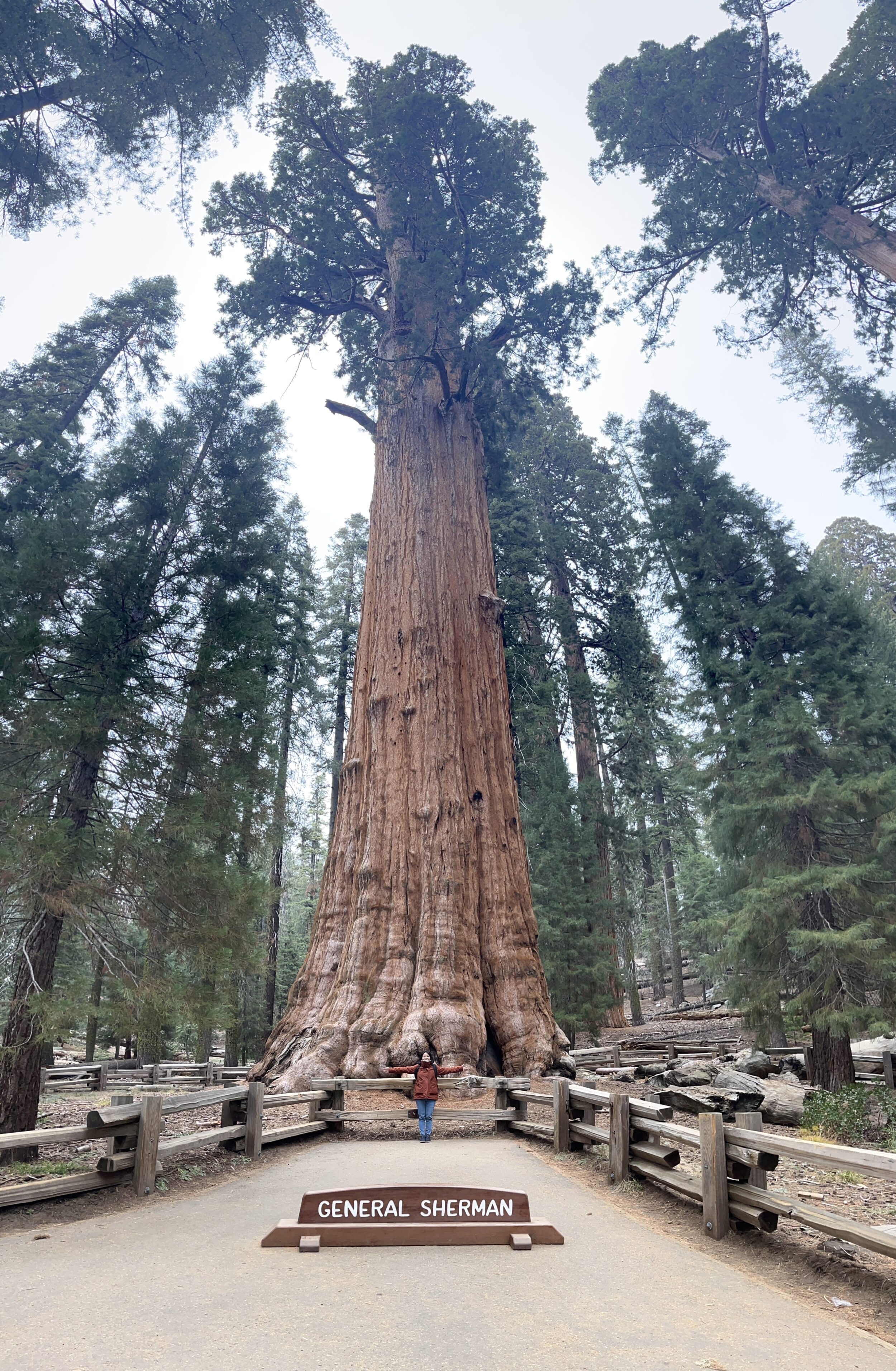
And General Sherman seen from afar. It’s the biggest tree in the world, in volume and weight (meaning it has the most wood in the world).
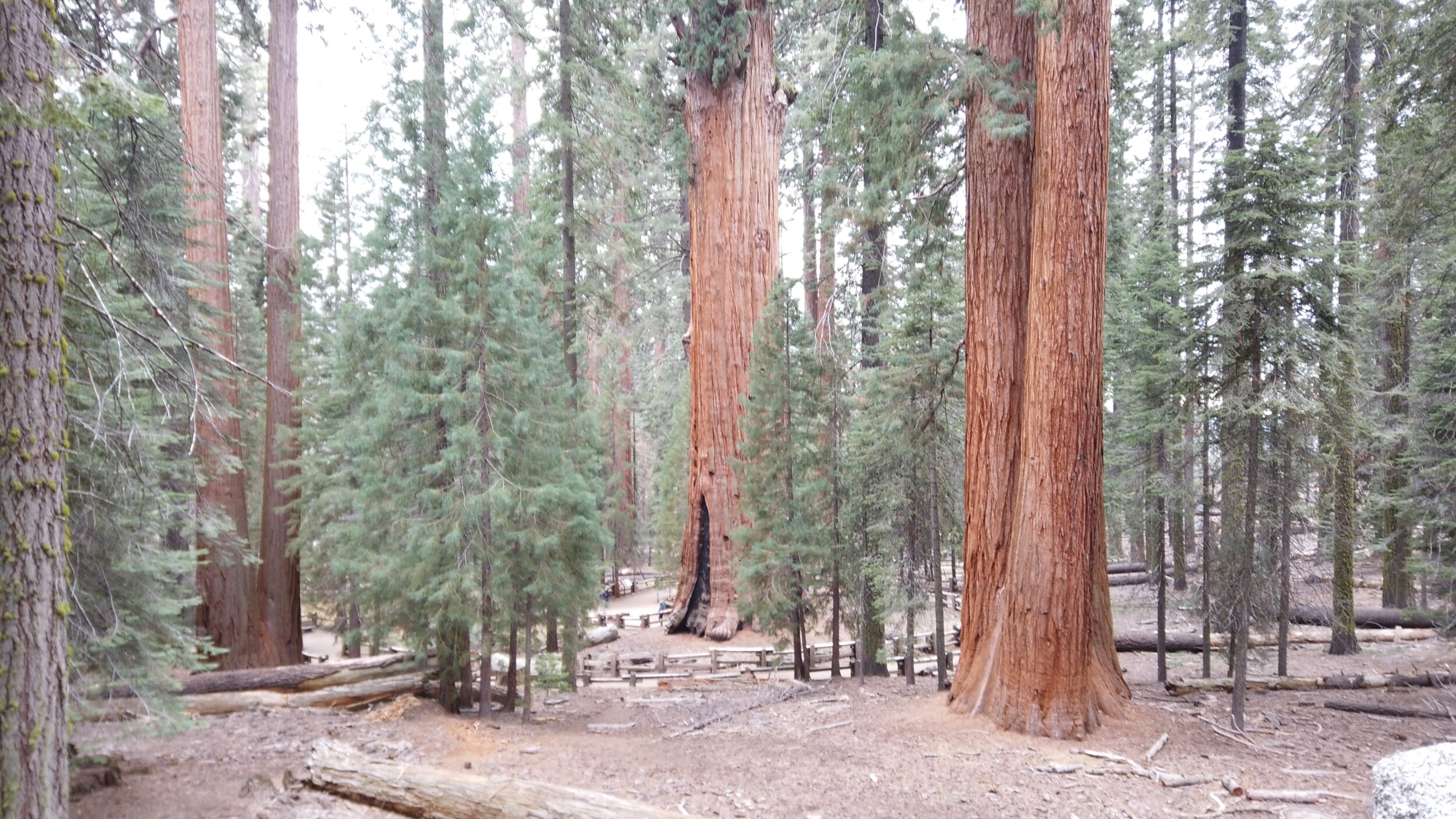
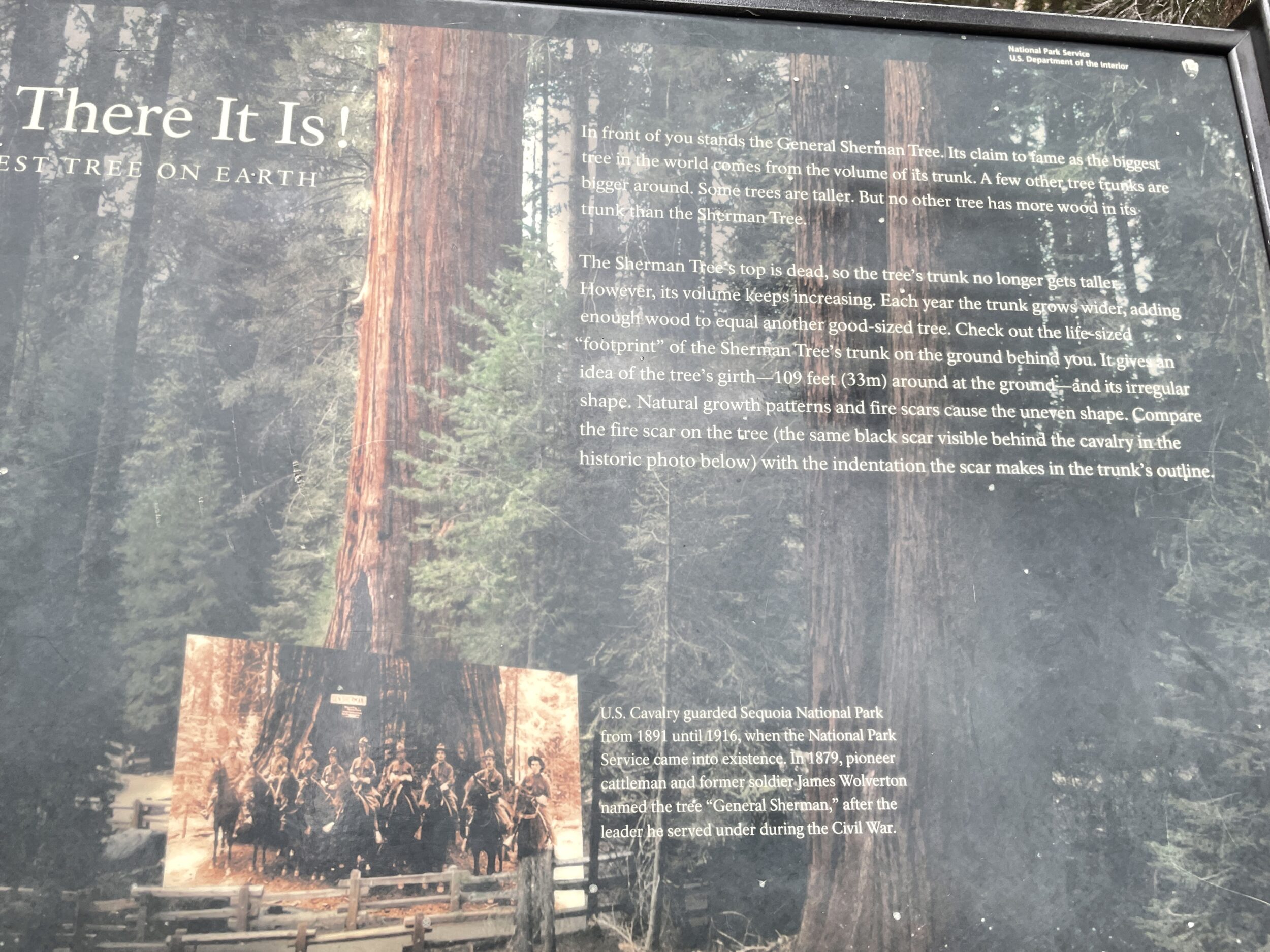
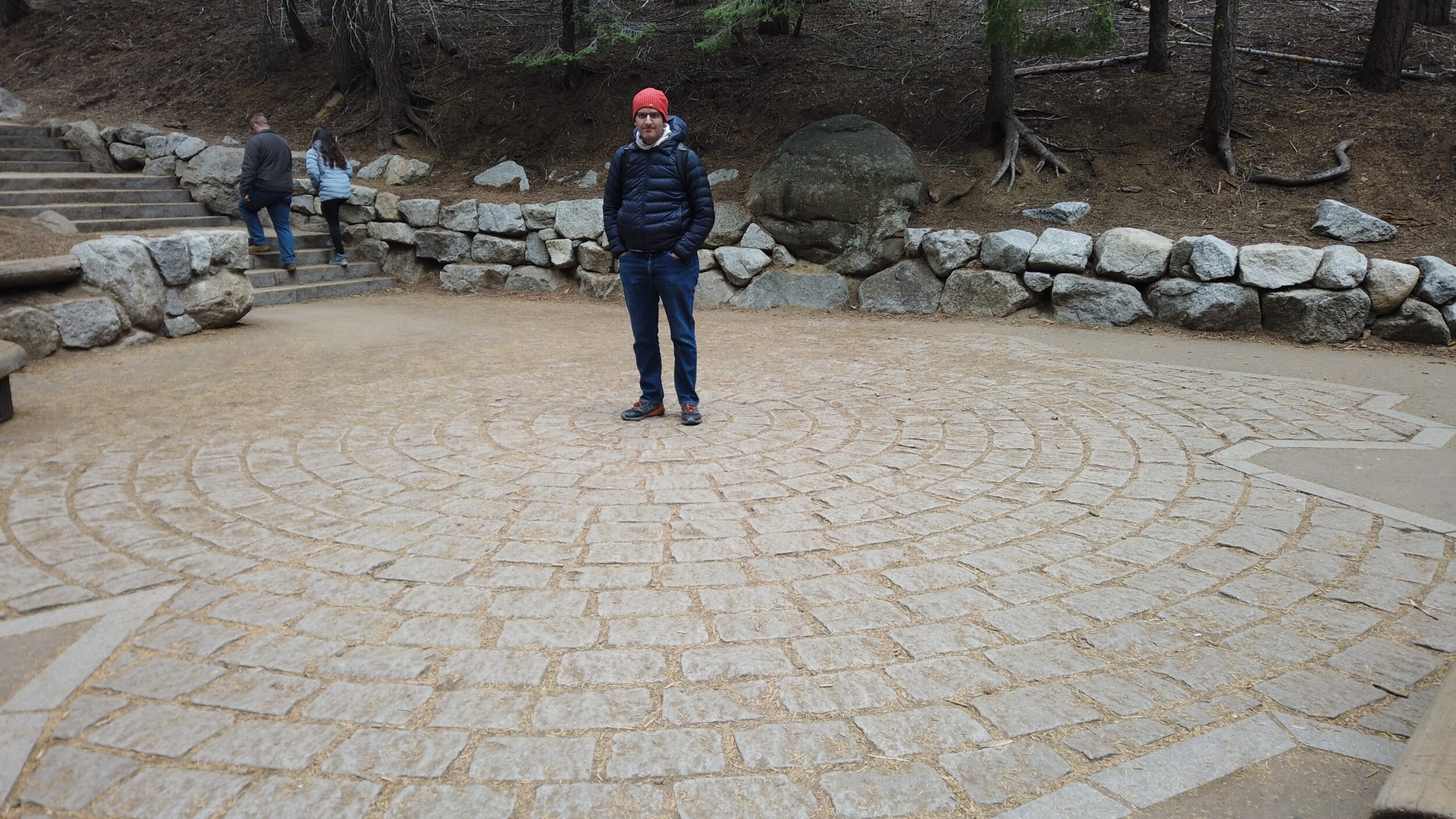
Since you can’t get close to it, a model of its base has been reproduced on the ground (11 meters in diameter). I think our first Parisian apartment was smaller than that.
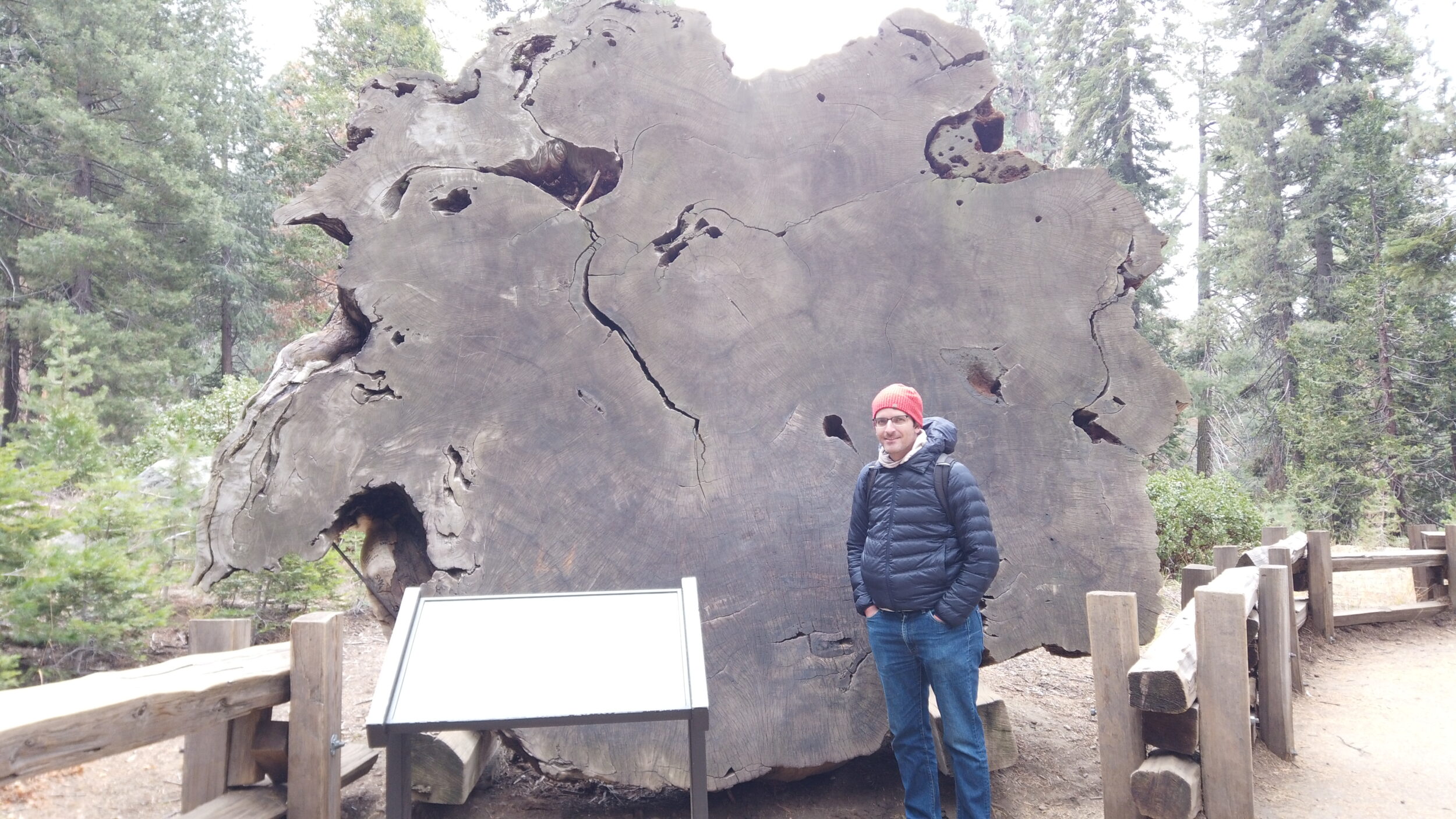
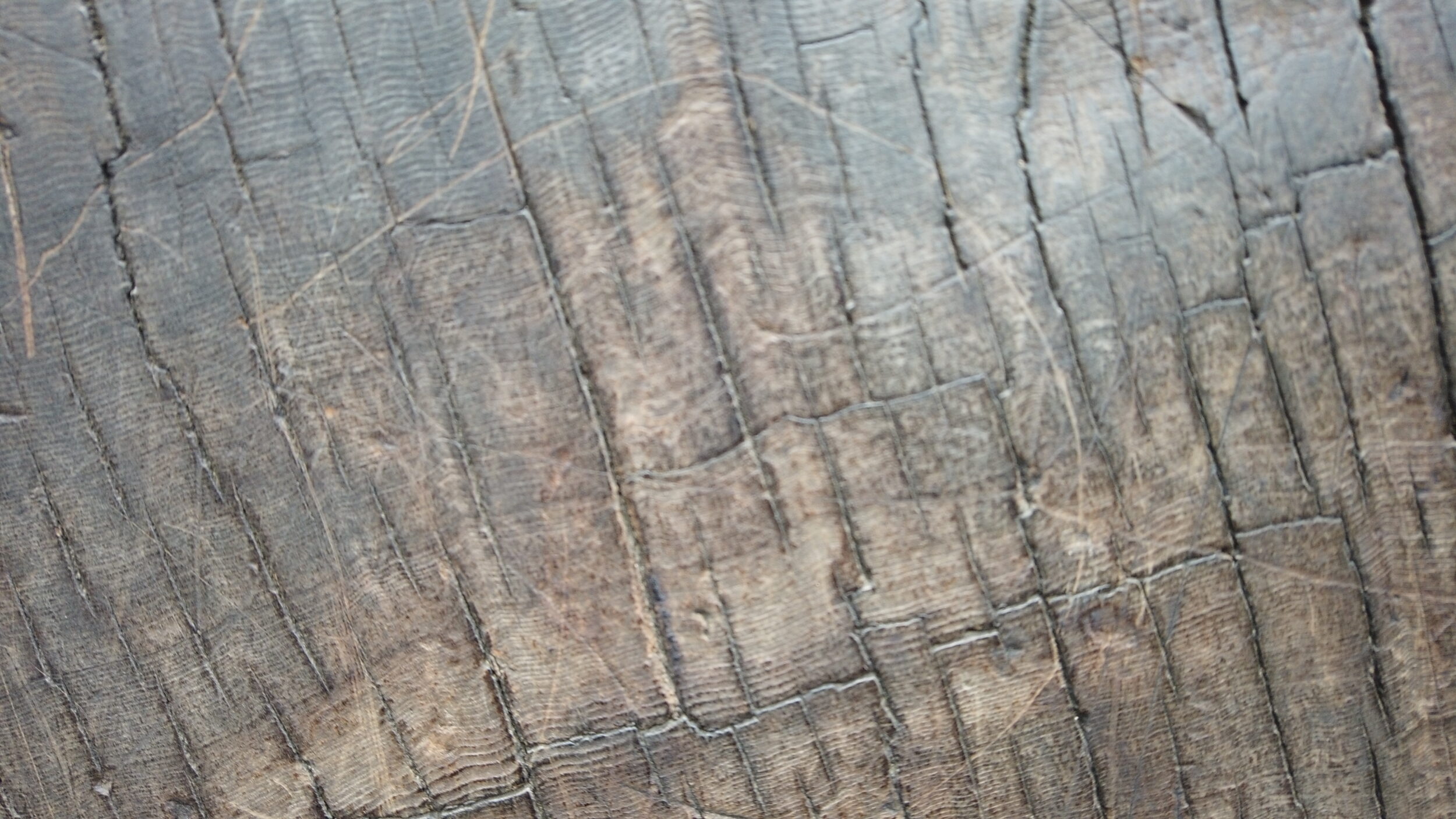
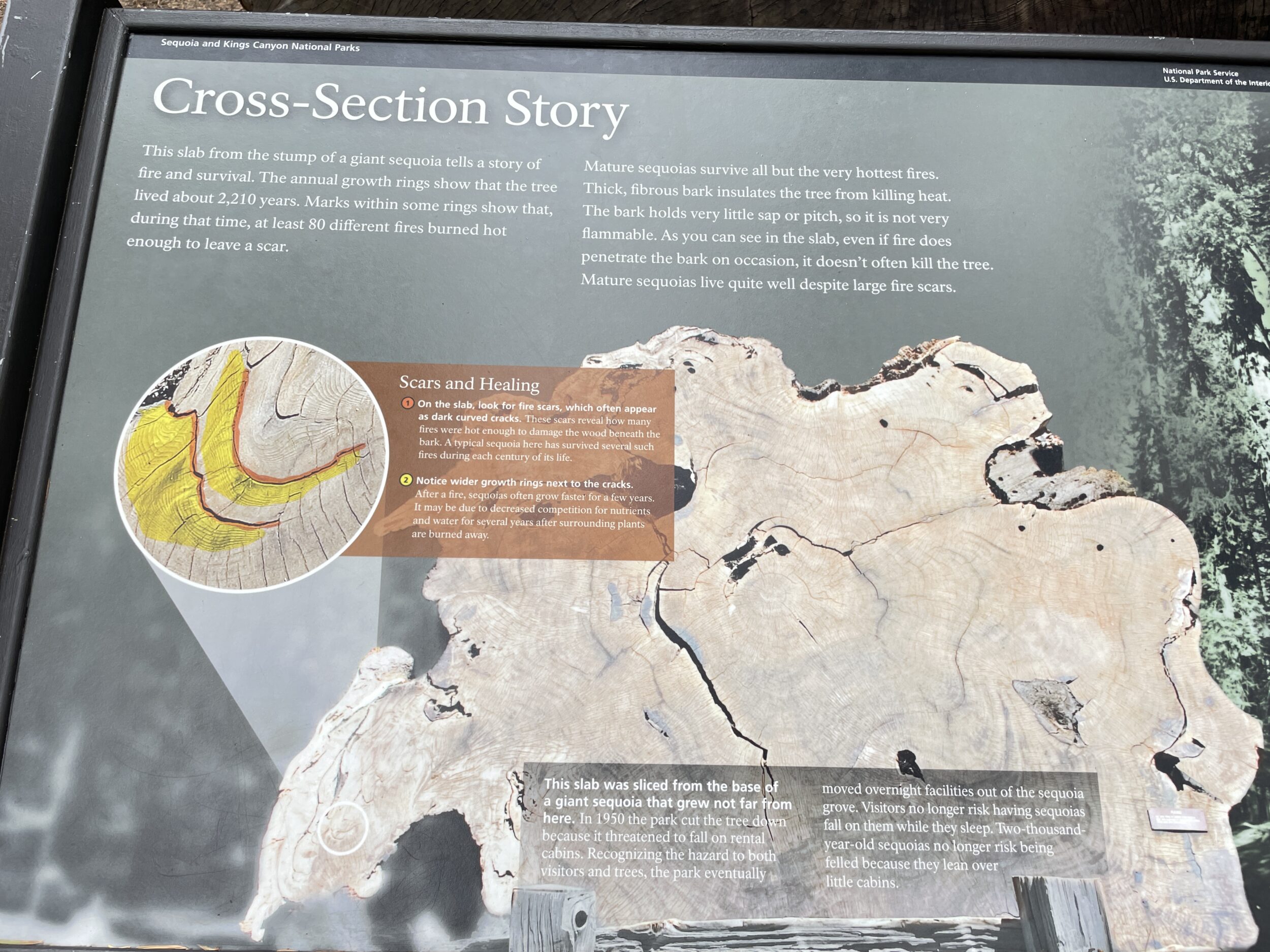
Around this tree, there are other paths leading to other sequoias and other discoveries, like this cut root, so you can clearly see the rings, the disparity of the rings, and the scars from fires. This one was 2,210 years old!!
Kings Canyon National Park
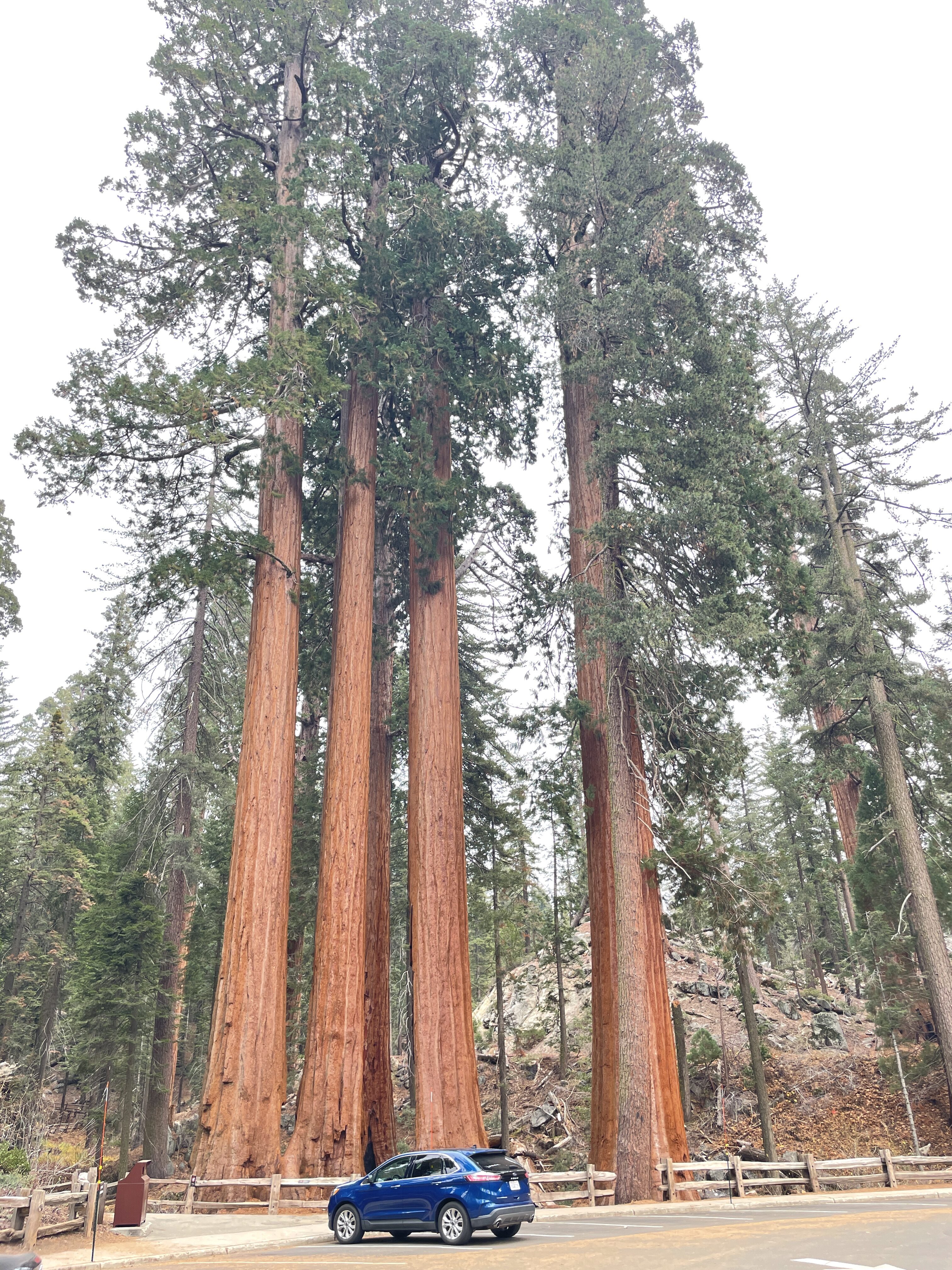
You just have to follow the road to reach Kings Canyon National Park. No one asks to see our ticket. I’m showing you the trees right next to the General Grant Tree parking lot. I’m happy because for the first time, I found sequoias that fit entirely in a photo haha
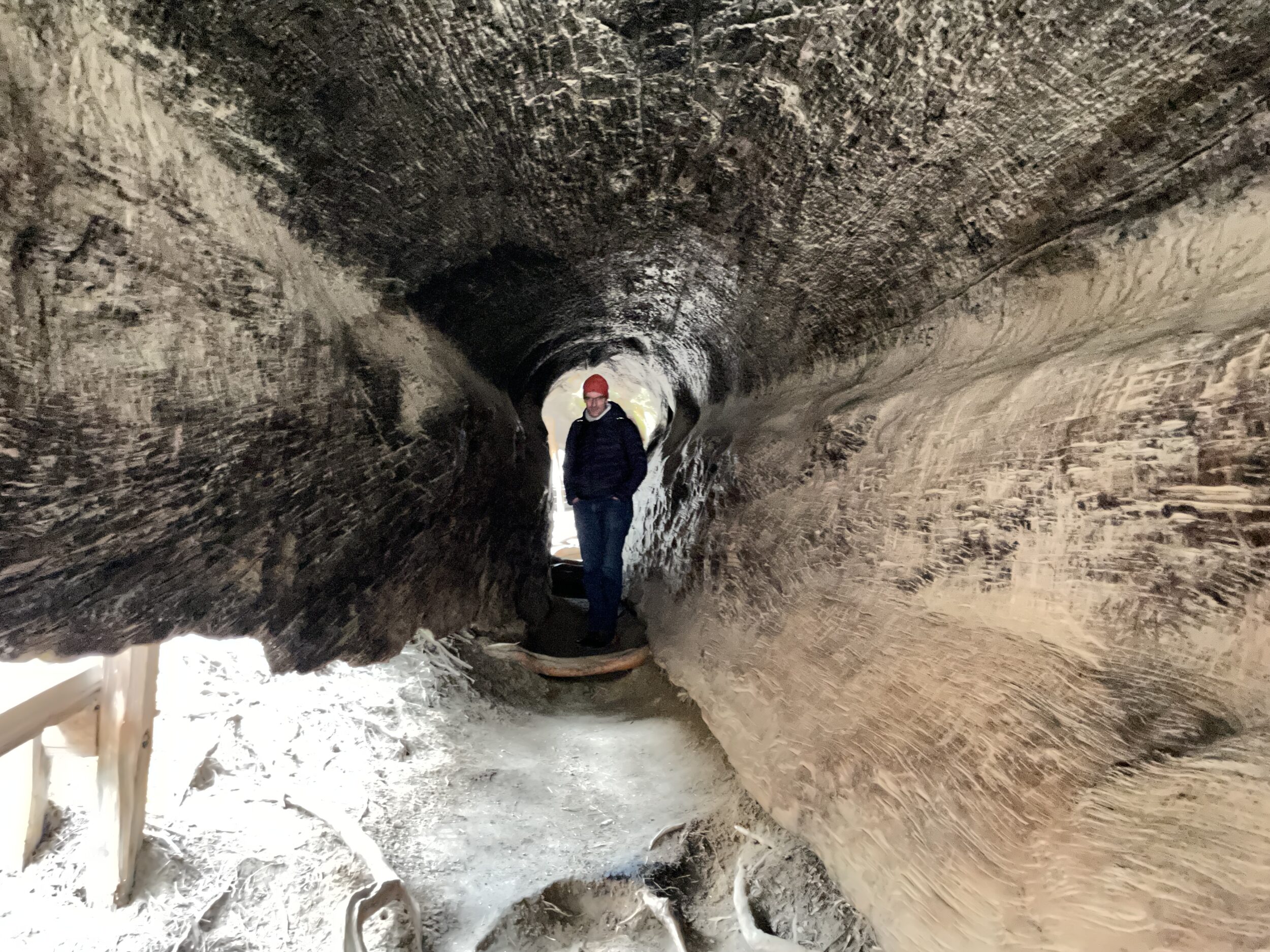
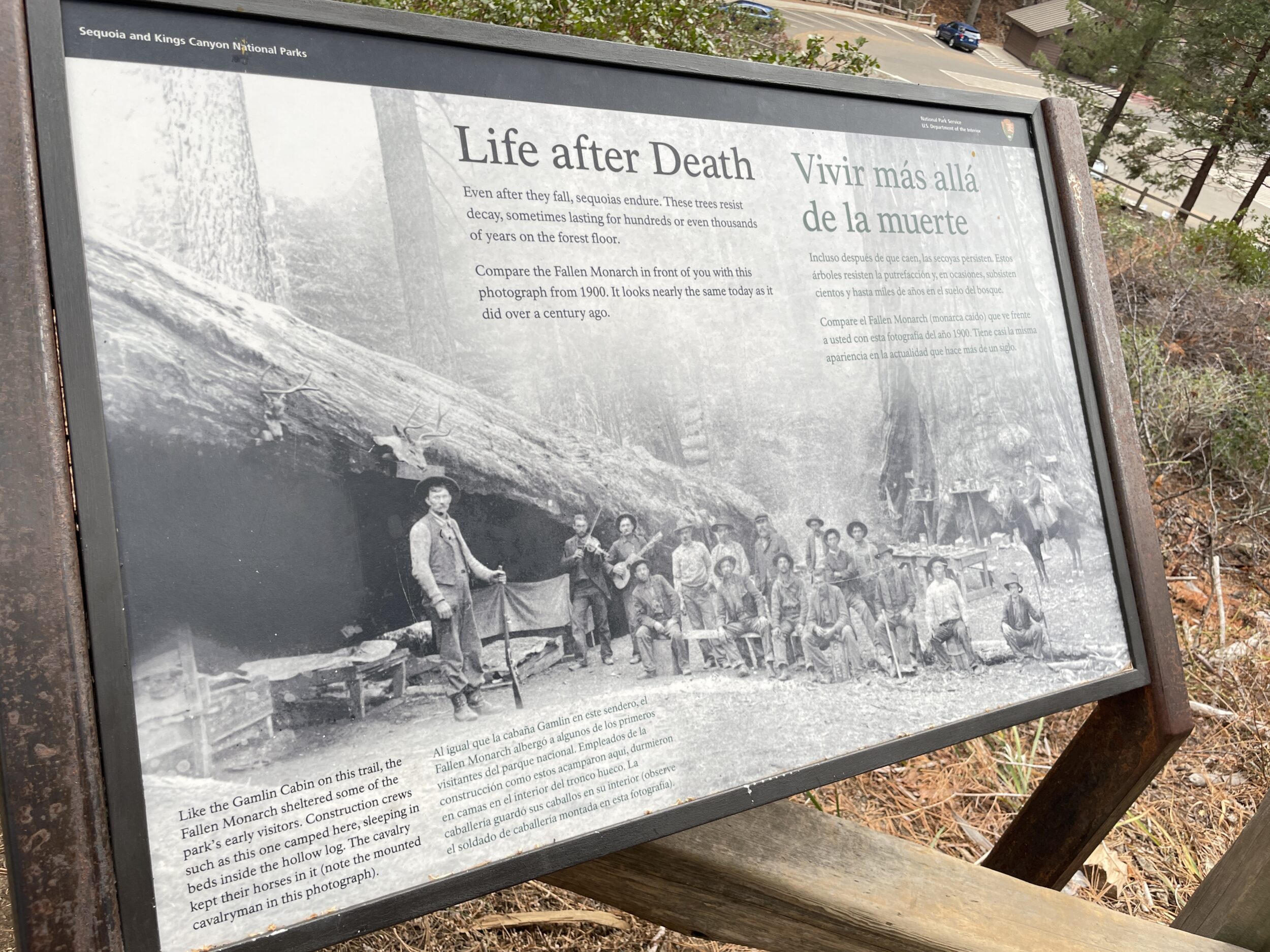
We’re a bit lost because the signs aren’t very clear and we have to check Google Maps to find where General Grant Tree is. In the meantime, we’re more attracted to a fallen tree that served as a home over a century ago. It’s very cozy inside.
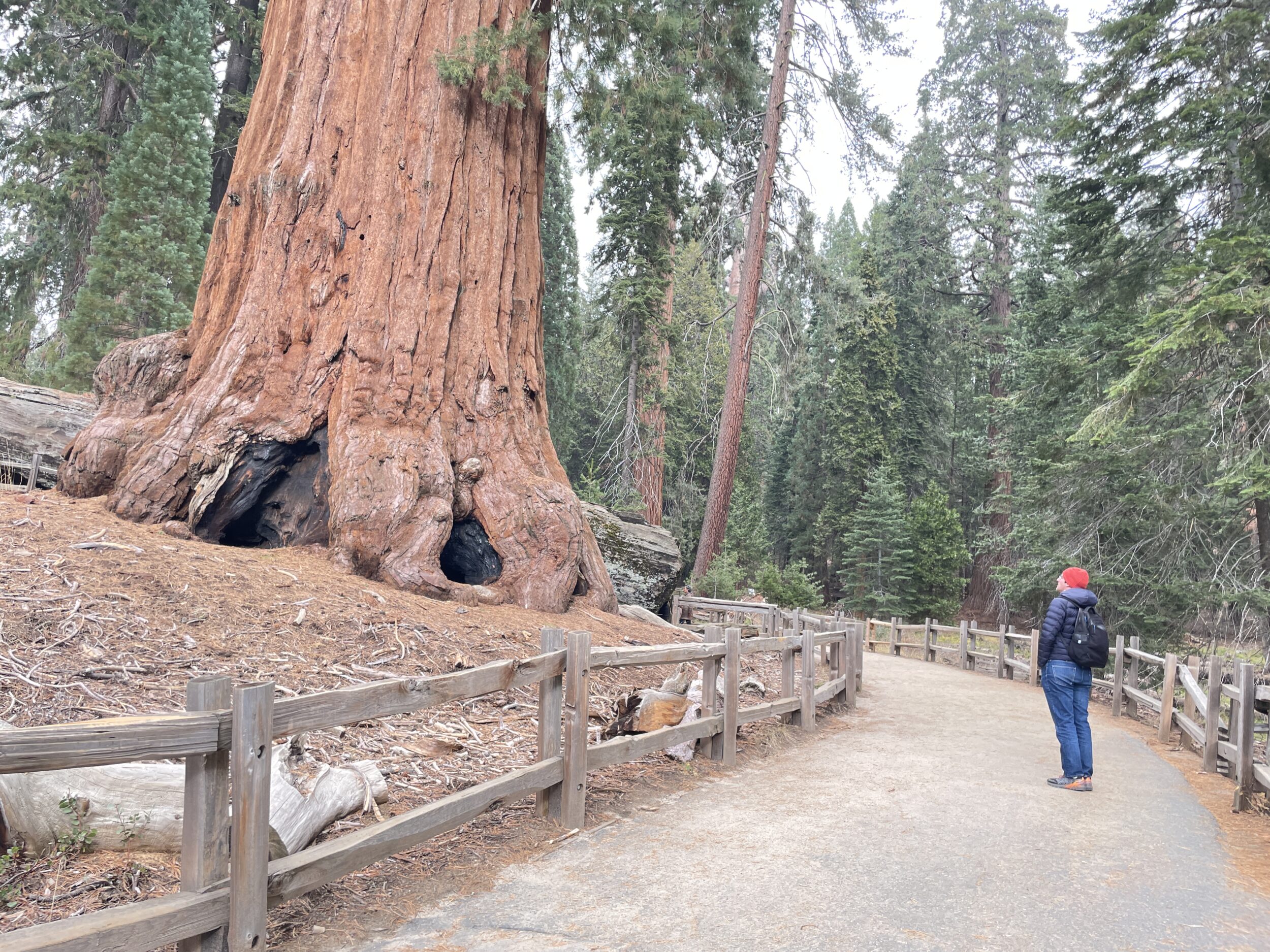
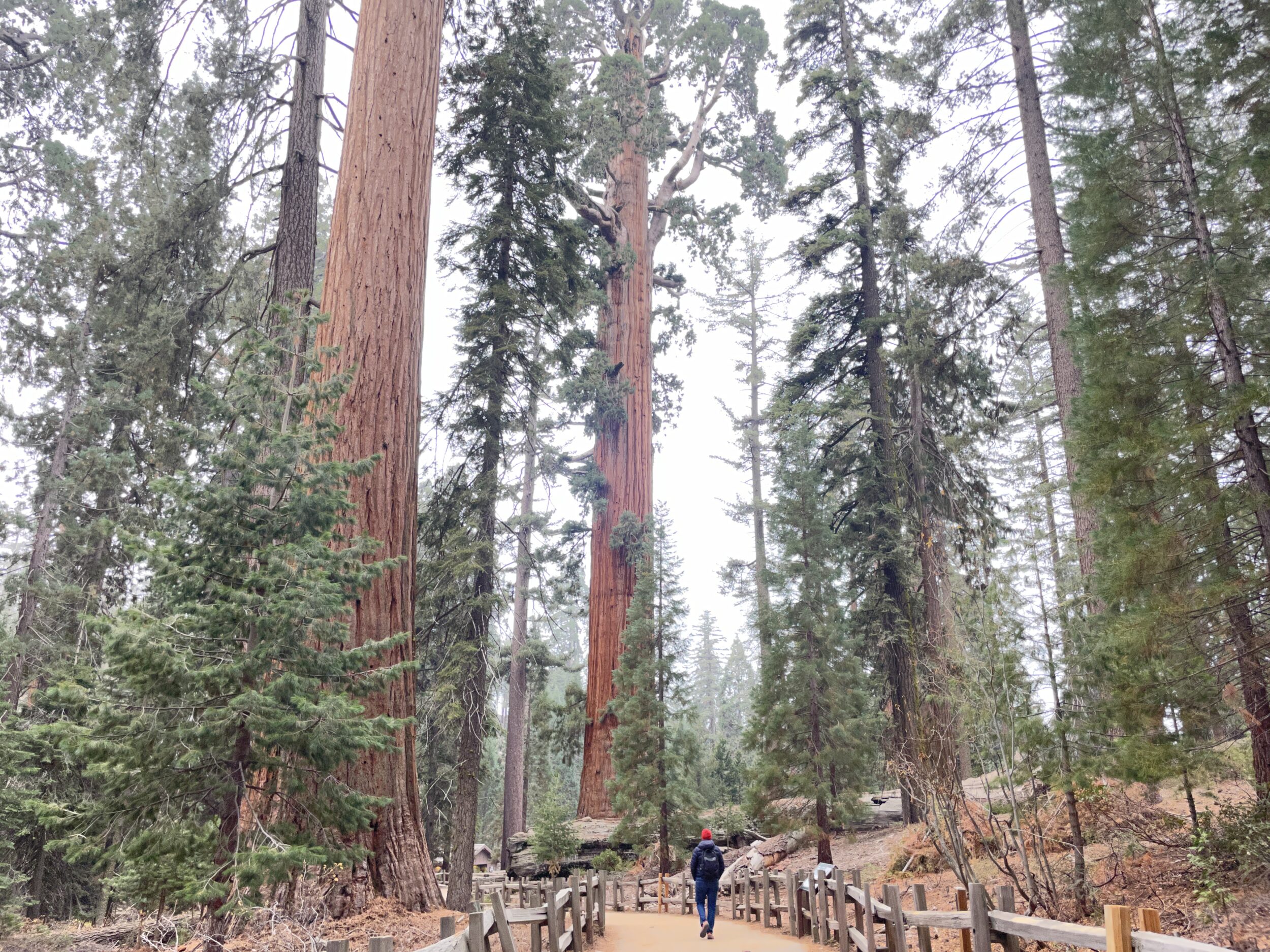
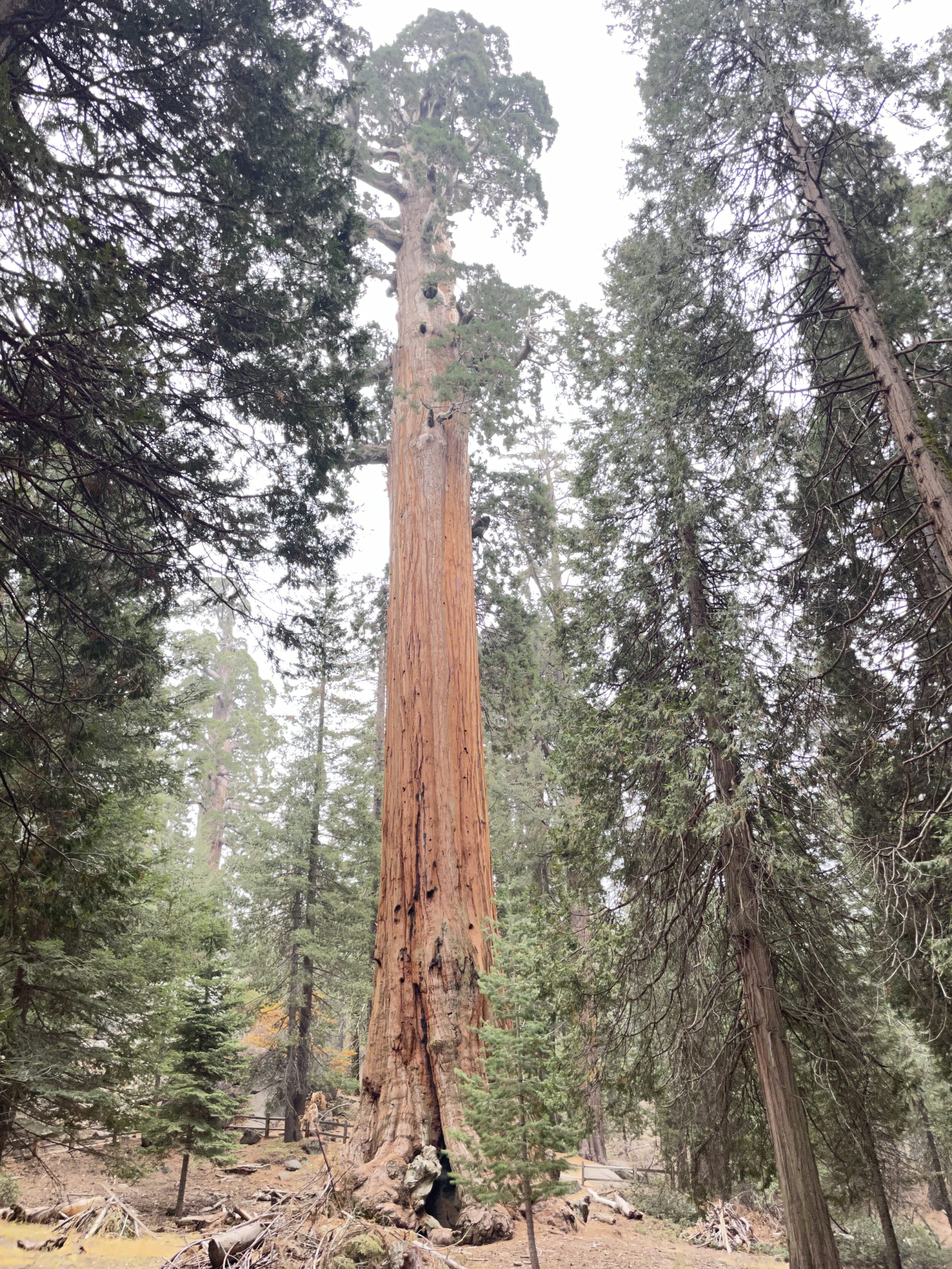
Here is the General Grant Tree, it’s the widest in the world. You wouldn’t think so because you can’t get close to it.
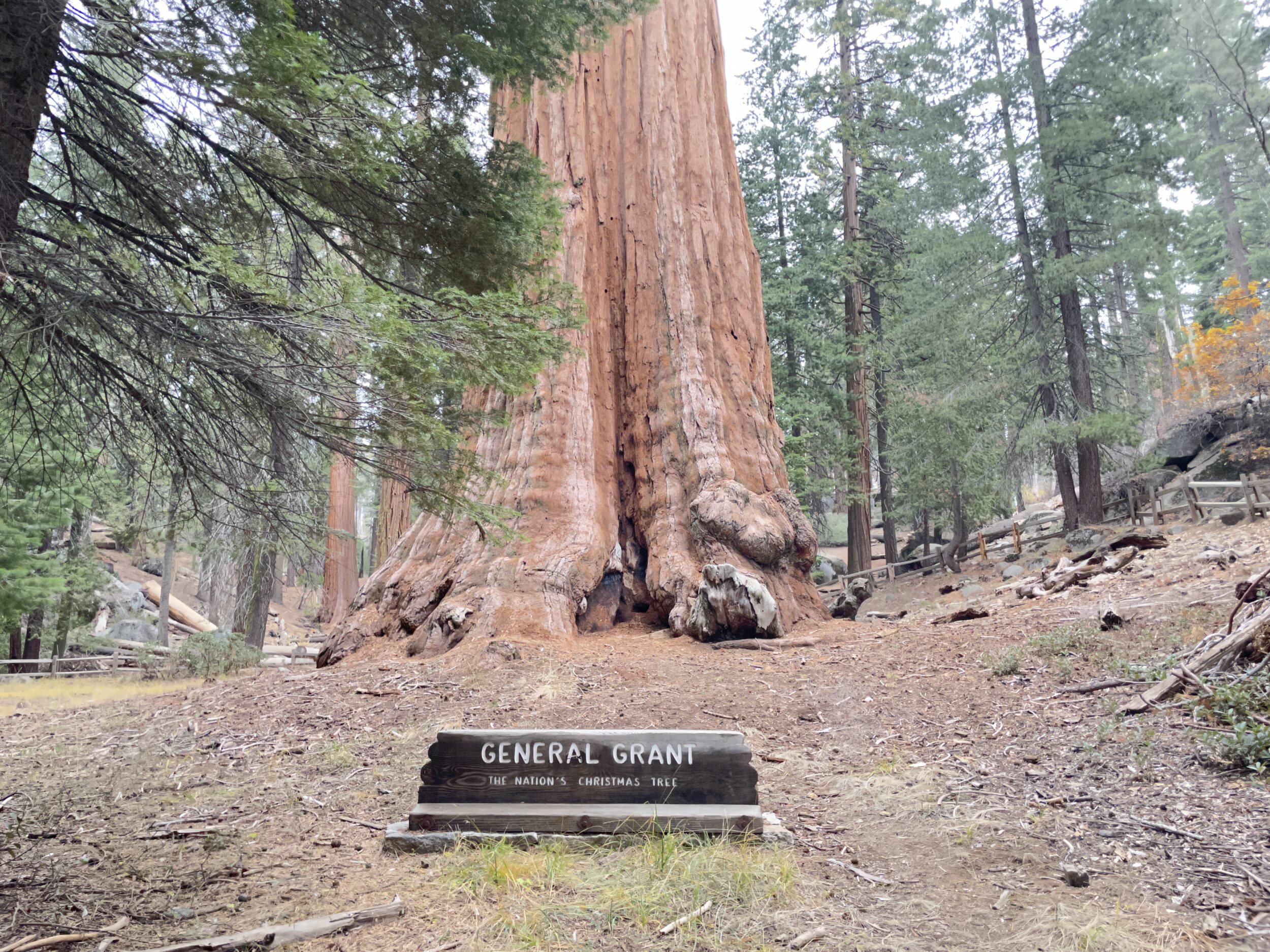
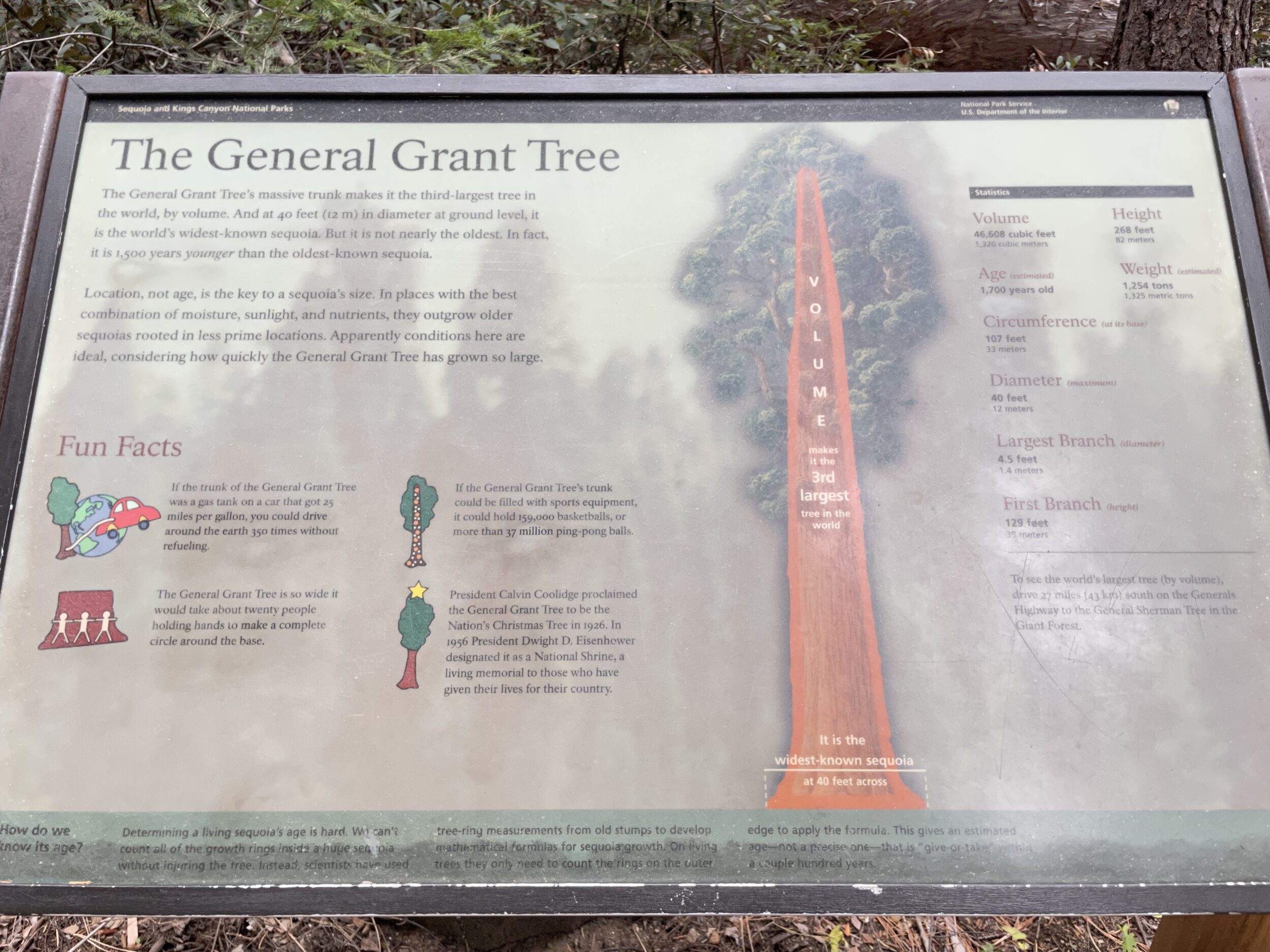
It’s the widest (12 meters in diameter) but only the 3rd biggest in the world by volume. It takes 20 people to form a circle around its trunk.
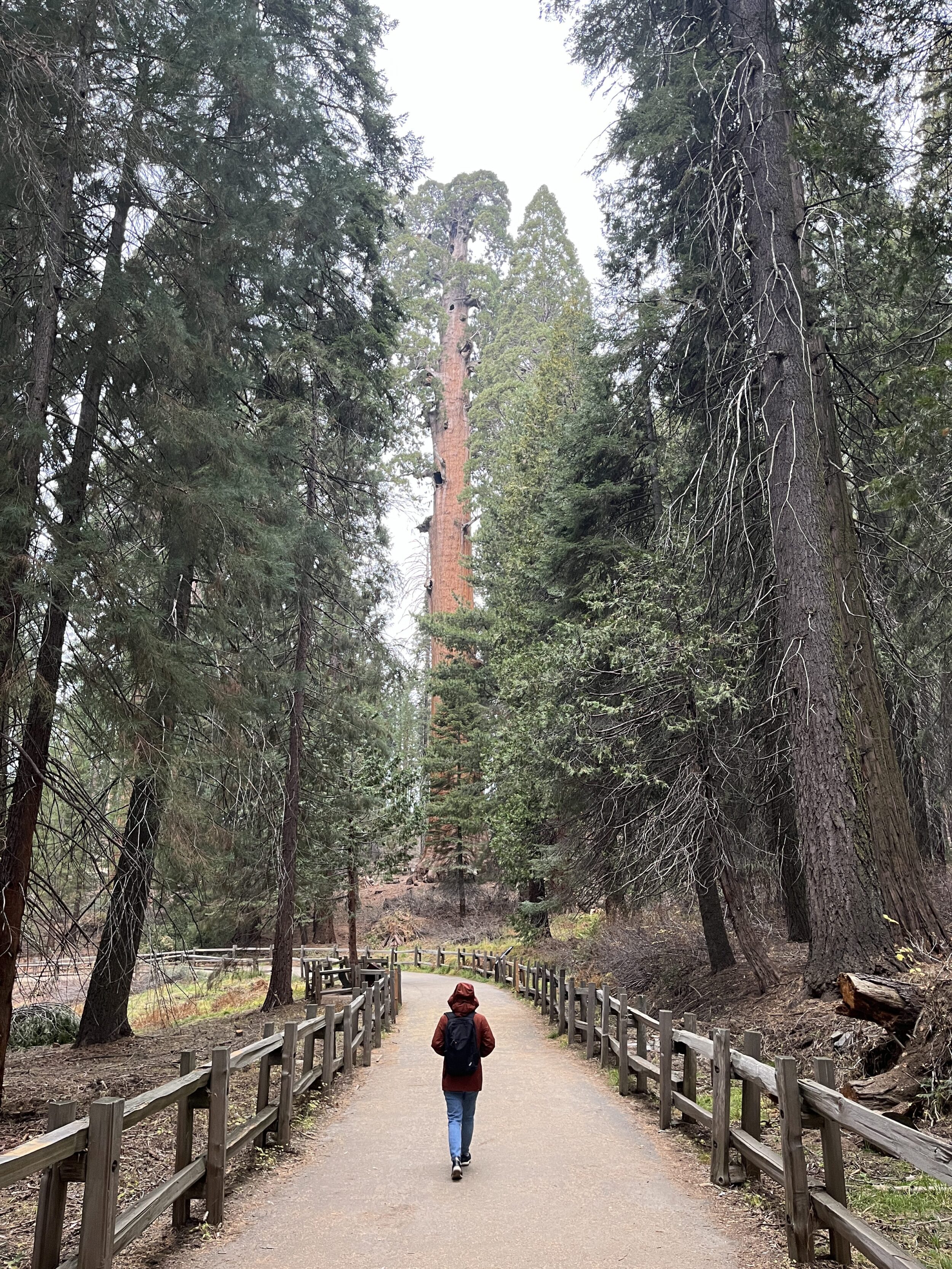
This area is very pleasant to explore on foot, but it’s very, very cold and we can’t wait to get back to the warmth of our car.
Since we’re leaving, we can finally allow ourselves to eat (without attracting or harming the bears). Our can of chips Springles does us a lot of good because we haven’t eaten anything since this morning, and without the beef jerky I used to snack on in the car at all hours, I’m starving.
We stop at the first Vietnamese restaurant we find on the road (there are plenty near Fresno). When we leave the restaurant, it’s already dark (at 5:30 PM!!) and JB has to drive in the dark on a small, winding two-lane road. We try to forget the long drive by listening to a podcast about typography. The wokism has even made its way into fonts, it’s crazy! We listen to a woman explaining how she created a font that is neither masculine nor feminine (with a special focus on the ‘o’ and ‘e’, and the ‘·’ of inclusive writing. However, when asked if her font is suitable for dyslexics (which affects 10% of the population), she gives a bullshit answer. Like that, “we” think about minorities, but not just any, preferably trendy minorities.. “We” don’t give a damn about dyslexics.
We finally arrive at our hotel, at the gates of Yosemite , and we’re very happy to be safe and sound. The rest of our adventure, is right here
Part 2: Practical Tips
All our routes and points of interest are available on this Google Maps map. I’ve already explained how to use our custom maps here
- Sequoia & Kings Canyon National Parks: access included in the America the Beautiful pass ($80 for a year)

