

My Current Favorites – [February 2024]: Don’t Expect to Get Rid of Books
Umberto Eco is an author I really like. I’m interested in what he writes about books and bibliophilia because he had a huge collection of books (50,000). Recently, I read “Don’t Expect to Get Rid of Books” (Amazon link), co-written with Jean-Claude Carrière, and I really enjoyed it. Both authors were bibliophiles, and the book is structured as a conversation between them.
I’ll comment on my favorite passages, but I think the quotes will be enough to make you want to read it. It’s a book about books, their preservation, their collection, their history, memory, and human knowledge. While I find Jean-Claude Carrière a bit chatty, a little too expansive, and he thinks all other civilizations are more interesting than his own, he still makes some interesting contributions, especially about the world of cinema. Umberto Eco, on the other hand, speaks only when necessary, and what he says is extremely interesting and varied.
If this book is rated a bit lower than Umberto Eco’s other books, it’s because of Mr. Carrière’s rambling, not because of Umberto Eco. However, it is a book I highly recommend because I learned a lot.
The title “Don’t Expect to Get Rid of Books” starts from the observation that people read less and less. And when they do read, it’s more on virtual media (ebooks, audiobooks). However, the evolution of technology in recent years has shown that technologies evolve too quickly; we can no longer read floppy disks or CD-ROMs from just twenty years ago, and the book in its standard paper format remains the most durable medium.
Imagine a planetary catastrophe. How can we preserve the knowledge accumulated over thousands of years to pass it on to survivors? What media should we use? Especially when even going to the moon becomes almost impossible in just 60 years?
Both authors were bibliophiles and had in their collections incunabula (books printed up to 1500) in impeccable condition, so they knew what they were talking about. However, Umberto Eco noted that modern books are now printed on poor-quality paper and don’t last more than 50 years: “In any case, we will no longer be able to read the Tolstoys and all the books printed on wood pulp, simply because they have already begun to decompose in our libraries.”
His remark made me think a lot because after having followed a bookbinding class and attended the manual making of rag paper, I realized that modern (paper) books can’t last 500 years like incunabula. Modern paper uses wood, which deteriorates quickly, and modern binding, which no longer gathers signatures via sewing, uses soft covers… doesn’t help with long-term preservation. So, all masterpieces printed from the 19th century onward are at risk of completely disappearing one day. Hence the importance of having “luxury” editions of 19th, 20th, and 21st century classics, printed on 100% linen rag paper and bound by hand in the traditional way. That’s what “fine presses” are currently doing, but more to appeal to a bibliophile audience, not with conservation in mind.
On my own small scale, I’d like to build a small library of my favorite books and give them a more durable envelope. To do that, I’m going to print these books on quality paper and do the binding myself. Parchment would have been an even more durable option, but I won’t have the means 😀 Speaking of binding, here’s a very interesting passage told by Jean-Claude Carrière, proving that even well-printed and well-bound books can also disappear:
…a bookbinder from Baghdad […] who lived in the 10th century and was called Al-Nadim. You know that the Iranians invented bookbinding, even the binding that completely covers the writing to protect it. A cultured binder, also a calligrapher, this man was interested in the books he was commissioned to bind, to the point of reading them and making a summary of each one. Yet the books he bound have now largely disappeared, and all that remains are the binder’s summaries, his catalog, which is called Al-Fihrist.
This reminds me of Photius, the world’s first “literary critic,” and his book Bibliotheca. His book still exists, even though some books he criticized in it no longer exist.
A very interesting anecdote about preserving information over 10,000 or 100,000 years highlights the importance of religions.
About twenty years ago, NASA, or another American government organization, was wondering where exactly to bury nuclear waste, which retains radioactive power for, as we know, a duration of ten thousand years – at least it’s an astronomical figure. Their problem was that even if they could find a site somewhere, they didn’t know what type of signal to surround it with to prohibit access.
Haven’t we, over two or three thousand years, lost the keys to understanding several languages? If in five thousand years humans disappear and visitors from deep space land, how would we explain to them that they must not venture onto the territory in question? These experts commissioned a linguist and anthropologist, Tom Sebeok, to study a form of communication to overcome these difficulties. After examining all possible solutions, Sebeok’s conclusion was that no language, not even pictographic, could be understood outside the context in which it was born. We cannot interpret with certainty the prehistoric figures found in caves. Even ideographic language may not be truly understood. The only possibility, according to him, would have been to establish religious brotherhoods that would circulate a taboo among themselves, “Do not touch this,” or, “Do not eat that.” A taboo can traverse generations.
This story reminds me of the prohibition on eating pork. That must have been linked to scientific reasons whose origin has been lost.
The foresighted ones are not who you’d expect. It’s OREO that took the initiative to store OREO biscuits and the recipe in a bunker for future generations 😀
A physical library is also an opportunity to access knowledge. It’s how you can leaf through unread books from time to time. You can’t randomly browse an ebook in your library; it’s not designed for that. So if you have children at home, even if you have 20,000 ebooks in your virtual library, they won’t see them or know how to leaf through them, whereas a small library at home with “the cream of the crop” of your favorite books will constitute a potential source of knowledge for them. Or you have to go browse books regularly at the bookstore or library. At least they know these books exist. As a child, I didn’t read much, but since my grandfather had all the classics in his library, I always knew that such-and-such a book was written by such-and-such an author. This passage made me think a lot:
The world is thus full of books we haven’t read but about which we know almost everything. The question is how we know these books. Bayard says he has never read Joyce’s Ulysses but is able to talk about it to his students. He can say that the book tells a story set in a single day, the setting is Dublin, the protagonist a Jew, the technique used the interior monologue, etc. And all these elements, even if he hasn’t read it, are rigorously true. […] The truth is that we all have at home dozens, or hundreds, or even thousands (if our library is imposing) of books we haven’t read. Yet, sooner or later, we end up picking up these books and realize we already know them.
So? How do we know books we haven’t read? First occultist explanation I don’t retain: waves circulate from the book to you. Second explanation: over the years, it’s not true that you haven’t opened this book; you’ve moved it many times, maybe even flipped through it, but you don’t remember. Third answer: during those years you read a bunch of books that quoted that book, which ended up becoming familiar to you. There are thus several ways to know something about books we haven’t read. Fortunately, otherwise where would we find the time to reread the same book four times?
This book is also very funny. At one point, Mr. Carrière talks about the auctioning of a footprint of Buddha (note: there’s also one of Mohammed at the Topkapi Museum in Istanbul) and Umberto Eco responds: “Those are the footprints at the Chinese Theatre on Hollywood Boulevard, avant la lettre!” ahahaha
And here are a few hoaxes about the future:
In the sixties, I wrote a hoax (published in Pastiches et Postiches). I imagined a future civilization finding in a lake a titanium box containing documents safeguarded by Bertrand Russell at the time when he organized the anti-nuclear marches and when we were literally obsessed, more than today, with the threat of nuclear destruction (it’s not that the threat has diminished, quite the contrary, but we’ve gotten used to it). The hoax was that the saved documents were actually texts of little ditties. The philologists of the future then tried to reconstruct what this vanished civilization, ours, had been, based on these songs, interpreted as the pinnacle of our time’s poetry.
I later learned that my text had been discussed in a Greek philology seminar where researchers wondered if the fragments of Greek poets they were working on weren’t of the same nature.
You certainly know this beautiful science fiction story telling how the Pentagon discovers, in the next century, in a society where now only computers think in our place, someone who still knows the multiplication tables by heart. The military then agree that this isa kind of particularly precious genius in wartime, the day the world suffers a global power outage.
In a society where people don’t even know how to do a Google search, that unfortunately seems credible. Maybe one day the movie “Idiocracy” will become reality.
There was a passage about Sofia. I spent a month in that city, without ever having heard of the place he mentioned:
I was recently in Bulgaria, in Sofia. I check into the hotel Arena Serdica that I don’t know. As I walk in, I realize the hotel was built on ruins that can be seen through a large glass panel. I ask the hotel staff about it. They explain that there used to be a Roman coliseum right on this very spot. Astonishment. I had no idea the Romans had built a coliseum in Sofia, a monument that, they add, was only ten meters smaller in diameter than the one in Rome. Huge, then. And on the outer walls of the coliseum, archaeologists have found sculptures that are like posters depicting the shows that took place there. You can see dancers, gladiators of course, and something I had never seen before: a fight between a lion and a crocodile. In Sofia!
Fun little anecdote:
J.-C.C.: Since Mexico is four hundred kilometers from each ocean, there were relay runners who brought fresh fish to the emperor’s table in less than a day. Each of them ran at full speed for four or five hundred meters, then handed off their load.
My favorite part is, of course, bibliophilia. I’ve already learned quite a few things from the little book “La Bibliophilie” in the “Que sais-je” collection and after visiting the printing museum in Lyon. But here are a few excerpts in case you didn’t know:
The first printed books were not bought bound, by the way. You had to buy sheets and then have them bound. And the variety of bindings in the books we collect is one of the reasons that explain the joy we can derive from bibliophilia. […] It’s between the 17th and 18th centuries, I believe, that the first books sold already bound appear.
J.-C.C.: That’s what we call “publisher’s bindings.”
U-E: But there was also another way to personalize printed books: leaving the large initials unprinted on each page to allow illuminators to make the owner believe he actually held a unique manuscript. All that work, of course, was done by hand. Same thing if the book had engravings: each one was touched up with color.[…]
It should also be noted that books were very expensive and only kings, princes, and wealthy bankers could acquire them. The price of this little incunable I took from my library was, at the time it was made, probably higher than it is today. Think of the number of calves that had to be killed to produce this type of work, where all pages are printed on vellum, i.e., calfskin from stillborn calves. Régis Debray wondered what would have happened if the Romans and Greeks had been vegetarians. We would have none of the books antiquity has bequeathed to us on parchment, i.e., on tanned, durable animal skin.[…]Over its history, the library of Timbuktu has been enriched by the books that students, who came from the Middle Ages onward to meet the wise Black men of Mali, brought with them as currency and left behind.
The collector’s obsession is often to get their hands on a rare object, not so much to keep it.[…]
[The book] becomes a financial object, a product, and that’s quite sad. Collectors, true book lovers, are not generally people of great wealth.[…]
I had a student who only collected tourist guides to various cities, the most outdated ones, which were sold to him for next to nothing. He still managed to write a doctoral thesis on the vision of a city through the decades. Then he published his thesis. He turned it into a book.[…]
Fahrenheit 451 is also the title of an Italian radio program. But it’s exactly the opposite: a listener calls in to explain that they can’t find or have lost a certain book. Another immediately calls to say they have a copy and are willing to part with it.
About books and inheritances:
I can tell the story of how I once acquired a complete Fludd, in uniform period binding. Probably a unique copy. The story begins in a wealthy English family that owns a precious library and has several children. Among them, as often happens, only one knows the true value of the books. When the father dies, the connoisseur casually says to his siblings: “I’ll just take the books. You deal with the rest.” The others are delighted. They get the land, the money, the furniture, the castle. But the new holder of the books, once they’re in his possession, can’t sell them officially, for fear of alerting the family, who would realize, from the sale results, that “just the books” was not nothing, quite the opposite, and that they’d been had. He then decides, without telling his family, to sell them secretly to international brokers, who are often very strange characters. The Fludd came to me through a broker who rode a moped, with a plastic bag hanging from the handlebars, and in that bag he sometimes carried treasures. It took me four years to pay for this set, but no one in the English family could ever know whose hands it ended up in, or at what price.[…]
There is a way to encourage reading, and it was imagined by the writer Achille Campanile. How did Marquis Fuscaldo become the most learned man of his time? He inherited an immense library from his father but couldn’t care less about it. One day, opening a book by chance, he finds a thousand-lira note between two pages. He wonders if the other books contain similar treasures and spends the rest of his life systematically leafing through all the books he inherited. And that is how he becomes a fountain of knowledge.
About vanity presses:
You send your text to one of those publishers who spare no praise for its obvious literary merits and offer to publish you. You are overjoyed. They have you sign a contract that stipulates you will finance the publication of your manuscript, in exchange for which the publisher will do their utmost to get you plenty of articles and even, why not, flattering literary distinctions. The contract does not specify the number of copies the publisher must print, but insists that unsold copies will be destroyed “unless you purchase them yourself.” The publisher prints three hundred copies: one hundred for the author, who sends them to relatives, and two hundred to newspapers, which promptly throw them in the trash.
But the publishing house has its own private magazines, in which reviews will soon be published praising this “important” book. To gain the admiration of his peers, the author buys, say, another hundred copies (which the publisher is quick to print). After a year, he is informed that sales have not been very good and that the remaining copies of the print run (which, he is told, was ten thousand) are to be destroyed. How many does he want to buy? The author is terribly frustrated at the idea of seeing his cherished book disappear. So he buys three thousand. The publisher immediately prints three thousand that did not exist before and sells them to the author. The business is thriving since the publisher has absolutely no distribution costs.
Another example of a vanity press (but one could cite many similar publications) is a book I own, the Biographical Dictionary of Contemporary Italians. The principle is that you pay to be included. You find “Pavese Cesare, born September 9, 1908, in Santo Stefano Belbo, and died in Turin, August 26, 1950,” with the note: “Translator and writer.” That’s it.
About the magnificent books by Kircher, which the two authors collected:
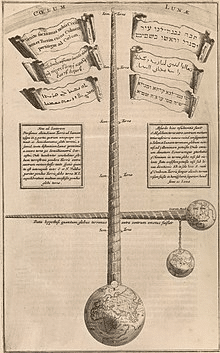
Not to mention the Turris Babel. In it, he shows, based on careful calculations, that the Tower of Babel could not have been completed because, if it had unfortunately been completed, it would have caused the Earth to pivot on its axis, due to its height and weight.
If you are an author, here is the number of sales that may await you (I imagine it’s even less in recent years?):
If you sell two hundred or three hundred thousand copies in France, that’s a record. In Germany, you need to go beyond a million to be well regarded. The lowest print runs are found in England. The English generally prefer to borrow books from libraries. Italy, for its part, must be situated just before Ghana. On the other hand, Italians read a lot of magazines, more than the French. In any case, it’s the press that has found a good way to bring non-readers back to books.
How? It happened in Spain and Italy, not in France. The daily newspaper offers its readers, for a very modest sum, a book or DVD with the newspaper. This practice was denounced by booksellers but eventually prevailed. I remember that when The Name of the Rose was offered free with La Repubblica, the newspaper sold two million copies (instead of the usual 650,000), and my book reached two million readers (and if you consider that the book might interest the whole family, let’s safely say four million). Indeed, that might have worried booksellers. But six months later, checking sales in bookstores for the semester, it was found that the sale of the paperback edition had decreased them only insignificantly. So those two million were simply not people who usually frequented bookstores. We had gained a new audience.
That’s how Harry Potter was promoted in Vietnam. These books encouraged a generation of children to read. Extracts from Harry Potter were first published in magazines, one chapter a week. Then they started selling 2-3 chapters per booklet, for a modest sum, one booklet a week, so that children could buy them. It was only after the second volume that they offered big books, when parents realized the value of Harry Potter and bought them for their children.
We end with a discussion on the number of books:
It has been shown that the most famous medieval libraries contained at most only four hundred books! […]
U.E.: I think there is usually a confusion between a personal library and a collection of ancient books. I have between my main house and my secondary houses, fifty thousand books. But these are modern books. My rare books represent twelve hundred titles. But there is still a difference. The ancient books are those I have chosen (and paid for), the modern books are those I have bought over the years but also, and increasingly, books sent to me as a tribute. Now, though I give a lot of them to my students, I keep a good number, and here we are at the figure of fifty thousand.
J.-C.C.: Setting aside my collection of tales and legends, I probably have about two thousand old books out of a total of thirty or forty thousand. But some of these books are sometimes a burden. For example, you can no longer part with a book a friend has inscribed for you.[…]Calculating the lowest price for a library with six shelves, the most economical option, I arrived at 500 euros per square meter. In one square meter of six shelves, I could probably fit about three hundred books. So the location of each book came to 40 euros. More expensive than its price.
So that’s good news. Their immense libraries contain more gifts than books truly worth keeping. This means that high-quality books are not that numerous. Of the 120 books I read in 2023, I thought only 3 books deserved a re-read. Not because they weren’t worth reading, but only once. These are books I can borrow from the library. To remember them, I just wrote my little 2-3 page summaries per book. On the other hand, books I need to re-read multiple times deserve to be in my physical library because they must be underlined and annotated. So my “ideal library” would represent only 50 books, I think. Even this book ‘N’espérez pas vous débarrasser des livres’, which I really really enjoyed, will never be read again.
Bibliophiles fear two things: fire, and bibliophile thieves:
A cathedral or a library burning down in the Middle Ages is roughly like a war film about the Pacific showing a plane going down. It was normal. The fact that the library in The Name of the Rose ends up burning is in no way an extraordinary event in that period.[…]
The most dangerous are the bibliophile thieves, those who steal a single book. Booksellers eventually identify these kleptomaniac customers and alert their colleagues. Ordinary thieves are not dangerous for the collector. Let’s imagine poor burglars venturing to steal my collection. They would need two nights to box up all the books, and a truck to transport them.
Then (if the complete lot isn’t bought by Arsène Lupin who would have hidden it in the Hollow Needle), secondhand booksellers would give them a pittance, and only unscrupulous dealers, because it would appear obvious that they were stolen goods. Moreover, a good collector makes a record for each rare book describing even the flaws and any other identifying marks, and there is a police section specializing in the theft of art and books. In Italy, for example, it is particularly effective, having acquired its skills during the time when it was about recovering works of art lost during the war. And finally, if the thief decides to take only three books, he will certainly make a mistake by taking the most imposing formats, or those with the most beautiful bindings, thinking they are the most expensive, while the rarer book might be so small that it goes unnoticed. The major risk is that of the person sent specifically by a mad collector who knows you own that particular book and wants it badly, even at the cost of theft. But you would have to own the 1623 Shakespeare Folio, otherwise it’s not worth taking such risks.
To conclude this article, we have the precise explanation of what was in the box from the film ‘Belle de jour’, for which Mr. Carrière was the screenwriter. Beware, the truth is not always pleasant to hear. Because it’s raw and unpleasant. If you still want to know, read to the end, otherwise, let your imagination run wild!
When asked what was in it, Buñuel would reply: ‘A photograph of Mr. Carrière. That’s why the girls are horrified.’ One day a stranger calls me at home, again about the film, and asks me if I’ve ever lived in Laos. I hadn’t set foot there, I said no. Same question for Buñuel and the same denial. The man on the phone is surprised. For him, the famous box absolutely reminds him of an ancient Laotian custom. I then ask him if he knows what’s in the box. He says, ‘Of course! — Please, then, tell me!’ He explains that the custom in question consisted of women attaching large beetles with silver chains to their clitoris during the act of love, the movement of the legs allowing them to climax more slowly and delicately. I’m taken aback and tell him we never thought of putting a beetle in the box in Belle de jour. The man hangs up. And I immediately feel a terrible disappointment at the very idea of knowing! I had lost the bittersweet flavor of mystery.

