
[A Book Lover’s Reflection] How to Choose Your Books?
Following a minor emotional shock at the end of 2022, I realized that my once excellent memory had been significantly affected. To remedy this, throughout 2023, I worked on my memory by reading about a hundred books. Each book got a little summary to reinforce memory. I achieved my goal, but then realized that out of the 120 books I read in 2023, only 3 were, in my opinion, worth re-reading. Thus, the ratio of exceptional books to books read seems too low.
Yet, the remaining 117 books were still carefully chosen. I asked myself: do I really know how to choose my books?
To find out, I read works by book lovers to understand how they choose their books.
There are two types of book collectors: those who collect for beauty, and those who collect to read. I’m interested in both, because if I’m going to read a book, I might as well read it in a beautiful edition (if one exists).
I bought several beautiful books from old and modern publishers, took a bookbinding course, watched how paper is made by hand, read several works on typography, layout, illumination, and visited several printing museums. In short, I now think I could make a book from scratch myself (except writing it): so layout, printing, paper selection, and binding.
I was led to read the following works:
- Les Collectionneurs by Philippe Jullian (Amazon link, the French edition is standard, but the English translation is illustrated by the author and adds some passages about Anglophone book collecting, which I really like). It’s a book about collectors in general, not just book lovers, with juicy anecdotes about antique dealers.
- La Bibliophilie de la collection Que sais-je ? by Michel Vaucaire (Amazon link), a small comprehensive book on the criteria book collectors use to determine a book’s value. There’s a very detailed explanation of image printing methods, the origin of foxing in 19th-century books.
- L’Art de former une bibliothèque by Emile Henriot (Amazon link) with a long list of recommended books
- N’espérez pas vous débarrasser des livres by Umberto Eco and Jean-Claude Carrière (Amazon link), a very interesting discussion on the preservation of knowledge and book collecting, I’ve already done a detailed article here
- Tôi tự học, a Vietnamese book by Thu Giang Nguyễn Duy Cần, explaining how one can continue learning through books.
All were written by great readers and occasional book collectors with physical libraries.
Here’s what I took away from them:
1. It’s perfectly normal to come across interesting books that you’ll never re-read. That doesn’t diminish their value.
I used to think only books you re-read at will had value. But in reality, very few books deserve to be re-read in the end. Modern books can easily be summarized in 2-3 pages (I summarize each book I read) because it’s very difficult to have new ideas when so much has already been written. But they still have value.
The books I re-read are quite rare. In my case, they tend to be ancient books that many anonymous authors contributed to over centuries. They have this peculiarity of including, in very few words, an enormous number of facets and personalities while remaining universal. These difficult books require a lot of general knowledge or specific vocabulary. There are ebooks that have been dormant in my library for years, and at each reading attempt, I can’t understand them, but then one day I read them in one go and understand everything. That’s because in the meantime, I’ve read other books that allow their comprehension.
So, we always need to read “introduction to…” type works. And the “Que sais-je” collection is perfectly suited for that. These are books that, if you’ve properly understood and retained the content, only need to be read once.
2. You need to set a goal
This is where I realize my mistakes.
Before 2023, I only read books for work (language learning, career-related books) or travel-related books (lots of Lonely Planet). Books you read once because they become obsolete in just 6 months to a year.
My 2023 goal was merely to recover my memory, so I read anything that could interest me. I relied on both my Facebook book lover groups (where everyone shares their reviews) and Goodreads to find good books to read. But I realized that many readers are drawn to modern books that haven’t yet stood the test of time over 10-30-100 years. Whereas classics, which have survived centuries, remain relevant because they deal with universal themes. “In Search of Lost Time,” for example, will never be has-been because everyone sees themselves in it, regardless of the era.
Now that the memory recovery goal is gone, I need to choose another goal. The poor quality of my previously read books simply reflected a very low goal I was setting for myself.
3. You should research the author
Before, I didn’t pay much attention and I read everything and anything. A lot of bestsellers are written by journalists! So people who summarize studies done by X, reports done by Y, and their books lack depth. But they’re well-written, well-explained, so people love them! Now, I only read books written by specialists or people who have actually achieved concrete results: a book on personal finance? Okay, but how do you make your money? By selling books on how to make money or by doing other things? A book on nutrition? OK, do you have a background as a doctor, naturopath, journalist, or quack??? All of that has to be taken into account. An author who doesn’t know Hebrew and dares to write a book on Kabbalah… is not trustworthy. Someone writes a book on the Tao Te Ching without speaking a word of Chinese, no thanks!
4. A book with a clear table of contents can be of good quality
You should always read a book’s table of contents. A poorly organized or nonexistent table of contents is proof that the author doesn’t know how to organize their ideas. Now, before buying the ebook, you can read an excerpt but you don’t necessarily have access to the table of contents, which is a shame. I’d advise you, if possible, to go flip through the book at the bookstore in that case.
5. You have to learn like a real student
A colleague told me that my greatest talent was my ability to learn things on my own. He’s surely referring to the fact that I taught myself to code, and I passed two certifications on my own, allowing me a career change.
I’ve kept that self-taught side for many fields, even if I’m not aiming for a career as a doctor or psychologist. For some more serious fields (science, law, and medicine), I find popular science books not that serious and not that comprehensive. You can’t learn marketing without reading Kotler, THE book taught in all business schools. So I really read books intended for first-year students (we call them textbooks). The foundations are much more solid, and you use professional vocabulary. I have a lot of medical textbooks because I spend a lot of time at the dentist and I need to ask good questions, discuss the techniques. Reading dermatology textbooks allowed me to find a beauty routine for adult acne. Actually, thanks to those books, I have access to serious studies and data, but since I’m not a student either, at least I can ask my doctors relevant questions, and spot quacks from miles away.
Even for craftsmanship, before I used to settle for hobby craft books, but they don’t teach the method, just “10 projects” for example. When you close the book, you know how to do 10 projects but no more, whereas books aimed at professionals (jewelers, bookbinders…) explain in 30 pages all the basic techniques that you can apply to thousands of projects. The pro book costs barely more than hobby craft books, but for me, it has more value. Likewise, thanks to these books, I was able to place nice orders with artisans and ask for finer details because I know it’s technically possible.
6. Book categories
I read online that you could have a modest (physical) library of about a hundred books, but with 10 exceptional books per category. However, depending on our preferences, it’s up to us to define the categories we want. Opinions differ greatly, some say you need: novels, poetry, history, philosophy, science. Others talk about: novels, essays, psychology, medicine…
As for me, I’m not really into novels, but the author of How to Form a Library? gives very good advice on literature. He even has a list of French authors and their works ranked by reading priorities (A, B, C). For example, Voltaire wrote many tales, but Zadig remains, in my opinion, the best of the tales; it’s the one you should read first if you want to read Voltaire. The other tales, also very interesting, are more or less similar, so if you don’t have much time to devote to him, you should choose a single work per author. And between two authors from the same era and with the same style, likewise, if you don’t have much time, you have to decide and choose just one book, and so on.
7. You need to have a physical library
Since I travel a lot, I read almost only ebooks. And then, I read N’espérez pas vous débarrasser des livres by Umberto Eco and Jean-Claude Carrière which explains the few advantages of a physical library at home:
- The paper book still remains the best medium for conservation. Who knows, one day, no one will be able to read my old ebooks because my e-readers will one day decide to stop supporting pdf or epub (as was the case with floppy disks, CD-ROMs, and DVDs).
- A book you love is a book you should own, so you can consult it in the middle of the night if you feel like it. You shouldn’t count on its permanent availability at the local library.
- A book you own can be annotated and commented on. It’s true that on a beautiful book printed on nice paper, I have a hard time highlighting or annotating. But it’s so important to do it. Thanks to the highlighted passages, you can reread a book in 10 minutes.
- Having a physical library allows for the act of randomly flipping through a book, re-reading a page. A friend told me how he knew the DUNE series by heart, because his mom didn’t have room for those books in the library, so she put them… in the bathroom. Needless to say, the time spent there is colossal. Every time, he’d pick a random book, read a page or two, and it allowed him to grasp all the richness and the many themes covered in DUNE. Each time, he discovered a new idea. Without that strategic spot, he never would have read all 6 DUNE books multiple times. Flipping through an ebook is harder because the act of choosing a book on an e-reader is less free and random than with a real library. I think the best books should, unfortunately, be kept in the bathroom 😀
- Moreover, if you have kids, they’ll be more or less influenced by the family library. The book titles will seep into their subconscious over the years. I remember my grandfather had a huge library. Even though I never paid much attention to his library as a child, I knew such-and-such a book existed just by walking past. And when I got older, between two similar books, I’d be more likely to pick the one my grandfather had on his shelves, rather than a more modern one. Because if my grandfather chose it, he must have had his reasons.
8. Knowing how to summarize and annotate your books
“A la recherche du temps perdu” is a very long novel. But thanks to it, I got to see how professionals summarize and annotate books. At the end of each volume, the FOLIO edition offers a very detailed summary, allowing you to find interesting passages (while following the story).
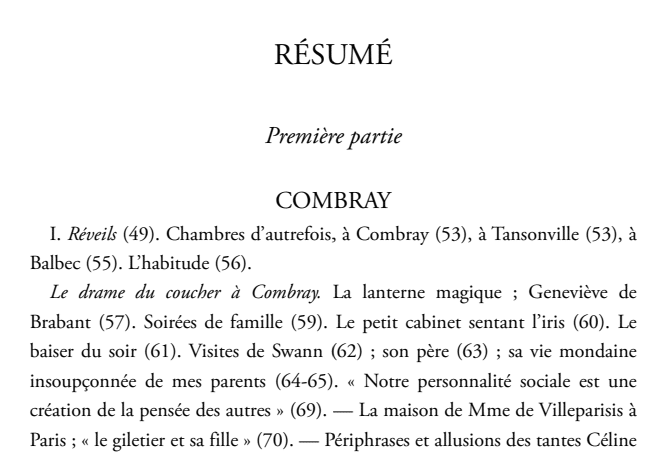
Here, Gustave Lanson, a literary critic, jots down a concise summary of Proust’s “La Prisonnière” on the flyleaf, with page numbers to quickly find the passage in question (source: Proustonomics)
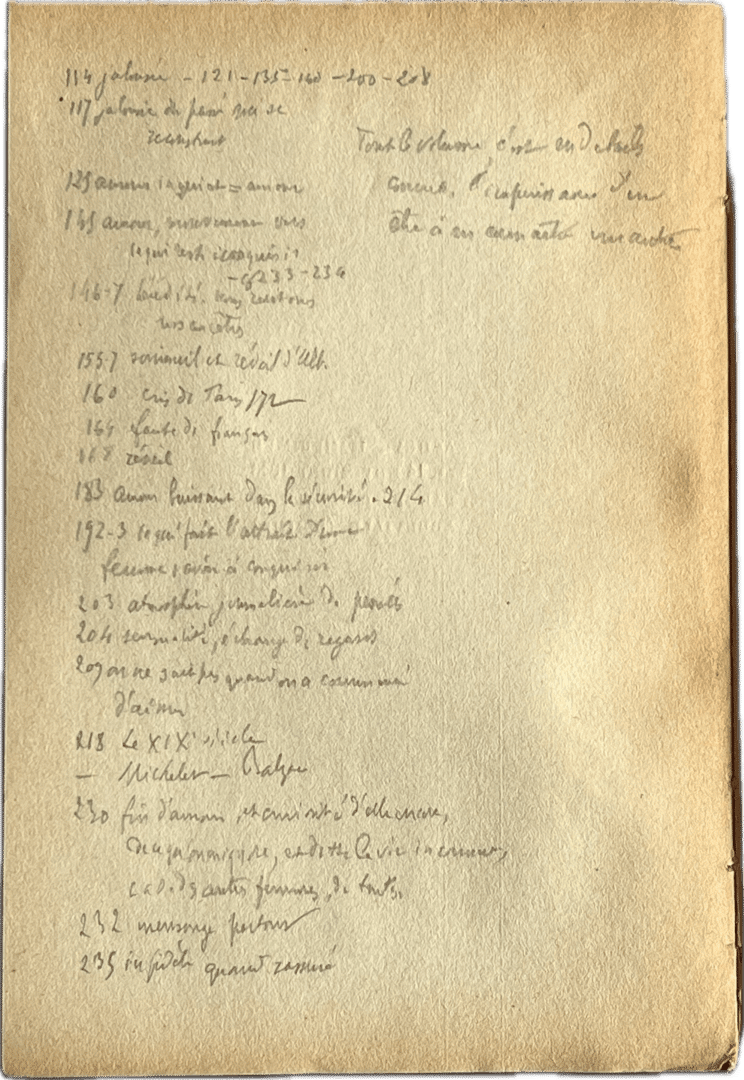
The annotations made on the book have been published on this website. Since I read the same book, I was able to compare my own notes with the literary critic’s, and I still have a lot of room for improvement in my annotations 😀
Another way to annotate, made easier by e-readers, is to highlight a passage, add your comments, and export them using the e-reader’s software. That way, you end up with something like:
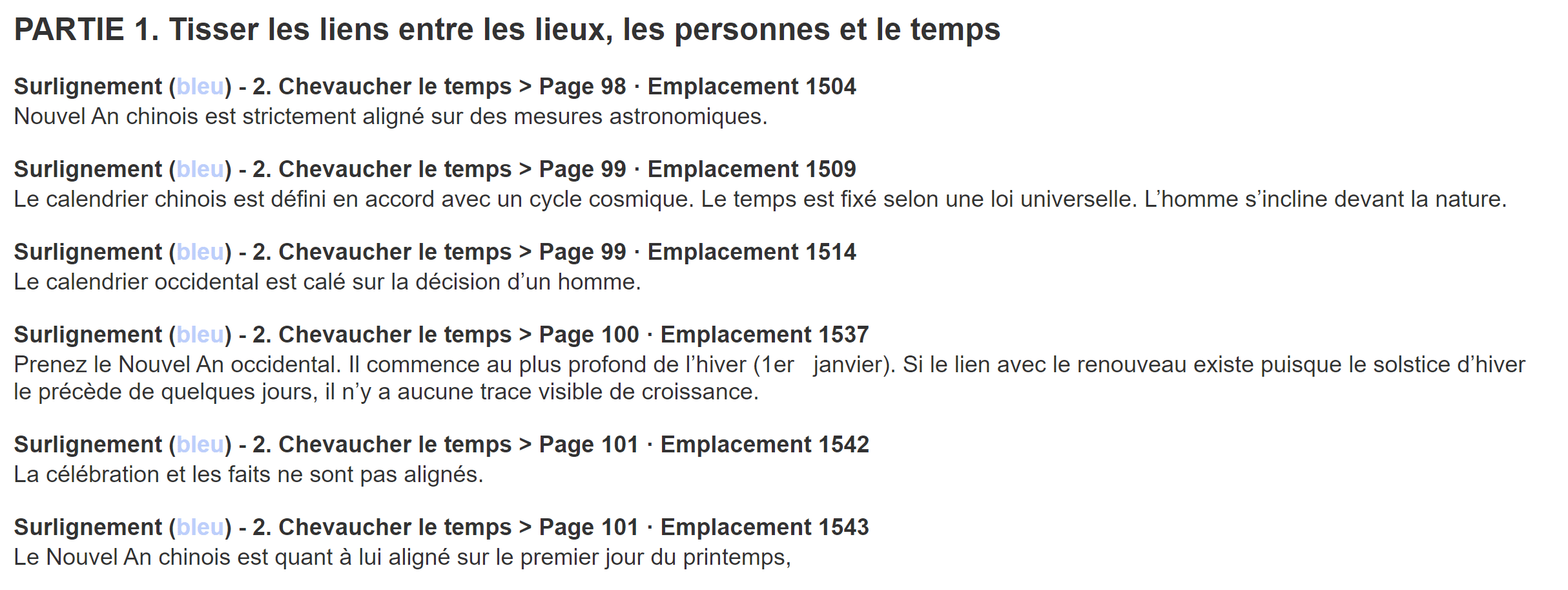
However, these highlights can only be organized by color, and the number of colors is limited. If there are many themes, it’s a pain, so I think handwritten note-taking is still the best. Writing by hand allows for better memorization than just typing on a keyboard or smartphone screen.
You can see some examples of my concise summaries here.
For non-fiction books, know that a book answers one or more questions.
By the end of the book, you should be able to understand (1) what those questions are (2) how the author attempts to answer them (3) his or her point of view.
If you haven’t managed to summarize these points, you’ll need to re-read the book. Or the book was too badly written, you didn’t understand a thing, so you should sell it 😀
7. Whatever you do, don’t become a collector
This is just my opinion. When I got interested in fine books, I started by buying a few. In France, classics are mostly found in second-hand bookshops, where you can buy old books from the 18th or 19th century. I bought a few and realized that I couldn’t stand the smell of old books slowly decomposing under my nose. That killed my desire to read them. Then, when I got interested in classics published by the Folio Society, Limited Edition Club, Heritage Press, Suntup, every time there was this whole “hunt” for books, because the ones I find beautiful, others do too. Collectors love the hunt, the thrill of a coveted book. Having the book matters less to them than searching for it. But that’s not for me, not at all! I thought I’d be into it, but my trip to the United States showed me I wasn’t.
In Chicago, I learned about a former publisher, Heritage Press, which makes high-quality books. But the bookstore I was in didn’t have many.
A few days later, in another city, I stumbled upon a shop filled with Heritage Press books. A collector would have been thrilled by this discovery, by the success of their “hunt,” but it left me cold.
Then I learned about another former publisher, Limited Editions Club, and by chance, my instincts led me to a shelf full of Limited Editions Club books. I was pleased, but nothing more, and I told myself: no, hunting through bookstores several times a month waiting for a coveted book to appear is not my passion. No way!
So, to have beautiful books that don’t smell, the solution I found is to make them myself. I have the epubs, which I can print on nice paper, and then I can do the binding myself. No more spending hours in bookstores, scouring Abebooks, Facebook groups… and above all, the books I love that don’t exist in fine editions can get my luxury treatment.
9. You cut yourself off from most knowledge if you limit yourself to translated books
Hence the importance of speaking multiple languages. I speak 4 languages, but it’s still not enough because I have no access to books written in Arabic, Hebrew, Indian, or Chinese. These are great civilizations, and many of their books aren’t translated. But! I found the solution! I’ve already explained here , and and there. Now, I can translate any ebook!
10. Reading isn’t enough, you need practice
You can apply the ideas learned from books to everyday life in many ways. I think reading for the sake of reading, like an addiction, is just as bad as binge-watching reality TV shows. Books should bring us transformation, a new perspective, an enriched soul… Sometimes, an author’s entire life and knowledge are concentrated in a single book. A book can be a lifetime of knowledge! By reading, we live thousands of lives, we save so much time, thought, and research. That’s what we should aim for, not just reading for reading’s sake.
In short, I currently use:
- Goodreads to keep track of my read/to-read/currently-reading list
- I still read mostly ebooks (I still travel a lot) but I already have a small list of books I’d like to print/bind myself when I’m settled down again
- I use reMarkable to read my ebooks because it allows me to write a lot, like in a notebook
Everyone has their own way of reading and collecting, but if you were a bit lost like me, I hope my article gave you some ideas.

